It is worth noting that none of the complexities below involve anything more sophisticated that pre-calculus study and logs and trig functions, and perhaps the early part of a first course in calculus, both of which are often taught at the high school level.
Thursday, August 27, 2026
Tuesday, July 7, 2026
Red River
Red River (Japanese: 天は赤い河のほとり, Hepburn: Sora wa Akai Kawa no Hotori; lit. 'The Sky Is on the Banks of the Red River'), also known as Anatolia Story, is a Japanese manga series written and illustrated by Chie Shinohara. The series was published by Shōgakukan in their Sho-Comi magazine from January 1995 to June 2002 and was collected in 28 tankōbon volumes. It is published in English in North America by Viz Media. An anime television series adaptation produced by Tatsunoko Production is set to premiere in July 2026.
As of March 2019, the manga had over 20 million copies in circulation, making it one of the best-selling manga series. In 2001, Red River won the Shogakukan Manga Award for the shōjo category.
From Wikipedia.
I read this manga series when my children were in middle school, basically in the early twenty-tens, not long after I began this blog, as one of the first really epic manga series that I'd read. American comics and graphic novels have almost no sub-genre that approximates this series.
It is back on my radar screen because the first episode of an anime based upon this manga series was released today, and so far, so good. It is a pretty faithful and successful adaptation so far.
Why am I writing about it here?
Because this manga series was instrumental in spurring my interest in prehistory, anthropology, and historical linguistics, in a story that brought the late Bronze Age Hittite Empire to life and contributed a lot to me caring about all of these fields. Some of my own writing on the Hittites can be found here.
And honestly, while it has fictional and magical elements, much like Bronze Age legendary history works actually written at or within a few centuries of that time period, by and large, this series has stood the test of time and is broadly consistent with what archaeologists, anthropologists, ancient historians, and historical linguistics scholars still believe now.
What all of those disciplines lack, however, that historical fiction like this can provide, is synthesis, relatability, and meaning. Academic scholars tend to focus in on tiny details and cower from providing a larger narrative or connecting the dots for fear of being wrong. But doing so takes away the joy and allure of that once captivated the people who are doing the work and keeps them motivated enough to continue to do so. Historical fiction can give the dry piecemeal reconstructions life and a "vibe" allowing you to feel some sense of what life was like back then.
The fictional account does so in ways big and small. For example, while the dialog is in Japanese (and translated into English in the versions I consume), this series retains enough of the historically accurate Hittite proper names to make those names relatable and not so intimidating, when you encounter them as you study the actual history of the Hittite people, a culture the remains the source of pivotal and important open questions in the broader picture of the Bronze Age and Indo-European linguistics.
Even the magical and supernatural and religious aspects of the story, while not actually things that happened in the past, are largely consistent with the religious and metaphysical worldviews of the people who lived in that era in Anatolia.
Thursday, October 17, 2024
Quote Of The Day
This paper is both novel and correct, but the novel part is not correct and the correct part is not novel.
Tuesday, April 16, 2024
Making More Nails
4gravitons has an excellent post entitled Making More Nails. It begins as follows:
They say when all you have is a hammer, everything looks like a nail.Academics are a bit smarter than that. Confidently predict a world of nails, and you fall to the first paper that shows evidence of a screw. There are limits to how long you can delude yourself when your job is supposed to be all about finding the truth.You can make your own nails, though.
Thursday, August 3, 2023
How Do People Decide Which Scientists To Believe?
Uncertainty that arises from disputes among scientists seems to foster public skepticism or noncompliance. Communication of potential cues to the relative performance of contending scientists might affect judgments of which position is likely more valid. We used actual scientific disputes—the nature of dark matter, sea level rise under climate change, and benefits and risks of marijuana—to assess Americans’ responses (n = 3150).
Seven cues—replication, information quality, the majority position, degree source, experience, reference group support, and employer—were presented three cues at a time in a planned-missingness design. The most influential cues were majority vote, replication, information quality, and experience. Several potential moderators—topical engagement, prior attitudes, knowledge of science, and attitudes toward science—lacked even small effects on choice, but cues had the strongest effects for dark matter and weakest effects for marijuana, and general mistrust of scientists moderately attenuated top cues’ effects.
Risk communicators can take these influential cues into account in understanding how laypeople respond to scientific disputes, and improving communication about such disputes.
Friday, February 3, 2023
Physics Needs Better Literature Reviews
Tuesday, October 25, 2022
Quote Of The Day
I have been Chair of the CWRU Department of Astronomy for over seven years now. Prof. Mihos served in this capacity for six years before that. No sane faculty member wants to be Chair; it is a service obligation we take on because there are tasks that need doing to serve our students and enable our research.
Academia is an area where the urge to "move up" into the direct management level position of department chair is not strong.
This fact is widely known by those in academia (incidentally, it also applies to the position of chief judge in most courts), and little known outside it.
Friday, February 26, 2021
About Newton
Everyone remembers Newton for his contributions to physics.
But he made much of his fortune as the director of London's mint, making coins, and investing in businesses, after he got sick of being a professor at Cambridge, where he felt tormented as a Unitarian in a Trinitarian institution.
Thursday, May 30, 2019
Teaching Science v. Celebrating Science
From 4gravitonsThe a movie like Avengers: Endgame doesn’t teach science, or even advertise it. It does celebrate it though.That’s why, despite the silly half-correct science, I enjoyed Avengers: Endgame. It’s also why I don’t think it’s inappropriate, as some people do, to classify movies like Star Wars as science fiction. Star Wars and Avengers aren’t really about exploring the consequences of science or technology, they aren’t science fiction in that sense. But they do build off science’s role in the wider culture. They take our world and look at the advances on the horizon, robots and space travel and quantum speculations, and they let their optimism inform their storytelling.
Sunday, February 10, 2019
How Does Physics Research Work?
Is there a group of (paid) researchers that work on M-Theory 24/7, hoping that someday they'll finally unify physics? Or is it more like a thing that passionate people do in their spare time?
Virtually all serious physics research is done by full time professionals on salaries funded by grants or the institutions they are associated with, or both, or by full time graduate students in physics. The graduate students have teaching or research obligations or both, get their tuition waived, receive a modest salary, and sometimes are given access to subsidized graduate student housing. A typical physics graduate student who successfully finishes a dissertation and earns a PhD will spend three to seven years as a graduate student, often followed by several one to three year stints as post-docs before obtaining a permanent position as a university or college, a corporation, or some sort of institution or laboratory. Those who get academic jobs with often get a series of one to three year assistant professorships which are not tenured before finally earning tenure and becoming an associate professor, after which with further productivity in research and experience, they are promoted to full professor status.
Also, obviously, physics researchers are human beings who sleep, spend time with their families, eat, have fun and even take vacations now and then, so almost no physics researchers truly work "24/7" on anything.
How is this actually being done?
Physics research is broken up into many highly specialized subcomponents that use very different methods.
Saturday, December 15, 2018
Alternative Facts Strike The Scientific Establishment
Tuesday, August 14, 2018
Unsurprising But Concerning
We find that at least 31.2% of the citations to retracted articles happen a year after the article has been retracted. And that 91.4% of these post-retraction citations are approving.From here (hat tip Marginal Revolution).
Sunday, April 8, 2018
Quote Of The Day
Of course the scientific paper will not die any time soon. I know that because I've measured the approximate speed by which academia moves, and it's about 0.01 mm per millenium.- Sabine Hossenfelder @skdh Apr 5, 2018
Friday, March 30, 2018
A Galaxy Without Dark Matter?
Studies of galaxy surveys in the context of the cold dark matter paradigm have shown that the mass of the dark matter halo and the total stellar mass are coupled through a function that varies smoothly with mass. Their average ratio M_{halo}/M_{stars} has a minimum of about 30 for galaxies with stellar masses near that of the Milky Way (approximately 5x10^{10} solar masses) and increases both towards lower masses and towards higher masses. The scatter in this relation is not well known; it is generally thought to be less than a factor of two for massive galaxies but much larger for dwarf galaxies.
Here we report the radial velocities of ten luminous globular-cluster-like objects in the ultra-diffuse galaxy NGC1052-DF2, which has a stellar mass of approximately 2x10^8 solar masses. We infer that its velocity dispersion is less than 10.5 kilometers per second with 90 per cent confidence, and we determine from this that its total mass within a radius of 7.6 kiloparsecs is less than 3.4x10^8 solar masses.
This implies that the ratio M_{halo}/M_{stars} is of order unity (and consistent with zero), a factor of at least 400 lower than expected. NGC1052-DF2 demonstrates that dark matter is not always coupled with baryonic matter on galactic scales.Pieter van Dokkum, et al., "A galaxy lacking dark matter", arXiv (March 27, 2018). A follow up paper by the same authors is here. It's abstract is as follows:
We recently found an ultra diffuse galaxy (UDG) with a half-light radius of R_e = 2.2 kpc and little or no dark matter. The total mass of NGC1052-DF2 was measured from the radial velocities of bright compact objects that are associated with the galaxy. Here we analyze these objects using a combination of HST imaging and Keck spectroscopy. Their average size is <r_h> = 6.2+-0.5 pc and their average ellipticity is <{\epsilon}> = 0.18+-0.02. From a stacked Keck spectrum we derive an age >9 Gyr and a metallicity of [Fe/H] = -1.35+-0.12. Their properties are similar to {\omega} Centauri, the brightest and largest globular cluster in the Milky Way, and our results demonstrate that the luminosity function of metal-poor globular clusters is not universal. The fraction of the total stellar mass that is in the globular cluster system is similar to that in other UDGs, and consistent with "failed galaxy" scenarios where star formation terminated shortly after the clusters were formed. However, the galaxy is a factor of ~1000 removed from the relation between globular cluster mass and total galaxy mass that has been found for other galaxies, including other UDGs. We infer that a dark matter halo is not a prerequisite for the formation of metal-poor globular cluster-like objects in high redshift galaxies.
For a MOND acceleration scale of a0 = 3.7 × 10^3 km^2 s^−2 kpc^−1, the expected velocity dispersion of NGC1052–DF2 is σM ≈ (0.05 GMstarsa0) 1/4 ≈ 20 km s^−1 , a factor of two higher than the 90% upper limit on the observed dispersion.
This would happen if the gravitational field was NGC1052 at a range of 20 MPc was greater than a0 or greater than the gravitational field due to the dwarf galaxy.
In terms of its apparent size and surface brightness it resembles dwarf spheroidal galaxies such as those recently identified in the M101 group at 7 Mpc, but the fact that it is only marginally resolved implies that it is at a much greater distance. Using the I814 band image we derive a surface brightness fluctuation distance of DSBF = 19.0 ± 1.7 Mpc (see Methods). It is located only 14' from the luminous elliptical galaxy NGC 1052, which has distance measurements ranging from 19.4 Mpc to 21.4 Mpc. We infer that NGC1052–DF2 is associated with NGC 1052, and we adopt D ≈ 20 Mpc for the galaxy.
Using the kinematic information from the 16 GCs, we can estimate the mass enclosed within the radius of the GC system observed. We use the projected mass estimator (Evans et al. 2003), assuming isotropy and an r−4 distribution, to derive a mass of 1.7 ± 0.9 × 10^12M⊙ within 19 kpc (∼6.5re). The mass estimate error was calculated by bootstrapping the observed velocities and errors. van Gorkom et al. (1986) used HIkinematics to measure a mass of 3.1 × 10^11M⊙ within 23 kpc.
UPDATE April 2, 2018: This post suggests that the correctly calculated MOND prediction is 14+/- 4 and that the measured value is 8.4 with a 90% confidence interval upper limit of 10. So, it does not disprove MOND, the paper's calculation simply failed to consider the external field effect. The limited data points used in the calculation (ten) also suggests that the measured value is likely to be an underestimate as it was in FORNAX. And, the 20 mpc was distance from Earth, not distance from the dwarf to the elliptical which is about 80 kpc, which is the main reason that my calculation was off.
UPDATE April 3, 2018 (from the comments to the previous link by its author):
On closer reading, I notice in the details of their methods section that the rms velocity dispersion is 14.3 km/s. It is only after the exclusion of one outlier that the velocity dispersion becomes unusually low. As a statistical exercise rejecting outliers is often OK, but with only 10 objects to start it is worrisome to throw any away. And the outlier is then unbound, making one wonder why it is there at all.
UPDATE April 11, 2018Consider: if they had simply reported the rms velocity dispersion, and done the MOND calculation correctly, they would have found excellent agreement. This certainly could be portrayed as a great success for MOND. Instead, tossing out just one globular cluster makes it look like a falsification. Just one datum, and a choice of how to do the statistics. Not a wrong choice necessarily, but a human choice… not some kind of statistical requirement.
One of the authors addresses a variety of concerns (of the kind that quite honestly should have been addressed at a pre-print/peer review stage rather than post-publication) (hat tip Backreaction).
In particular, he justifies at great length his velocity dispersion calculation, although the paper really fails seriously in failing to address just how problematic and assumption prone it really is and the reasoning behind the choices made. The uncertainty due to fundamental assumption issues is greatly understated.
He acknowledges that he screwed up the MOND calculation and shifts attention from that mistake to a different dwarf galaxy (Dragonfly 44) where MOND might be off without conclusively showing that this is the case. He states: "The whole MOND / alternative gravity discussion in the paper rests on a misunderstanding on my part."
He acknowledges the need for more and better data to get a more accurate measurement, some of which can be done quite easily (and really should have been done prior to publication in Nature).
He unconvincingly argues that "lacking" and "without" have different meanings while backpedaling on the "no" dark matter claim, although this criticism isn't honestly such a big deal since other language in the abstract does clarify the point (and indeed highlights that the dark matter a priori prediction was off by a factor of 100 v. a factor of about 0.4 at most for the correctly done MOND prediction).
Bottom line: Nature printed what was really a rough draft with some serious problems as a final and definitive work.
UPDATE April 14, 2018
A rebuttal paper.
Saturday, January 7, 2017
Africans Independently Invented Pottery
Wednesday, November 30, 2016
Academics Aren't Paid (Directly) For Their Publications
In fact, academics don’t get paid by databases, journals, or anyone else that publishes or hosts our work. In the case of journals, we’re often the ones who pay publication fees. Those who write textbooks get royalties, but that’s about it on that front.I grew up with a father who was a professor and a mother who was a university administrator who helped professors get grants for research and comply with human subjects requirements, so I've know this for as long as I knew it was something to know about. But, lots of people don't realize this fact.
Now, this doesn't mean that professors don't receive economic benefit from publishing. The business model of academia works like this:
1. You need to do research, ideally publishable in some form, to earn a PhD, and a PhD or good progress towards earning one in the very near future, is the basic prerequisite for being hired as a professor.
2. Professors are initially hired for one to three year fixed terms as lecturers or as tenure track "Assistant Professors".
3. An Assistant Professor is evaluated for tenure (usually after three years, but practice varies and sometimes there are multiple stints as an Assistant Professor at the same institution or successive ones). If you get tenure, you are usually simultaneously promoted to "Associate Professor" and get a raise. If you don't get tenure, you may be given another shot, but usually, you are terminated.
4. An Associate Professor with tenure can then be evaluated for promotion to full "Professor" with greater prestige and higher pay.
In all of the main career steps in an academic's life: getting a PhD, getting hired as a tenure track professor, earning tenure, getting promoted to Associate Professor, and getting promoted to full Professor, the dominant consideration is what research you have published in peer reviewed scholarly journals and how significant that research is (e.g. measured by citations in other scholarly work). There are other factors, but that is the dominant one. Hence the phrase, "publish or perish".
Your publications are also the primary consideration in how prestigious and high paying a post you will be hired at (often after landing a first post elsewhere) and of your prestige in your field and the academic profession in general.
A professor at a research university has a teaching load expected to use about 25%-67% of his or her time, with the most esteemed professors having the lightest teaching loads. In the balance of your time you are expected, but not required (once you have tenure) to do research, most of which should be potentially publishable in peer reviewed journals.
Subsidies for universities and colleges from state governments that make this possible is the main way that state government finances basic research.
So professors have strong incentives to publish, but are not directly rewarded for the publications themselves (many of which have arguably weak claims to intellectual property protection due to exceptions for factual compilations and scientific principles).
This is a good thing, because, in the end, their incentive is to produce more papers, not necessarily for those papers to have lots of readers, and even very respectably cited papers are often read by a very small number of readers and purchased by few customers other than academic libraries.
Sunday, November 13, 2016
An Exceptional Opportunity At The Perimeter Institute
Perimeter’s PSI program is now accepting applications for 2017. It’s something I wish I knew about when I was an undergrad, for those interested in theoretical physics it can be an enormous jump-start to your career. Here’s their blurb:
Perimeter Scholars International (PSI) is now accepting applications for Perimeter Institute for Theoretical Physics’ unique 10-month Master’s program. Features of the program include:
All student costs (tuition and living) are covered, removing financial and/or geographical barriers to entry.
Students learn from world-leading theoretical physicists – resident Perimeter researchers and visiting scientists – within the inspiring environment of Perimeter Institute.
Collaboration is valued over competition; deep understanding and creativity are valued over rote learning and examination.
PSI recruits worldwide: 85 percent of students come from outside of Canada.
PSI takes calculated risks, seeking extraordinary talent who may have non-traditional academic backgrounds but have demonstrated exceptional scientific aptitude.
Apply online at http://perimeterinstitute.ca/apply.
Applications are due by February 1, 2017.
Friday, November 11, 2016
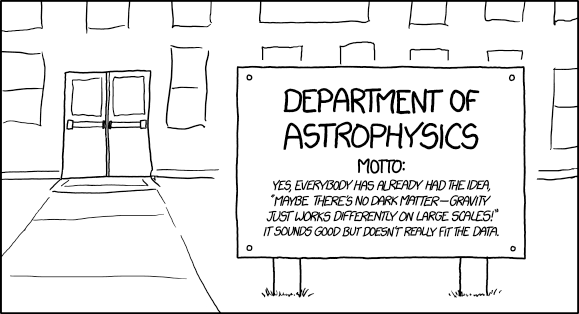
xkcd on dark matter v. gravity modification
The motto is typical but not very accurate. Modified gravity theories arguably fit the data better and some modified gravity theories work better than others. More importantly, it is very hard to get dark matter particle theories to fit the data.
Thursday, October 20, 2016
Academic Linguists Cannot Agree On Whether Adverbs Exist
Who knew?
Saturday, November 21, 2015
Hollywood Habits Reach Particle Physics
But, taking a cue from Hollywood, a researcher from the ALICE collaboration has gone one step further. After the usual abstract telling you what the current paper says, she throws in one more sentence about coming attractions which are not actually included in the paper, stating: "Recent results obtained from these measurements will be presented and the measured cross sections will be compared to perturbative Quantum Chromodynamics calculations at next-to-leading order."
Now, admittedly, maybe she just means that they will present the results in this paper. But, in context, it reads more to me like an announcement of an upcoming conference paper rather than a description of what is currently being presented.