Showing posts with label pseudoscience. Show all posts

Thursday, April 25, 2024

Sophisticated Science Denial

For those of you who aren't Young Earth Creationists (as about 0.1% of scientists and 46% of American adults are) or Flat Earthers (as essentially no scientists and 10% of American adults are), but still want to ignore consensus physics with lots of independent sources of high precision observational evidence to back it up, this more sophisticated form of science denial, that only rolls back scientific knowledge by about 120 years, may be for you.

As an aside, note that denying that space-time is non-Euclidian, a broad, theory independent observation, is a considerably stronger form of science denial than the mere scientific field of inquiry into whether General Relativity, as formulated by Einstein more than a century ago, is precisely the correct set of equations or is only a very close approximation of reality that is subtly wrong (e.g., because it is classical rather than quantum). The latter doesn't deny scientific evidence. It merely explores the full range of the possible within the constraints of what we know from experiments and scientific observations.

The percentage of the general adult public in the United States who understands that space-time itself is non-Euclidian is probably pretty low. My high, probably overoptimistic, estimate would be that 10-20% of American adults (i.e. about half of four year college graduates plus or minus) understand this fact. I make this estimate even though non-Euclidian geometry is part of the standard high school math curriculum for college bound students, and high school geometry textbooks often mention general relativity as one of the motivations for it. Spherical Earth theory and evolution are taught in K-12 education too, but the absence of scientific worldviews in those subjects is still pretty high. 

In this case, of course, the issue is mostly just lack of knowledge, rather than actual science denial. You can't deny science knowledge you never knew about in the first place. In the same vein, you can't deny the existence of quantum tunneling, or quantum entanglement, or quarks (concepts that are often first formally introduced in intermediate level undergraduate science courses), unless you've learned about these scientific discoveries in the first place and then rejected their validity.

See also, a new study on the percentage of Gen X members who believe in evolution at different ages. The study is: 

Jon D. Miller, et al., "The acceptance of evolution: A developmental view of Generation X in the United States." Public Understanding of Science (2024). DOI: 10.1177/09636625241234815

Monday, April 1, 2024

Multi-Messenger Astrology

It has long been accepted that the cosmos determine our personalities, relationships, and even our fate. Unlike our condensed matter colleagues - who regularly use quantum mechanics to determine the healing properties of crystals - astrology techniques have been unchanged since the 19th century. In this paper, we discuss how astrophysical messengers beyond starlight can be used to predict the future and excuse an O(1) fraction of our negative personality traits.
Gwen Walker, Nick Ekanger, R. Andrew Gustafson, Sean Heston, "Multi-Messenger Astrology" arXiv:2403.19749 submission for Acta Prima Aprilia (2024). 

Monday, June 10, 2019

There Is No Experimental Or Observational Evidence To Support A Zero Aggregate Baryon Number At T=0

A recent physics paper described for the first time (at the more than five sigma discovery threshold in a reputable peer reviewed physics journal) CP violation in charmed hardon decays that they had measured to the precise degree predicted by the Standard Model of Particle Physics. The paper is R. Aaij et al. (LHCb Collaboration), "Observation of CP Violation in Charm Decays." 122 Phys. Rev. Lett. 211803 (May 29, 2019).

In response to this paper, I noted at the Physics Forums (underlined emphasis added in this post):
Basically, this is just one more confirmation of a Standard Model prediction, made possible by improved experimental detection capacity at the LHCb. 
The introduction of the Letter notes that:
The noninvariance of fundamental interactions under the combined action of charge conjugation (C) and parity (P) transformations, so-called CP violation, is a necessary condition for the dynamical generation of the baryon asymmetry of the universe. The standard model (SM) of particle physics includes CP violation through an irreducible complex phase in the Cabibbo-Kobayashi-Maskawa (CKM) quark-mixing matrix. The realization of CP violation in weak interactions has been established in the K- and B-meson systems by several experiments, and all results are well interpreted within the CKM formalism. However, the size of CP violation in the SM appears to be too small to account for the observed matter-antimatter asymmetry, suggesting the existence of sources of CP violation beyond the SM. The observation of CP violation in the charm sector has not been achieved yet, despite decades of experimental searches. Charm hadrons provide a unique opportunity to measure CP violation with particles containing only up-type quarks. The size of CP violation in charm decays is expected to be tiny in the SM, with asymmetries typically of the order of 10^−4 − 10^−3, but due to the presence of low-energy strong-interaction effects, theoretical predictions are difficult to compute reliably.
The observed amount of CP violation of just the magnitude that the Standard Model predicts: 
(−15.4 +/- 2.9) × 10^−4 
The paper notes in its conclusion that:
The result is consistent with, although in magnitude at the upper end of, SM expectations, which lie in the range 10^−4 − 10^−3. In particular, the result challenges predictions based on first principle QCD dynamics. It complies with predictions based on flavor-SU(3) symmetry, if one assumes a dynamical enhancement of the penguin amplitude.
The researchers belief that it is likely that there will be BSM phenomena that will explain the baryon asymmetry of the universe is a case of hope triumphing over experience. Every single bit of available empirical and observational evidence suggests that the baryon asymmetry of the universe was part of its initial conditions, and these initial conditions do not violate any requirement theoretically necessary for a consistent cosmology model. But, because a Big Bang made of "pure energy" that is then deviated from due to CP violation somehow seems prettier than a non-zero baryon number of the universe to start with, researchers have presumptuously convinced themselves that they must be missing something.
Another very knowledgable participant in the discussion (mfb) responded to the language underlined above stating:
Please name such a piece of evidence, because I think that statement is blatantly wrong (unless you say “0 out of 0 is 100%”).
The post that follows was my response:
1. There has never been an observation of non-conservation of baryon number. This has been tested in multiple processes, e.g. proton decay, flavor changing neutral currents, etc. The experimental bounds on proton decay and neutron oscillation are both very strict. "No baryon number violating processes have yet been observed." Lafferty (2006) citing S. Eidelman et al. (Particle Data Group), Phys. Lett. B592 (2004). 
"Despite significant experimental effort, proton decay has never been observed. If it does decay via a positron, the proton's half-life is constrained to be at least 1.67×10^34 years." Yet, the universe is roughly 1.4*10^9 years old. This experimental result has been a leading means by which GUT theories are ruled out. 
Similarly, neutron-antineutron oscillation is not observed but if baryon asymmetry involves this process there "is an absolute upper limit on the n − n¯ oscillation time τn−n¯ of 5 × 10^10 sec. irrespective of the B − L breaking scale, which follows from the fact that we must generate enough baryon asymmetry via this mechanism (according to the linked 2013 paper). The limit on neutron-antineutron oscillation as of 2009 was τn−n¯ ≥ 10^8 sec. See also confirming the experimental result here
Exclusions for flavor changing neutral currents at the tree level have also not been observed although the measurements are less precise:
In the SM, flavor-changing neutral currents (FCNC) are forbidden at tree level and are strongly suppressed in loop corrections by the Glashow–Iliopoulos–Maiani (GIM) mechanism with the SM branching fraction of t → qH predicted to be O(10^−15). Several extensions of the SM incorporate significantly enhanced FCNC behavior that can be directly probed at the CERN LHC.
In top quark decays they are excluded to a branching fraction of not more than about 0.47% (per the link above). 
2. Likewise, there are no processes which have ever been observed which do not conserve lepton number (e.g. there is no observational evidence of neutrinoless double beta decay). These bounds are very strict already. 
The universe is roughly 1.4*10^9 years old, so the current limit from GERDA (from 2015) means that no more than one in 3.8*10^16 of hadrons that could have done so have actually experienced neutrinoless double beta decay since the formation of the universe. 
3. There has never been an observation of a sphaleron interaction (which would not conserve baryon number or lepton number) but the energies at which sphaleron interactions would take place (about 10 TeV and up) and the rates at which they would occur in the SM (whose parameters and equations are well tested) if they do exist are too small, particularly in light of the small CP violating phase in the CKM matrix (which has been carefully measured). See also, e.g., Koichi Funakub, "Status of the Electroweak Baryogenesis" ("[W]e find that the sphaleron process is in chemical equilibrium at T between 100 GeV and 10^12 GeV.") 
4. It is widely accepted and has been proven that with SM physics (and the linked article below acknowledges), that (1)-(3) imply that the baryon number of the initial conditions is positive and non-zero in the absence of BSM physics of particular baryon number and lepton number violating, CP violating processes that occur (only) out of equilibrium.
These are known as Sakharov’s conditions (Yoshimura is also sometimes given credit for them). This source also notes that:
Another way to view things consists in assuming that the primordial Universe developed through interactions of gravity and other fundamental forces, e.g. through the amplification of vacuum fluctuations. In such a case, gravity being blind to the difference between matter and antimatter, equal initial numbers of baryons and antibaryons are expected, and the current unbalance must be induced by subsequent interactions. . . . We only mention for completeness the possibility that the observed baryon excess is a local artefact, and that the Universe is constituted with domains with either baryon or antibaryon excess. The gamma rays arising from annihilation at the boundary of such domains would be a tell-tale sign, and the fact that they have not been observed rejects such a possibility to the limit of the observable Universe.
See also Paolo S. Coppi, "How Do We Know Antimatter Is Absent?" (2004) (reviewing the evidence against spatial anti-matter domains). 
Thus, no theory of quantum gravity alone can solve the problem unless it has CP violation which no leading theory of quantum gravity does. There is no experimental evidence of CP violation in gravity at the local level. 
In the Standard Model, neither the strong force nor the electromagnetic force have any CP violation either. 
The sole source of CP violation in the Standard Model is the weak force, a force in which the coupling constant gets smaller, not larger, a higher energies (as shown in the famous MSSM gauge coupling constant unification illustration below in the left hand panel; no anomalies in the running of any of the SM coupling constants with energy scale has been observed at the LHC so far), which is the opposite of the direction needed if it is to provide a source of CP violation sufficient to explain the baryon asymmetry of the universe ("BAU") given an assumption that aggregate baryon number at the time of the Big Bang was zero.
See also Wikipedia articles on Baryon asymmetry and Baryogenesis
5. The Higgs boson mass and the associated beta function for it, imply that the SM maintains unitarity up to Big Bang energies. There is nothing that would cause the SM to break down in terms of mathematically if there were no new physics at all at any scale above what is measured and the universe is at least metastable up to the mass (the Higgs boson and top quark masses haven't been measured precisely enough to determine if the universe is stable or metastable if there are no laws of physics other than the Standard Model). See also, e.g., Koichi Funakub, "Status of the Electroweak Baryogenesis" (noting that Higgs boson masses with more than 120 GeV are problematic for models creating BAU from a starting point of zero, when the global average measured value as of 2019 is 125.10 ± 0.14 GeV). 
We know empirically that the SM laws of physics remain valid at least up to Big Bang Nucleosynthesis energy scales (see below) and Large Hadron Collider ("LHC") energy such as those necessary to create a quark-gluon plasma. 
6. No one disputes that the aggregate mass-energy of the universe at the Big Bang was non-zero so it isn't as if there is a precedent that every aggregate parameter of the universe had to be zero at time equals zero (there is dispute, however, over whether gravitational energy is conserved globally in general relativity). 
7. Another quantity that is conserved in the Standard Model locally, and in the aggregate, is electromagnetic charge (for example, e → νe γ and astrophysical limits [m] >4.6 × 10^26 yr, CL = 90%), which still indistinguishable from zero in the aggregate in the universe now, and at all observable times in the history of the universe, and hence, aren't subject to wildly different laws of the universe from the SM if they were zero in the aggregate at the time of the Big Bang. 
This is particularly notable because aggregate baryon number, is equal three times the number of quarks in the universe minus the number of anti-quarks in the universe, and all quarks also electromagnetically charged. Thus, any baryon number violating or lepton number violating process must also be electromagnetic charge neutral. 
8. There are no traces in the predictions of Big Bang Nucleosynthesis that imply that there was not baryon asymmetry in the initial conditions of the universe. Indeed J.-M. Fr`ere, "Introduction to Baryo- and Leptogenesis" (2005) notes that:
based on nucleosynthesis (which occurs late in the history of the Universe and is therefore not too sensitive to the various scenarios – even if it can be affected by the number of neutrino species and the neutrino background) indicate a stricter, but compatible bound: 4 10^−10 < nB/nγ < 7 10^−10.
Any baryon number violating process must take place at T > 200 MeV (the QCD phase transition temperature), otherwise the success of nucleosynthesis will be spoiled. This temperature is about 400,000,000 times the temperature of the Sun and is believed to correspond to a time one microsecond after the Big Bang in the conventional chronology of the universe. One microsecond is about the time it takes a muon to decay. BBN itself is assumed to take place 10 to 1000 seconds after the Big Bang. This temperature is in the ballpark of the highest temperatures arising at the Large Hadron Collider (a temperature scale at which the Standard Model continues to perform as expected in myriad experimental tests). 
Put another way, even advocates of a zero baryon number initial condition (and this would be a majority of theoretical physicists and cosmologists notwithstanding the lack of empirical or observational evidence for it) pretty much agree based upon observation and empirical evidence and well established SM equations and reasonable extrapolations beyond the Standard Model, that the baryon asymmetry of the universe had to be in place around one microsecond after the Big Bang. 
The main reason we can't rule out baryon number violation prior to one microsecond after the Big Bang is that we have no way to observe it. 
9. There are no traces in the CMB that imply that there was not baryon asymmetry in the initial conditions of the universe. (This is unsurprising given that BBN happens much earlier in the cosmology timeline than the CMB traces at t=100,000 years or so). See also the implications of the CMB for inflation
Indeed, both of these windows into the very early universe (8) and (9) imply that if there was not baryon asymmetry at time equal zero, that baryon asymmetry had to completely arise very, very quickly. 
10. As of 2019, all experimentally measured CP violation observed in Nature (apart from neutrino oscillations data where the experimental uncertainties are too great to saying anything more than that CP violation occurs in these oscillations which may be possible to characterize with a single parameter of the PMNS matrix), is defined by a single parameter out of four parameters in all, in the CKM matrix, which as noted above, is insufficient in magnitude to explain the baryon asymmetry of the universe.
The present consistency of global CKM fits is displayed in Fig. 4. Each coloured band defines the allowed region of the apex of the unitarity triangle, according to the measurement of a specific process. Such a consistency represents a tremendous success of the CKM paradigm in the SM: all of the available measurements agree in a highly profound way. In presence of BSM physics affecting the measurements, the various contours would not cross each other into a single point. Hence the quark-flavour sector is generally very well described by the CKM mechanism, and one must look for small discrepancies.
244891


There are also no experimentally measured deviations from CPT symmetry in non-gravitational physics. See generally, Thomas Mannel "Theory and Phenomenology of CP Violation" (2006). 
But see Belfatto, et al. (pre-print 2019) (arguing that there is a 4 sigma tension with unitarity in the measurements of the CKM elements involving the up quark, although such a tension, even if it is more than a fluke measurement wouldn't be remotely sufficient to explain BAU and primarily involves the non-CP violating parameters of the CKM matrix). 
11. Attempts to fit cosmology data to inflation theories allow for only a reasonably narrow number of e-fold (ca. 20-80 at the outside with 40-60 cited more often as consistent with the data), which implicitly imposes strict minimum boundaries on the amount of baryon asymmetry that has to emerge per e-fold since the available time in which cosmological inflation must occur and the available time in which baryon asymmetry must occur if you start from zero aggregate baryon number are basically the same. But, we don't have any indication whatsoever that there is a process that is both baryon number violating and CP violating to the necessary degree, or anything remotely close to that. 
12. We don't need it to get dark energy. Indeed, while the conventional cosmological constant starts with a near zero dark energy and then has it grow proportionately to the volume of space over time, a transition of zero baryon number to massive baryon asymmetry would imply a huge surplus of energy very close to time zero that is not needed to make the Lambda-CDM model (a.k.a. the Standard Model of Cosmology) work. 
13. We don't need it to get 21cm observations to coincide with what is observed. These measure conditions at ca. 300,000 years after the Big Bang so we wouldn't expect them to so signs of baryon symmetry violating processes. 
14. We don't need an initial condition of baryon number equal to zero to get Hubble's constant or a particular amount of dark matter. Assuming a dark matter particle paradigm, according to a pre-print by Yang (2015) subsequently published in Physical Review D, the lower bound on the mean lifetime of dark matter particles is 3.57×10^24 seconds. This largely rules out the possibility that dark matter could bear baryon number and serve as an escape valve around baryon number conservation that is hard or impossible to measure directly. 
There really are no observed phenomena in astronomy or the SM which we need an initial baryon number of zero to explain. Even if the phenomena searched for were "just beyond" current experimental limits, the rates of phenomena like proton decay, neutron oscillation, neutrinoless double beta decay and CP violation beyond the Standard Model, and sphaleron interactions were all observed, so long as the existing experimental results remained accurate, none of these could explain the BAU from a hypothesis that aggregate baryon number was zero at T=0.
A non-zero baryon number as an initial condition is the null hypothesis. It is the conclusion that we reach when we follow the available experimental and observational data, and all experimentally validate laws of physics to their logical conclusion, and assume no modifications of those laws of physics not motivated by empirical or observational evidence. 
To be clear, it isn't impossible that the laws of physics could deviated wildly from the Standard Model at energy scales well in excess of those at the LHC. Lots of respectable physics believe that someday, somehow, we will discover something like this, and almost all published articles in the field of baryogenesis consider the hypothesis that the initial aggregate baryon number of the universe to be "well motivated". Some physicists even assume, without any evidentiary or theoretical consistency support that the initial conditions of the universe must have included a zero baryon number. For example: 
the CP violation in the standard model is a small effect. In particular it is too small to create the observed matter-antimatter asymmetry of the universe, for which CP violation is an indispensable ingredient.
- Thomas Mannel "Theory and Phenomenology of CP Violation" (2006) (emphasis added). 
But, we have no meaningful positive evidence to indicate that not only does this happen, but that the deviation from the Standard Model violates baryon and lepton number, is strongly (basically maximally) CP violating, and only occurs in out of equilibrium systems. Indeed, some of the strongest experimental exclusions in all of physics involve searches for baryon number violating processes and lepton number violating processes.

Arguing for a non-zero aggregate baryon number at the Big Bang isn't glamorous or fun. It's like arguing that the Electoral College is a good idea, or that coal needs to be phased out gradually rather than immediately to prevent the economy from collapsing. But, all existing empirical and observational evidence to date supports this conclusion.
I will be curious to see what kind of response I get (if any).

The "agenda" I am pushing in this post is essentially the same one advanced by Sabine Hossenfelder in her 2018 book "Lost in Math: How Beauty Leads Physics Astray", which which I wholeheartedly agree (the German title, which I prefer, is "The Ugly Universe.").

The notion that the initial aggregate baryon number of the universe must have been zero at the moment of the Big Bang is very widely endorsed by physicists with many prominent ones taking it as an article of faith. But, that is all that it is, a faith based position no supported by an empirical or observational evidence, or any deductions from validated laws of physics, motivated almost entirely by a sense of mathematical beauty that is ultimately in the eye of the beholder.

Like Dr. Hossenfelder, I believe that if hypothesis generation was more closely tied to empirical and observational evidence and deductions from validated theories, and less strongly driven by mathematical beauty, that we would make more progress as a scientific community instead of spending inordinate amounts of time chasing down rabbit holes at great express producing little scientific knowledge of value.

Thursday, May 30, 2019

Teaching Science v. Celebrating Science

Warning: There are no spoilers in this post, but there are in the linked source material.

Many commentators on science fiction assume that science fiction should accurately explain science because it is teaching people about science. But, usually, it isn't doing that, so accuracy isn't the point. This doesn't mean that there is no relationship between science and science fiction. But, it is as much about eternal narratives and cultural alternatives, as it is about hard science, in many cases.
The a movie like Avengers: Endgame doesn’t teach science, or even advertise it. It does celebrate it though. 

That’s why, despite the silly half-correct science, I enjoyed Avengers: Endgame. It’s also why I don’t think it’s inappropriate, as some people do, to classify movies like Star Wars as science fiction. Star Wars and Avengers aren’t really about exploring the consequences of science or technology, they aren’t science fiction in that sense. But they do build off science’s role in the wider culture. They take our world and look at the advances on the horizon, robots and space travel and quantum speculations, and they let their optimism inform their storytelling.
From 4gravitons

Monday, July 10, 2017

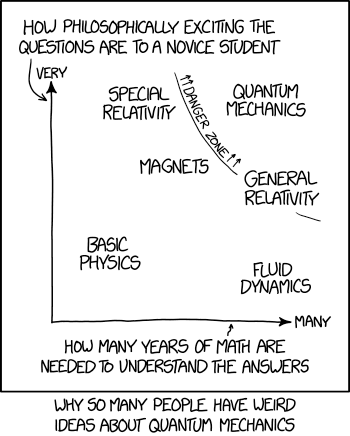
Why Do People Have Weird Ideas About Quantum Mechanics?

Once again xkcd nails it.


Mouseover: 
If you draw a diagonal line from the lower left to the upper right, 
that's the ICP "Miracles" axis.

Tuesday, June 4, 2013

A Style Note For Would Be Einsteins Regarding The Term "Aether"

Many lay persons who want to talk about their ideas for "new physics" beyond general relativity to explain observations made by astronomers use the term "aether" to describe their ideas, as someone leaving a comment at one of my recent posts did. 

I am making this post as a public service to discourage aspiring non-professional scientists from doing so (professional scientists already know better).   Most people use this term do so out of ignorance of its modern connotations.

The central notion of the idea of "aether" is that space-time is not just "nothing", and that the vacuum itself has physical properties that make it in some sense a real substance.  As discussed below, this core concept is not dead.

But, the term "aether" jumped the shark a couple of decades before the Happy Days episode in 1977 that gave rise to this expression aired.  Despite the fact that Albert Einstein used the term himself in published works as late as 1930 and that Paul Dirac published a paper using the term to describe a similar concept as late as 1951, this term is no longer in current usage as a scientific term used by legitimate physicists and hasn't been since the late 1950s.

Today, this term is very strongly associated with a very particular kind of 19th century luminiferous aether theory that was definitively disproven with a many experiments conducted by multiple investigators that were replicated with increasing precision from 1810 to 1935.  As a result, the luminiferous aether theory is synonymous in contemporary physics writing by professional physicists with pseudoscience.  "Aether" is to physicists what Young Earth Creationism is in the fields of biology and geology.  Thus, from a P.R./marketing/credibility perspective, it is hard to imagine a worse choice of name for the medium of space-time than aether by anyone trying to seriously and sincerely advance a scientific hypothesis about physics.

While many "new physics" modern gravitation/dark energy/dark matter theories proposed by professional physicists (and indeed general relativity itself) treat the fabric of space-time as something that has properties rather than being "nothing", using the term "aether" for that medium is the rhetorical equivalent of calling yourself a crackpot.  This is the perception that people who naively use this term are unintentionally broadcasting to people who read their writings about physics. 

Sometimes it makes sense to embrace a word that has become a slur (e.g. "gay" and "lesbian"), but this is not one of those times.

Among professional physicists anywhere in the world in the twenty-teens of the current era, the word "Aether" has connotations that make it basically a dirty word in reputable discussions of physics. Using the word "aether" sincerely, to describe a possible real physical phenomena in a published physics paper or blog post or physics forum comment, is a roughly equivalent writing an official government report or think tank paper or newspaper article describing 2010 census data that uses the word "Nigger" describe African-Americans, the word "Savages" to describe Native Americans, the phrase "Wetback" to describe Hispanics, and the word "Gook" to describe Asian Americans. It destroys your credibility before you have a chance to make a point about the legitimate physics idea that you want to express.  Use of the term "aether" brands you as a backward anti-scientific idiot even if this isn't really who you are at all.  If you want to make a positive impression you should not make this rookie mistake.

When professional physicists wish to express the notion that space-time itself may give rise to gravitational or inertia effects or otherwise fundamentally re-think of the foundational mechanism of effects observed by astronomers and physicists, they have a great many alternative ways of saying what they mean.   A non-professional physicist (or a professional physicist) who wants to express similar ideas should do likewise.  Physicists who talk about a theory in which the physical properties of a vacuum or space-time or empty space that are not nothing, often speak of the properties of space-time, manifolds, branes, the physical properties of the vacuum, the inherent curvature of space-time, the background, the cosmological constant, vacuum energy, dark energy, quintessence, scalar fields such as the Higgs field and the inflaton, superfluid vacuum theory,  the Dirac sea, Le Sage gravity, a Bose-Einstein condensate, and Mach's principal.  But, legitimate physicists almost never use the term "aether" in any sense other than a derogatory or dismissive one.

Given the term aether's illustrious history of use back to the days of Aristotle that it shares with terms like "atom" that have endured the test of time better, this may seem to a would be lay physicist to be a crying shame.  But, life is not fair and this is the sociological reality of modern academia and physics. Any amateur physicist who uses the term should be forewarned about this linguistic connotation reality, and should expect the treatment that they will receive when they use it from professional physicists and more sophisticated amateur physicists alike.

Wednesday, May 8, 2013

Study Purporting To Link Seven Language Families At 15 kya Time Depth Based On Iffy Data

On the web site of the Proceedings of the National Academy of Sciences, in the "Early Edition" section, is an article by Mark Pagel, Quentin D. Atkinson, Andreea S. Calude, and Andrew Meade: "Ultraconserved words point to deep language ancestry across Eurasia". The authors claim that a set of 23 especially frequent words can be used to establish genetic relationships of languages that go way, way back — too far back for successful application of the standard historical linguistics methodology for establishing language families, the Comparative Method. The idea is that, once you've determined that these 23 words are super-stable (because they're used so often), you don't need systematic sound/meaning correspondences at all; finding resemblances among these words across several language families is enough to prove that the languages are related, descended with modification from a single parent language (a.k.a. proto-language).

From Language Log.

As the trenchant analysis in the linked post explains, the study is deeply flawed because it is based on dubious choices of cognates in the seven proto-languages which were compared. In many cases, there are several cognates for the allegedly ultraconservated word and there is no consensus on which is correct in the proto-language, but the authors simply choose one by whim.

The data also cast serious doubt on the hypothesis that these words are truly ultra-conserved. For example, only a quarter of the ultraconserved Indo-European cognates survive in English, despite a time depth from proto-Indo-European to English estimated by more reliable means on the order of 6,000 years. The survival rates of these "ultraconserved" words are even lower in some of the other language families examined.

The hypothesis that the seven families discussed in the paper are part of a single macro-language family is not widely accepted among linguists, and isn't a good fit to genetic data for the populations who speak them either, as explained in comments to this post at Dienekes' Anthropology blog.

There is lots of very good research in the area of historical linguistics, but this, like a number of other papers with Quentin D. Atkinson as one of the authors, isn't one of them.

Wednesday, August 1, 2012

Anatomy of A Crackpot

Razib has posted a nicely done profile of "human origins in the Americas" blogger and self-published author German Dziebel.  I've come across his posts at a number of prehistory and population genetics blogs and concur with Razib's assessment.