Monday, November 21, 2016

Genetic Evidence Of Natural Selection In Human Ancestors

What genes were selected for in the course of the evolution of our primate ancestors? 

An examination of multiple primate genomes sheds some light on this question. It looks likes genes involved in immune response, sensory perception, metabolism and energy production were under particularly strong selective pressure in our primate ancestors.
Gene set enrichment approaches have been increasingly successful in finding signals of recent polygenic selection in the human genome. 
In this study, we aim at detecting biological pathways affected by positive selection in more ancient human evolutionary history, that is in four branches of the primate tree that lead to modern humans. 
We tested all available protein coding gene trees of the Primates clade for signals of adaptation in the four branches mentioned above, using the likelihood-based branch site test of positive selection. The results of these locus-specific tests were then used as input for a gene set enrichment test, where whole pathways are globally scored for a signal of positive selection, instead of focusing only on outlier "significant" genes. 
We identified several pathways enriched for signals of positive selection, which are mainly involved in immune response, sensory perception, metabolism, and energy production. These pathway-level results were highly significant, at odds with an absence of any functional enrichment when only focusing on top scoring genes. 
Interestingly, several gene sets are found significant at multiple levels in the phylogeny, but in such cases different genes are responsible for the selection signal in the different branches, suggesting that the same function has been optimized in different ways at different times in primate evolution.
Josephine Daub, Sebastien Moretti, Iakov Igorevich Davydov, Laurent Excoffier, Marc Robinson-Rechavi, "Detection of pathways affected by positive selection in primate lineages ancestral to humans" (Pre-Print November 21, 2016). doi: http://dx.doi.org/10.1101/044941

Earlier version of the paper were released in March and October of this year.

More On Gravitational Self-Interactions

Deur's research program is arguably the most promising in quantum gravity today.

He demonstrates how modeling the self-interaction of the graviton in the case of a scalar graviton can reproduce all dark matter phenomena, predict previously unobserved correlations between the extent to which an elliptical galaxy and its apparent dark matter content, and explain at least some dark energy phenomena, without (in principle at least) introducing any new fundamental physical constants to general relativity, or any new particles beyond the Standard Model other than the graviton.

His model also plausibly suggests that the key insights secured from the self-interacting scalar graviton regime and by analogy to QCD might not be materially altered by generalizing these result to the full tensor graviton.

The elegance with which his research explains a huge range of phenomena that seem to call for beyond the Standard Model (and general relativity) physics, with minimal tweaks to existing knowledge, and integrates quantum gravity into a Standard Model-like framework, in the face of extreme computational barriers to addressing these questions in a brute force numerical manner, is remarkable.
We study two self-interacting scalar field theories in their strong regime. 
We numerically investigate them in the static limit using path integrals on a lattice. We first recall the formalism and then recover known static potentials to validate the method and verify that calculations are independent of the choice of the simulation's arbitrary parameters, such as the space discretization size. The calculations in the strong field regime yield linear potentials for both theories. 
We discuss how these theories can represent the Strong Interaction and General Relativity in their static and classical limits.  
In the case of Strong Interaction, the model suggests an origin for the emergence of the confinement scale from the approximately conformal Lagrangian. The model also underlines the role of quantum effects in the appearance of the long-range linear quark-quark potential. 
For General Relativity, the results have important implications on the nature of Dark Matter. In particular, non-perturbative effects naturally provide flat rotation curves for disk galaxies, without need for non-baryonic matter, and explain as well other observations involving Dark Matter such as cluster dynamics or the dark mass of elliptical galaxies.
A. Deur, "Self-interacting scalar fields in their strong regime" (November 17, 2016) (Hat tip to Viljami from the comments).

From the body text:
The (gφ∂µφ∂µφ + g2φ2∂µφ∂µφ) theory calculations in strong field regime yield a static potential which varies approximately linearly with distance, see Figs. 5 and 6. This can be pictured as a collapse of the three dimensional system into one dimension. As discussed in Section V D and shown numerically, typical galaxy masses are enough to trigger the onset of the strong regime for GR.
Hence, for two massive bodies, such as two galaxies or two galaxy clusters, this would result in a string containing a large gravity field that links the two bodies –as suggested by the map of the large structures of the universe. That this yields quantitatively the observed dark mass of galaxy clusters and naturally explains the Bullet Cluster observation [18] was discussed in [19]. For a homogeneous disk, the potential becomes logarithmic. 
Furthermore, if the disk density falls exponentially with the radius, as it is the case for disk galaxies, it is trivial to show that a logarithmic potential yields flat rotation curves: a body subjected to such a potential and following a circular orbit (as stars do in disk galaxies to good approximation) follows the equilibrium equation:

v(r) = √ G'M(r), (14)


with v the tangential speed and M(r) the disk mass integrated up to r, the orbit radius. G' is an effective coupling constant of dimension GeV−1 similar to the effective coupling σ (string tension) in QCD. Disk galaxies density profiles typically fall exponentially: ρ(r) = M0e−r/r0/(2πr02 ), where M0 is the total galactic mass and r0/ is a characteristic length particular to a galaxy. Such a profile leads to, after integrating ρ up to r:

v(r) = √ G'M0 (1 − (r/r0 + 1)e−r/r0), (15)

At small r, the speed rises as v(r) approximately equal to √ G'M0r/r0 and flatten at large r: v approximately equal to √ G'M0.
This is what is observed for disk galaxies and the present approach yields rotation curves agreeing quantitatively with observations [19]. For a uniform and homogeneous spherical distribution of matter, the system remains three-dimensional and the static potential stays proportional to 1/r. The dependence of the potential with the system’s symmetry suggested a search for a correlation between the shape of galaxies and their dark masses [19]. Evidence for such correlation has been found [20].
VI. SUMMARY AND CONCLUSION 
We have numerically studied non-linearities in scalar field theory.
Limiting ourselves to static systems allowed us to greatly simplify and speed-up the numerical calculations while providing a possible description of the strong regimes of the Strong Interaction and of General Relativity in the static case. The overall validity of the method is verified by recovering analytically known potentials. We further verified the validity of the simplifications in the case of General Relativity by recovering the post-Newtonian formalism. 
Lattice gauge calculations of QCD are well advanced. What justifies developing the present approximation is that it provides fast calculations that can be run on any personal computer, and it may help to isolate the important ingredients leading to confinement. This method is able to provide: 1) the expected field function, 2) a mechanism –straightforwardly applicable to QCD– for the emergence of a mass scale out of a conformal Lagrangian, 3) a running of the field effective mass in qualitative agreement with that seen in QCD, and 4) a potential agreeing with the phenomenological Cornell linear potential up to 0.8 fm, the relevant range for hadronic physics. Quantum effects, which cause couplings to run, are necessary for producing the linear potential and must be supplemented to the approach. A non-running coupling, even with a large value, would only yield a short range Yukawa potential. 
An important benefit of this method is that it may apply to theories, such as General Relativity, that are too CPU-demanding to be easily computed on a lattice. That the method recovers the essential features of QCD supports its application to GR. Since GR is a classical theory, no running coupling needs to be supplemented.
In QCD, the strong regime arises for distances greater than 2 × 10⁻¹⁶ m, while it should arise for gravity at galactic scales: Two massive bodies, such as galaxies, or at larger scale two galaxy clusters, would then be linked by a QCD-like string/flux tube. This would explain the universe’s large scale stringy structure observed by weak gravitational lensing. It also agrees quantitatively with cluster dynamics [19]. Furthermore, in the case of massive disks of exponentially falling density, such as disk galaxies, the logarithmic potential resulting from the strong field non-linearities trivially yields flat rotation curves. Those agree quantitatively with observations [19]. Finally, for a uniform and homogeneous spherical distribution of matter, the non-linearity effects should balance out [19]. Evidences for the consequent correlation expected between galactic ellipticity and galactic dark mass have been found [20].
Alexandre Deur has had some key insights into how to explore quantum gravity. 

The first has been to exploit parallels arising from the fact that both the strong force theory of  QCD and gravity involve self-interacting carrier bosons. 

The second has been to simplify the analysis of gravity by starting from a scalar graviton rather than a spin-2 tensor graviton. This produces identical results in a static case.  Even in the dynamic case, the deviations from the static case due to tensor components of linear momentum, angular momentum, pressure and electromagnetic flux are often negligible.

Also, the adjustments due to using a self-interacting tensor graviton (full GR) relative to a self-interacting scalar graviton (simplified GR) are unlikely to cancel out the differences between a self-interacting scalar graviton (simplified GR) and a non-self interacting scalar graviton (Newtonian gravity plus propagation at the speed of light and couplings to energy as well as mass).

His description of the impact in GR as pertaining to the "strong field regime" is somewhat misleading, because the effects in question, while involving large masses that generate gravitational fields much stronger than those generated by small masses, are generally only observable when the gravitational field is weak. In stronger gravitational fields (such as those in the vicinity of black holes, or even those involving solar system gravitational fields) the first order effects of gravitons pulling on other objects overwhelm any visible second order effects due to graviton self-interactions (particularly in the circularly symmetrical case).

Thursday, November 17, 2016

Modified Gravity Can Explain Cluster Data

The galaxy cluster system Abell 1689 has been well studied and yields good lensing and X-ray gas data. Modified gravity (MOG) is applied to the cluster Abell 1689 and the acceleration data is well fitted without assuming dark matter. Newtonian dynamics and Modified Newtonian dynamics (MOND) are shown not to fit the acceleration data, while a dark matter model based on the Navarro-Frenk-White (NFW) mass profile is shown not to fit the acceleration data below ~ 200 kpc.
J. W. Moffat and M. H. Zhoolideh Haghighi, "Modified gravity (MOG) can fit the acceleration data for the cluster Abell 1689" (16 Nov 2016).

The introduction observes that:
MOG has passed successful tests in explaining rotation velocity data of spiral and dwarf galaxies (Moffat & Rahvar (2013)), (Zhoolideh Haghighi & Rahvar (2016)), globular clusters (Moffat & Toth (2008b)) and clusters of galaxies (Moffat & Rahvar (2014)). Recently, it was claimed (Nieuwenhuizen (2016)) that no modified gravity theory can fit the Abell 1689 acceleration data without including dark matter or heavy (sterile) neutrinos. The cluster A1689 is important, for good lensing and gas data are available and we have data from 3kpc to 3Mpc. We will show that MOND (Milgrom (1983)) does not fit the A1689 acceleration data, nor does the dark matter model based on an NFW mass profile. However, MOG does fit the A1689 acceleration data without dark matter.
The conclusion of the paper notes:
The fully covariant and Lorentz invariant MOG theory fits galaxy dynamics data and cluster data. It also fits the merging clusters Bullet Cluster and the Train Wreck Cluster (Abell 520) without dark matter (Brownstein & Moffat (2007); Israel & Moffat (2016)). A MOG application to cosmology without dark matter can explain structure growth and the CMB data (Moffat & Toth (2013)). The fitting of the cluster A1689 data adds an important success for MOG as an alternative gravity theory without dark matter.
I will leave a detailed explanation of MOG theory and any analysis of this paper's conclusions for another day.

Tuesday, November 15, 2016

Metabolism and Mass Are Deeply Related And Powerfully Drive Evolution

A new preprint describes in detail how metabolism and body mass are intimately related to each other and to other key aspects of how they have evolved. Natural selection has been a unifying force explaining this process from the scale of viruses all of the way up to elephants and whales. 
I show that the natural selection of metabolism and mass is selecting for the major life history and allometric transitions that define lifeforms from viruses, over prokaryotes and larger unicells, to multicellular animals with sexual reproduction. 
The proposed selection is driven by a mass specific metabolism that is selected as the pace of the resource handling that generates net energy for self-replication. This implies that an initial selection of mass is given by a dependence of mass specific metabolism on mass in replicators that are close to a lower size limit. 
A maximum dependence that is sublinear is shown to select for virus-like replicators with no intrinsic metabolism, no cell, and practically no mass. A maximum superlinear dependence is instead selecting for prokaryote-like self-replicating cells with asexual reproduction and incomplete metabolic pathways. 
These self-replicating cells have selection for increased net energy, and this generates a gradual unfolding of a population dynamic feed-back selection from interactive competition. The incomplete feed-back is shown to select for larger unicells with more developed metabolic pathways, and the completely developed feed-back to select for multicellular animals with sexual reproduction. 
This model unifies natural selection from viruses to multicellular animals, and it provides a parsimonious explanation where allometries and major life history transitions evolve from the natural selection of metabolism and mass.
Lars Witing, "The natural selection of metabolism and mass selects lifeforms from viruses to multicellular animals" (November 15, 2016). doi: http://dx.doi.org/10.1101/087650

Monday, November 14, 2016

Population Waves In Greenland

Paleo-Eskimos arrived in Greenland around 2500 BCE and has a diet including a substantial component of Bowhead whales based upon ancient DNA analysis of the contents of middens from 2000 BCE.
Previously it was thought the Thule culture was the first to hunt and eat whales extensively, 800 to 600 years ago. Evidence of hunting large mammals prior to this was largely missing because of the lack of bones and weapons for hunting. 
However, samples show whale was very much part of the diets of humans before 1200 CE. Most notably, findings revealed bowhead whales and other large mammals were being exploited by the Saqqaq culture 4,000 years ago. 
At one of the sites, the bowhead whale was the most abundant species identified, making up almost half of the DNA analysed. At another site, it was the second or third most utilised species. 
The team believes these prehistoric Greenlanders would have transported large carcasses from the shore to the settlement as a result of their size – a bowhead whale can reach up to 60ft and weight between 75 and 100 tonnes. 
"The underrepresentation of whale bones in archaeological sites is a well-known phenomenon, typically ascribed to difficulties in transporting large carcasses from shore to the settlement in combination with the higher value of blubber or meat compared with bones," they wrote. 
"In the Arctic, several studies have suggested that the fossil record may underestimate the importance of whales to ancient Arctic cultures, however, the lack of suitable methods to detect remains of tissue like blubber and meat in sediment have prevented further investigations on this matter. As such, our findings represent the first tangible evidence that bone counts alone may underestimate large whales in Arctic midden remains." 
Concluding, they added: "These findings expand our current knowledge of the Paleo-Inuit and illustrates that the Saqqaq people had a wider diet-breadth than was previously thought and were able to exploit most of the mammals available to them."
Vikings arrived around 1000 CE, but had vanished by the 15th century, possibly as a consequence of a failure to adapt to climate changes during the Little Ice Age. But, the demise of the four or five century long occupation was more complex than that:
Over the last decade, however, new excavations across the North Atlantic have forced archaeologists to revise some of these long-held views. An international research collective called the North Atlantic Biocultural Organisation (NABO) has accumulated precise new data on ancient settlement patterns, diet, and landscape. The findings suggest that the Greenland Norse focused less on livestock and more on trade, especially in walrus ivory, and that for food they relied more on the sea than on their pastures. There's no doubt that climate stressed the colony, but the emerging narrative is not of an agricultural society short on food, but a hunting society short on labor and susceptible to catastrophes at sea and social unrest.
Read the whole thing which is dense with paleo-climate data and a rich description of Viking Greenlander's history.

A Short History Of Nuclear Binding Energy And The Nuclear Force

In the Standard Model of particle physics, the nuclear binding energy that binds protons and neutrons into atoms arises as a spillover from the strong force that binds quarks together into hadrons via an exchange of gluons according to the rules of quantum chromodynamics (QCD) and is mediated mostly via pions, rho mesons, and omega mesons exchanged between protons and neutrons in the nucleus of an atom. 

But, for almost all practical purposes, what matters is the nuclear binding energy in an atom that arises from these interactions and not the details of the process that give rise to nuclear binding energy. Nuclear binding energy is the most important thing you need to know in order to do engineering and make predictions related to nuclear fission and nuclear fusion.


The nuclear binding energy of atoms in real life is summarized in the chart above. 

Weizsäcker's formula

For a nucleus with A nucleons, including Z protons and N neutrons, a semi-empirical formula (also called Weizsäcker's formula, or the Bethe–Weizsäcker formula, or the Bethe–Weizsäcker mass formula) for the binding energy (BE) per nucleon is:
where the coefficients are given by: ; ; ; ; .
The first term is called the saturation contribution and ensures that the binding energy per nucleon is the same for all nuclei to a first approximation. The term  is a surface tension effect and is proportional to the number of nucleons that are situated on the nuclear surface; it is largest for light nuclei. The term  is the Coulomb electrostatic repulsion; this becomes more important as  increases. The symmetry correction term  takes into account the fact that in the absence of other effects the most stable arrangement has equal numbers of protons and neutrons; this is because the n-p interaction in a nucleus is stronger than either the n-n or p-p interaction. The pairing term  is purely empirical; it is + for even-even nuclei and - for odd-odd nuclei.

According to Wikipedia the formula: "gives a good approximation for atomic masses and several other effects, but does not explain the appearance of magic numbers of protons and neutrons, and the extra binding-energy and measure of stability that are associated with these numbers of nucleons. . . . The semi-empirical mass formula provides a good fit to heavier nuclei, and a poor fit to very light nuclei, especially 4He. This is because the formula does not consider the internal shell structure of the nucleus. For light nuclei, it is usually better to use a model that takes this structure into account."
Magic Numbers

What are the magic numbers (again per Wikipedia)?
In nuclear physics, a magic number is a number of nucleons (either protons or neutrons, separately) such that they are arranged into complete shells within the atomic nucleus. The seven most widely recognized magic numbers as of 2007 are 2, 8, 20, 28, 50, 82, and 126. Atomic nuclei consisting of such a magic number of nucleons have a higher average binding energy per nucleon than one would expect based upon predictions such as the semi-empirical mass formula and are hence more stable against nuclear decay. 
The unusual stability of isotopes having magic numbers means that transuranium elements can be created with extremely large nuclei and yet not be subject to the extremely rapid radioactive decay normally associated with high atomic numbers. 
Large isotopes with magic numbers of nucleons are said to exist in an island of stability. Unlike the magic numbers 2–126, which are realized in spherical nuclei, theoretical calculations predict that nuclei in the island of stability are deformed. Before this was realized, higher magic numbers, such as 184, 258, 350, and 462, were predicted based on simple calculations that assumed spherical shapes: these are generated by the formula (see binomial coefficient). It is now believed that the sequence of spherical magic numbers cannot be extended in this way. Further predicted magic numbers are 114, 122, 124, and 164 for protons as well as 184, 196, 236, and 318 for neutrons. . . . 
Nuclei which have neutron number and proton (atomic) numbers each equal to one of the magic numbers are called "double magic", and are especially stable against decay. Examples of double magic isotopes include helium-4, oxygen-16, calcium-40, calcium-48, nickel-48, nickel-78, and lead-208. 
Double-magic effects may allow existence of stable isotopes which otherwise would not have been expected. An example is calcium-40, with 20 neutrons and 20 protons, which is the heaviest stable isotope made of the same number of protons and neutrons. Both calcium-48 and nickel-48 are double magic because calcium-48 has 20 protons and 28 neutrons while nickel-48 has 28 protons and 20 neutrons. Calcium-48 is very neutron-rich for such a light element, but like calcium-40, it is made stable by being double magic. Nickel-48, discovered in 1999, is the most proton-rich isotope known beyond helium-3. At the other extreme, nickel-78 is also doubly magical, with 28 protons and 50 neutrons, a ratio observed only in much heavier elements apart from tritiumwith one proton and two neutrons (Ni-78: 28/50 = 0.56; U-238: 92/146 = 0.63). 
Magic number shell effects are seen in ordinary abundances of elements: helium-4 is among the most abundant (and stable) nuclei in the universe and lead-208 is the heaviest stable nuclide. 
Magic effects can keep unstable nuclides from decaying as rapidly as would otherwise be expected. For example, the nuclides tin-100 and tin-132 are examples of doubly magic isotopes of tin that are unstable, and represent endpoints beyond which stability drops off rapidly.
The nuclear shell model forms the basis of the "magic number" determination.

The Nuclear Force a.k.a. Residual Strong Force 


Nuclear binding energy arises from the nuclear force a.ka. the residual strong force. The neutral rho meson plays a part together with pions (pseudoscalar mesons made of up and down quarks), charged rho mesons (made up up and antidown or antiup and down quarks), and omega mesons (vector mesons that combine the components of the neutral rho meson in a different way) in carrying the nuclear force (a.k.a. residual strong force a.k.a. strong nuclear force), not to be confused with the gluon mediated strong interaction of QCD from which it derives residually, that gives rise to nuclear binding energy within atoms. Per Wikipedia:
The nuclear force is powerfully attractive between nucleons at distances of about 1 femtometer (fm, or 1.0 × 10⁻¹⁵ metres) between their centers, but rapidly decreases to insignificance at distances beyond about 2.5 fm. At distances less than 0.7 fm, the nuclear force becomes repulsive. This repulsive component is responsible for the physical size of nuclei, since the nucleons can come no closer than the force allows. By comparison, the size of an atom, measured in angstroms (Å, or 1.0 × 10⁻¹⁰ m), is five orders of magnitude larger. The nuclear force is not simple, however, since it depends on the nucleon spins, has a tensor component, and may depend on the relative momentum of the nucleons.

A chart demonstrating the nuclear force per distance from Wikipedia that ignores more complex aspects of the nuclear force.
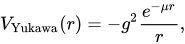
The Yukawa potential [of Yukawa per his 1934 theory shown above] (also called a screened Coulomb potential) is a potential of the form 

where g is a magnitude scaling constant, i.e., the amplitude of potential,  is the Yukawa particle mass, r is the radial distance to the particle. The potential is monotone increasing, implying that the force is always attractive. The constants are determined empirically. The Yukawa potential depends only on the distance between particles, r, hence it models a central force. . . .
To disassemble a nucleus into unbound protons and neutrons requires work against the nuclear force. Conversely, energy is released when a nucleus is created from free nucleons or other nuclei: the nuclear binding energy. Because of mass–energy equivalence (i.e. Einstein's famous formula E = mc2), releasing this energy causes the mass of the nucleus to be lower than the total mass of the individual nucleons, leading to the so-called "mass defect". 
The nuclear force is nearly independent of whether the nucleons are neutrons or protons. This property is called charge independence. The force depends on whether the spins of the nucleons are parallel or antiparallel, as it has a non-central or tensor component. This part of the force does not conserve orbital angular momentum, which under the action of central forces is conserved. 
The symmetry resulting in the strong force, proposed by Werner Heisenberg, is that protons and neutrons are identical in every respect, other than their charge. This is not completely true, because neutrons are a tiny bit heavier, but it is an approximate symmetry. Protons and neutrons are therefore viewed as the same particle, but with different isospin quantum number. The strong force is invariant under SU(2) transformations, just as are particles with intrinsic spin. Isospin and intrinsic spin are related under this SU(2) symmetry group. There are only strong attractions when the total isospin is 0, which is confirmed by experiment. 
Our understanding of the nuclear force is obtained by scattering experiments and the binding energy of light nuclei. 
The nuclear force occurs by the exchange of virtual light mesons, such as the virtual pions, as well as two types of virtual mesons with spin (vector mesons), the rho mesons and the omega mesons. The vector mesons account for the spin-dependence of the nuclear force in this "virtual meson" picture.  
The nuclear force is distinct from what historically was known as the weak nuclear force. The weak interaction is one of the four fundamental interactions, and plays a role in such processes as beta decay. The weak force plays no role in the interaction of nucleons, though it is responsible for the decay of neutrons to protons and vice versa.
Another presentation of these concepts can be found here.


A Feynman diagram of a strong proton–neutroninteraction mediated by a neutral pion. Time proceeds from left to right.
Historical Timing
The semi-empirical formula for nuclear binding energy was first formulated in 1935 by German physicist Carl Friedrich von Weizsäcker, and although refinements have been made to the coefficients over the years, the structure of the formula remains the same today.
Magic number shell effects were first noted in 1933, although the idea was largely dropped until it was rediscovered in 1948.
In 1934, Hideki Yukawa made the earliest attempt to explain the nature of the nuclear force. According to his theory, massive bosons (mesons) mediate the interaction between two nucleons. Although, in light of quantum chromodynamics (QCD), meson theory is no longer perceived as fundamental, the meson-exchange concept (where hadrons are treated as elementary particles) continues to represent the best working model for a quantitative NN potential. 
Throughout the 1930s a group at Columbia University led by I. I. Rabi developed magnetic resonance techniques to determine the magnetic moments of nuclei. These measurements led to the discovery in 1939 that the deuteron also possessed an electric quadrupole moment. This electrical property of the deuteron had been interfering with the measurements by the Rabi group. The deuteron, composed of a proton and a neutron, is one of the simplest nuclear systems. The discovery meant that the physical shape of the deuteron was not symmetric, which provided valuable insight into the nature of the nuclear force binding nucleons. In particular, the result showed that the nuclear force was not a central force, but had a tensor character. Hans Bethe identified the discovery of the deuteron's quadrupole moment as one of the important events during the formative years of nuclear physics.
Historically, the task of describing the nuclear force phenomenologically was formidable. The first semi-empirical quantitative models came in the mid-1950s, such as the Woods–Saxon potential(1954). There was substantial progress in experiment and theory related to the nuclear force in the 1960s and 1970s. One influential model was the Reid potential (1968). In recent years, experimenters have concentrated on the subtleties of the nuclear force, such as its charge dependence, the precise value of the πNN coupling constant, improved phase shift analysis, high-precision NN data, high-precision NN potentials, NN scattering at intermediate and high energies, and attempts to derive the nuclear force from QCD.
By comparison, the muon was discovered (it was a surprise and not predicted when it was discovered) in 1936, and the discovery was confirmed in 1937, although it was originally believed to be the pion, a meson predicted by Hideki Yukawa in 1934, which was not discovered until 1947.

Kaons, the first particles discovered with the property of "strangeness" (i.e. a strange quark component) were first discovered in 1947 and elucidate further through 1955, although the way that these mesons fit into the larger picture was not ascertained until the quark model was proposed in 1964.

The neutrino was predicted in 1930 and first experimentally detected in 1956. The muon neutrino was detected in 1962 and the tau neutrino was detected in 2000 (with each predicted not long after the charged counterpart was detected).

More of the history of nuclear mass measurements and evaluation can be found in this 2006 paper. 

Some of the genes humans got from Neanderthals were good.

Our ancestors picked up one of the particularly virulent strains of the HPV retrovirus that causes genital warts and cervical cancer when they had sex with Neanderthals. But, the genes that modern human received into its gene pool via Neanderthal hybrid individuals also enhanced the selective fitness of non-African modern humans in their new non-African environment in some important respects including immunity genes. In contrast, many other genes that we received from Neanderthals impaired selective fitness in modern humans, and were quickly purged from the modern human gene pool via natural selection.

Neanderthals (who were light pigmented relative to the Cro-Magnon modern humans that they encountered as a result of adaptation to their more northerly range) also provided some of the pigmentation genes now found in modern humans (although many of the pigmentation genes in Northern Europeans evolved independently and convergently in modern humans). Another kind of modern human with whom we admixed, the Denisovans, appear to have been a source of high altitude adaptations that are common in Tibetans and other Himalayan peoples and appear to have provided a different and additional set of novel immunity related genes.

Quick Physics Hits

* Torsion fields interacting with an expanded Higgs doublet could be a dark matter candidate.

* Erik Verlinde is known for his conjecture that gravity is an emergent property of the entanglement of particles via quantum mechanics, providing a natural and parsimonious first principles theory of quantum gravity. Several of his new talks on the subject are mentioned in the link. Peter Woit has also chimed in on this work, saying he doesn't understand the argument being made and doesn't see a case comparing it with the empirical evidence yet.

* The DUNE experiment, which is just getting started, should be able to shed light on the "two major unknowns in neutrino oscillation physics. These are [the] octant of θ23 (i.e. if θ23 is <45∘ or >45∘) and Dirac CP phase δCP."

* The 4gravitons blog has correspondence from one of the authors of a paper casting doubt on the strength of the evidence for dark energy and cosmic acceleration, which argues that the strength of the evidence is overstated by the use of inappropriate statistical methods by its proponents. They still find evidence for it, but at a slightly less than 3 sigma significance as opposed to the more than five sigma discovery level of significance claimed by supporters of the theory. Thus, even if there is dark energy or a positive cosmological constant, its magnitude may be smaller than previously claimed. This would tend to bring the amount of dark energy in the universe closer to the magnitude of the component of the total make up of the universe attributed to dark matter, heightening the so called "coincidence problem" and tending to favor theories in which dark matter and dark energy phenomena have a common source.

* Sabine Hossenfelder joins Steve Weinberg in expressing concern that the definition of a measurement that collapses the wave function in quantum mechanics is not yet satisfactory. As she explains:
My misgivings of quantum mechanics are pretty much identical to the ones which Weinberg expresses in his lecture. The axioms of quantum mechanics, whatever interpretation you chose, are unsatisfactory for a reductionist. They should not mention the process of measurement, because the fundamental theory should tell you what a measurement is.
She is a fan of superdeterminism.

* We have a good model for explaining the exclusive leptoproduction of the neutral rho meson, which in confirmed experimentally. It is normally theorized as a blend of an up and antiup quark meson and a down and anti-down quark meson. It is a vector meson (spin-1, negative P parity and negative C parity) that has a mass of 775.49±0.34 MeV/c2.

It swiftly (in a mean lifetime of about 4.5 x 10⁻²⁴ seconds) decays to a positively charged and negatively charged pion pair (which it does 99.9% of the time, while decaying to a pair of electrons or pair of muons 0.05% of the time each (possibly in an interaction that also involves an additional photon) with the helicity predicted by the Standard Model and QCD.

The neutral rho meson is one of several mesons that carry the residual strong force that binds nucleons in atoms.

* In contrast, we struggle to explain the decay of a boson called X(3915) with QCD and the Standard Model. As the abstract of a November 11, 2016 preprint by P. Gonzales explains:
Strong decays of X(3915) are analyzed from two quark model descriptions of X(3915), a conventional one in terms of the Cornell potential and an unconventional one from a Generalized Screened potential. We conclude that the experimental suppression of the OZI allowed decay X(3915)→DD⎯⎯⎯⎯ might be explained in both cases as due to the momentum dependence of the decay amplitude. However, the experimental significance of the OZI forbidden decay X(3915)→ωJ/ψ could favor an unconventional description.
The myth that the Standard Model fully explains all experimental observations is particularly exaggerated in the case of QCD, which there are lots of unexplained anomalies like this one. But, nobody has proposed an alternative that does a consistently better job in all circumstances (although there are some alternatives to Standard Model QCD that seem to do a better job in particular kinds of circumstances). It is also hard to say what true Standard Model QCD really predicts, because everyone uses approximations of it in practice because the Standard Model equations cannot, in general, be solved analytically in most circumstances that present themselves in real life. Existing methods get quite close to reality up to the limited accuracy of current calculations, but they don't reliably and consistently explain all observations in anything approaching a straightforward manner.

* The search for flavor changing neutral currents, which violate the Standard Model's conservation of baryon number and/or lepton number, continues to come up empty and produces every tighter constraints. One way to more accurately search for lepton number violation is to develop a more accurate Standard Model prediction for a process that provides most of the background in searches for lepton number violation in muon decays, which happens to predict a smaller background than lower order calculations had suggested. The same approach can also provide a template for predicting the tau lepton decays that contribute to the background in lepton number violation searches.

Together with neutrinoless beta decay searches and proton decay searches, the evidence is overwhelming that baryon number and lepton number are perfectly conserved in Nature. But, tightening these limits is important because they constrain beyond the Standard Model physics, where there is a powerful desire in formulating grand unified theories (GUTs) and theories of everything (TOEs) to allow baryon number and lepton number violations, because without doing so, it is impossible to explain baryogenesis, leptogenesis, and the matter-antimatter asymmetry of the universe, if you assume that the Big Bang originated from pure energy.

No Standard Model process explains how the current universe could arise from that initial state, however, largely because of baryon number conservation, lepton number conservation, and the absence of any sufficiently strong CP violating process that treats matter and antimatter different to a strong enough degree. Naively, the Standard Model predicts that a universe starting from a pure energy state should give rise to equal amounts of matter and antimatter in the universe, separately on both the quark side of the ledger and the lepton side. 

So, either (1) the prediction of a pure energy initial condition for the Big Bang are false (something that has always been entirely possible), or (2) the existence of new processes that do not conserve these quantities at energies beyond the domain of applicability of the Standard Model (in which case highly sensitive high energy collider experiments might glimpse them). 

My own pet theory to resolve this is that the Big Bang gave rise to two separated universes, our own and another dominated by antimatter in which time and thermodynamics move away from the Big Bang (in the opposite direction relative to each other of arrow of time and thermodynamics in our universe), with the "bang" in the Big Bang caused by matter-antimatter collisions at this point of intersection as antimatter tries to make its way back through the singularity and matter tries to make its way forwards from the universe on the other side of the Big Bang. (Something I recognize has no real solid support, but which is parsimonious and simply compared to many of the equally speculative alternatives.)


Sunday, November 13, 2016

An Exceptional Opportunity At The Perimeter Institute

The Perimeter Institute is a real cutting edge center for innovative physics research that I have the greatest respect for as a likely source of world changing breakthroughs. Some readers of my blog may be well suited to the following opportunity (via 4gravitons whose author is employed there):
Perimeter’s PSI program is now accepting applications for 2017. It’s something I wish I knew about when I was an undergrad, for those interested in theoretical physics it can be an enormous jump-start to your career. Here’s their blurb: 
Perimeter Scholars International (PSI) is now accepting applications for Perimeter Institute for Theoretical Physics’ unique 10-month Master’s program. Features of the program include: 
All student costs (tuition and living) are covered, removing financial and/or geographical barriers to entry.  
Students learn from world-leading theoretical physicists – resident Perimeter researchers and visiting scientists – within the inspiring environment of Perimeter Institute. 
Collaboration is valued over competition; deep understanding and creativity are valued over rote learning and examination. 
PSI recruits worldwide: 85 percent of students come from outside of Canada. 
PSI takes calculated risks, seeking extraordinary talent who may have non-traditional academic backgrounds but have demonstrated exceptional scientific aptitude. 
Apply online at http://perimeterinstitute.ca/apply. 
Applications are due by February 1, 2017.

Friday, November 11, 2016

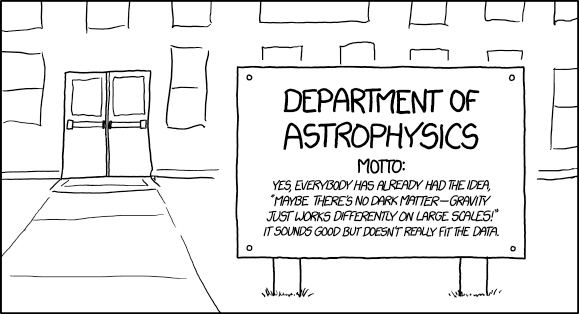
xkcd on dark matter v. gravity modification


The motto is typical but not very accurate. Modified gravity theories arguably fit the data better and some modified gravity theories work better than others. More importantly, it is very hard to get dark matter particle theories to fit the data.

Monday, November 7, 2016

Out of Africa Details Continue To Evade Resolution

Eurogenes calls attention to a new conference paper out humanity's out of Africa dispersals.
When and how modern humans left the African continent is still a debated question. 
Recently, three projects have analysed new genetic data from modern populations in Papua New Guinea and Australia, which has provided new insights on this topic. I will present analyses from one of these publications (Malaspinas et al. 2016), and compare results with findings from the two other projects (Mallick et al. 2016, Pagani et al. 2016). Here, we used MSMC2, a novel computational framework to analyse the distribution of times to the most recent common ancestor along multiple sequences. 
We find that all non-African populations that we analysed, including Australians, experienced a very similar population bottleneck in the past, consistent with only one out-of-Africa migration for all extant non-African populations. At the same time, we find evidence that some African populations are more distantly related to Australians than to Eurasian populations, and we show that this result is robust to haplotype phasing errors and archaic introgression. 
We interpret our result as evidence for gene flow between some Africans and Eurasians after the initial split, which is also consistent with results from other population genetic methods. Our analysis suggests that in order to understand human dispersal out of Africa, we need to better understand ancient population substructure within Africa, which is an important direction for future research.
Stephan Schiffels, "Analysing Australian genomes to learn about early modern human dispersal out of Africa, Human Dispersals in the Late Pleistocene - Interdisciplinary Approaches Towards Understanding the Worldwide Expansion of Homo sapiens" (Human Dispersals in the Late Pleistocene - Interdisciplinary Approaches Towards Understanding the Worldwide Expansion of Homo sapiens conference, November 2016).

Much of the "hot debate" revolves around archaeological evidence of a modern human presence as early as 125,000 years ago in Arabia, at least 100,000 years ago in the Levant, and some time prior to the Toba volcanic eruption of 75,000 years ago in India. And, there is evidence of modern human admixture in the ancient DNA of Altai Neanderthals that would have to date from at least 100,000 years ago, and the is also some evidence of modern humans or modern human hybrids in China well before the 50,000 to 65,000 years before present date expected for modern humans in Australia, Papua New Guinea and Southeast Asia based upon existing archaeological data.

But, both mutation rate DNA estimates, and linkage disequilibrium methods from ancient DNA have suggested a most common recent out of Africa ancestor for Eurasians of closer to 50,000 years ago than 75,000 years ago, and certainly not 100,000 to 125,000 years ago. Some argue that this reflects an "out of Africa that failed". 

Another possibility is that the single wave Out of Africa population was confined to Arabia or some other small geographic area that was a single population genetic unit until the most recent common ancestor date. 

Another possibility is massive dilution of earlier waves of modern humans that has eliminated almost all genetic trace of them (which is one possible interpretation of this paper).

Also, while most modern humans may derive from one wave, and the Y-DNA DE split seems to be close in time to the Y-DNA CF split that includes the vast majority of non-Africans, sampling issues may be hiding a northern route Y-DNA DE and D associated population that could have been another out of Africa wave. This is further complicated by increasingly credible suggestions of northern route expansions into Eurasia by modern humans, with a light archaeological footprint and genetic traces of which may have been largely erased by Ice Age of the Last Glacial Maximum around 20,000 years ago.

Given the seemingly contradictory and unresolved state of the evidence, understanding modern human out of Africa migrations during pre-history may take a lot longer to figure out.

How Would A Lull In Collider Physics Impact Theoretical Physicists?

The author of the blog 4gravitons in my sidebar is a theoretical physicists whose subfield figures out more efficient ways to do quantum physics calculations, which are particularly a barrier to progress in quantum chromodynamics (QCD) and quantum gravity, although the issues he and his colleagues explore are remote from these applications and often study calculations in simplified or more general versions of the equations in question than the ones that are actually a part of the Standard Model.

The time has come for a new collider that would provide power to probe energies greater than those found at the Large Hadron Collider that is the current global state of the art, and both China and Europe are investigating potential successors. But, that is an immensely expense venture. Between construction cost an $1 billion a year of operating costs, the planned LHC run will cost $13-$14 billion, and any more powerful future collider would cost more.

Given the lack of any strong indications of new physics beyond the discovery of the Higgs boson and confirmation that it is quite close to the Standard Model Higgs boson at the LHC, it is quiet plausible (and maybe even a good idea from a policy perspective) to put the next collider on hold for a while.

If that happens, however, it not only puts thousands of collider physicists out of work, it also impacts the job prospects of theoretical physicists, and that is what the author of 4gravitons ponders in a recent post. Interestingly, he suggests that out of work collider physicists may have more good substitute forms of employment for their lost jobs than folks in his subfield do.

I am more of an optimists but don't disagree that theoretical physicists need to immediately begin rethinking their funding sources if they are to weather this possible transition well.

In the short run, I am inclined to think that election results will matter more than decisions on new colliders in China or Europe since the major political parties in the United States have different attitudes towards federal funding of science.

There doesn't seem to be any serious effort in the U.S. to build a new collider in the U.S., something that hasn't been seriously considered since the Superconducting Super Collider project to be located in Texas was cancelled in 1993. The Tevatron collider in Illinois was once one of the leading colliders in the world but went off line in 2011. So, for the last five years, domestic collider work has been pretty much limited to lower energy experiments like Jefferson Labs in Virginia (which is, for example, home to the GlueX experiment), and rehashing old Tevatron data resulting in a variety of post-script papers over the past few years.

A Love Letter To Quantum Mechanics

It isn't Valentine's Day, but Lubos Motl has posted a love letter lauding the aesthetic beauty of quantum mechanics.