Wednesday, October 21, 2026

How Significant Was The LZ Event?

A dark matter detection experiment, Lux Zepplin (LZ) has seen one event that could be dark matter. 

How likely is it that it could just be an extreme outlier of the background?

A new preprint attempts to quantify that better than the original note reporting the detection. The paper doesn't reach a final conclusion which is highly model dependent, but points the way to determining if the LZ event could be just a fluke of ordinary physics rather than a singular dark matter detection, and points the way to how to clarify the matter.

This is mandatory reading for anyone proposing a beyond the Standard Model explanation of this result.

We reconstruct the continuum electron-recoil contribution to the LZ background expectation from the collaboration's released simulation configuration. The released model specifies a definite response tail, but the published calibration information supplies no bound on how far the physical tail may depart from it at the probabilities the expectation depends on. 
Distributions reproducing the executable model's mean, variance, and standardised skewness exactly, and its event-conditioned 10, 50, and 90% (N_e) quantiles to about one per cent, differ in the relevant tail probability by more than five orders of magnitude. 
The ladder is short: a tail agreeing with that central characterisation to 0.14% in the quantiles lifts the electron-recoil contribution out of the negligible range, and one agreeing to 0.47% makes it comparable to the entire background quoted for the comparison region. We go on to identify the measurements that would settle it.
Triparno Bandyopadhyay, Rajarajeswari Ramasamy, Nishitha TP, "The Electron-Recoil Response Tail and the LZ High-Energy Event Background" arXiv:2610.27105 (October 19, 2026).

Thoughts On The Riemann Hypothesis

AI has purported to prove two new and improved versions of the quasi-Riemann hypothesis, as discussed at Quanta magazine and a Twitter thread discussing additional proofs (by humans) that flow from the new quasi-Riemann hypothesis proof.

What is the Riemann Hypothesis?

The Riemann hypothesis can be explained as follows (from the first link):


The Riemann hypothesis is about which values of s will make the zeta function equal zero.

But it is also about far more than how this particular function behaves. As Bernhard Riemann realized when he first made the conjecture in 1859, the function relates to patterns in the prime numbers — integers divisible only by 1 and themselves that many mathematicians call the “atoms of arithmetic.”

It’s long been known that as you move along the number line, the primes thin out. Riemann showed that exactly how the primes thin out is, in a sense, governed by the zeta function — in particular by the places where it equals zero.

It’s straightforward to prove that if s is a negative even number (−2, −4, −6, …), then ζ(s) = 0. These are called trivial zeros. The Riemann hypothesis says that the only other zeros of the zeta function, called nontrivial zeros, occur when s has a real part of 1/2. That is, they should all be located on a vertical line:
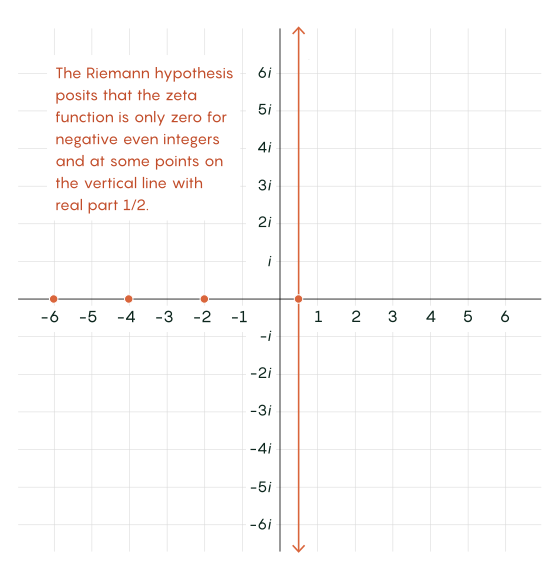
If any nontrivial zero were to be found somewhere away from that vertical line, it would imply that the primes must form an extremely surprising pattern, one that has never been observed to date.

Just narrowing the area where the nontrivial zeros can appear has had huge ramifications. Riemann himself proved that nontrivial zeros of the zeta function can only be found in a vertical strip between zero and 1. Then, in 1896, two mathematicians showed that zeros could not lie on the edges of the strip. As a direct consequence, they were able to prove an important result called the prime number theorem, a formula for how quickly, on average, the primes thin out.

If the Riemann hypothesis holds, then mathematicians can guarantee that any deviations from the average given by the prime number theorem will always be small.

Mathematicians have numerically verified(opens a new tab) that the first 12 trillion nontrivial zeros are on the 1/2 line. But they can’t be sure the hypothesis holds for all the zeros, and even one solitary outlier would land like an earthquake. As Enrico Bombieri(opens a new tab) wrote in the paper(opens a new tab) laying out the Millennium Prize formulation of the problem: “The failure of the Riemann hypothesis would create havoc in the distribution of prime numbers.”
The connection between the zeta function and the primes was known before Riemann. In 1737, Leonhard Euler showed that for any complex number s, the zeta function is equivalent to another function that can be written entirely in terms of primes:
This brings us to the quasi-Riemann hypothesis. Where the Riemann hypothesis posits that all the nontrivial zeros are on the vertical line at 1/2, the “quasi” version just asks one to prove that they are all contained in a vertical strip that’s narrower than the known strip between zero and 1. The narrower the strip, the more one can say about how the primes are distributed.

What did AI recently prove? 

OpenAI announced two different versions of their quasi-Riemann hypothesis proof. The first version, dated September 30, 2026(opens a new tab), claimed to show that all nontrivial zeros must be between 1/8 and 7/8, and was formally verified using the Lean programming language. The second version, which was completed almost a week later(opens a new tab) (and is not yet formally verified), claimed to prove a weaker result: that the zeros must have a real part between 1/12 and 11/12. But while the first paper is 199 pages long, the second weighs in at a comparatively modest 49 pages.

More background

The Euler version makes it more obvious, but the zeta function is undefined and at s=0, and approaches a limit of infinity close to s=0.

Even this simple explanation for a relatively simple hypothesis (all the good ones are) begs the question of what a complex exponent of an integer even means (and I won't try to explain that here). Suffice it is say that this isn't trivially intuitive in the way that an integer exponent is, and that it is less intuitive than a non-integer real exponent is.

Commentary on the AI proof

First off, consider that the new proofs are less impressive than they seem. We already knew that the real part of the exponent s in a zeta function zero has to be more than 0 and less than  1. We knew that in 1896, one hundred and thirty years ago. Narrowing that range to greater than 1/12 and less than 11/12, or greater than 1/8 and less than 7/8 improves on that result, but it isn't that Earth shaking of an improvement over the status quo.

Ideas for breaking down the Riemann Hypothesis into subparts

Next, lets break this down and consider some points that would help prove the overall Riemann hypothesis. Some of them may already have been proven. All of them must be true if the Riemann Hypothesis is correct, which numerical methods strongly suggest.

* It would be nice to prove that for any given value of the imaginary part of s that there is only one zero.

* It would be nice to prove that for any given value of the real part of s that there are either zero or an infinite number of zeros.

* It would be nice to prove that, to produce a zero, the real part of s must be a rational number (a subset of the real numbers).

* It would be nice to prove that, to produce a zero, the imaginary part of s must be a whole number (i.e. a positive, non-zero, integer), or failing that, that it must be a positive rational number, or in between, a positive rational number related by some rule to the rational number that is the real part of s, or better still, a whole number related by some rule to the rational number that is the real part of s.

* It would be nice to prove that the imaginary part of s must be an odd number to produce a zero.

* It would be nice to prove that all values of s with a real part of 1/2 and an imaginary part which is a prime number of zeros. Keep in mind that the Riemann Hypothesis is an if and only if conjecture: it says that non-trivial zeros have a real part of 1/2 and an imaginary part that is prime, and it also says that there are no other non-trivial zeros. Proving the affirmative part standing alone would be a big deal, even without a proof that there are no other non-trivial zeros, but requires consideration of far fewer possibilities.

* Proof of the affirmative part of the Riemann Hypothesis would likely require that the term in the Euler infinite series definition of the zeta function where integer in the imaginary part of s is equal to the number that it is the exponent of is special somehow, because it cancels out all of the other terms of the infinite series (I don't think that a single term of either infinite series definitions of the zeta function can be zero by itself, but proving that would itself be a step).

* Proof of the negative part of the Riemann Hypothesis might start with a determination that the imaginary part of s can't produce a zero if it is even. 

* Proof of the negative part of the Riemann Hypothesis might establish that the imaginary part of s can't produce a zero if it has exactly two, or better yet, an even number, of prime factors.

* Proof the the negative part of the Riemann Hypothesis might establish that the imaginary part of s can't produce a zero if it has an odd number of prime factors greater than one.

* Proof of inability to produce a zero, in a given case, amounts to showing there are one or more terms of the infinite series that don't cancel out at that value.

* It would be nice to tie in the conclusion about trivial zeros of the zeta function to the conclusion about non-trivial zeros of the zeta function somehow.

Post Script

Of course, I'm not going to prove (or disprove) the Riemann Hypothesis. Complex analysis (i.e. the calculus of imaginary numbers) was my weakest subject as a math major in college, and I never formally studied number theory at all. 

And, I only scratch the surface of the most obvious ideas in a deeply reached and explored corner of mathematics.

But I had a long dentist appointment this morning and needed a distraction, so I thought about it then, and that's why I'm writing about it now.

Monday, October 19, 2026

A New Anomaly

There are four sets of valence quarks that produce kaons, two of which are charged and two of which are electromagnetically neutral: 

K⁺ (positive charge: up quark + anti-strange quark)
K⁻ (negative charge: anti-up quark + strange quark)
K⁰ (neutral: down quark + anti-strange quark)
K̄⁰ (neutral antiparticle: anti-down quark + strange quark)

In certain heavier atom collisions, there are more charged kaons than expected relative to the number of neutral kaons observed, which means that there are more up quarks (and anti-up quarks) relative to down quarks (and anti-down quarks) than expected.

Isospin symmetry is the concept that particles with up quarks substituted for down quarks (and vice versa) are identical in strong force interactions (in part, due to their similar mass and the indifference of the strong force to electromagnetic or weak force charge).

For some reason, however, more charged kaons are seen in argon-scandium collisions and also in some other particle collisions. The paper below fails to come up with a good explanation for why this is the case and calls for further study. The introduction to the paper explains that:

This paper focuses on hadron–nucleus and nucleus–nucleus collisions at center-of-mass (cms) energies of the order of 10 GeV per nucleon pair. Such processes are governed by (mostly) non-perturbative strong interactions, and result in the production of a large number– tens, hundreds– of new particles in the final state (multiparticle production). 
Isospin symmetry (IS) which can be considered as a remnant of the QCD flavor symmetry between u and d quarks, remains an essential even if approximate feature of the production process. 
At energies equal (or higher) to those specified above, the bulk features of multiparticle production (inclusive spectra, total multiplicities, etc) are widely believed to obey IS up to a very good accuracy, of the order of 3−4%. Nevertheless, the simultaneous measurement of inclusive spectra and yields of charged (K+, K−) and neutral (K0 S) mesons reported by the NA61/SHINE experiment in central Ar+Sc collisions at √ sNN = 11.9 GeV [1] reveals an unexpectedly large IS violation (18 ±6% at kaon mid-rapidity). 
As will be discussed below, measurements from other experiments over a wide range of collision energy appear consistent with this observation. At the present moment (Oct., 2026), the origin of this effect remains unclear.

The paper and its abstract are as follows: 

The NA61/SHINE experiment at the CERN SPS reports an unexpectedly large excess in the inclusive production of charged over neutral kaons in 0-10% central Ar+Sc collisions at sNN‾‾‾‾√=8.8 and 11.9 GeV. This effect corresponds to an unexpectedly large violation of isospin symmetry, that cannot be explained by known mechanisms contained in the present theoretical models. 
The comparison of the NA61/SHINE results to data from other experiments reveals, within sizeable uncertainties, a consistent isospin symmetry-violating excess of charged kaon production in the energy regime 2.6<sNN‾‾‾‾√<200 GeV. At LHC energies (0.9<sNN‾‾‾‾√<13 TeV) the charged-over-neutral kaon ratio appears consistent with unity, but the uncertainties remain sizeable. 
A similar excess of charged over neutral kaon yields is observed by NA61/SHINE in minimum bias π−+C reactions at sNN‾‾‾‾√=17.3 and 25.7 GeV, also in disagreement with model predictions. 
No clear theoretical explanation of these phenomena has been provided so far. An unexpectedly large violation of isospin symmetry brings potential heavy consequences for our understanding of particle production, and calls for a concentrated experimental and theoretical effort.
Andrzej Rybicki for the NA61/SHINE Collaboration, "Unexpectedly large violation of isospin symmetry in nucleus-nucleus collisions at CERN SPS energies" arXiv:2610.23498 (October 16, 2026) (18th International Workshop on Meson Physics (MESON 2026), Kraków, Poland).

I'm personally confident that ultimately an explanation consistent with Standard Model physics will be found. But it is a fairly recent anomaly that hasn't gotten a lot of attention yet, so it deserves a post here.

Friday, October 16, 2026

Milgrom's Latest MOND Paper

Mordehai Milgrom, who invented MOND, has long been ambivalent about whether this is really a modification of gravity or a modification of inertia. In his latest paper, he considers the possibility that it could be both.
It is plausible that in a more fundamental theory of MOND both gravity and inertia will differ from their Newtonian versions. Such theories, if they embody the basic tenets of MOND, will share its primary predictions with existing theories, which modify either gravity or inertia. But they are expected to differ in their structure and in their secondary predictions. 
Here, I discuss families of nonrelativistic MOND theories that modify both the kinetic and the gravitational actions of Newtonian dynamics. Each family is spanned by one parameter 0≤η≤1, which is the scaling dimension of the deep-MOND limit of all terms in the action. Pure modified gravity (η=0) and pure modified inertia (η=1) are the end cases in each family. I speak of families, since the modified action terms themselves are not strictly specified, but are treated in rather general terms. 
These theories are artificial in that they are not based on a single unifying idea that dictates the modification of the two components. But they are still useful in pinpointing some idiosyncracies of such theories. 
For example, neither of the two modified terms, by itself, leads to MOND phenomenology; only their combined effect does. I show how the two combine to make some of the primary MOND predictions, such as asymptotic flatness of rotation curves, the mass-asymptotic-speed relation, and the deep-MOND, virial, mass-velocity-dispersion (M−σ) relation. 
Another idiosyncracy of such theories is the emergence of different interpolating functions in the kinetic equations of motion and in the gravitational field equations, each relevant under different circumstances, and neither of which have the standard deep-MOND limit. Such examples alert us to the wide range of theories that can lead to MOND phenomenology.
Mordehai Milgrom, "Mixed modified-gravity--modified-inertia MOND theories" arXiv:2610.21699 (October 15, 2026).

Gallium Non-Anomaly Confirmed

The Gallium Anomaly had been used to support the idea of sterile neutrinos. But it turns out that the anomaly was just a result of a flawed calculation of the Standard Model expectation. The correct calculation shows no anomaly in independent experimental measurements.
The Gallium Anomaly is the disagreement between the measured capture rate of neutrinos by 71Ga and the rate theoretically expected from the electron capture decay of 71Ge. The experimental measurements were performed with intense artificial sources. 
In the present work we consider the sun as a neutrino source that can be calibrated via the fundamental, standard-model neutrino-electron elastic scattering reaction in terrestrial detectors. The result is found to be not anomalous, with good agreement between the measured value of 66.1 ± 3.1 SNU from SAGE and Gallex/GNO, and the total measured source strengths of solar sources, 67.5 +1.4 −1.1 SNU. It may be concluded that neither the 71Ga charged-current cross section nor gallium experiment extraction and counting efficiencies account for the Gallium Anomaly.
Steven R. Elliott, R. G. Hamish Robertson, "Gallium Anomaly and Solar Neutrinos"arXiv:2610.22219 (October 15, 2026).

Another paper confirms again that muon g-2 doesn't show a discrepancy between theoretical predictions of it and experimental measurements of it at extreme precision. The muon g-2 anomaly was also due to a flawed calculation of the Standard Model expectation. 

Progress is also being made in the tau g-2 calculation, but the experimental measurements of tau g-2 are too imprecise to meaningfully compare them to the theoretical calculation.

Friday, October 9, 2026

More On MOND And Mach

More exploration of one possible "fundiMOND" explanation for why MOND/dark matter phenomena are observed appears in a new preprint. 

Mach's principle is the hypothesis that inertia is a consequence of the collective gravitational pull of everything in the Universe on matter, rather than just an assumption that goes into the Newton's laws of motion and modern derivations of them, without any mechanism or cause.
The physical origin of Modified Newtonian Dynamics (MOND), which predicts galaxy rotation curves via a single empirical acceleration constant a(0) without the need for dark matter, remains unknown. I propose a modified-inertia origin for both MOND's interpolating function and a(0) within a framework closely related to Gravitoelectromagnetism, the linearized limit of General Relativity. Following Sciama's model unifying gravity and inertia, which implements Mach's principle and the relativity of acceleration through gravitoelectric induction, I consider an idealized homogeneous universe undergoing constant Hubble expansion. 

I identify a(0) ∼ H(0)^2*R(u) ∼ c^2/R(u) with the relative recession acceleration of cosmic matter near the horizon, which dominates the cosmological contribution. I show that this scale enters local inertial dynamics only when the relative acceleration of the universe becomes anisotropic and the Rindler horizon is comparable to or larger than the cosmic Hubble horizon, at accelerations of order a(0) and below. 

By the simplest Ansatz for the observer's acceleration-dependent causal volume, accounting for the interplay between the cosmic and Rindler horizons, I derive MOND's simple interpolating function as a modified inertia law without the need to insert it by hand or make any further ad hoc adjustments. Physically, the region brought into causal connection ahead of the accelerating observer by the deformation of the cosmic horizon contributes less inertial drag than is lost from the region removed behind him by the Rindler horizon. This proof of concept motivates the possibility that MOND arises from large-scale linear inertial frame-dragging induced by the expanding universe within General Relativity.
Manuel Uruena Palomo, "Is MOND an effect of cosmic frame-dragging à la Mach?" arXiv:2610.09987 (October 7, 2026).

A previous paper from the same author was discussed here and has been accepted for publication in a peer reviewed journal (see that comments to that post).

AI Revolutionizes Math Research

The year 2026 will be remembered as the year that AI revolutionized mathematics research.

In August, AI made some real breakthroughs in some notable unsolved problems in mathematics, mostly involving disproof of conjectures by counterexample. But this week, Open AI published more than three hundred proofs of unsolved problems by various methods, that were significant although not quite as notable, across all major areas of mathematics on a single day (although a few of those proofs have been withdrawn or revised in response to comments).

Its single day results (rumored to be from an initial set of 400 problems), that probably took several months to put together and were just released all at once for drama. 

But its productivity on mathematical problems of this medium level of significance which are what the best human mathematics researchers might solve once every few years, rivals the productivity of the entire global mathematical research community over a time frame somewhere between many months and a few years.

The announcement this week leaves no doubt that AI will forever and profoundly change how mathematical research is done. We can expect a surge of mathematical breakthroughs for a few years as the backlog of AI solvable unsolved problems in mathematics are conquered and human mathematicians have to come up with new mathematics problems for humans and AI to solve together, in many cases probably building on the findings made in a new surge of proofs.

“If a human did this, it would be an instant Fields Medal, no questions asked.”

That’s how Alex Kontorovich, chair of the department of mathematics at Rutgers, responded to an A.I.-generated proof that OpenAI, the artificial intelligence giant, released on Tuesday.

And that single proof — worthy, in Dr. Kontorovich’s assessment on social media, of arguably the highest honor in the field of mathematics — was just one among more than 350 findings that the firm released that day, all at once.

Not all of them were quite so remarkable. But Martin Bridson, a mathematician at Oxford and the president of the Clay Mathematics Institute, which established the coveted Millennium Prize Problems, called OpenAI’s release “breathtaking.”

“Until very recently, it would have been impossible to imagine that the frontiers of mathematics could move so far in one day,” Dr. Bridson said.

If there had been any doubt that the leaps achieved by artificial intelligence this year would transform the discipline of mathematics, the tens of thousands of pages let loose on Tuesday have put that doubt to rest. The puzzles apparently conquered by OpenAI include crucial open questions in nearly every subfield of math, including algebra, number theory, theoretical computer science, mathematical logic and topology.

None of the proofs fully resolve any of the five remaining Millennium Prize Problems, which were designated at the turn of the century as a way of celebrating mathematics and its vast frontier of mysteries. But the trove of findings seemed to include results that make tangential or related progress on all of them. Perhaps the most significant result — the one Dr. Kontorovich was responding to — was a proof of the “quasi-Riemann hypothesis,” a conjecture related to the best known of the Millennium problems, the Riemann hypothesis, and a possible steppingstone of sorts to its resolution.

Ken Ono, a professor at the University of Virginia and the founding mathematician at Axiom Math, a math-focused artificial intelligence firm, wasn’t sure whether the quasi-Riemann solution would be a springboard for solving the original hypothesis. But he said that, as is expected with the original Riemann hypothesis, an encyclopedia of consequences would flow from this result, providing rich fodder for future breakthroughs. . . .

(As of Thursday, OpenAI had made a number of updates to the public online repository; withdrawing three papers and making fixes to several others. A spokeswoman said: “Where errors are identified, we will work to correct them promptly and withdraw papers if no fixes can be found. As with other research manuscripts, this is an iterative process.”) . . . .

For Bryna Kra, a mathematician at Northwestern University, problem No. 145 on the list was of great interest — “the Rokhlin problem on mixing implying higher order mixing,” which answers a question from the 1940s. “The writing, however, makes it impossible to understand,” said Dr. Kra, former president of the American Mathematical Society, who is among a group of mathematicians who are proactively working to chart a course for the field through this period of “uncertainty and seismic change,” as she described it. . . .

The French mathematician Jean-Pierre Serre, an emeritus professor at the Collège de France in Paris — who has won two of math’s top prizes, the Fields Medal and the Abel Prize, and celebrated his 100th birthday last month — was naturally attracted to finding No. 46 in OpenAI’s list, which solves positively a conjecture he made almost 70 years ago.

But Dr. Serre is conflicted about doing math with A.I. He uses the technology for things like references, and, with the help of friends, for chasing down hunches about errors. “Mathematicians take pleasure in doing maths in two different ways: learning and finding new things,” Dr. Serre said. “Hence a conflict: A.I. increases the first pleasure and lowers the second one. The problem is it may lower the pleasure too much; that is especially serious for young mathematicians.”

From the New York Times.

More analysis from Woit (a math professor at Columbia who blogs about and researches math, particle physics, and academic life) can be found here and here. Reacts from others are compiled here.

3.3 Sigma Support For Normal Neutrino Mass Ordering

A combined analysis of multiple neutrino experiments strongly favors a normal rather than inverted ordering of the neutrino masses at the 3.3 sigma level, echoing the preference from almost all previous observational indications including JUNO's new most precise measurement of some neutrino oscillation parameters.
We present a combined analysis of the latest publicly available atmospheric neutrino data from Super-Kamiokande including all data-taking stages previous to the gadolinium phase, IceCube-DeepCore, and the six-detection-unit configuration of KM3NeT/ORCA. Our fit uses all event samples simultaneously and treats the systematic uncertainties shared among experiments as fully correlated, while detector-response uncertainties are modeled independently for each experiment. 
The combined data constrain the atmospheric oscillation parameters to Δm(31)^2 = 2.44 +0.06 −0.04 × 10^−3 eV^2 and sin^2(θ23) = 0.52 +0.03 −0.04, with a precision of 2.2% and 6.1%, respectively, which is competitive with current accelerator-based measurements, and independently constrain the CP-violating phase to δCP = 1.30 +0.24 −0.28 π. 
Finally, comparing the orderings of the neutrino mass spectrum, we find a preference for the normal ordering with Δχ2 = 11.0; further calibrated with pseudoexperiments, we exclude the inverted ordering at 99.95% confidence level (3.3σ).
Miaochen Jin, et al., "Evidence for Normal Neutrino Ordering with Combined Atmospheric Neutrino Experiments" arXiv:2610.12208 (October 8, 2026).

Thursday, October 8, 2026

Inferred Dark Matter Distribution Interpreted As Non-Equilibrium

Honestly, this is a plausible interpretation under any model. But, of course, the predisposition is to treat any deviation from the LambdaCDM model as a non-equilibrium system, rather than a flaw in the model.
We present a combined strong and weak gravitational lensing mass model of the massive merging galaxy cluster Abell 2744 (z = 0.308). The mass reconstruction combines strong-lensing constraints in the cluster core with weak-lensing measurements derived from deep imaging with the Hubble Space Telescope (HST) and the James Webb Space Telescope (JWST), enabling a reconstruction of the projected mass distribution from the core to the cluster outskirts. 
Using the resulting mass map, we identify cluster substructures and construct the subhalo mass function (SHMF) for Abell 2744. To interpret the observed substructure population, we apply identical detection methods to projected mass maps of massive galaxy clusters from the BAryons and HAloes of MAssive Systems (BAHAMAS) simulations. We observe a systematic excess of detected substructures in Abell 2744 compared to BAHAMAS. 
We interpret this excess as likely reflecting Abell 2744's exceptionally disturbed dynamical state, characterised by complex ongoing mergers, rather than tension with ΛCold Dark Matter (ΛCDM) or self-interacting dark matter (SIDM) predictions. Although confirming this interpretation will require extending the analysis to a larger sample of clusters spanning a range of dynamical states.
Nency R. Patel, et al.,"The BUFFALO Survey : The Subhalo Mass Function for Abell 2744 with Strong+Weak Gravitational Lensing" arXiv:2610.08919 (October 6, 2026).

Tuesday, October 6, 2026

Nobel Prize In Physics (2026) Announced

This year's Nobel Prize in physics was awarded for the relatively uncontroversial first discovery in 2013 of high energy neutrinos from space at the IceCube Neutrino Observatory that Francis Halzen spearheaded.
Francis Halzen was awarded the Nobel Prize in Physics on Tuesday for pioneering a telescope that paved the way for a new kind of astronomy. Scientists used this telescope, embedded deep in the ice at the South Pole, to detect ghostly particles known as neutrinos whizzing in at high energies from the far reaches of the universe.

“It’s a way of bringing us information about distant cosmic sources, which we are unable to acquire in other ways,” Mark Pearce, chair of the Nobel Committee for Physics, said at the prize announcement. In a statement following the announcement, he added that Dr. Halzen had “provided us with a fantastic instrument.”

Dr. Halzen conceptualized the IceCube Neutrino Observatory in the late 1980s as a way to observe the natural particle accelerators of the cosmos, such as supermassive black holes. These objects generate neutrinos at far higher energies than what can be produced on Earth.

The IceCube team, which today consists of more than 400 scientists around the world, completed construction of the telescope in 2011 and announced the discovery of high-energy neutrinos originating from far beyond our solar system two years later.
Aurelien Breeden, Katrina Miller, "Nobel Prize in Physics Is Awarded for the Advent of Neutrino Astronomy: The Nobel Committee honored Francis Halzen for his “vision and scientific leadership” of a telescope within the ice at the South Pole." New York Times (October 6, 2026).

A New Phenomenological Relationship Of Neutrino Masses

A new phenomenological relationship of the neutrino mass differences is interesting, and close matches to simple formulas like this one are rare.

In the standard three-flavor paradigm, two of the three neutrino mass-squared differences are independent. The existence of an additional dependence between these oscillation parameters was recently predicted on empirical grounds, taking the form

The JUNO Collaboration has now reported the most precise measurements to date of both Δm(21)^2 and Δm(31)^2. We demonstrate that this relation is in excellent agreement with the experimental data, which yield 1.4143 +0.0036 −0.0038 corresponding to a relative precision of 0.27%. Remarkably, the central value differs by less than 0.03 standard deviations from the prediction (2‾√≈1.4142). This provides strong experimental support for the novel constraint and thereby suggests an underlying symmetry governing the neutrino mass spectrum, rather than purely independent parameters.

I. Alikhanov, "Novel dependence between neutrino mass splittings strongly supported by initial JUNO results" arXiv:2610.06738 (October 5, 2026). This updates:

I. Alikhanov, "Another relation among the neutrino mass-squared differences?", arXiv:2601.18781 (January 26, 2026).

There are more comparisons along this line from a different author, Vernon Barger, at https://arxiv.org/html/2603.00810v2.

An Attempt To Compare MOND v. CDM

A preprint finds a draw between MOND and CDM, with each having issues in some domains.
The rotation curves of the 175 disk galaxies in the SPARC database are confronted, one by one and under identical conditions, with the two mass models that have dominated the missing-mass debate for four decades: a cold dark-matter halo of Navarro-Frenk-White (NFW) form, and Milgromian dynamics (MOND) with the acceleration constant held at a0=1.2×10^−10 m s^−2. Stellar mass-to-light ratios, distances and inclinations are treated as nuisance parameters with priors set by the 3.6 μm photometry and by the SPARC error budget, and every galaxy is sampled with a Markov-chain Monte Carlo. 
Three findings emerge. 
(i) Judged by the Bayesian information criterion, the free NFW halo is preferred in 96 galaxies and MOND in 79; once the halo is required to obey the ΛCDM concentration-mass relation the score becomes 86 to 89, i.e. a draw. The two theories fail in different places: MOND loses in massive, high-surface-brightness, bulge-dominated systems, NFW loses in slowly rising dwarf rotation curves. 
(ii) The NFW concentrations demanded by the data sit a median 0.24 dex below the ΛCDM expectation, and 53% of the sample lies more than 2σ below it, independent of halo mass; this is the core-cusp problem expressed as a scaling-relation offset rather than as a handful of anecdotes. 
(iii) The radial acceleration relation built from the full sample has a0= (1.13 ±0 .02) × 10^−10 m s^−2 and an observed scatter of 0.14 dex, yet the value of a0 preferred by individual galaxies spans more than a decade and correlates with surface brightness. The two statements are not in contradiction: the population-level relation is tight because it averages over exactly the degeneracies with mass-to-light ratio and distance that make a0 ill-determined galaxy by galaxy. The full table of fits is provided.
Mikhael Da Silva, "Cusps, cores, and one acceleration: dark-matter haloes versus modified dynamics across the full SPARC sample" arXiv:2610.05871 (October 5, 2026).

Monday, October 5, 2026

Gallium Anomaly Solved Without New Physics

The gallium anomaly as a 20% deviation from the expected number of neutrino interactions with a gallium atom, which was pointed at as evidence of sterile neutrinos. Only, it turns out that what was wrong was a 20% error in the calculation of the theoretically expected value by ignoring parts of the calculation that were too important to ignore. When calculated correctly, theory and experiment were consistent (in what has become, by now, a familiar pattern).

For more than 30 years, scientists have found that roughly 20% fewer electron neutrinos are captured by gallium nuclei than expected. Dubbed the gallium anomaly, this discrepancy has raised the possibility that something fundamental might be missing from our understanding of neutrinos or atomic nuclei. Now Matteo Cadeddu at the National Institute for Nuclear Physics (INFN) and the University of Cagliari, both in Italy, and his colleagues have shown that this mismatch may instead originate from the way the electron-neutrino capture rate is calculated [1]. . . . 
When an electron neutrino is captured by a gallium nucleus, an electron is created and a neutron turns into a proton, transforming gallium into germanium. In the standard capture-rate calculation, the behavior of the nucleus is treated separately from that of the neutrino and electron. This approximation simplifies the calculation but may overlook key aspects of the capture process. Cadeddu and his colleagues instead developed a more rigorous approach that fully accounts for the interplay between the nucleus, neutrino, and electron. Using this technique, the researchers predicted a capture rate about 20% lower than previous estimates, closely matching the experimental results. This finding offers a solution to the gallium anomaly without requiring new physics. It disfavors one of the previously leading explanations: the existence of so-called sterile neutrinos. . . . 

[1] M. Cadeddu, et al., "Possible solution to the gallium anomaly moving beyond the leptonic wave-function factoriziation," 137 Phys. Rev. Lett. 131805 (September 24, 2026). 

From here.

Thursday, October 1, 2026

Are Neutrinos Really Massive? (And Top Quark Mass Technicalities)

Neutrino oscillation is the primary evidence for the conclusion that neutrinos have mass. And, this paradigm has been pretty successful so far (although, with six degrees of freedom, fitting the data isn't necessary too difficult). The short (five page) paper below makes the provocative argument that neutrino oscillation arises from the curvature of space-time rather than from massive neutrinos.

This would solve the problem of how neutrinos acquire mass, which is a major unsolved problem in physics, in an unexpected way: they don't. I'm skeptical, and this isn't a fully worked out idea that explains neutrino oscillation in full yet. But it is at least notable and deserves serious exploration by other researchers to see if this idea really has merit.
The Dirac equation in stationary curved spacetime implies that describing two-flavor neutrino oscillations requires treating the invariant mass and conserved energy of each propagating state distinctly, as gravity affects energy differently than mass. 
By re-analysing the publicly released KamLAND dataset, we show that modeling flavor states of massless neutrinos as two-level quantum states with energy-dependent level splitting, analogous to modified Jaynes-Cummings models, results in a higher-likelihood fit to the observed data than the standard massive-neutrino paradigm.
Golam Mortuza Hossain, Pushpit Kumar, "Neutrino Oscillations without Mass: A Re-analysis of KamLAND Data following the Dirac Equation in Curved Spacetime" arXiv:2609.39638 (September 30, 2026).

In other physics news, a preprint suggests corrections to the formula used to determine the top quark mass in one of the approaches used to do so (the introduction to the paper is also a good background discussion of the general issue addressed):

We calculate the three-loop O(αα2s) mixed QCD-EW corrections to the top quark mass and obtain the relationships between the pole (Mt) and MS bar (mt(μ)) masses at this order. 
In performing our calculation, we express the three-loop self-energies as a function of three-loop master integrals (MIs). These MIs are defined so as to solve a differential equation in ϵ-factorized form, allowing for their solution to be expressed as iterated integrals. We discuss the types of differential forms that we encounter, which include periods of elliptic curves, and their role in the final physical result. 
Using our results, we calculate the shift in mt(Mt) arising at this order. For Mt = 172.3 GeV, the shift is -216 MeV, which is comparable to the currently quoted experimental uncertainty.
Daniele Gaggero, Ciaran Williams, "O(αα2s) corrections to the Top Quark mass" arXiv:2609.40229 (September 30, 2026).