Tuesday, July 30, 2013

Rethinking Madagascar's Prehistory

There are archaeological traces of villages of mixed Indonesian and East African heritage dating back to at least 500 CE in Madagascar, a date that roughly coincides with megafauna extinctions on the island.[1]  The Malagasy language spoken in Madagascar is closely related to a particular Austronesian language spoken in a particular river valley of Borneo from which about 90% of the words in Malagasy are derived.[5]  The remaining Malagasy lexicon is derived from a number of other Southeast Asian and South Asian languages, and from the African Bantu language.[5]

Linguistic and cultural evidence, strongly supported by archaeological evidence, population genetic evidence, evidence of Indonesian plants that appeared in Africa with Austronesian names around that time (e.g. the banana is native to Southeast Asia, not to Africa), and evidence of Austronesian seamanship in Oceania that make such a journey plausible, all combine to make the settlement of Madagascar one of the most well established and remarkable long distance migrations of a whole people in pre-modern human history.

The story from the genetic evidence

A number of studies have been done of the non-recombining Y-DNA population genetics, mtDNA population genetics, and autosomal population genetics of the Malagasy people.[2][3][4][5][6][7][8].  These studies show significant (but differing) relative proportions of Asian and African genetic origins in Y-DNA, mtDNA, and autosomal DNA.  Only a small portion of Malagasy individuals are entirely Asian or entirely African as measured by their Y-DNA, mtDNA and autosomal DNA.[3]  The vast majority of the Asian genetic contribution to this population is consistent with origins in Southern Borneo.[2][4][5][6]  Based on the mtDNA diversity in the Asian part of the mtDNA of the Malagasy people, it is estimated that there were only about thirty women in the Indonesian founding population of the island.[6]

The African component of the population genetic makeup of the Malagasy people is a better match, in Y-DNA, mtDNA and autosomal genetics, to East African Bantus, such as the Luhya people, than to any other modern African population.

The African component of the uniparental and autosomal components of Malagasy population genetics.  As a percentage of the total mtDNA mix in the Malagasy population, the African haplogroup breakdown in one study was as follows [5]:
L* 5%
L2b1b 2%
L3b1 28%
L3e1a 4%
Total: 37%
Asian: 63%

Of these mtDNA haplogroups, all are very typical of Bantu populations except L* (which may in this context mean L not elsewhere classified rather than maximally basal form of haplogroup L).[12]

As a percentage of the total Y-DNA mix in the Malagasy population, the African haplogroup breakdown was comprised mostly of E3a (36% of the total), with smaller amounts of E2b, E1b1a, and B2.[5] These are mostly characteristic Bantu Y-DNA haplogroups.[11]

Genetics blogger Razib Khan compared the whole genomes of two Malagasy individuals to a number of reference populations.[8][9]  He used software that does a best fit of the data from the reference populations and subjects to ten hypothetical source populations using what amounts to eigenvector analysis of the data sets.  With this software, he was able to estimate the percentage of the African component in the Malagasy individuals attributable to each of the source populations, and to compare the mix of African autosomal genetic components in these individuals to those in his African reference populations.

The largest African component in each Malagasy individual was a component which makes up about 90% to 95% of the Mandenka and Yoruba populations, which a Bantu peoples from near the Nigeria-Cameroon border where the Bantu people originated.  There was also small contributions of from other African autosomal genetic components:

*About 3-4% (of the total) of a component that is modal in the pastoralist Nilo-Saharan Maasi of East Africa and in Ethiopian Jews.  This contribution made up about the same share of the African autosomal genetics of both Malagasy individuals, but in each case was smaller relative to the Bantu contribution than in the East African Bantu Luhya reference population.

*About 2-4% (of the total) of the various components that are predominant in Biaka Pygmies, Mbuti Pygmies, the San people, and the Sandawe people of Africa (all of whom are relict hunter-gatherer populations in Africa).  The proportion of these components in the Malagasy individuals relative to the size of their Bantu genetic component was very similar to that seen in the East African Bantu Luhya reference population.

*There was no evidence of admixed contributions from Yemen Jews (a SW Asian reference population) or a European reference population, although there were both SE Asian and South Asian autosomal components of the Asian part of their autosomal genetics.

In sum, Razib Khan's detailed, nuts and bolts autosomal genetic analysis of Malagasy individuals shows that the African contribution to their autosomal DNA looks very much like that of East African Bantu Luhya people, except that the East African Bantus show more Nilo-Saharan admixture.

History may explain the discrepancy.  It is likely that a group of Africans joined a group of Borneans with some minor South Asian admixture to make the trip to Madagascar and settled there at around this earliest archaeologically supported data for an Indonesian presence in Madagascar around 500 CE.  There is historical and prehistory evidence (including Maasai oral histories) to suggest that  the Maasai people and other Nilo-Saharan peoples migrated through East Africa from North to South starting around the 1400s CE.  If this contact resulted in some level of admixture in the hundred of years between then and the present, we would expect modern East African Bantus to have more Nilo-Saharan admixture today than they did in the 500s CE at the time of the fusional proto-Malay ethnogenesis.

Other autosomal genetic studies of the Malagasy people have likewise concluded that the African component of the Malagasy autosomal gene pool is basically Bantu in character.[2][3]  And, the uniparental genetic studies have similarly been congruent with a predominantly East African Bantu source for the African component of the Malagasy gene pool.[3][4][5]

Notably, the only study of which I am aware of the autosomal population genetics of Mozambique, the Southeastern African country closest to the island of Madagascar specifically noted that the Bantu people of Mozambique are not genetically similar to any of the three reference populations that Razib Khan compared to the two Malagasy individuals for whom he had whole genome data:  the Mandenka and Yoruba populations, and the East African Bantu Luhya people.[9] The population genetics of the Bantus of Mozambique show far less population replacement and far more assimilation of an indigenous pre-Bantu population that is genetically distant from any of the extant relict hunter-gather "Paleo-African" populations of Africa that are extant today.[9]

The studies of autosomal genetics in Madagascar that have been done to date either showed no sign at all of a Mozambique component to the gene pool of the Malagasy people,[2][7][8], although one uniparental study did see some sign of a trace and secondary contribution of Mozambique or the vicinity.[5]  That 2009 high resolution uniparental genetics study stated:
The pattern of diffusion of uniparental lineages was compatible with at least two events: a primary admixture of proto-Malay people with Bantu speakers bearing a western-like pool of haplotypes, followed by a secondary flow of Southeastern Bantu speakers unpaired for gender (mainly male driven) and geography (mainly coastal).
Thus, a small number of Malagasy people have Y-DNA haplotypes associated with coastal Mozambique or the vicinity, and an even smaller number of individuals have mtDNA haplogroups that are distinctively from there.

The new evidence

A study released this summer complicates this neat and simple narrative.

The new study finds clearly modern human microlithic stone tools and other artifacts in layers of two long occupied terrestrial forager villages in Madagascar dating back to about 2000 BCE, about 2500 years before the earliest solid evidence of proto-Malagasy settlement in Madagascar.[1]  These settlements also greatly predate the megafauna extinctions that occurred in Madagascar when the mix of Borneans and East African Bantus who gave rise to the Malagasy people arrived.[1]

This first wave of settlers must have been either entirely replaced or swamped demographically by the proto-Malay people who arrived around 500 CE. The people who were in the first wave of human settlers of Madagascar could not have been Bantus, because the Bantu expansion, which began about 2000 BCE in West Africa near the Nigeria-Cameroon border, did not reach the East African coast until ca. 1000 BCE.[10]  But, the African genetic component of the Malagasy people is East African Bantu which is very different from that of all coastal populations of Africa around 2000 BCE, so this genetic contribution to the Malagasy people must have arrived later, probably in the same boats that the Austronesians did.  The absence of non-Eastern Bantu genes in the Malagasy gene pool, establishes that these indigenous foragers of Madagascar did not contribute much to the modern gene pool, either because they were entirely replaced, or because their contribution was so small in proportion to the newcomers that it has left almost no discernible mark on the modern gene pool in Madagascar.

Alternatively, the foragers could have been relocated to continental Africa by the Austronesians, in a manner similar to the relocation of Native Americans to reservations in early American history, although this seems like a possibility with fewer historical precedents in the expansion histories of the Austronesian and Bantu peoples who made up the proto-Malays.

The data interpreted as a subsequent and secondary wave of male dominated migration from Mozambique in the high resolution uniparental genetic data [5] could really be, at least in part, a relict of pre-Malay African foragers in Madagascar.  But, the fact that the Southeast African uniparental genetic haplogroups are male dominated disfavors a relict population as the primary source of these Southeast African uniparental genetic haplogroups in the Malagasy gene pool.  Generally, when an indigenous substrate population is demographically swamped by a newly arrived dominant superstrate population, more matriline transmitted mtDNA survives in the resulting gene pool from the substate population than Y-DNA.

So, the maximum contribution of a relict population to the Malagasy gene pool is probably some fraction of the distinctively Southeast African contribution that was observed in [5] and the data are not inconsistent with a total replacement of the first wave humans of Madagascar by the proto-Malays that left no surviving genetic trace of this first wave forager population (i.e. with genocide).

Why didn't first wave human settlers of Madagascar cause a mega-fauna extinction?

Equally important, why didn't the arrival of African foragers ca. 2000 BCE result in a mega-fauna extinction in Madagascar as hunter-gatherer migrations into Australia and Papua New Guinea, into the Americas, in Europe and into Siberia did tens of thousands of years earlier with presumably more primitive technology?

This is also not a case comparable to that of continental Africa where the local wildlife co-evolved with modern humans and their hominin predecessors and hence learned to survive in spite of them for tens of thousands of years.

How could this be possible?

Here is one speculative narrative that could explain this new discovery.

The arrival of this first wave of African foragers may have been a one way trip by a small population made possible only by luck and pluck that wasn't repeated.  If these foragers had been able to reliably navigate to Madagascar and back at the time, presumably, they would have engaged in trade with mainland Africa.  But, there is no archaeological evidence of ongoing trade between Madagascar and continental African prior to 500 CE, which would have been highly distinctive in the archaeological record because it contained species of flora and fauna found nowhere in mainland Africa.

In a case similar to that of the people of Tasmania, once separated from their continental African communities, they may have regressed technologically (e.g. in terms of hunting effectiveness) as their population fell below critical mass to sustain this knowledge, if not immediately, after some mishap or bad foraging season or disease outbreak at a latter time.  They may have held on to enough cultural capital to be a sustainable population, but may not have been a large enough community to sustain the level of excellence in hunting and gathering practices that made them a dominant species in Africa and Eurasia and the Americas.

Since Madagascar's flora and fauna are so distinct from those of continental Africa, it may also have been the case in which the knowledge the first wave African foragers brought with them from continental Africa may have been of limited usefulness in this new ecology. Since they were not farmers or herders, they would have brought no familiar plants or animals to feed themselves with them.  The need to rapidly develop new gathering skill sets could have given this first wave of modern humans on the island a rocky start, causing their population to fall before eventually recovering as they learned to adapt to local conditions.  This could have caused them to regress culturally, in part from their loss of important hunting and gathering knowledge. Without the cultural capital shared by other Upper Paleolithic peoples who brought about mega-fauna extinctions (and contributed to the demise of the Neanderthals), they may have lost the capacity to become so dominant as hunters and gatherers who could cause mega-fauna extinctions.

There also isn't even any sign that they brought domesticated dogs with them.  Dogs were first domesticated around 30,000 years ago and were widespread by ca. 2000 BCE, even into Australia where they weren't initially present for tens of thousands of years but appeared about 4000 years ago. Perhaps the relevance of domesticated dogs that modern humans brought with them has been underestimated, which could also explain why Southeast Asia, which is a point of origin of many species of domestic dogs, has so less mega-fauna extinction since Southeast Asian fauna co-evolved with these dogs.

Even if the first wave of humans in Madagascar eventually recovered technologically and cultural, centuries later, their recovery may have been gradual enough to be less disruptive to the local ecology.

These disadvantages wouldn't burden later proto-Malays who brought food sources with them, had reliable sea transportation that permitted them to colonize Madagascar at populations in excess of the critical mass needed to sustain their population, and thus didn't need detailed knowledge of how to turn indigenous plants and animals into food and didn't suffer the cultural regression that may have been experienced by first wave foragers on the island twenty-five centuries earlier.

References

1. Robert E. Deward et al., "Stone tools and foraging in northern Madagascar challenge Holocene extinction models.", PNAS (2013).[doi:10.1073/pnas.1306100110] (Mr. Deward died on April 8, 2013.)

2. Regueiro, et al., "Austronesian genetic signature in East African Madagascar and Polynesia.", Journal of Human Genetics (2008) 53, 106–120; doi:10.1007/s10038-007-0224-4

3. Poetsch, et al., "Determination of population origin: a comparison of autosomal SNPs, Y-chromosomal and mtDNA haplogroups using a Malagasy population as example.", European Journal of Human Genetics (24 April 2013) doi:10.1038/ejhg.2013.51

4. Hurles, et al. "The dual origin of the malagasy in island southeast Asia and East Africa: evidence from maternal and paternal lineages.", Am J Hum Genet. 2005;76;894-901. PMID: 15793703

5. Tofanelli, et al., "On the origins and admixture of Malagasy: new evidence from high-resolution analyses of paternal and maternal lineages.", Mol. Biol. Evol. 26, 2109–2124 (2009) (doi:10.1093/molbev/msp120)

6. Cox, et al., "A small cohort of Island Southeast Asian women founded Madagascar", Proc. R. Soc. B. (21 March 2012) doi: 10.1098/rspb.2012.0012

7. Razib Khan, "The Betsileo of Madagascar are Malay and Bantu.", Gene Expression (October 23, 2011). (Supplemental materials: here).

8. Razib Khan, "The Merina of Madagascar are Malay and Bantu.", Gene Expression (September 9, 2011).

9. Sikora, et al., "A genomic analysis identifies a novel component in the genetic structure of sub-Saharan African populations.", European Journal of Human Genetics (2011) 19, 84–88; doi:10.1038/ejhg.2010.141.

10.  Wikipedia entry on "Bantu Expansion" (the Bantu reach the East African coast sometime after 1500 BCE and before 500 BCE; and there is no evidence of Bantu seafaring activity independent of assistance from other cultures such as the Austronesians).

11.  Gemma Berniell-Lee, et al., "Genetic and demographic implications of the Bantu expansion: insights from human paternal lineages.", Molecular Biology and Evolution (April 2009) doi:10.1093/molbev/msp069 (quoted at Dienekes' Anthropology Blog)("these lineages have been associated either to Bantu-speaking people - E1b1a (E3a according to The Y Chromosome Consortium (2002)), B2a, and E2 - or to Pygmy populations (haplogroup B2b).").

12.  Salas, et al., "The Making of the African mtDNA Landscape",  Am J Hum Genet. 71(5): 1082–1111.(November 2002) PMCID: PMC385086. ("L2b, L2c, and L2d appear to be largely confined to West and western Central Africa (and African Americans), with only minor occurrences of a few derived types in the southeast. . . . [L3b is a] major southeastern haplogroups of clear West African origin. . . .  L3e1 is distributed throughout sub-Saharan Africa, but it is especially common in southeastern Africa. This clade appears to have a west Central African origin and is rare among West Africans, although it is well represented among African Americans. Several southeastern African types are shared with East African Bantu-speaking Kikuyu from Kenya. This suggests that L3e1 may have spread into Kenya via the eastern stream from a Cameroon source population (best represented in this data set by Bioko and São Tomé) or from some Central African source. It subsequently dispersed into the southeast (although, with so little data, back migration into Kenya cannot be ruled out). The African American types may be the result of direct transportation from Mozambique, given the lack of West African representatives. One L3e1a type is also present at elevated frequency in the Khwe, but, since it matches two Herero and also has a direct derivative in the southeast, this again appears to have been the result of gene flow from Bantu speakers, even though the type has not been sampled in that group.")
Thursday, July 25, 2013

Xenolinguistics

Researchers have deciphered a class of words in the language of wild dolphins that make up about half of their conversations.  Specifically, they have learned to identify the names that wild dolphins use for each other (also called "signature whistles"), established that these dolphin whistles, first distinguished in the 1960s, really are names of individual dolphins and learned how these names are used in dolphin conversations.
[D]olphin signature whistles are exclusive to individuals, rather than being part of a shared repertoire. They’re social sounds, unlike bird songs which are largely used to attract mates or defend territories. And they’re learned; many animals like birds and monkeys use distinctive calls to refer to specific objects (like different types of predators), but these are innate and inherited behaviours. “The use of new or learned sounds to label an object or class of objects is rare in the animal kingdom,” says King.
This combination of traits makes the signature whistles unique in the non-human world, at least for now. It’s possible that parrots and other birds might use similar calls. 
Reference: King & Janik. 2013. Bottlenose dolphins can use learned vocal labels to address each other. PNAS http://dx.doi.org/10.1073/pnas.1304459110

The fact that so much of the conversations of dolphins consist of proper names also suggests that while dolphins do have a more human-like language than most other species of animals that their language probably has considerably less lexical content (i.e. fewer words) than even the most primitive human language.  A dictionary of dolphinese would have a huge directory of individuals with only a modest vocabulary beyond that.  The way that the signature whistles are used, however, suggest that there is a fair amount of "grammatical context" to what one means and when one uses one based on context and intended meaning.

Tuesday, July 23, 2013

SUSY Increasingly Irrelevant

New large hadron collider data on B_s meson decays into muon pairs has confirmed the Standard Model expectation and once again has constrained the parameter space of any supersymmetry (SUSY) theory.  The process is so rare that it hasn't been possible in experiments until now to get enough events to provide a statistically significant confirmation or refutation of the Standard Model prediction of the frequency with which B_s mesons decay into muon pairs (this happens about three times per B_s meson decays and producing a B_s meson in the first place isn't an easy thing).

The frequency with which these decay products of B_s mesons is produce a muon pair is very sensitive to the existence of heavy fundamental particles.

In part, this is because the signal associated with any indirect influence of heavy fundamental particles in other kinds of indirect hadron decays are swamped by a background of direct decay processes. But, a decay of a B_s meson into two muons can't happen directly.  This can only happen through intermediate steps that are rare to start with and so wouldn't statistically swamp other possible rare decay paths of B_s mesons into two muons involving currently unknown heavy particles.

The decays of B_s mesons into muon pairs are also sensitive to high energy processes, because in many other decays the source particle is too light have enough mass-energy to include loops involving heavy particles at any measurable frequency.  Virtual processes can "tunnel" to particles in intermediate steps that seem to violate mass-energy conservation so long as the end products do not, but the less mass-energy you start with, the less likely a virtual process of a given mass-energy is to take place.  The B_s meson is the third heaviest pair of quarks that can form a meson (after a pair of bottom quarks and a bottom quark-charm quark pair), so it can more easily have decay chains involving heavy virtual particles, but only if such particles exist.

The fact that a B_s meson is a pseudo-scalar spin-zero particle also rules out a lot of decays that would be possible in other systems, further reducing the background to signal ratio in the measured decay products.

As Jester explains, the closeness of the number of muon pairs observed to the Standard Model expectation is inconsistent with certain kinds of particles of less than 100 TeV mass (aka 10^5 GeV) in beyond the Standard Model theories that don't have special features that suppress decays via the new fundamental particle (although still far below the 10^16 GeV of the "GUT scale").  More recent prognostications have suggested that SUSY particle masses might mostly be on the order of 30 TeV.  The 100 TeV naive exclusion range is about a hundred times heavier than theorists had expected supersymmetric particles mass to be in the early days of SUSY theory.  The heaviest known fundamental particle, top quark, is about 0.17 TeV.  The data also disfavor low values for the supersymmetry parameter tan beta, which is basically the ratio of the two main mass constants of minimal or near minimal supersymmetry models.  Jester calls this result "just another handful of earth upon the coffin" of supersymmetry.

I'd put it differently.  If supersymmetry exists, there is just one set of supersymmetry parameters and they could be anywhere in the parameter space for reasons that may defy any human explanation.  We still have no good story to explain the host of parameters in the Standard Model, even though we have measured them to some degree of precision and have seen some trends.  So, even the profound shrinking of the supersymmetry parameter space and ruling out of some subtypes of supersymmetry models entirely, doesn't necessarily rule it out (although the many decades in which not a scintilla of evidence strongly hinting that SUSY exists has been found).

While SUSY can't really be definitively ruled out until a vice of parameter constraints reduce SUSY parameter space to zero, however, as more data come in SUSY starts looking more and more like the Standard Model at higher and higher energies. Results like this make any supersymmetry theory that could exist increasingly irrelevant with no meaningful phenomenological impact outside processes not seen in nature since the early parts of the Big Bang.  When you reach a point where you are talking about particles that wouldn't even have measurable effects on neutron stars, black holes, black holes, quasars, and cosmology in a young universe, you are talking about particles and a theory that may be largely irrelevant, even if it is correct.

Friday, July 19, 2013

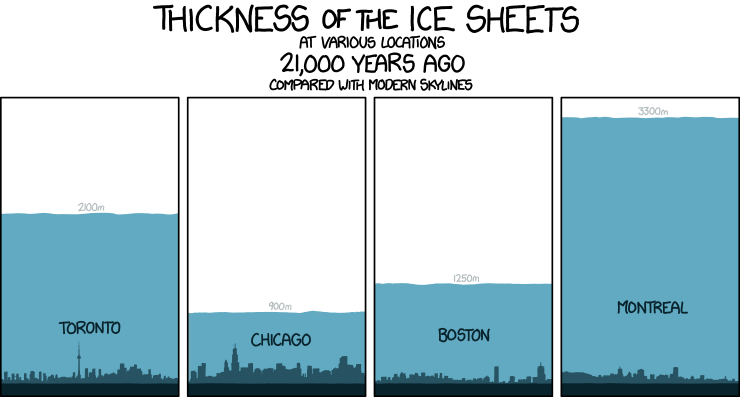
The Last Glacial Maximum: A Visual Aid


Today, you have to go on a boat a considerable distance into the nearest ocean (or the deepest parts of Lake Superior) to walk on that much water.

Thursday, July 18, 2013

Distinguishing Between Systemic and Statistical Error Mathematically

Background

It is not common in experimental research to make two error estimates for each measured quantity.

One is "statistical error" which can often be determined with precision based upon sample size and a few other assumptions, most of which are quite robust (i.e. big errors in many of the other assumptions have only a minor impact on the statistical error estimate for estimates in the range of values usually considered with these methods).

There other is systemic error, which is the notion that all of the measurements made may have varied from the accurate value by a certain amount due to limitations of the measurement tool.  Systemic error also includes what social scientists would call "bias."  Often this is determined non-mathematically (e.g. based on the precision with which a calibrating value is capable of being measured).

Distinguishing Statistical From Systemic Error Mathematically

It is also sometimes possible to distinguish statistical error from systemic error mathematically.  For reasons explained in any advanced undergraduate or graduate level statistics class, statistical errors in samples with large samples always trend towards a "Gaussian distribution" which is to say that they can be accurately approximated by a normal distribution (i.e. a "Bell Curve").

In contrast, any errors that cannot be well fit to a normal distribution are necessarily not statistical errors.  Thus, to the extent that error distributions are non-Gaussian, you know that this component of the experimental error must be systemic.

These concept are briefly alluded to here which is the blog post that inspired this post.

Wednesday, July 3, 2013

English Is Weird, Basque Is Not

A natural language processing software company devised a "language weirdness index" to distinguish between languages that have features in the WALS database that are atypical of languages in the database on multiple dimensions, from those that have language features that are more common in the languages in the database.

Out of 239 languages for which there was enough data to make a meaningful evaluation, English ranked 33rd most weird, while Basque ranked 10th least weird.  Hindi was the most "normal" language in the database, while Mixtec (Chalcatongo) which is spoken by about 6,000 people in Oxaca, Mexico was most weird by this measure.

The lengthy analysis in the linked post discusses how the index was formulated and what strengths and weaknesses it has as a measure of language weirdness.

Tuesday, July 2, 2013

How Did An Medieval Tanzanian Coin End Up On An Australian Beach?

In the ancient African city of Kilwa, in modern-day Tanzania, about 1300 CE, four metal coins were minted by the local prince.  Portuguese forces invaded and destroyed Kilwa in 1505 CE and took coins and other valuables from the city as plunder.

In 1944, a British soldier stationed in Australia during World War II was walking down a beach when he came across some old coins and kept them as souvenirs.

More than half a century later, after he died, someone tried to figure out what kind of coins these were and got a big surprise.  Some of the coins were Dutch East India Company coins minted in the late 1600s, but four of them were the ones minted in Kilwa, six and a half centuries earlier.  No attested group of Portuguese explorers arrived in Australia for another hundred years after the coins were minted.

How did the Kilwa coins end up in Australia in the company of Dutch East India Company coins from the late 1600s? 

More particularly, is this find evidence simply of trade for Portuguese soldiers to Dutch East India Company traders to someone who arrived on Australia's shore and was careless?  Or, is this evidence of previously unattested early maritime trade with Australia?

Source: "Archaeology Detective: How did this African coin wind up in Australia?", The Denver Post, Section CC, Page 1 (July 2, 2013).  CNN covered the same story on June 27, 2013..

Friday, June 28, 2013

Tetraquark Or Two Meson Molecule Discovered

A new particle, called Zc(3900) is either a tetraquark (an elusive hadron made up of four quarks in a single composite particle) or a molecule made up of two mesons (which are composite particles made of two quarks each).  Either possibility would be the first confirmed sighting of a particle of that type.  This particle is one of the decay products of another unknown particle called Y(4260).

The numbers refer to the estimated particle mass in MeV/c^2 (mega-electron-volts/speed of light squared; the large letter code for general properties displayed by the particle and the c subscript denotes the presence of a charm quark in the particle.

All particles made of quarks found to date (and under the Standard Model) are "confined" to composite particles which are strong force color neutral (i.e. they have "red", "green" and "blue" flavored quarks, or have a quark that is, for example "red" and "antired").  So far, all known composite particles made of quarks come in two quark varieties called mesons, and three quark varieties called baryons.  Prior to this report and some previously unpublished conference reports, no tetraquarks, pentaquarks or larger number of quarks have been observed so far.

But, the rules of quantum chromodynamics (QCD), that governs the strong force interactions of quarks, does not forbid composite particles made up of more than three quarks so long as their are strong force color neutral, which is theoretically possible for any number of quarks two or greater if the structure can be small enough to allow the short range strong nuclear force to operate between all of the quarks involved.

Likewise while baryons (made up of three quarks, such as protons and neutrons) have been observed to form atomic nuclei which in turn form molecules bound electromagnetically, no composite structures made of multiple mesons have previously been observed even though they aren't prohibited by the rules of QCD either.
The Belle and BESIII teams were both studying an odd particle called  when they realized that it decayed to make another interesting particle, Zc(3900). Its mass, says Poling, who is part of the BESIII team, suggests that it is an electrically neutral meson made up of two quarks with opposite charges, called charm and anticharm. But surprisingly, both teams found that Zc(3900) has an electrical charge.
In fact, Poling says no two-quark or three-quark combinations can explain Zc(3900)’s charge and mass. That is leading physicists to the more exotic and exciting conclusion that the particle consists of four quarks: a charm and an anticharm along with an up and an antidown, which are extremely light and create a net positive charge. “The particle’s charge makes it a smoking gun for a four-quark state,” says Tomasz Skwarnicki, a physicist at Syracuse University in New York.
Assuming the evidence for a four-quark arrangement holds up, the big question will be how those quarks are arranged. Zc(3900) could be a single entity of four quarks, Skwarnicki says, but it could also be a coupling of two mesons, analogous to two atoms linking up to form a molecule.
Previous conference report papers on possible tetraquark sightings have tended to favor the two meson molecule explanation, which is the less revolutionary and dramatic of the two possibilities.

Of course, Zc(3900), like all composite particles made of quarks other than protons and neutrons, is a highly unstable particle with a mean lifetime measured in fractions of a second that almost immediately decays to simpler particles. 

So, while its discovery is relevant to clarifying the fine details of what is possible in QCD, and perhaps to the dynamics of the period immediately following the Big Bang, the discovery has essentially no practical technological applications and it will not explain any important phenomena observed outside of intense man made particle accelerator conditions.

If it is a meson molecule, rather than a true tetraquark, the discovery might actually tend to support the theory that there is some unarticulated and unknown law of physics pertinent to QCD that forbids the creation of unitary composite quark structures with more than three quarks, even though none of the current rules of QCD clearly impose this limitation.  This would be as much of a major breakthrough as a finding that unitary composite quark structures with more than three quarks are possible.

A meson molecule model would imply that something similar to the strong force interactions that in diluted form bind atomic nuclei together applies to mesons as well.  The experimentally measured lifetime of Zc(3900) as an indirect measure of this indirect version of the strong force, could help to better pin down experimentally the speed of strong force interactions generally.  These would also be valuable discoveries.

Source

Andrew Grant, "First four-quark particle may have been spotted: Finding might shed light on how nucleus is held together", Science News (June 21, 2013) citing M. Ablikim et al., "Observation of a charged charmoniumlike structure in e+e−→π+π−J/ψ at √s=4.26 GeV.", Physical Review Letters (June 17, 2013) and Z. Q. Liu et al., "Study of e+e−→π+π−J/ψ and observation of a charged charmoniumlike state at Belle.", Physical Review Letters  (June 17, 2013).


Tuesday, June 18, 2013

An Ancient Wonder Of The World Misplaced

One of the seven wonders of the ancient world was the Hanging Garden of Babylon. 


Map via the Wikipedia entry on Mesopotamia

One problem.  Contrary to the account of 1st century CE Jewish historian Josephus (in his defense, probably due to inaccuracies in the sources he relied upon), they weren't built by Nebuchadnezzar and they weren't in Babylon in what is modern day Iraq a little bit to the South of Bagdad.

Old research showing an absence of any archaeological evidence or historical writings in places where they should exist strongly disfavor this location.  Instead, new research including ancient written sources (although not yet archaeological evidence) now strongly supports the conclusion that the Hanging Gardens did exist, but that they were located instead in Nineveh, which in ancient times was near the modern city of Mosul, and were built by Assyrian King Sennacherib, a century before the reign of King Nebuchadnezzar in Babylon.

Notably, the new location is also geographically closer to all of the other seven wonders of the ancient world, while Babylon had been a geographic outlier of the seven.


Wednesday, June 5, 2013

A Dialog On Non-Denisovan Archaic Admixture In Denisovan DNA (Postscript added)

The dialog after the jump (edited to remove discussions of other issues) is from the comments to a post from last month at this blog and I've elevated it to a new post for the benefit of readers not following the comments on old posts closely (some of the emphasis in quoted material is mine specific to this post).

Denisovan autosomal DNA was found archaic hominin remains in a Siberian cave a few years ago and is a match for traces of archaic admixture found in modest percentage in modern Australian aborigines and Melanesian populations (and populations derived from these populations), but in no other modern human populations, as shown in the following map (via John Hawks blog).


Recent analysis has determined that the Denisovan DNA is admixed with Neanderthal DNA (who were contemporaneous with the population whose remains were found in Siberia from ca. 30,000 years ago) and not too far to west of them and in the same cave at a later date), just as non-African modern humans are today.  More intriguingly, there is also evidence in the Denisovan autosomal genome of admixture with another unidentified archaic hominin species. They were 17% Neanderthal and 4% unknown archaic hominin.

The $64,000 question is which species of archaic hominin account for the core of the Denisovan DNA and the unidentified archaic admixture in it, respectively.

Tuesday, June 4, 2013

A Style Note For Would Be Einsteins Regarding The Term "Aether"

Many lay persons who want to talk about their ideas for "new physics" beyond general relativity to explain observations made by astronomers use the term "aether" to describe their ideas, as someone leaving a comment at one of my recent posts did. 

I am making this post as a public service to discourage aspiring non-professional scientists from doing so (professional scientists already know better).   Most people use this term do so out of ignorance of its modern connotations.

The central notion of the idea of "aether" is that space-time is not just "nothing", and that the vacuum itself has physical properties that make it in some sense a real substance.  As discussed below, this core concept is not dead.

But, the term "aether" jumped the shark a couple of decades before the Happy Days episode in 1977 that gave rise to this expression aired.  Despite the fact that Albert Einstein used the term himself in published works as late as 1930 and that Paul Dirac published a paper using the term to describe a similar concept as late as 1951, this term is no longer in current usage as a scientific term used by legitimate physicists and hasn't been since the late 1950s.

Today, this term is very strongly associated with a very particular kind of 19th century luminiferous aether theory that was definitively disproven with a many experiments conducted by multiple investigators that were replicated with increasing precision from 1810 to 1935.  As a result, the luminiferous aether theory is synonymous in contemporary physics writing by professional physicists with pseudoscience.  "Aether" is to physicists what Young Earth Creationism is in the fields of biology and geology.  Thus, from a P.R./marketing/credibility perspective, it is hard to imagine a worse choice of name for the medium of space-time than aether by anyone trying to seriously and sincerely advance a scientific hypothesis about physics.

While many "new physics" modern gravitation/dark energy/dark matter theories proposed by professional physicists (and indeed general relativity itself) treat the fabric of space-time as something that has properties rather than being "nothing", using the term "aether" for that medium is the rhetorical equivalent of calling yourself a crackpot.  This is the perception that people who naively use this term are unintentionally broadcasting to people who read their writings about physics. 

Sometimes it makes sense to embrace a word that has become a slur (e.g. "gay" and "lesbian"), but this is not one of those times.

Among professional physicists anywhere in the world in the twenty-teens of the current era, the word "Aether" has connotations that make it basically a dirty word in reputable discussions of physics. Using the word "aether" sincerely, to describe a possible real physical phenomena in a published physics paper or blog post or physics forum comment, is a roughly equivalent writing an official government report or think tank paper or newspaper article describing 2010 census data that uses the word "Nigger" describe African-Americans, the word "Savages" to describe Native Americans, the phrase "Wetback" to describe Hispanics, and the word "Gook" to describe Asian Americans. It destroys your credibility before you have a chance to make a point about the legitimate physics idea that you want to express.  Use of the term "aether" brands you as a backward anti-scientific idiot even if this isn't really who you are at all.  If you want to make a positive impression you should not make this rookie mistake.

When professional physicists wish to express the notion that space-time itself may give rise to gravitational or inertia effects or otherwise fundamentally re-think of the foundational mechanism of effects observed by astronomers and physicists, they have a great many alternative ways of saying what they mean.   A non-professional physicist (or a professional physicist) who wants to express similar ideas should do likewise.  Physicists who talk about a theory in which the physical properties of a vacuum or space-time or empty space that are not nothing, often speak of the properties of space-time, manifolds, branes, the physical properties of the vacuum, the inherent curvature of space-time, the background, the cosmological constant, vacuum energy, dark energy, quintessence, scalar fields such as the Higgs field and the inflaton, superfluid vacuum theory,  the Dirac sea, Le Sage gravity, a Bose-Einstein condensate, and Mach's principal.  But, legitimate physicists almost never use the term "aether" in any sense other than a derogatory or dismissive one.

Given the term aether's illustrious history of use back to the days of Aristotle that it shares with terms like "atom" that have endured the test of time better, this may seem to a would be lay physicist to be a crying shame.  But, life is not fair and this is the sociological reality of modern academia and physics. Any amateur physicist who uses the term should be forewarned about this linguistic connotation reality, and should expect the treatment that they will receive when they use it from professional physicists and more sophisticated amateur physicists alike.

Monday, June 3, 2013

Duly Noted

There have been notable papers published on population genetics in Italy (which Maju also analyzes well), on Mesopotamian influences on the Maikop culture in the Caucasus mountains, which was one of the first prehistoric metal age cultures (also here), a big picture view of the spread of uniparental genetic markers in Asia and Europe, East Asia's Y-DNA history, the ancient mtDNA of the Japanese Jomon people (also here), on Balkan genetics and Armenian origins, providing open access to a lengthy study on Indo-European origins (of course, controversial since there is no uniform consensus on the issue), the climate impact of the Toba eruption in Africa, the cause of the Younger DryasMiddle Stone Age Paleoclimate, Tibetian genetics, evidence for colonization across the Wallace line as ancient as 60,000 years ago or earlier, the dating of Acheulean lithic tools in SW Europe, the taxonomy and origins of the Uralic languages, ancient Siberian mtDNA, and ancient Minoan DNA.

Collectively, the story is that the precisions and resolution of our knowledge of population genetics and prehistory is getting finer especially in the critical area of ancient DNA.  Individually, none of these papers announce definitive paradigm shifting results.  But, the source materials for an increasingly empirically backed and nuanced story of human prehistory and ancient history are being assembled and are ready to be synthesized into something more comprehensible than raw data accessible only specialists and intense hobbyists (like prehistory bloggers).  The prospects for resolving alternative hypotheses about key issues in prehistory look increasingly good.

Maju also notes a story I saw in the newspaper and didn't get a chance to blog: the tragic destruction of a Maya pyramid to get road gravel.  People still do stupid stuff motivated by mild greed and great ignorance.

I also have a separate post in progress about the methodological flaws, but useful factual points made in a recent paper on property right and the early Neolithic era.

Tuesday, May 28, 2013

130 GeV Fermi Line Inconsistent With Dark Matter

Whatever the Fermi line is, it isn't a dark matter signal
The cusp in the dark matter distribution required to explain the recently found excess in the gamma-ray spectrum at energies of 130 GeV in terms of the dark matter annihilations cannot survive the tidal forces if it is offset by 1.5° from the Galactic center as suggested by observations.
From Dmitry Gorbunov, Peter Tinjakov, "On the offset of a DM Cusp and the interpretation of the 130 GeV line as a DM signal" via Tommasso Dorigo's blog.

One of the strongest bits of experimental data favoring WIMP (weakly interacting massive particle) dark matter with particle masses at the electroweak scale is the Fermi line, i.e. 130 GeV photon signals detected by the Fermi Gamma-Ray Space Telescope that have no understood astronomical process as its source.

These signals have been hypothesized by theorists to be evidence of the annihilation of matter and antimatter dark matter particles of about 130 GeV mass with each other. But, even if these signals are evidence of such annihilations, they can only be the dark matter that everyone is looking for as the biggest gap in fundamental physics today if the signals come mostly from the right direction. The latest study indicates that they do not. Thus, the Fermi line grows an ever lengthening list of possible direct detections of dark matter or dark matter annihilation signals that have been ruled out as true dark matter signals.

The Fermi line could still be real; it just can't be dark matter

The study still doesn't tell us if the Fermi line is "real" or just some sort of statistical or systematic error in the observations.  So far, no plausible explanation that could explain the Fermi line as an experimental error has been identified. 

But, for example, suppose there was a supersymmetric particle with that mass or a second kind of Higgs boson of slightly different mass than the one already discovered, that was highly unstable.  If this particle existed, its annihilation could produce this signal in some unknown process, such as some kind of high energy interactions near the Milky Way's central black hole's event horizon, even though such an unstable particle can't be an important source of the phenomena attributed to dark matter.

A true SUSY optimist could see both the Fermi line and the ASM-02 positron excess as signatures of SUSY particle annihilations.  But, even for a SUSY optimist, the likelihood that a canonical sparticle or SUSY Higgs boson can provide a dark matter candidate that fits the experimental evidence is rapidly waning. 

The best hope in a SUSY theory for a dark matter candidate is now the same as it is in minimal Standard Model extensions - some sort of sterile (i.e. right handed) neutrino with a mass on the other of 2 keV (i.e. warm dark matter).  These models are highly constrained and it hasn't been fully established that they can really reproduce all observed dark matter phenomena.  But, these particles are the only game in town using the dark matter particle paradigm that hasn't been pretty definitively ruled out by observational evidence to date.

Independent lines of experimental evidence disfavor WIMP dark matter

This isn't too surprising. 

Multiple lines of evidence disfavor weakly interacting dark matter particles with masses of 10 GeV or so or more.  For example, heavy WIMPs are disfavored by (1) the small scale structure of the universe (i.e. the fact that there aren't enough dwarf satellite galaxies), (2) the exclusion ranges in multiple direct dark matter detection experiments at cross-sections of interactions many orders of magnitude weaker than those of neutrinos, (3) the "cuspy halo" problem (that heavy wimp dark matter doesn't naturally distribute itself in the shapes necessary to match observed galactic rotation curves), and (4) the non-detection of particles in the appropriate mass ranges at particle accelerators like the LHC. 

A determination that the directional source of the Fermi line gamma-rays is inconsistent with dark matter just adds one more independent line of experimental data to the others.

While the refutation of the ASM-02 positron excess as a possible dark matter annihilation signal at 300 GeV or more isn't yet complete, the astronomy data problems with cold dark matter apply to particles this heavy with especially great force, and there is other circumstantial evidence (such as the fact that other things we would expect to discovery at the same time as the annihilation of a dark matter particle that heavy) have not been seen.  Cosmic rays from quasars continue to be a more plausible source for this signal.

A personal conjecture

For what it is worth, my own intuition, informed by studies that disfavor dark matter models with more than one kind of dark matter particle in any significant frequency, is that a warm dark matter sterile neutrino, if there is one, is not a right handed neutrino in the usual sense, but is instead a singlet particle that is taxonomically part of the gravity sector in a gravi-weak unification theory or some other particle outside the domain of the three Standard Model forces and their interactions, rather than a missing piece within the SU(3)*SU(2)*U(1) group structure of the Standard Model that has almost nothing to do with any Standard Model particle other than the Higgs boson (which might interact with dark matter since it seems to couple to mass).

Also, while warm dark matter is the best prospect in the dark matter paradigm, I believe that it is still hasty to rule out theories outside that paradigm.  The best runner up would be some sort of gravity modification, possibly rooted in quantum gravity effects or limitations on the wavelengths of gravity waves as a result of the finite size of the universe.  Another would be that the phenomena attributed to dark matter actually consist, at least in part, of multiple kinds of "dim matter" phenomena consisting of ordinary matter, quite possibly maintained in some sort of dynamic equilibrium by ill understood astronomy processes, particularly in galactic clusters and/or galaxy formation, about which we have the least solid understanding.

Thursday, May 16, 2013

How Long Was A Trip From Sweden To Cyprus And Back By Sail?

As noted in the previous post at this blog, there appears to have been maritime trade network that extended from Southern Sweden to Cyprus in the Bronze Age (ca. 1500 BCE and later).

How long would it have taken to sail the entire distance and back?

Resort to an atlas (giving the benefit of the doubt to the ability of ancient sailors to take straight oversea routes rather than hugging the coast), shows that the total distance by sea is about 4000 nautical miles one way, and hence an 8000 nautical mile long round trip.

Based upon historically attested reports of travel times by sail in the Roman era, sailing speeds averaged about four knots with favorable winds and about two knots with unfavorable winds. 

Canny pre-modern sailors probably knew the wind patterns well enough to time their trips so that they had favorable winds at least half of the time, suggesting an average speed of at least three knots over such a long, multistage journey.

This would suggest a one way travel time of about 56 days of travel time, and a round trip travel time of about 112 days. 

But, while the trips used to calibrate these speeds in the Mediterranean may have been mostly direct trips, for a trip of this distance, probably at least two days a week and possibly more to conduct the trade that was the point of these cruises, would have been spent in port. 

This gives us our answer (below the jump):

Tuesday, May 14, 2013

Bronze Age Long Distance Trade In Europe

Dienekes' Anthropology blog notes three papers showing imports of early Nordic Bronze Age metals from as far as Cyprus, in exchange for amber making its way as far as the Mycenaean Greeks. 

Maju, in turn, gives these papers a more critical analysis looking at them in a wider archaeological context in light of additional data points.  He emphasizes the likely intermediate role played by Iberians in these long trade connections (perhaps as the hub with the Scandinavian and Eastern Mediterranean connections as the ends of spokes of the network).  He notes the problems with a chronology that gives the Nordic Bronze Age a Mycenaean source (the Nordic Bronze age begins two hundred years before the Nordic Bronze Age and this part of the link is thinner than the abstracts to the papers would suggest). 

Maju also tempers the implications of the papers suggesting that the Minoans did not engage in East-West trade in the Mediterranean and that this connections was made for the first time by the Mycenaeans, even though it does appear that the Minoans may not have been part of the Eastern Mediterrean-Iberian bronze for Nordic amber trade route that these papers have documented.  He also makes the useful observation that any trade in copper must also have involved trade in tin when the end products traded were bronze artifacts and that the papers are silent about the source of the tin in these artifacts even though they do identify the sources of the copper.

Also, Maju notes the spread culture specific symbols (in particular four interlocking spirals) of not entirely certain cultural origins in this network.  This provide a parallel line of evidence to explain the connections that helps to discriminate between alternative theories concerning the nature of the trade links joining the end points of the Southern Sweden to Greece and Cyprus.  He also notes that important timing of the appearance of Greek cultural influences in Iberia which coincides with the earliest evidence of this pan-European Bronze Age trade network.

While Maju's analysis casts serious doubt on the naive implications of these three papers, his criticism is constructive and does a great deal to illuminate an alternative visions of the way that distant cultures in Bronze Age Europe interacted economically and via cultural contact in this era. 

A naive reading of the three papers could easily lead to my first impression which was that this link might be powerful evidence that the Indo-European Germanic language and peoples are directly derived from the Indo-European Mycenaeans.  These cultures, respectively, are the first attested Indo-European cultures in their respective geographic locations.  Prior to reading these papers, it had not been clear to me, at least, that the first half of the Nordic Bronze Age was culturally (and presumably linguistically) Germanic at all (for the second half of the Nordic Bronze Age this is much more clear).  A first read of the paper suggested, astoundingly, that the Germanic languages might actually be derived from ancient Greek.  Closer inspection, aided by Maju's analysis, has largely dismissed that theory as implausible, and muddied the waters as to whether the early Nordic Bronze Age peoples of Southern Sweden really were Indo-European at all (which is the view with which I had started).  But, these new papers do show that there really was a regular pan-European maritime trade network in existence as far back as 1500 BCE, along the Southern coast of Europe and all of the way up the Atlantic coast to the Baltic Sea.

Maju's Iberio-centric suggestion that copper and tin mines in Iberia may well have formed the principal source of metal production for this trade network and that it may have been its hub (perhaps indeed even providing a source for Plato's legendary account of "Atlantis"), in the end, provides a very credible "forest" level big picture interpretive lens that can explain all of the archaeological data without requiring any unreasonably far fetched assumptions.

In terms of questions of historical linguistics and the associates clash of great prehistoric European civilizations, Maju's read tends to suggest that the Atlantic coast and early Nordic Bronze Age may have been in a Vasconic, rather than Indo-European sphere of influence with Mediterranean influences transmitted via the Atlantic maritime trade routes mediated though the Iberian civilization of that era.  Still, these papers do provide fuel for the conjecture that Bronze Age Indo-European civilizations may have been far more conscious of the cultural counterparts at vast distances from them than had previously been safe to assume.  The world was smaller and better understood, earlier on, than we have given the residents of prehistory credit for.

Wednesday, May 8, 2013

Study Purporting To Link Seven Language Families At 15 kya Time Depth Based On Iffy Data

On the web site of the Proceedings of the National Academy of Sciences, in the "Early Edition" section, is an article by Mark Pagel, Quentin D. Atkinson, Andreea S. Calude, and Andrew Meade: "Ultraconserved words point to deep language ancestry across Eurasia". The authors claim that a set of 23 especially frequent words can be used to establish genetic relationships of languages that go way, way back — too far back for successful application of the standard historical linguistics methodology for establishing language families, the Comparative Method. The idea is that, once you've determined that these 23 words are super-stable (because they're used so often), you don't need systematic sound/meaning correspondences at all; finding resemblances among these words across several language families is enough to prove that the languages are related, descended with modification from a single parent language (a.k.a. proto-language).

From Language Log.

As the trenchant analysis in the linked post explains, the study is deeply flawed because it is based on dubious choices of cognates in the seven proto-languages which were compared. In many cases, there are several cognates for the allegedly ultraconservated word and there is no consensus on which is correct in the proto-language, but the authors simply choose one by whim.

The data also cast serious doubt on the hypothesis that these words are truly ultra-conserved. For example, only a quarter of the ultraconserved Indo-European cognates survive in English, despite a time depth from proto-Indo-European to English estimated by more reliable means on the order of 6,000 years. The survival rates of these "ultraconserved" words are even lower in some of the other language families examined.

The hypothesis that the seven families discussed in the paper are part of a single macro-language family is not widely accepted among linguists, and isn't a good fit to genetic data for the populations who speak them either, as explained in comments to this post at Dienekes' Anthropology blog.

There is lots of very good research in the area of historical linguistics, but this, like a number of other papers with Quentin D. Atkinson as one of the authors, isn't one of them.

GR Uniquely Determined By Properties Of Hypothetical Graviton

On the Origin of Gravitational Lorentz Covariance


Justin Khoury, Godfrey E. J. Miller, Andrew J. Tolley(Submitted on 3 May 2013)


We provide evidence that general relativity is the unique spatially covariant effective field theory of the transverse, traceless graviton degrees of freedom. The Lorentz covariance of general relativity, having not been assumed in our analysis, is thus plausibly interpreted as an accidental or emergent symmetry of the gravitational sector. . . . Lorentz covariance is a central pillar of the modern field-theoretic interpretation of general relativity (GR). From this point of view, GR is no more and no less than the unique Lorentz covariant theory of an interacting massless spin-2 particle. In this paper, we show that GR can be derived without assuming Lorentz covariance. Our approach relies on the weaker assumption of spatial covariance, within the context of the effective field theory of the transverse, traceless graviton degrees of freedom[.]


The massless spin-2 graviton, while hypothetical and never directly observed, has strong theoretical support for this reason. No other hypothetical particle is so widely believed to really exist.


Friday, May 3, 2013

WIMP Dark Matter Does Not Exist

For decades, the prime candidates for dark matter were WIMPs (weakly interaction massive particles), that interacted only via the weak nuclear force and gravity, and that had masses in the GeV to thousand GeV range.  Evidence from multiple experiments essentially rules out the existence of such particles as an important constituent of dark matter.

Direct searches for WIMPS have excluded the entire parameter space of WIMP dark matter candidates, and all hints of WIMP dark matter in any given experiment have been contradicted by many other independent experiments.  Astronomy data compel the conclusion that if dark matter exists, that its particles must look like 2 keV sterile neutrinos, rather than GeV scale WIMPS.  Weakly interacting and SUSY particles have been ruled out in the appropriate mass ranges.

Note also that the direct dark matter searches, by pushing down the maximum possible cross-section of interaction of any heavy WIMPS to about 10^-44 v. 10^-36 or so for neutrinos, rule out Cold Dark Matter models in which the CDM particles deviate meaningfully from being sterile and collisionless.  This makes astronomy simulation exclusions ruling out pure collisionless CDM conclusive for pretty much all kinds of CDM that couldn't be detected by Xenon-100.

Direct Searches For WIMPs have come up empty

The Xenon-100 experiment is the most sensitive of all of the direct dark matter detection experiments that has reported results. Xenon-100 contradicts all positive results for direct dark matter detection.

Its results from 2012 ruled out the existence of dark matter particles with the properties purportedly seen in five other experiments, only a couple of which are consistent with each other (as well as those associated with Fermi line (ca. 130 GeV) and AMS-02 experiment (of at least 350 GeV) that are looking for evidence of dark matter-antimatter annihilation).

For comparison purposes, the cross-sections of WIMP-Nucleon interaction probed are many orders of magnitude weaker than neutrino-nucleon cross-sections of interaction over almost all of the region excluded.


As Lubos Motl notes:

You see various claims of this kind – not really compatible with each other – made by DAMA/I, DAMA/Na, CoGeNT, CRESST-II. An extra shape could perhaps be added to reflect the data from PAMELA, Fermi, and the newest three events from CDMS II (which wouldn't be too far from the CoGeNT potato).

On the other hand, the long lines depict the statements by the "negative experiments" that claim that all the points above their curve are excluded: SIMPLE, COUPP, ZEPLIN-III, EDELWEISS, CDMS (2010/2011: later betrayed the axis), and – most famously – XENON100. I say "most famously" because XENON100 is by far the most powerful experiment of this kind, at least among the negative ones.

The newest exclusion curve makes this priority even more obvious. Note the blue line inside the green-and-yellow (Brazil) band at the bottom (the exclusion is about a sigma stronger than expected). It is safely below all the "positive" potato ellipses and it is also well below the other exclusion curves. The contradiction between the latest XENON100 results and the "positive" experiments couldn't be stronger. Well, it could but it's already strong enough! ;-) One may say that pretty much all the preferred regions are disfavored by XENON100 at 5 sigma or more.

Note that the liquid xenon is a relatively diverse mixture of many isotopes (or do they filter which ones they use?). So the absence of signals is probably not due to some special properties of a xenon nucleus. On the other hand, the absence could be explained if the signals ultimately involved the interaction of a particle with the electrons – because xenon (unlike germanium, silicon, and all the other elements used in the experiments) is an inert gas with full electron shells and L=S=J=0 , when it comes to atomic physics. The events don't look like interactions with the electrons but there could be some subtleties. The tension between XENON100 and others seems so strong that the inert character of xenon seems "almost necessary" for me to understand the apparent xenophobia of the dark matter particle – but the de Broglie wavelength of the new particle would have to be of atomic size or longer for the vanishing atomic angular momentum to matter at all (which seems like an insanely low momentum, too). Also note that the collisions with the electrons are supposed to be "background" and distinguished from the dark-matter-like collisions with the nuclei but there could be a reason why some particle's collisions with the electrons look nucleus-like.
Each experiment that claims to have seen a dark matter particle with a particular cross-section of interaction and mass has about ten other experiments that have seen nothing in the same parameter space.  The case that all of the claimed direct dark matter detections reported to date are erroneous is quite powerful.  This is particularly so because the kinds of signals purportedly seen are more or less identical to the kinds of signals that would be seen if an unaccounted for source of background noise was omitted from the analysis:
Yet one more sobering fact (NYU’s Neal Weiner emphasized this in his talk last week in Princeton) is that in all of these underground experiments, a failure to account for a small background will typically show up as a few extra low-energy collision candidates, which will then closely resemble what you’d expect for a low-mass dark matter particle. In other words, lightweight dark matter is what an oops! will look like.
Efforts are currently underway to build a Xenon based sensor that is more sensitive by the same factor as the leap from Xenon-10 to Xenon-100 illustrated above.

Astronomy data rule out Cold Dark Matter models

Astronomy simulations that show galactic scale structures and halo shapes different from those that cold dark matter would produce also rule out most cold dark matter in the 1 GeV and up range, and favor warm dark matter models instead with particles closer to a single kind of 2 keV mass particle that behaves like a sterile neutrino, although the exclusions of heavier and lighter dark matter particles is more definitive than the positive evidence that a 2 keV dark matter particle (give or take) could fit the data.

A good summary of the reasons that cold dark matter is experimentally excluded can be found at H.J. de Vega and N.G. Sanchez, “Warm dark matter in the galaxies:theoretical and observational progresses. Highlights and conclusions of the chalonge meudon workshop 2011″ (14 Sept 2011) http://arxiv.org/abs/1109.3187 Here are some key quotes from the abstract and body text:

Warm Dark Matter (WDM) . . . essentially works, naturally reproducing the astronomical observations over all scales: small (galactic) and large (cosmological) scales (LambdaWDM). Evidence that Cold Dark Matter (LambdaCDM) and its proposed tailored cures do not work at small scales is staggering. . . .
The most troubling signs of the failure of the CDM paradigm have to do with the tight coupling between baryonic matter and the dynamical signatures of DM in galaxies, e.g. the Tully-Fisher relation, the stellar disc-halo conspiracy, the maximaum disc phenomenon, the MOdified Newtonian Dynamics (MOND) phenomenon, the baryonic Tully-Fisher relation, the baryonic mass discrepancy-acceleration relation, the 1-parameter dimensionality of galaxies, and the presence of both a DM and a baryonic mean surface density. . . .
It should be recalled that the connection between small scale structure features and the mass of the DM particle follows mainly from the value of the free-streaming length lfs. Structures smaller than lfs are erased by free-streaming. WDM particles with mass in the keV scale produce lfs ∼ 100 kpc while 100 GeV CDM particles produce an extremely small lfs ∼ 0.1 pc. While the keV WDM lfs ∼ 100 kpc is in nice agreement with the astronomical observations, the GeV CDM lfs is a million times smaller and produces the existence of too many small scale structures till distances of the size of the Oort’s cloud in the solar system. No structures of such type have ever been observed. Also, the name CDM precisely refers to simulations with heavy DM particles in the GeV scale. . . . The mass of the DM particle with the free-streaming length naturally enters in the initial power spectrum used in the N-body simulations and in the initial velocity. The power spectrum for large scales beyond 100 kpc is identical for WDM and CDM particles, while the WDM spectrum is naturally cut off at scales below 100 kpc, corresponding to the keV particle mass free-streaming length. In contrast, the CDM spectrum smoothly continues for smaller and smaller scales till ∼ 0.1 pc, which gives rise to the overabundance of predicted CDM structures at such scales. . . . 
Overall, seen in perspective today, the reasons why CDM does not work are simple: the heavy wimps are excessively non-relativistic (too heavy, too cold, too slow), and thus frozen, which preclude them to erase the structures below the kpc scale, while the eV particles (HDM) are excessively relativistic, too light and fast, (its free streaming length is too large), which erase all structures below the Mpc scale; in between, WDM keV particles produce the right answer. 
See also in accord: S. Tulin, et al. “Beyond Collisionless Dark Matter: Particle Physics Dynamics for Dark Matter Halo Structure” (15 Feb 2013) http://arxiv.org/abs/1302.3898:
As is well known, the collisionless cold DM (CCDM) paradigm has been highly successful in accounting for large scale structure of the Universe. . . . Precision observations of dwarf galaxies show DM distributions with cores, in contrast to cusps predicted by CCDM simulations. It has also been shown that the most massive subhalos in CCDM simulations of Miky Way (MW) size halos are too dense to host the observed brightest satellites of the MW. Lastly, chemo-dynamic measurements in at least two MW dwarf galaxies show that the slopes of the DM density profiles are shallower than predicted by CCDM simulations.
A number of more recent papers have highly constrained the mass range for warm dark matter and have disfavored models with multiple kinds of dark matter.

deVega and Sanchez, for example, offer up, "Dark matter in galaxies: the dark matter particle mass is about 2 keV" (Submitted on 2 Apr 2013) http://arxiv.org/abs/1304.0759
Warm dark matter (WDM) means DM particles with mass m in the keV scale. For large scales, for structures beyond 100 kpc, WDM and CDM yield identical results which agree with observations. For intermediate scales, WDM gives the correct abundance of substructures. Inside galaxy cores, below 100 pc, N-body classical physics simulations are incorrect for WDM because at such scales quantum effects are important for WDM. Quantum calculations (Thomas-Fermi approach) provide galaxy cores, galaxy masses, velocity dispersions and density profiles in agreement with the observations. All evidences point to a dark matter particle mass around 2 keV. Baryons, which represent 16% of DM, are expected to give a correction to pure WDM results. The detection of the DM particle depends upon the particle physics model.  . . . So far, not a single valid objection arose against WDM.
See also, for example, C. Watso, et al. “Constraining Sterile Neutrino Warm Dark Matter with Chandra Observations of the Andromeda Galaxy” http://arxiv.org/abs/1111.4217 (10 Jan 2012) (WDM mass capped at 2.2 keV); R. de Souza, A. Mesinger, A. Ferrara, Z. Haiman, R. Perna, N. Yoshida, “Constraints on Warm Dark Matter models from high-redshift long gamma-ray bursts” (17 Apr 2013) http://arxiv.org/abs/1303.5060 (WMD mass at least 1.6 keV); D. Anderhaldena, et al. “Hints on the Nature of Dark Matter from the Properties of Milky Way Satellites” (12 Dec 2012) http://arxiv.org/pdf/1212.2967v1.pdf (mixed CDM/WDM models disfavored); J. Viñas, et al. “Typical density profile for warm dark matter haloes” (9 Jul 2012) http://arxiv.org/abs/1202.2860 (models with more than one WDM species disfavored);  Xi Kang, Andrea V. Maccio, aaron A. dutton, "The effect of Warm Dark Matter on galaxy properties: constraints from the stellar mass function and the Tully-Fisher relation" (8 April 2013) http://arxiv.org/abs/1208.0008 (WDM mass of more than 0.75 keV and consistent with 2 keV).

Weakly interacting particles light enough to be dark matter are ruled out experimentally

Particles that interact via the Standard Model weak force with masses of less than 45 GeV have been excluded for many years by precision electro-weak measurements at LEP (and this will soon rise to 62.5 GeV as Higgs boson decays are analyzed).

This means that any dark matter particles must interact with ordinary matter, if it interacts at all other than via gravity, via a force other than the three Standard Model forces (although it could conceivably couple to the Higgs boson).

SUSY can't supply particles that could be dark matter

Searches for SUSY particles at colliders like the LHC have likewise established that there are no sparticles with masses below the hundreds of GeV in fairly simple MSSM and NMSSM SUSY models.

None of the SUSY models propose particles consistent with experimental data describing dark matter phenomena. Any viable explanation of dark matter effects needs to come from a source outside SUSY and SUGRA theories.

Experiments do not rule out the possibility that ephemeral and unstable heavy SUSY particles exist, but even if they do, they cannot the source of dark matter. SUSY theories, generically, have no features which could help solve this most glaring of remaining unsolved problems in fundamental physics.

Wednesday, May 1, 2013

Some Important Open Issues In Human Prehistory

1. When and where did Neanderthal admixture take place?

One, two and three admixture event scenarios are all plausible (and, of course, more complex scenarios are also possible).

The simplest model assumes that admixture took place ca. 100 kya to 75 kya at a time when the archaeology shows the two species overlapping in the Levant and the effective population size would have been smallest, and not thereafter. But, this would mean that a schism into West Eurasian and East Eurasian populations would have had to happen very early on to prevent the admixed Neanderthal genes from coming closer to fixation between the proto-West Eurasians and proto-East Eurasians than differences in which Neanderthal genes are found in each population reflect.

Another one admixture model puts the date closer to 50-75 kya when the modern human population is at a post-Toba low point after an initial Out of Africa surge, perhaps in an Arbian or Persian Gulf refugium. This reduced effective population size, and allows for a sustained period of declining population during which genetic drift can loose some of the Neanderthal inheritance and give rise to Founder effects not likely to be seen in a rapidly expanding population that has reached fixation.

In a simple two event model, West Eurasians and East Eurasians split before admixture takes place and Neanderthal admixture takes place in parallel processes that produce similar overall levels of admixture in each clade of Eurasians in different places - perhaps one in Anatolia, and another in Arabia, Persia or South Asia. This also has the virtue of driving down effective population sizes in each source population.

A three event model combines these two models, which some admixture taking place early on and pre-schism and some taking place later in parallel.

An example of a more complex model would be one with a common admixture event, additional East Eurasian admixture, and then additional West Eurasian admixture that is diluted in the Upper Paleolithic to Neolithic transition by West Asian populations that did not experience the additional West Eurasian admixture experienced by Europeans with prolonged co-existence with Neanderthals.

2. Were there cases of archaic admixture in Africa?

Preliminary population genetic analysis and possibly one Y-DNA haplogroup A00 that looks older than the species make this look plausible and may have happened in two or three separate cases there quite recently.

The case for Neanderthal and Denisovan admixture where observed is in my opinion rock solid and not adequately explained by any other mechanism (such as deep population structure in Africa within modern humans).

The window of time in which additional non-African, non-Neanderthal, non-Denisovan admixture could be discovered in modern humans alive today hasn't completely closed but is well on its way to doing so. It is quite clear that this isn't present outside modern relict populations of Eurasia and the Americas.

3. It is clear that there was a major modern human population genetic transition in Europe between the Upper Paleolithic and the early Iron Age. How much of this transition in any given part of Europe took place:
* during the Mesolithic era on the eve of the Neolithic revolution;
* when the first farmers arrived with the Neolithic revolution;
* in the mid- to late Neolithic (i.e. the Copper Age and early Bronze Age);
* in the early Iron Age.

Two subquestions here are particularly unclear.

First, were Y-DNA Haplogroup R1b and mtDNA haplogroup H, respectrively which expanded from Iberia during the Neolithic era and Bronze Age indigeneous haplogroups in continuity with the Paloelithic era, or did they arrive with folk migrations in the Mesolithic, the early Neolithic, or the Bell Beaker people?

Tenatively, I favor an arrival of R1b predominantly with the Bell Beaker people, and an arrival of mtDNA haplogroup H in Iberia mostly in the Mesolithic or with the Bell Beaker people. But, there is no ancient Y-DNA evidence old enough to definitively resolve the question, mutation rate based dates are too uncertain to resolve the issue, and the ancient mtDNA evidence is thin. Publically available data from France on this point is particularly thin.

Second, what were the relative contributions to the expansion of Y-DNA Haplogroup R1b and mtDNA haplogroup H, respectrively which expanded from Iberia during the Neolithic era and Bronze Age of the first farmer early Neolithic megalithism culture and the Bell Beaker expansion?

I suspect that R1b and H expansions in Western Europe are predominantly Bell Beaker rather than Megalithic, but the eivdence is not yet secure enough to be sure.

This goes hand in hand with the question of whether the Bell Beaker expansion gave rise to language shift from previous languages of the first farmers of that region. I suspect that it did, but resolution of this prehistoric genetic question would go a long way towards shoring up or undermining that assumption.

On the other hand, many points are fairly settled.

In my mind, there is increasingly little reason to doubt that linguistically Indo-European didn't arrive in Western Europe until at least the Urnfield culture, and that prior to that point almost the entire maximal range of Bell Beaker influence had at some point been linguistically Vasconic.

In my mind, it is all but settled that the Indo-European Iron Age tweaks to the gene pool of Western Europe were quite modest.

It is also likely all but settled in my mind that mtDNA H was at the very least confined to far Southern regions in Europe until the Neolithic at the earliest, and that mtDNA H bearers did not participate materially in the repopulation of Europe immediately after the retreat of the glaciers after the Last Glacial Maximum. This in turn implies that this was probably not an important mtDNA component of refugia populations that participated in this repopulation and were probably rare in, or absent from Southern Europe until at least the Mesolithic (e.g. as a pilot wave from the Fertile Crescent and vicinity in advance of the first farmers on the eve the Neolithic revolution).

4. What were the geographic and archaeological culture sources for the first wave Neolithic populations of Europe and the Bell Beaker peoples?

Modern Europe is to a crude approximation a composite of a West Asian, Mediterrean and Northeast Asian signal. New ancient DNA data from Central Europe makes it an unlikely Bell Beaker source population. A region roughly stretching from the Balkans to Anatolia to the Caucasus to the Zargos Mountains and Western Persia to the remainder of the Fertile Crescent are the most plausible candidates. But, some of these areas are blanks in the ancient DNA map, we don't have a perfectly solid sense of how the ancient populations of these regions differed from the modern ones other than to be forewarned that there has been a lot of historic and late prehistoric era population. It is also possible that at least one signal from a first wave Neolithic population (most likely the LBK) has been so obscured that it can no longer be distinguished from noise in modern populations.

The emerging notion of LBK as "the Neolithic revolution wave that failed" is looking more plausible.

Data from the Ukraine, Central Asia and Iran are particular thin.

5. Are the outlier dates for modern humans in the New World from 20,000 years ago and older valid or not?

There is good reason to scrutinize this data as explained in a previous post, but the evidence is what it is and if there is really no methodological flaw then we have to explain it. The possibility that outlier sites could represent archaic hominin populations that made the trip before modern humans but left a very modest footprint because their lithic technology was less advanced and they were less ecology distrupting top predators is particularly intriguing if the evidence becomes strong enough to force us to fit the theory to it.

6. What archaic hominin species is Denisovan DNA associated with?

Denisovan DNA was found in a Siberian cave. Denisovan admixture is found from roughly the Wallace line and beyond. At least two know archaic hominin species were present in between: Homo Erectus, in most of that region, and Homo Florensis on Flores and perhaps a couple of neighboring islands only. Theories about the existence as a separate species and range of Homo Heidlebergus is also sketchy.

There is no solid indication of Neanderthals beyond South Asia, but they aren't entirely ruled out, particular via a Northern route to the Denisovan cave. Some clade analysis of the Denisovan DNA suggests a clade shared with Neanderthals apart from Homo Erectus.

7. When did modern humans make it from South Asia to Southeast Asia?

The window admitted by archaeology is approximately 100,000 years ago to 45,000 years ago, with a time frame of 65,000 to 75,000 most strongly favored by the evidence, but not very conclusively established.

8. How many waves of mass migration were there to Asia in the Upper Paleolithic and when did they take place?

There is little evidence of prehistoric mass population genetic transfer between East Eurasia and West Eurasia (with a couple of notable exceptions, e.g., for Uralic populations and in the case of mtDNA haplogroup X) prior to the historic era after this initial first order split of Eurasians after leaving Africa.

The data is probably a better fit to several waves of pre-Neolithic migration, rather than just one (although the major Neolithic waves need to be understood to parse the earlier waves from the genetic data). But, the timing and paths of these waves is subject to reasonable dispute.

9. How did Homo Erectus go extinct?

While the evidence is very thin indeed on this point, extinction due to warfare and/or inability to complete for food and territory with modern humans upon first contact, outside of Flores where a cooperative mode emerged, possibly boosted by the Toba erruption or a climate shift seems most plausible.

10. When, if ever, did Homo Florensis go extinct?

The earliest possible date for the extinction is about 10,000 years ago, which is the date of the oldest skeletal evidence, but there is good reason to think that they persisted even after first contact with Europeans and that there may even be a tiny population of this species extant on one known part of one Indonensian island.

11. Is the Inuit language linguistically related to the Uralic languages as part of a transpolar language family?

There is some scholarly evidence to suggest that this might be the case, but it is not widely accepted at this point.

12. Was the Na-Dene a separate migration wave to the New World separate from the Paleo-Eskimo Dorsett, or do they represent admixture of Dorsett and first wave indigeneous American populations?

Historically, these have been treated as two separate post-first wave indigeneous population events, but some suggestive ancient DNA analysis points to collapsing them into one wave. This population is the only one strongly linked to an old world Paleo-Siberian population lingustically to date.

13. To what extent can known historical cultures of the New World in the last several thousand be properly said to be derived from each other? What is the sequence of historical cultures in North America?

There is accumulating evidence that a lot of separate archaeological cultures in the New World can all be traced back to an early one near Monroe, Louisiana.

14. What are the linguistic origins of Japanese?

The Yayoi people came from Korea and the evidence strongly favors one of the languages of Korea at about that time as a source, but there is not agreement on which one. There is likewise dispute over whether Korean and Japanese languages are related to the Altaic languages with some evidence, particularly statistical analysis of lexemes, favoring that position.

15. Is the Dravidian language family indigeneous or did it have an outside source, and if so which one?

Multiple theories exist. I tend to favor an Afro-Dravidian hypothesis with a source language not that different from early Swahili, although distinct from it. This is because the South Asian Neolithic involved a heavy component of Sahel African crops. Some archaeological evidence suggests that it could be that these crops were brought to South Asia, domesticated by the Harappans or related populations, and then returned to Africa.

16. How did Y-DNA haplogroup T end up in the western EASTERN part of South Asia?

This distribution is suggestively similar to the expansion of the Dravidian language and South Asian Neolithic. But, the resolution of the Y-DNA haplogroup T data collected so far is not high enough to discern its source (and possibly with it a source for Dravidian crop transfer).