Tuesday, September 15, 2020

How Big Are The Lepton Universality Violation Tensions With The Standard Model?

A "tension" with the Standard Model that isn't definitive proof of new physics, is normally defined as more than two sigma (less than that is "consistent" with the Standard Model prediction) and less than five sigma (which is considered a discovery of new physics if replicated and other conditions regarding vetting of the results are met). 

One of the most notable tensions with the Standard Model involves violations of its assumption of lepton universality (i.e. that the electron, muon and tau lepton have identical properties apart from fundamental rest mass). So far, this is see only in in certain decays of mesons that contain valence bottom quarks (a meson is a short lived compound particle with integer spin made up of a valence quark and a valence antiquark, in addition to a sea of virtual quark and antiquarks, bound together by the strong force as mediated by gluons). 

The abstract from the new preprint below sums up how strong those tensions are (which arguably approach a new physics level of treated as independent manifestations of the same new physics phenomena and multiplied). But it does not, however, list of myriad null results in different decays, nor does it fully take into account look elsewhere effects or consider issues like correlated errors, so it is somewhat overstated.

Lepton universality violations are not seen in W boson decays at the LHC, are not found in tau lepton decays or pion decays (also here), and are not found in anti-B meson and D* meson decays or in Z boson decays. There were still tensions in the data from B meson decays, but the deviations were smaller as of 2019 than they were in 2015 (also here).

Angular analysis of Bs→f′2(1525)(→K+K−)μ+μ− decays as a probe to lepton flavor universality violation

The flavor anomalies reported in RK, RK∗, P′5 and (Bs→ϕμ+μ−) indicate lepton flavor universality violation in b→sl+l− quark level transition decays. The deviation from the SM prediction reported in the underlying flavor observables currently stand at the level of 2.5σ, 2.4σ, 3.3σ and 3.7σ, respectively. 
In this context, we perform an angular analysis of the four-body differential decay of Bs→f′2(1525)(→K+K−)μ+μ− in a model independent effective field theory framework. The decay mode Bs→f′2(1525)l+l− undergoes similar b→s neutral current quark level transition and, in principle, can provide complementary information regarding lepton flavor universality violation in b→sl+l− quark level transition decays. We give predictions of various physical observables such as the branching ratio, the longitudinal polarization fraction, the forward-backward asymmetry, the angular observables P1, P2, P′4, P′5 and also the lepton flavor sensitive observables such as the ratio of branching ratio Rf′2, QFL, QAFB, Q1, Q2, Q′4, Q′5 for Bs→f′2(1525)(→K+K−)μ+μ− decays in the standard model and in the presence of several 1D and 2D new physics scenarios.
Comments:25 pages, 7 figures
Subjects:High Energy Physics - Phenomenology (hep-ph)
Cite as:arXiv:2009.06213 [hep-ph]
 (or arXiv:2009.06213v1 [hep-ph] for this version)
From the introduction in the body text:
Exploring and identifying the Lorentz structure of possible new physics (NP) that lies beyond the standard model (SM) is of great importance particularly in semileptonic B meson decays mediated via b → s l+ l− neutral current and b → c l ν charged current interactions. It is well known that the flavor sector could be an ideal platform to explore NP since it can provide possible indirect evidence of NP in the form of new interactions that can, in principle, be very sensitive to the existing experiments. It is also well known that, apart from the flavor sector, existence of NP is also evident from several other phenomena such as the matter antimatter asymmetry of the universe, neutrino mass, dark matter, dark energy and so on. 
In the recent years, several measurements have shown hints of lepton flavor universality violation (LFUV) in the semileptonic decays of B mesons involving b → s l+ l− (l ∈ e, µ) neutral current and b → c l ν (l ∈ e/µ, τ ) charged current quark level transitions. Significant deviation from the SM expectation has been reported in various flavor observables such as RK, RK∗ , P'5 in B → K(∗) l + l− decays; B(Bs → φ µ+ µ−); RD, RD∗ , P τ D∗ , F D∗ L in B → D(∗) l ν decays and RJ/Ψ in Bc → J/Ψ l ν decays. 
Here we will focus mainly on the anomalies present in B meson decays mediated via b → s l+ l− quark level transitions. The ratio of branching ratio RK and RK∗ in B → (K , K∗ )l+ l− decays are defined as: 
RK(∗) = B(B → K(∗) µ+ µ−)  / B(B → K(∗) e+ e−). (1) 
After the Rencontres de Moriond, 2019, the current status of several observables pertaining to b → s l+ l− quark level transition decays is as follows: 
the measurement of RK from the combined data of both Run 1 and Run 2 of LHCb reports RK = 0.846+0.060 −0.054 (stat) +0.016 −0.014 (syst) in the central q^2 region (1 ≤ q^2 ≤ 6 GeV2 ) where, q^2 is the invariant mass-squared of the dilepton. The deviation from the SM value of RK ∼ 1 is found to be at the level of ∼ 2.5σ. 
Similarly, the RK∗ was measured in two different q^2 bins from two different experiments where, the LHCb reports RK∗ = 0.660+0.110 −0.070 (stat) ±0.024 (syst) and Belle reports RK∗ = 0.52+0.36 −0.26 (stat) ±0.05 (syst) in the low q^2 bin (0.045 ≤ q 2 ≤ 1.1 GeV2 ) and similarly in the central q^2 bin (1.1 ≤ q 2 ≤ 6 GeV2 ), LHCb reports RK∗ = 0.685+0.113 −0.069 (stat) ±0.047 (syst) and Belle reports RK∗ = 0.96+0.45 −0.29 (stat) ±0.11 (syst). 
These measurements differ from the SM prediction of RK∗ ∼ 1 at the level of ∼ 2.4σ. 
In addition to RK and RK∗ , the deviation from the SM expectation is also found in the measurements of the angular distributions of B → K∗ µ+ µ−, particularly in P'5. The ATLAS and LHCb collaborations measured P'5 in the bin q^2 ∈ [4, 6] GeV2 and they differ by ∼ 3.3σ from the SM expectation. 
Similarly, the CMS measurement in q^2 ∈ [4.3, 6] GeV2 and the Belle measurement in q^2 ∈ [4.3, 8] GeV2 differ by 1σ and 2.1σ, respectively from the SM expectations. 
In addition, the measured value of the branching ratio B(Bs → φ µ+ µ−) is found to deviate at the level of ∼ 3.7σ from the SM expectations. 
In Table I we report the current status of RK, RK∗ and P'5 . At present, the dedicated ongoing B factory programs at Belle II and LHCb emerge as promising platforms that can either confirm or refute the existence of NP in b → s l+ l− transition decays. 
Our main aim is to study the impact of NP on Bs → f 0 2 (1525) µ+ µ− decay observables in a model independent effective theory formalism. The Bs → f 0 2 (1525) µ+ µ− decay mode has received less attention both from the theoretical and the experimental side and it has not been discussed earlier in detail. Although, in Ref. [18], the authors discussed the SM results for both the µ mode and τ mode of Bs → f 0 2 (1525)l+ l− along with the B → K∗ 2 (1430)l+ l− decays, but more emphasis was given to B → K∗ 2 rather than Bs → f 0 2 decays. Also the branching ratio of f 0 2 decaying into K+ K− was not considered in their numerical analysis. In Ref. [18], the authors also discussed the impact of NP on several observables coming from two different NP models such as the vector-like quark model and the family non-universal Z 0 model. Similarly, there are ample number of literatures discussing the B → K∗ 2 (1430)l+ l− decays mediated vis same b → s l+ l− quark level transition. 
So far we don’t have many experimental results on electroweak penguin decays involving spin 2 particles. The experimental techniques used for Bs → φ l+ l− can be adjusted to Bs → f 0 2 (1525)l+ l− decay as well because both φ and f 0 2 (1525) decay to a pair of charged kaons which are easily detected by the LHCb detector. Since the dominating structures in K+K− spectrum are the P wave φ(1020), and there are several possible resonances around 1500 MeV/c 2, it’s a natural thing to look at this regime to study. Further, the presence of D waves in this mass region yields a richer spectrum for exploring interesting angular observables. Moreover, we will show afterwards that the branching ratio of this decay mode is found to be sizable using pQCD form factors, hence we expect hundreds of signal events to be observed by analyzing the current LHCb data available

Still No Sign Of Neutrinoless Double-β Decay

The Latest Neutrinoless Double-β Decay Experiment Results

The world's new most probing search ever for neutrinoless double-β decay (a decay with violates conservation of lepton number and does not occur in the Standard Model if neutrinos are not Majorana neutrinos) at GERDA has yet to see any sign of this decay.

GERDA established a minimum Ge76 half-life for these decays of 1.8 × 10^26 yr, and a maximum sum of the three neutrino masses in a three Majorana mass neutrino model of 180 meV at a 90% confidence interval (with a best fit limit of about 130 meV).

The latest limits from GERDA are strong that those any other experiment at the moment, although Xenon and Tellurium based neutrinoless double-β decay experiments strongly corroborate the new GERDA result and make it more robust. Combining the limits slightly improves the limitation, but only slightly in excess of the best result.

The current result implies that there is less than one neutrinoless double-β decay per 2.3 kg of Ge76 per year, if it happens as all.[1] 

How do these results compare to other things we know?

The age of the Universe is approximately 13.8 billion years (i.e. 10^9 years) ± about 1.5%. 

The sum of the three neutrino masses is more than about 50-60 meV in a normal ordering and more than about 100-140 meV in an inverse ordering (based on neutrino oscillation data), with cosmology data favoring three generations of neutrinos that have masses under about 1-10 eV, and a sum of the three neutrino masses of under about 130-180 meV at 90%-95% confidence level, with a best fit value that is under the 100 meV that is the minimum sum of the three neutrino masses in an inverse ordering. The cosmology bound on absolute neutrino masses is indifferent to their mass ordering.

Implications

There is a model dependent linear relationship between half life and the sum of the three neutrino masses if the masses are Majorana. 

Therefore, Majorana neutrino hypothesis is ruled out (in a model dependent way with conventional assumptions) in both a normal ordering of neutrino masses (which is observationally favored) or an inverse ordering of neutrino masses, at a Ge76 half-life of T1/2 > 6 × 10^27 yr (a 67% tightening of the limits) Majorana neutrino masses with an inverse ordering are ruled out at a Ge76 half-life of T1/2 > 1.3 × 10^26 yr (a 28% tightening of the limits).

Several experiments which can resolve the question of the nature of the neutrino mass (subject to widely accepted conventional model assumptions about neutrinoless double-β decay in a Majorana neutrino mass model) are underway. 

An answer to the nature of the neutrino mass is probably achievable in the next three to ten years with currently planned experiments.

My Predictions

For what it is worth, my conjecture and prediction (a long standing one) is that neutrinos have a normal mass ordering, that neutrinoless double-β decay does not occur, and that neutrinos do not have Majorana mass. 

Of course, if there are three Majorana mass neutrinos with a normal mass ordering (probably the most widely held prediction in the field), the non-detection of neutrinoless double-β decay to date is perfectly consistent with the data as well. But models in which neutrinoless double-β decay occurs more often than with the conventional Majorana neutrino mass models are already ruled out experimentally.

Likewise, my long standing conjecture and prediction proton decay and flavor changing neutral currents at tree level, does not occur, and that neither lepton number nor baryon number are violated outside of sphaleron interactions (which may or may not actually exist). 

An experimental test of the existence of extremely high energy small volume sphaleron interactions (which conserve baryon number minus lepton number, but not baryon number and lepton number separately) is at least decades, and at least two generations of particle accelerator experiments, away from an experimental test.

More Details

[1] There would be one neutrinoless double-β decay per 10^10 Ge76 atoms in the entire life of the universe, if it happens at all. One mole of Ge76 has a mass of 75.9214026(18) grams and contains about 6*10^23 atoms (Avogardo's number).

More technical details and citations are below the fold.

Monday, September 14, 2020

New Constraints On Sterile Neutrino Hypothesis

A variety of experiments and observations limit the parameter space of a hypothetical sterile neutrino that oscillates with the three Standard Model active neutrinos but has no weak force interactions of its own. This chart (below) from the latest paper from the Double Chooz experiment, while not making much of a dent in the strong exclusions on sterile neutrino parameters established by the Daya Bay experiment, does make the evidence against sterile neutrinos more robust by largely replicating its results.

As usual: "No significant disappearance signal additionally to the conventional oscillations related to θ13 is observed and correspondingly exclusion bounds on the sterile mixing parameter θ14 as function of ∆m^2 41 are obtained."

Y-axis shows the square of the difference between the lightest neutrino mass and the the sterile neutrino mass. The top of the chart corresponds to a fourth generation neutrino mass of approximately 0.548 eV (about 1 millionth the mass of the electron). The bottom of the chart corresponds to a fourth generation neutrino mass of approximately 0.007 eV (about the same as the second generation neutrino mass).

The X-axis shows a function of the mixing angles of the electron neutrino and the fourth sterile neutrino species.

Sin^2 (2theta(14))=0.1 corresponds to a mixing angle of about 9.2º.

Sin^2 (2theta(14))=0.005 corresponds to a mixing angle of about 2º.

For comparison's sake, the best experimentally determined fits to the existing neutrino mixing angles (as of 2018) are:


Why did LP develop late in human evolution?


Background here.

A New Root For Y-DNA P

Y-DNA haplogroup P (a.k.a. K2b2) whose subclade P1 is the parent haplogroup of Y-DNA Q and Y-DNA R and a descendant of Y-DNA K2, has a new and older root. 

It probably emerged in Southeast Asia and then ends up in Northern Asia and Europe through a counter-clockwise across Asia during the Upper Paleolithic era (and hence, prior to the Holocene era).

Y-DNA Q is the predominant pre-Columbian male lineages in indigenous peoples of the Americas and is also found across Eurasia, with the highest frequencies in Northern and Central Asia. 

Y-DNA R is the most common Y-DNA haplogroup Europe and is also common in South Asia.
With almost 35,000 branches comprised of 316,000 SNPs, branches on the Y DNA tree are split every day. In fact, roughly 1000 branches are being added to the Y DNA tree of mankind at Family Tree DNA each month. I wrote about how to navigate their public tree, here, and you can view the tree, here. You can also read about Y DNA terminology, here.

Splitting a deep, very old branch into subclades is unusual – and exciting. Finding a new root, taking the entire haplogroup back another notch in time is even more amazing, especially when that root is 46,000 years old. . . .  
Recently, Goran Runfeldt who heads the R&D team at FamilyTreeDNA was reading the paper titled Ancient migrations in Southeast Asia and noticed that in the supplementary material, several genomic files from ancient samples were available to download. Of course, that was just the beginning, because the files had to be aligned and processed – then the accuracy verified – requiring input from other team members including Michael Sager who maintains the Y DNA haplotree.

Additionally, the paper’s authors sequenced the whole genomes of two present-day Jehai people from Northern Parak State, West Malaysia, a small group of traditional hunter-gatherers, many of whom still live in isolation. One of those samples was the individual whose Y DNA provided the new root SNP, P-PF5850, that is located above the previous root of haplogroup P, P-P295.

Until this sample was analyzed by Goran, Michael and team, three SNPs, PF5850, P295 and F115, were considered to be equivalent, because no tie-breaker had surfaced to indicate which SNPs occurred in what order. Now we know that PF5850 happened first and is the root of haplogroup P.

I asked Michael Sager, the phylogeneticist at FamilyTreeDNA, better-known as “Mr. Big Y,” due to his many-years-long Godfather relationship with the Y DNA tree, how he knew where to place PF5850, and how it became a new root.

Michael explained that we know that P-PF5850 is the new root because the three SNPs that indicated the previous root, P295, PF5850 and F115 are present in all previous samples, but mutations at both P295 and F115 are absent in the new sample, indicating that PF5850 preceded what is now the old P root.

The two SNPs, P295 and F115 occurred some time later.

This sample also included more than 300 additional unique mutations that may become branches in the future. As more people test and more ancient samples are found and sequenced, there’s lots of potential for further branching. Even with more than 50,000 NGS Big-Y DNA tests in the Family Tree DNA database, there’s still so much we don’t know, yet to be discovered. . . .  
Goran was kind enough to provide additional information as well, including the estimated “Time to Most Recent Common Ancestor,” or TMRCA, a feature currently in development for all haplogroups. You can see that P-PF5850 is estimated to be approximately 46,000 years old, “ca 46 kybp,” meaning “circa 46 thousand years before present.”
The founding ancestor of haplogroup Q lived approximately 31,000 years ago, and ancestral R lived about 28,000 years ago, someplace in Asia. Their common ancestor, P-P226, lived about 33,000 years ago.
From here.

Thursday, September 10, 2020

66 Million Years Of Paleoclimate Data

A new study maps out the last 66 million years of climate data from Earth and discerns four major states that it has transitioned between in that time period.
The states of past climate

Deep-sea benthic foraminifera preserve an essential record of Earth's past climate in their oxygen- and carbon-isotope compositions. However, this record lacks sufficient temporal resolution and/or age control in some places to determine which climate forcing and feedback mechanisms were most important. 
Westerhold et al. present a highly resolved and well-dated record of benthic carbon and oxygen isotopes for the past 66 million years. Their reconstruction and analysis show that Earth's climate can be grouped into discrete states separated by transitions related to changing greenhouse gas levels and the growth of polar ice sheets. Each climate state is paced by orbital cycles but responds to variations in radiative forcing in a state-dependent manner.

Abstract

Much of our understanding of Earth’s past climate comes from the measurement of oxygen and carbon isotope variations in deep-sea benthic foraminifera. Yet, long intervals in existing records lack the temporal resolution and age control needed to thoroughly categorize climate states of the Cenozoic era and to study their dynamics. 
Here, we present a new, highly resolved, astronomically dated, continuous composite of benthic foraminifer isotope records developed in our laboratories. 
Four climate states—Hothouse, Warmhouse, Coolhouse, Icehouse—are identified on the basis of their distinctive response to astronomical forcing depending on greenhouse gas concentrations and polar ice sheet volume. Statistical analysis of the nonlinear behavior encoded in our record reveals the key role that polar ice volume plays in the predictability of Cenozoic climate dynamics
Thomas Westrhold, et al., "An astronomically dated record of Earth’s climate and its predictability over the last 66 million years" 369 (6509) Science 1383-1387 (September 11, 2020). 
DOI: 10.1126/science.aba6853

Hubble Lensing Data Examines Dark Matter Phenomena In Galaxy Clusters

Cold dark matter models fail to match observational evidence once again. How long will it take before the astrophysics community acknowledges that their model has been falsified?

The large mass of a galaxy cluster deflects light from background objects, a phenomenon known as gravitational lensing. The large-scale gravitational lens caused by the whole cluster can be modified by smaller-scale mass concentrations within the cluster, such as individual galaxies. 
Meneghetti et al. examined these small-scale gravitational lenses in observations of 11 galaxy clusters. They found small lenses that were an order of magnitude smaller than would be expected from cosmological simulations. The authors conclude that there is an unidentified problem with either prevailing simulation methods or standard cosmology.

From Science. The abstract of the article states that:

Cold dark matter (CDM) constitutes most of the matter in the Universe. The interplay between dark and luminous matter in dense cosmic environments, such as galaxy clusters, is studied theoretically using cosmological simulations. Observations of gravitational lensing are used to characterize the properties of substructures—the small-scale distribution of dark matter—in clusters. 
We derive a metric, the probability of strong lensing events produced by dark-matter substructure, and compute it for 11 galaxy clusters. The observed cluster substructures are more efficient lenses than predicted by CDM simulations, by more than an order of magnitude. We suggest that systematic issues with simulations or incorrect assumptions about the properties of dark matter could explain our results.
Massimo Meneghetti, et al., "An excess of small-scale gravitational lenses observed in galaxy clusters" 369 (6509) Science 147-1351 (September 11, 2020). DOI: 10.1126/science.aax5164

The article is closed access but an article based on a NASA press release discusses the findings at greater length. Full text pre-print available at arXiv. From the body text:
We performed several tests to investigate potential sources for this discrepancy. The results remain unchanged even when one key ingredient - energy feedback from active-galacticnuclei powered by SMBH accretion - which alters the internal structure of halos is disabled in the simulations. This feedback suppresses star formation in substructures, altering the slope of their inner density profiles, making them less centrally concentrated and, hence, weaker gravitational lenses. Even without feedback, we are unable to bridge the gap between simulations and observations completely. In addition, simulations without feedback would be grossly discrepant from observations for other well measured quantities like the total fraction of baryons in clusters converted into stars. The mass and spatial resolutions of our simulations are sufficiently high to resolve the typical substructures included in the lensing mass models. We also exclude the possibility that the computed GGSL probability could be enhanced by unassociated halos along the line-of-sight (LOS) to these clusters. Including multiple lens planes in the models generated using cosmological simulations, we find that the substructure critical lines and caustics are negligibly affected by halos along the LOS. The observationally constrained lens models reproduce the shapes and sizes of the observed GGSL events. For instance, the model predicted image positions match within ∼ 0.5 arc sec with what is seen. 
The discrepancy between observations and simulations may be due to issues with either the CDM paradigm or simulation methods. Gravitational lensing has previously been used to probe detailed properties of dark-matter halos associated with individual cluster galaxies. Simulations show that the mass and radial distributions of sub-halos are nearly universal. Varying results have been reported for the level of agreement between lens model predictions and simulations for other derived quantities, e.g. the mass distribution functions of substructure derived from lensing data agree with simulations but their radial distributions are more centrally concentrated in observed clusters than seen in simulations. Strong lensing clusters also contain more high-circular-velocity sub-halos (i.e. sub-halos with maximum circular velocities Vcirc > 100 km s−1 ) compared with simulations. The maximum circular velocity is given by 
Vcirc = maxs GM(r) r , (1) 
where G is the gravitational constant, M(r) is the galaxy mass profile and r is the distance from the galaxy center. Fig. 4 shows that, in our lens models, observed galaxies have larger circular velocities than their simulated analogs at a fixed mass. This implies that dark matter sub-halos associated with observed galaxies are more compact than theoretically expected. Observed substructures also appear to be in closer proximity to the larger scale cluster critical lines. Explaining this difference requires the existence of a larger number of compact substructures in the inner regions of simulated clusters. Baryons and dark matter are expected to couple in the dense inner regions of sub-halos, leading to alterations in the small-scale density profile of dark matter, it could be that our current understanding of this interplay is incorrect. Alternatively, the difference could arise from incorrect assumptions about the nature of dark matter. 
Previous discrepancies between the predictions of the standard cosmological model and data on small scales have arisen from observations of dwarf galaxies and of satellites of the Milky Way, namely the so called missing satellite, cusp-core, too-big-to-fail problems, and planes of satellite galaxies. The discrepancy that we report is unrelated to these other issues. Previous studies revealed that observed small satellite galaxies were fewer in number and were less compact than expected from simulations; here, we find the opposite for cluster substructures. The GGSL events that we observe show that subhalos are more centrally concentrated than predicted by simulations i.e. there is an excess not a deficit. Hypotheses advocated to solve previous controversies on dwarf galaxy scales would only serve to exacerbate the discrepancy in GGSL event numbers that we report here. 
Our results therefore require alternative explanations. One possibility is numerical effects arising from the resolution limits of simulations. However, currently known numerical artefacts are not effective enough at disrupting satellites. We investigated this issue thoroughly and found that it can change the predicted GGSL event rate at most by a factor of 2, which is insufficient to explain the nearly order of magnitude discrepancy that we find. These numerical artefacts would also appear on galactic scales, where they would in turn worsen the missing satellite problem.


Monday, September 7, 2020

Solar Winds Are A Major Factor In Causing Earthquakes

Figure 4

An ability to predict major earthquakes (even if imperfect) has immense potential benefit to public safety. It doesn't really even matter if we aren't 100% sure why it works.
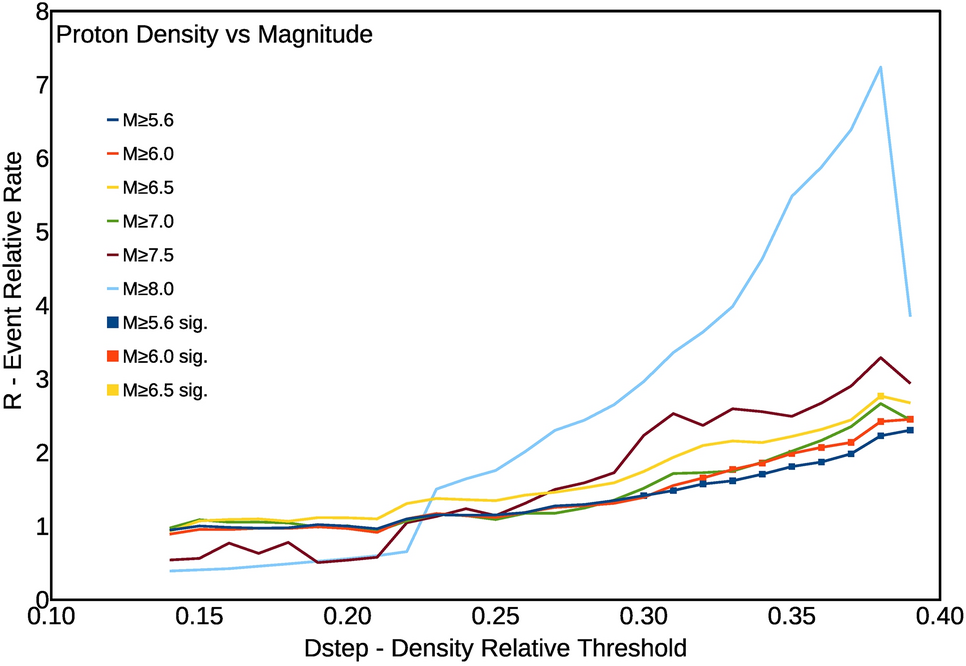
Large earthquakes occurring worldwide have long been recognized to be non Poisson distributed, so involving some large scale correlation mechanism, which could be internal or external to the Earth. Till now, no statistically significant correlation of the global seismicity with one of the possible mechanisms has been demonstrated yet. 
In this paper, we analyze 20 years of proton density and velocity data, as recorded by the SOHO satellite, and the worldwide seismicity in the corresponding period, as reported by the ISC-GEM catalogue. 
We found clear correlation between proton density and the occurrence of large earthquakes (M > 5.6), with a time shift of one day. The significance of such correlation is very high, with probability to be wrong lower than 10^–5. The correlation increases with the magnitude threshold of the seismic catalogue. 
A tentative model explaining such a correlation is also proposed, in terms of the reverse piezoelectric effect induced by the applied electric field related to the proton density. This result opens new perspectives in seismological interpretations, as well as in earthquake forecast.
Vito Marchitelli, Paolo Harabaglia,  Claudia Troise &  Giuseppe De Natale, "On the correlation between solar activity and large earthquakes worldwide" 10 Scientific Reports 11495 (July 13, 2020) (open access).

Milk Mattered A Lot

Davidski notes other serious problems with the data analysis in the paper (particularly the assertion I have emphasized in the abstract). But, the rise of lactase persistence is well documented from multiple sources. 

I personally think it is more likely that an LP variant was present, but at low frequency in Steppe peoples and then expanded in frequency exponentially due to selection on this variant in Northern Europe. But this certainly isn't the first study to show that LP wasn't common on the steppe and arose from near zero during the Bronze Age in Northwest Europe

The question of why LP was so strongly selected for also remains an open question. There is really no indicated of a strongly punctuated selection for it - it continued more or less steadily for centuries. My best guess would be that the impact on infant morality via the nutritional health of nursing mothers is the most important factor. The fact that steppe people hailed from a lower latitude and might have been prone to Vitamin D deficiencies at a greater rate than the locals could also have been a factor.

Lactase persistence (LP), the continued expression of lactase into adulthood, is the most strongly selected single gene trait over the last 10,000 years in multiple human populations. It has been posited that the primary allele causing LP among Eurasians, rs4988235-A, only rose to appreciable frequencies during the Bronze and Iron Ages, long after humans started consuming milk from domesticated animals. This rapid rise has been attributed to an influx of people from the Pontic-Caspian steppe that began around 5,000 years ago. 
We investigate the spatiotemporal spread of LP through an analysis of 14 warriors from the Tollense Bronze Age battlefield in northern Germany (∼3,200 before present, BP), the oldest large-scale conflict site north of the Alps. Genetic data indicate that these individuals represent a single unstructured Central/Northern European population. 
We complemented these data with genotypes of 18 individuals from the Bronze Age site Mokrin in Serbia (∼4,100 to ∼3,700 BP) and 37 individuals from Eastern Europe and the Pontic-Caspian Steppe region, predating both Bronze Age sites (∼5,980 to ∼3,980 BP). 
We infer low LP in all three regions, i.e., in northern Germany and South-eastern and Eastern Europe, suggesting that the surge of rs4988235 in Central and Northern Europe was unlikely caused by Steppe expansions. We estimate a selection coefficient of 0.06 and conclude that the selection was ongoing in various parts of Europe over the last 3,000 years.
Burger et al., Low Prevalence of Lactase Persistence in Bronze Age Europe Indicates Ongoing Strong Selection over the Last 3,000 Years, Current Biology, Available online 3 September 2020, https://doi.org/10.1016/j.cub.2020.08.033

Previous posts relevant to LP selection:


* Quick Hits (March 12, 2018)


* Did The Yamnaya Die Or Run? (October 10, 2015).


* Parallel Human Evolution (May 8, 2012)

Labor Day Humor.

 Image may contain: text that says 'When you tell him over the phone that you're "built like a goddess" but he never took art history and is in for for a shock'

Thursday, September 3, 2020

Understanding Space Dust

In addition to stars and planets, space has lots of interstellar dust, although it make up only a quite modest share of all ordinary matter in the universe and can't explain dark matter phenomena. But we need to adjust other observations for dust effects to make them more precise. Our accumulated astronomy research has improves our understanding of what interstellar dust is and its properties.

Observational Constraints on the Physical Properties of Interstellar Dust in the Post-Planck Era

We present a synthesis of the astronomical observations constraining the wavelength-dependent extinction, emission, and polarization from interstellar dust from UV to microwave wavelengths on diffuse Galactic sightlines. Representative solid phase abundances for those sightlines are also derived. Given the sensitive new observations of polarized dust emission provided by the Planck satellite, we place particular emphasis on dust polarimetry, including continuum polarized extinction, polarization in the carbonaceous and silicate spectroscopic features, the wavelength-dependent polarization fraction of the dust emission, and the connection between optical polarized extinction and far-infrared polarized emission. Together, these constitute a set of constraints that should be reproduced by models of dust in the diffuse interstellar medium.
Comments:38 pages, 14 figures. Submitted to ApJ, comments welcome
Subjects:Astrophysics of Galaxies (astro-ph.GA)
Cite as:arXiv:2009.00018 [astro-ph.GA]
 (or arXiv:2009.00018v1 [astro-ph.GA] for this version)

Tuesday, September 1, 2020

High Energy Physics Quote Of The Day

Quantum chromodynamics (QCD) calculations have been lagging behind experimental tests of it in precision for the last 40 years, at least. Feynman concluded his short introduction to quantum mechanics, "QED" (1985) with almost the same observation.
When particle physicists try to model experiments, they confront an impossible calculation — an infinitely long equation that lies beyond the reach of modern mathematics.  
Fortunately, they can generate largely accurate predictions without seeing this arcane math all the way through. By cutting the calculation short, scientists at CERN’s Large Hadron Collider in Europe make forecasts that match events they actually observe when they send subatomic particles barreling toward each other around a nearly 17-mile track. 
Unfortunately, the era of agreement between forecast and observation may be ending. As measurements grow more precise, the approximation schemes theorists use to make predictions may not be able to keep up.
From here. 

I explained the issue at greater length in a recent comment at the Physics Forums:
QCD calculations are not very precise, and this isn't just a matter of imprecise measurements.

For example, we have measured the mass of the charged pion to a precision of 1.5 parts per million. But we can only calculate that mass from first principles to a precision of a few parts per thousand.

We understand why this is the case quite well. The strong force coupling constant has been measured only to about one part per thousand. The high numerical value of the dimensionless strong force coupling constant relative to one means that even at five loops you only have about one part per thousand theoretical precision compared to one part per 61 billion theoretical precision in QED calculations to five loops in which the dimensionless QED coupling constant is much smaller relative to one. Photons don't have self-interactions and only have one charge plus polarization, greatly reducing the number of possible Feynman diagrams per loop of calculation and qualitatively reducing the potential complexity involved, while gluons have self-interactions and three colors in addition to polarization requiring far more Feynman diagrams per loop. We can observed free photons and charged particles, while quarks and gluons (apart from top quarks) are confined so we have to infer their properties from composite particles.

But the problem of the slow convergence of the infinite series path integrals we use do to QCD calculations isn't simply a case of not being able to throw enough computing power at it. The deeper problem is that the infinite series whose sum we truncate to quantitatively evaluate path integrals isn't convergent. After about five loops, using current methods, your relative error starts increasing rather than decreasing. From the link in this paragraph:

1596817558222.png

When you can get to parts per 61 billion accuracy at five loops as you can in QED, or even to the roughly one part per 10 million accuracy you can in weak force calculations to five loops, this is a tolerable inconvenience since our theoretical calculations still exceed our capacity to measure the phenomena that precisely. But when you can only get to parts per thousand accuracy at five loops as is the case in perturbative QCD calculations, an inability to get great precision by considering more loops is a huge problem when it comes to making progress.

You can't even measure the fundamental constants with more accuracy due to this problem, because you do that by theoretically reverse engineering the precisely measured observable quantities of composite particles like the charged pion and proton and neutron masses, with QCD theoretical formulations, to figure out the values of the fundamental constants that produce those experimental values in the theory.

Now, this isn't necessarily insurmountable. It might be possible to use math tricks to do better. For example, mathematically speaking, one can resort to techniques along the lines of a Borel transformation to convert a divergent series into a convergent one. And, path integral formulations are limitations associated with perturbative QCD calculations that can be overcome by using non-perturbative QCD methods like lattice QCD. But getting great precision in QCD calculations is as much a theoretical problem as a practical one.