Thursday, January 15, 2015
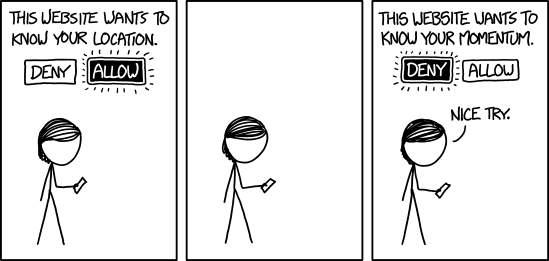
You Have A Personal Obligation To Uphold The Laws Of Quantum Physics
From xkcd (the original contains a mouse over phrase as well: "Our phones must have great angular momentum sensors because the compasses really suck.").
Background for non-physicists on the comic and the mouse over is available at Wikipedia.
Wednesday, January 14, 2015
SUSY Constrained By Electric Dipole Moment Of The Electron
A preprint released in November of 2013 and published in 2014 set a new limit on the electron dipole moment of the electron. It stated its raw data conclusion and explained that:
A factor of ten improvement on this limitations is expected in the near future.
UPDATE: Previously blogged here without analysis of how it pertains to SUSY exclusions in the main post, although the comments note that "Jester, with numerous caveats, explains that "the simplest explanation of the current data is that there are no superpartners up to at least ~10 TeV.""
The electron EDM constraint is more strict than the anomalous magnetic moment of the muon constraint which limits various superpartners to masses in the low to middle single digit TeV range (with the exception of chiral scalars).
Direct superpartner and additional Higgs boson searches also place less strict limitations on SUSY theories.
END UPDATE
I previously noted at Wash Park Prophet in February of 2011 that:
This corresponds to an upper limit of |de| < 8.7×10⁻²⁹ e cm with 90 percent confidence, an order of magnitude improvement in sensitivity compared to the previous best limits.The best fit value is -2.1×10⁻²⁹ e cm, which is consistent with zero within less than one standard deviation of the best fit value.
A factor of ten improvement on this limitations is expected in the near future.
UPDATE: Previously blogged here without analysis of how it pertains to SUSY exclusions in the main post, although the comments note that "Jester, with numerous caveats, explains that "the simplest explanation of the current data is that there are no superpartners up to at least ~10 TeV.""
The electron EDM constraint is more strict than the anomalous magnetic moment of the muon constraint which limits various superpartners to masses in the low to middle single digit TeV range (with the exception of chiral scalars).
Direct superpartner and additional Higgs boson searches also place less strict limitations on SUSY theories.
END UPDATE
I previously noted at Wash Park Prophet in February of 2011 that:
While we haven't quite reached the promised land of 10−30 e cm, the limitation published in 2014 greatly constrains SUSY parameter space.The standard model predicts that the electron's electric dipole moment is less than 10^–38 in units of electron charge times centimeters. That's equivalent to separating an electron and a similar charged particle by a distance of 10^–38 centimeters. . . But extensions of the standard model predict the electric dipole moment to be bigger, between 10^–25 and 10^–30. In 2002, [scientists] published the most stringent limit yet: 1.6 × 10⁻²⁷.Experiments in progress costing about $10 million, a bargain in the fundamental physics world, should determine if the electron's electric dipole moment is more than 10^-29 by one of a few possible methods in the next few years.
The minimal supersymmetric standard model, or MSSM, is a standard model extension that holds that every elementary particle has a “superpartner.” One of the simplest versions has been ruled out by the current limit.
An electric dipole moment for an electron of less than 10^-30 would rule out most versions of supersymmetry, and hence, most versions of string theory.
Tuesday, January 13, 2015
Subtle Evidence For Two Higgs Doublets At The LHC?
Tommaso Dorigo reports a series of three different measurements at the Large Hadron Collider that differ with moderate statistical significance from the Standard Model expectation, each of which would be consistent with a modification of the Standard Model in which there are five Higgs bosons instead of just one, a situation called "two Higgs doublet" models.
The Effects
Lepton Flavor Violation in Higgs boson decays
Most recently, the CMS experiment has seen 2.6 sigma evidence (without considering look elsewhere effects) of lepton flavor violation in Higgs boson decays; specifically decays that seem to involve one muon and one tau.
Baryon number (the number of quarks minus the number of anti-quarks in a system) is perfectly conserved in the Standard Model (with one exceedingly rare and obscure example called a sphaeleron), as is lepton number (the number of leptons minus the number of anti-leptons in a system).
Lepton flavor number conservation means that the number of third generation leptons (taus and tau neutrinos) minus the number of third generation anti-leptons (anti-taus and tau antineutrinos) is constant, and similarly for the second generation (muons and muon neutrinos) and first generation (electrons and electron-neutrinos).
Neutrinos violate lepton flavor number every time they oscillate, and there is no corresponding concept to lepton flavor number of quarks. But, there are no other observed violations of lepton flavor number conservation involving charged leptons (i.e. electrons, muons and taus) to date (for example, in Z boson decays), up to limits of more restrictive than one in a million Z boson decays, when all other Z boson decays have branching fractions on the order of 3.363% (which embodies the "democratic" principle or "universality" principle of weak force decays).
The fact that lepton flavor number violation could be occurring in Higgs boson decays, but not in other circumstances, could indicate that the Higgs sector we observe is not quite the Standard Model Higgs sector.
The muon-tau decays make up about 0.9% of all observed Higgs boson decays, when they shouldn't happen at all, except for extremely rare (i.e. one a billionish) instances with virtual oscillating neutrino loops that indirectly violate lepton flavor conservation.
B meson decays to excited kaons and muon-antimuon pairs
Another experimental anomaly from the LHCb experiment involves the angular distribution and branching fraction of decay products of B mesons (made of a bottom quark and and an anti-up quark) to an excited spin-1 kaon (made of a strange quark and an anti-up quark with aligned spins) called a K* and a muon-antimuon pair (i.e. B-> K*mumu)
These decays deviated from the Standard Model expectation by 3.7 sigma (2.8 sigma with the look elsewhere effect considered) in relatively low energy interactions. Dorigo notes, however, that in general, the assumption that error is distributed in a normal distribution (i.e. Gaussian) overstates the actual rarity of atypical events which actually have a distribution with longer tails of a particular type (known as the Student t test distribution type 10 with coefficient 1/1.11).
You need to be a hard core physicist to figure out that having five Higgs bosons rather than one could produce this effect, but at least one such person thinks that it could.
B meson decays violating lepton universality
A third experimental anomaly from the LHCb involves the ratio of the decay discussed above and a similar one that substitutes electron pairs for muon pairs (B->K*mumu/B->K*ee), which should be almost exactly unity if a principle called "lepton universality" applies. Instead, the decays with muon pairs are about 25% less common than the decays with electron pairs.
This is a 2.6 sigma effect before considering look elsewhere effects.
Analysis
Standing alone a sub-three sigma deviation from the Standard Model expectation in an experiment is no big deal when you have thousands of scientists making hundreds or thousands of measurements every year.
But, if three different Standard Model deviations of this significance out of the modest number seen at the LHC are all consistent with the same theoretical tweak to the Standard Model, and that tweak wouldn't be expected to modify anything else that has been observed to fit the Standard Model expectation, then the results look more likely to be pointing at New Physics, in this case, the two Higgs doublet model.
Lubos discusses the underlying proposed theoretical physics model with more gusto and enthusiasm than I can muster. One gross oversimplification of what is going on that he mentions when sums up the commonalities between the effects, is that basically, in this model, there is something special about muons that differs from the Standard Model expectation for them. (One might imagine that strange quarks in a parallel position in the Standard Model mass matrix, might have a similar anomaly that is yet to be discovered).
This model would imply a mixing angle of muons and taus of 0.002, and a Z' boson with a mass in the vicinity of 550 GeV to 3,200 GeV, and an additional Higgs field with a vacuum expectation value in the tens of TeVs, in addition to BSM neutrino physics.
It is also worth noting that the LHC exclusions of non-Standard Model Higgs bosons in the absence of other supersymmetric phenomena are less impressive than you might intuitively expect, although aside from these data points, there is really no other evidence pointing positively to the existence of five Higgs bosons which one might think would have a more noticable signature.
Even taken together, these results are still a long shot that is more likely to result from experimental error, or a failure to include something in the theoretical model generating the Standard Model expectation.
For example, the theoretical expectation might inappropriately omit the probability that a Higgs boson will decay to a W boson pair with one W boson decaying to a tau and a tau-antineutrino, and another decaying to a muon and muon antineutrino, where noise in the signal obscures the missing energy from the antineutrinos produces and makes it look as if the Higgs boson decayed directly to a muon and a tau, because the data cuts aren't strict enough to exclude this kind of W boson pair decays from a Higgs boson with a noisy background that makes missing energy hard to notice.
But, these results do leave a rather more promising experimental window for beyond the Standard Model physics than most, although with the downside that the extra four Higgs bosons would have very subtle effects indeed on the phenomenology of the universe with a possible exception at very high energies.
Background on Two Higgs Doublet Models
The Standard Model has one Higgs doublet, which means it should have four Higgs bosons, but the W+, W- and Z boson "eat" three of them, leaving just one Higgs boson. A two Higgs doublet model has (2*4)-3=5 Higgs bosons, adding a positively charged Higgs boson (H+), a negatively charged Higgs boson (H-), a pseudoscalar Higgs boson, i.e. spin-0, odd parity (A), and an extra scalar Higgs boson just like the Standard Model one, but either heavier or lighter in mass, a lighter one (h) and a heavier one (H0).
All supersymmetric models have at least 5 Higgs bosons (two Higgs doublets), and some non-minimal SUSY models have 9 (three Higgs doublets) or 13 (four Higgs doublets) or more, with the Higgs bosons beyond the first five sometimes having exotic properties like a +/-2 electric charge. But, one can have a multiple Higgs doublet model as a stand alone feature without superpartners to the Standard Model particles.
The Effects
Lepton Flavor Violation in Higgs boson decays
Most recently, the CMS experiment has seen 2.6 sigma evidence (without considering look elsewhere effects) of lepton flavor violation in Higgs boson decays; specifically decays that seem to involve one muon and one tau.
Baryon number (the number of quarks minus the number of anti-quarks in a system) is perfectly conserved in the Standard Model (with one exceedingly rare and obscure example called a sphaeleron), as is lepton number (the number of leptons minus the number of anti-leptons in a system).
Lepton flavor number conservation means that the number of third generation leptons (taus and tau neutrinos) minus the number of third generation anti-leptons (anti-taus and tau antineutrinos) is constant, and similarly for the second generation (muons and muon neutrinos) and first generation (electrons and electron-neutrinos).
Neutrinos violate lepton flavor number every time they oscillate, and there is no corresponding concept to lepton flavor number of quarks. But, there are no other observed violations of lepton flavor number conservation involving charged leptons (i.e. electrons, muons and taus) to date (for example, in Z boson decays), up to limits of more restrictive than one in a million Z boson decays, when all other Z boson decays have branching fractions on the order of 3.363% (which embodies the "democratic" principle or "universality" principle of weak force decays).
The fact that lepton flavor number violation could be occurring in Higgs boson decays, but not in other circumstances, could indicate that the Higgs sector we observe is not quite the Standard Model Higgs sector.
The muon-tau decays make up about 0.9% of all observed Higgs boson decays, when they shouldn't happen at all, except for extremely rare (i.e. one a billionish) instances with virtual oscillating neutrino loops that indirectly violate lepton flavor conservation.
B meson decays to excited kaons and muon-antimuon pairs
Another experimental anomaly from the LHCb experiment involves the angular distribution and branching fraction of decay products of B mesons (made of a bottom quark and and an anti-up quark) to an excited spin-1 kaon (made of a strange quark and an anti-up quark with aligned spins) called a K* and a muon-antimuon pair (i.e. B-> K*mumu)
These decays deviated from the Standard Model expectation by 3.7 sigma (2.8 sigma with the look elsewhere effect considered) in relatively low energy interactions. Dorigo notes, however, that in general, the assumption that error is distributed in a normal distribution (i.e. Gaussian) overstates the actual rarity of atypical events which actually have a distribution with longer tails of a particular type (known as the Student t test distribution type 10 with coefficient 1/1.11).
You need to be a hard core physicist to figure out that having five Higgs bosons rather than one could produce this effect, but at least one such person thinks that it could.
B meson decays violating lepton universality
A third experimental anomaly from the LHCb involves the ratio of the decay discussed above and a similar one that substitutes electron pairs for muon pairs (B->K*mumu/B->K*ee), which should be almost exactly unity if a principle called "lepton universality" applies. Instead, the decays with muon pairs are about 25% less common than the decays with electron pairs.
This is a 2.6 sigma effect before considering look elsewhere effects.
Analysis
Standing alone a sub-three sigma deviation from the Standard Model expectation in an experiment is no big deal when you have thousands of scientists making hundreds or thousands of measurements every year.
But, if three different Standard Model deviations of this significance out of the modest number seen at the LHC are all consistent with the same theoretical tweak to the Standard Model, and that tweak wouldn't be expected to modify anything else that has been observed to fit the Standard Model expectation, then the results look more likely to be pointing at New Physics, in this case, the two Higgs doublet model.
Lubos discusses the underlying proposed theoretical physics model with more gusto and enthusiasm than I can muster. One gross oversimplification of what is going on that he mentions when sums up the commonalities between the effects, is that basically, in this model, there is something special about muons that differs from the Standard Model expectation for them. (One might imagine that strange quarks in a parallel position in the Standard Model mass matrix, might have a similar anomaly that is yet to be discovered).
This model would imply a mixing angle of muons and taus of 0.002, and a Z' boson with a mass in the vicinity of 550 GeV to 3,200 GeV, and an additional Higgs field with a vacuum expectation value in the tens of TeVs, in addition to BSM neutrino physics.
It is also worth noting that the LHC exclusions of non-Standard Model Higgs bosons in the absence of other supersymmetric phenomena are less impressive than you might intuitively expect, although aside from these data points, there is really no other evidence pointing positively to the existence of five Higgs bosons which one might think would have a more noticable signature.
Even taken together, these results are still a long shot that is more likely to result from experimental error, or a failure to include something in the theoretical model generating the Standard Model expectation.
For example, the theoretical expectation might inappropriately omit the probability that a Higgs boson will decay to a W boson pair with one W boson decaying to a tau and a tau-antineutrino, and another decaying to a muon and muon antineutrino, where noise in the signal obscures the missing energy from the antineutrinos produces and makes it look as if the Higgs boson decayed directly to a muon and a tau, because the data cuts aren't strict enough to exclude this kind of W boson pair decays from a Higgs boson with a noisy background that makes missing energy hard to notice.
But, these results do leave a rather more promising experimental window for beyond the Standard Model physics than most, although with the downside that the extra four Higgs bosons would have very subtle effects indeed on the phenomenology of the universe with a possible exception at very high energies.
Background on Two Higgs Doublet Models
The Standard Model has one Higgs doublet, which means it should have four Higgs bosons, but the W+, W- and Z boson "eat" three of them, leaving just one Higgs boson. A two Higgs doublet model has (2*4)-3=5 Higgs bosons, adding a positively charged Higgs boson (H+), a negatively charged Higgs boson (H-), a pseudoscalar Higgs boson, i.e. spin-0, odd parity (A), and an extra scalar Higgs boson just like the Standard Model one, but either heavier or lighter in mass, a lighter one (h) and a heavier one (H0).
All supersymmetric models have at least 5 Higgs bosons (two Higgs doublets), and some non-minimal SUSY models have 9 (three Higgs doublets) or 13 (four Higgs doublets) or more, with the Higgs bosons beyond the first five sometimes having exotic properties like a +/-2 electric charge. But, one can have a multiple Higgs doublet model as a stand alone feature without superpartners to the Standard Model particles.
Thursday, January 8, 2015
Boya and Rivera On Mass Scales Together With My Own Musings On Standard Model Parameters
Boya and Rivera have a 2011 paper spinning out most of the half-formed notions floating around out there about the origins of the masses of various objects in physics with unorthodox comparisons of fundamental particles of different types and composite particles that are all of about the same mass with each other. Bernard Riley posted a preprint this month with essentially the same sentiment but compelling charts to make it more persuasive and illustrate a connection between the various mass scales that they identified in a single linear progression.
Do electroweak self-energy fields explain the masses of the first generation Standard Model fermions?
One observation that I have now seen in quite a few papers in the last couple of weeks resurrects a century old notion about the rest mass of the electron, which, it turns out, is very close to the mass associated with the electromagnetic potential energy field that an electron generates if one assumes that rather than being point-like it has a radius which dimensional analysis naturally suggests, and make some clever choices about how to do the math as one recent preprint on the topic that I read found a way to manage.
This charge radius, by the way, isn't simply a physically irrelevant curiosity. While we now think of the electron and other fundamental particles as fundamentally point-like, the charge radius physically governs the scattering cross section (i.e. likelihood of fundamental particles a given distance from each other interacting) in a matter heuristically similar to the probabilities of conventional spheres of the same size colliding with each other if quantum mechanics did not apply.
The weak force between two neutrinos is about 10^-5 weaker than the force between two electrons. Since this factor is squared in the self-energy equation, assuming that the radius of a neutrino is about the same as the radius of an electron, you get the experimental result that the electron neutrino mass which is about 10^-10 less than the electron mass.
Alternately, the 10^-10 ratio of the electron mass to the electron neutrino mass, give or take, is really 10^-5 to 10^-6 due to the ratio of the electromagnetic force strength to the weak force strength, and the balance of the ratio comes from the fact that the appropriate effective radius of a neutrino, which is about 10^-15 for an electron in the proper units, the same as an electron, for a neutrino in those same units.
One can also imagine neutrino rest masses arising entirely from the masses of their W boson virtual particle fields, which while non-zero, are very, very small because quantum tunneling over the huge virtual particle energy hurdle from the near zero neutrino mass to the W boson mass and back again dramatically suppresses the probability of generating virtual particles that contribute to its self-energy. In contrast, since the electron has no virtual particle hurdle to generate at all to cross to generate a zero rest mass photon, and the weak force self-energy is only a little bit more than that of the electron neutrino because the gap between the electron mass of 0.000511 GeV and the W boson mass of about 80 GeV is still so immense, and because it has no color charge self-energy, the self-energy inertia that an electron generates very cleanly matches its rest mass. All the complicating confounds to muddy a self-energy source for first generation fundamental fermion mass in this case are so negligible or absent that the one clean relationship between rest mass and self-energy that remains stands out true and clear (just as the Koide relationship of the charged leptons, with such a negligible neutrino contribution to muddy up the relationship, is so exact as explained in more depth below).
Of course, the trouble with this terribly elegant source for the ground state lepton masses is that it still leaves us without a clue as to why second and third generation leptons of the same type are so much heavier than those of the first generation. Also, it leaves unclear what the source of the up and down quark masses should be.
The up quark, of course, has a charge of +2/3, while the down quark has a charge of -1/3. And, empirically, our best estimates of the relative masses of the up quark and down quark suppose a down quark that is twice as heavy as the up quark, which is inversely proportionate to the relative charges of the particles - the opposite of the result we would naively expect based upon an electroweak self-energy relationship if the up and down quarks had the same classical radius.
The fact that the up and down quark rest masses are roughly four and eight times heavier respectively than the electron mass (0.511 MeV), i.e. about 2.44 MeV for the up quark and about 4.88 MeV for the down quark, given best fit experimental measurements which admittedly aren't very precise, when the up quark has an electromagnetic potential field that would be 4/9ths as strong as the electron, and the down quark has an electromagnetic potential field that would be 1/9th as strong as the electron, respectively, if they each had the same charge radius of the electron, is notable.
Put another way, the classical radius of the up quark is 1/9th of the classical radius of the electron, and the classical radius of the down quark is 1/72nd of the classical radius of an electron. These inferred smaller classical charge radii for quarks (which can't be observed in isolation) is consistent with the fact that the classical charge radius of the electron is about 2.82*10-15 m, the measured classical charge radius of the proton (with an identical and opposite charge) is about 0.88*10-15 m (muonic hydrogen inexplicably, however, has a measured classical charge radius of 0.84*10-15 m). Specifically, the classical charge radius of an up quark is about 0.31*10-15m and the classical charge radius of a down quark is about 0.04*10-15 m.
Apparently, something different is going on with quarks than with leptons. Perhaps, unlike first generation leptons, even first generation quarks they have some rest mass from some source beyond the rest mass arising from their electroweak interactions.
There is no real indication the QCD has anything at all to do with fundamental fermion mass in quarks, except for the fact that it needs different flavored quarks to have some kind of different properties from each other so that it can have six different distinguishable flavors, but what if? (Query for future investigation: what would 1 light or massless flavor, 3 color QCD ignoring electroweak effects look like? - with an eye towards quantum gravity applications).
But, is it really just a coincidence that all of these classical charge radii are on the same order of magnitude as the distance of a bit more than 1*10-15m at which the strong force that governs quarks, but not leptons, is strongest, when this distance has no special significance to the electromagnetic force that seemingly is the dominant contributor to the rest mass of the electron?
What if the charge radius of a "bare quark" was the same as the leptons, giving an up quark 0.23 MeV of rest mass from electromagnetic self-energy, and the down quark 0.06 MeV of mass from electromagnetic self-energy (disregarding the comparatively negligible self-energy contribution of weak force self-energy interactions via Z bosons in up quarks, down quarks and electrons which should be approximately identical to the electron neutrino mass of about 0.000000001 MeV). This would be a residual of about 2.21 MeV in an up quark and about 4.82 MeV in a down quark.
Is the simple self-energy model too naive? Perhaps the electron gets some of its mass from flavor changing W boson mediated mixings with muons and tau leptons, and only the remainder from its own self-energy from electromagnetic field potential has has a different than canonical true classical radius? And, similarly, perhaps the residual rest masses of the up and down quarks have a source in their W boson mediated mixings with other quarks.
If we could merely find some plausible reason for these scaling factors, when the classical charge radii pertinent to determining fundamental particle rest masses from the self-energies of first generation fermions, which is the same for leptons, but much smaller and different from each other, for first generation quarks, we would be well on our way to a deeper understanding of the source of the mass constants in the Standard Model.
At any rate, looking through a glass darkly on can imagine that with just two or three more leaps of insight, one could develop a fundamental calibration point from the electroweak potential self-energies for each of the first generation fermions of the Standard Model.
Of course, it also doesn't help that the light quark masses are ill defined, an issue that I've been ignoring so far. Extrapolating perturbative QCD formulas for light quarks down to the up and down quark scale would suggest "dressed" quark masses that make the mass difference between the proton and the neutron, and the low mass of the pion, impossibly small. One can (and does) use a subtraction scheme like MS, rather than the more natural "pole masses" of the up, down and strange quarks (or for that matter, for all hadronized quarks in some applications). But, it isn't at all obvious that this is the right way to think about these fundamental quantities for theoretical purposes, as opposed to for the practical work of doing QCD with confined quarks in hadrons.
Aesthetically, there is a lot to like about a self-energy driven approach to setting the masses of the first generation fermions.
1. This approach makes it possible to determine these masses from first principles removing four parameters from the Standard Model using ideas that are a century old and were seriously considered by the founders of modern physics even though they couldn't figure out how to make it work at the time.
2. It means that the entire debate over Dirac mass v. Majorana mass for neutrinos, that has in the Dirac mass case cast doubt on the universality of the Higgs mechanism itself which relies on Higgs field fueled parity oscillation to extend to these fermions even though it extends to all of the others. In this approach, the same fundamental physical process naturally gives rise to the rest mass of each of the fundamental fermions.
3. It provides a natural explanation flowing from the nature of the particles themselves for why neutrinos are so light, and a sensible motivation for why the Standard Model's natural tendency towards massless fundamental particles that it had in earlier incarnations is fundamentally unworkable in a set of consistent and universal physical laws that incorporates Einstein's observation that mass and energy are equivalent.
4. A calibration of the first generation fermions from self-energies would allow the absolute scale of the Standard Model particle masses to be set in a bottom up, rather than a top down, manner as the Standard Model does today (thereby solving the hierarchy problem), This would give us a firm footing from which we could renormalize the Standard Model up to a GUT or Planck scale (although a quantum gravity adjustment to each of those those beta functions would probably be necessary), rather than the current system where more often than not we assume that the laws of the universe are set at a high energy scale chosen somewhat arbitrarily without empirical guidance, to give rise to a low energy effective field. This would put our speculations about a higher energy regime in the early universe on a more firm foundation.
Of course, this step alone doesn't get us to the promised land of explaining the rest of the physical constants for fundamental particle mass in the Standard Model, but it is progress at least.
Expressing a similar sentiment with another approach see here.
Is Sterile Neutrino Dark Matter Theoretically Impossible?
The article also makes the observation that in nature, everything that is possible is also mandatory, and that rest mass is possible, and therefore mandatory, for all charged particles. But, it fails to make the even more exact observation:
Gravity interacts with all of the Standard Model particles and the hypothetical graviton also interacts with other gravitons on the same basis. All Standard Model particles with rest mass interact via the weak force, while no particles that lack rest mass (including the hypothetical graviton) interact via the weak force. The Standard Model Higgs field interacts with all particles with rest mass except neutrinos (since they can't engage in mass generating, Higgs field driven, parity oscillation), including the Z boson that lacks electric charge. All particle that interact via the Higgs field also interact via the weak force and gravity. All charged fundamental particles also interact via the weak force and the Higgs field and gravity. Quarks interact via the strong force, the electromagnetic force, the Higgs field, the weak force and gravity.
There is only one exception to this hierarchical pattern in the Standard Model as extended by a hypothetical graviton. Gluons interact via the strong force and via gravity, but they do not interact via the electromagnetic force, the Higgs field, or the weak force. They lack electric charge, weak force charge and rest mass, although they can acquire mass dynamically in infrared confinement situations. (The creation of a Higgs boson via "gluon fusion" is an indirect process. The gluons create intermediate particles that unlike gluons do interact with the Higgs boson, and it is the intermediate particles that the gluons produce, rather than the gluons themselves that produce the Higgs bosons.)
One takeaway conclusion that flows from that observation is that truly collisionless dark matter particles such as sterile neutrinos (as opposed to WIMPS that interact via the weak force), which have no strong force interactions, no couplings to photons or electric charge, and no weak force interactions, must also have a zero rest mass, because all particles that do not interact via the weak force lack rest mass.
Due to a lack of rest mass, sterile dark matter particles of any kind would always move at the speed of light.
Dark matter particles, by hypothesis, do interact via gravity, so they would interact with gravity with a strength equal to proportional to their own wavelength times Planck's constant, since this would have to be the only source of their own mass-energy in the absence of a rest mass.
In other words, if one applies the logic that weak force interactions are necessary for a particle to have rest mass as is true in every other case, and join that to the standard assumptions that define dark matter particles, then a dark matter particle must have all of the properties, with the possible exception of total angular momentum J aka spin, as a graviton. Indeed, they would look exactly like hypothetical Neo-Newtonian, spin-0 gravitons, in the non-self-interacting case, and exactly like the hypothetical spin-2 graviton in the self-interacting case. But, this reasoning is not dependent upon these dark matter particles being scalars. It applies with equal force to any particle, boson or femion alike, that lacks strong, electromagnetic and weak force interactions.
Of course, whatever its spin, any massless sterile neutrino would be "hot dark matter", due to its speed of light velocity. But, this is inconsistent with one of the axiomatic observational requirement for dark matter, because hot dark matter would blur out all small and not so small scale structure in the universe if it was a common as the Planck satellite observations and galactic rotation curve observations suggest.
Therefore, if the only way that fundamental particles can obtain a rest mass is through electroweak interactions, it follows that dark matter that does not consist of WIMPS cannot exist.
Yet, as I've previously discussed at this blog, there are very deep problems with WIMP dark matter. We know from W and Z boson decays that there are no undiscovered weakly interacting particles with masses of less than 45 GeV (soon to be increased to 62 GeV once we have enough Higgs boson decay data).
We also know that direct dark matter detection experiments have ruled out dark matter particles whose weak force couplings are a strong as a neutrino of that mass to considerably higher masses than 62 GeV. The LUX experiment excludes cold dark matter particles with a weak force cross section of interaction as strong as a neutrino at masses in excess of 1,000 GeV (aka 1 TeV). Yet, the flaws of CDM theories relative to WDM theories are particularly accentuated in the case of dark matter with masses of 1 TeV or more.
Also, those exclusions are probably understated, because they assume a dark matter density in the vicinity of the solar system that is roughly half of what a recent precision observation of RAVE stars in the Milky Way galaxy used to calibrate the parameters of a cold dark matter halo for the Milky Way, and other recent precision measurements of the Milky Way, require.
But, this provides a good theoretical reason to reject the possibility of dark matter at all, in favor of gravity modification theories to explain dark matter phenomena, unless:
(1) a fifth force Yukawa self-interactions confined exclusively to the dark sector on the same order of magnitude in strength as the electromagnetic force, or
(2) the possibility that warm dark matter critics of cold dark matter theorists are wrong and resolution of almost all of the apparent flaws of CDM theories in N-body simulations with the inclusion of both baryons and dark matter particles is correct (something that sounds less plausible when one learns about some of the empirically and physically unjustified but little discussed tweaks to those models that are necessary to get them to reproduce the galactic scale of the universe even with baryon interactions), or
(3) the one other solution that comes to mind is some sort of composite dark matter particle (perhaps with a mass at the warm dark matter scale) that substitutes the binding energy holding its particles together for fundamental particle mass, in much the same way that light hadrons get 98% of their mass from the binding energy contained in massless gluons. This two would require a self-interacting fifth force restricted to the dark sector, but would have a very different character than the forces proposed in self-interacting dark matter theories. It would have to be a very stable confining force like the strong force, rather than an intermediate distance force like the kinds usually proposed in self-interacting dark matter theories. Indeed, such a confining force could even operate on already known Standard Model particles, like neutrinos, by confining a large share of them to produce composite dark matter, and thereby creating just one new particle (a short range force carrying boson), rather than two. Basically, this applies to the possibility that there is no viable fundamental particle that is a dark matter candidate, the same strategy that Technicolor theory applied to the possibility that there was no fundamental particle to serve the role of the Higgs boson in the Standard Model by proposing a composite particle alternative bound by a previously unknown fifth force.
Furthermore, keep in mind that any SUSY superpartner particle must have the same force couplings as its superpartners. All of the hypothetical SUSY superpartners except the gravitino (even neutralinos) would have mass and interact via the weak force at least as intensely as neutrinos do, and most interact via other Standard Model forces as well. And, while gravitinos are expected by many supergravity theorists to have a mass of 1 TeV or more, possibly allowing them to escape detection by current direct dark matter detection edperiments, it is well known that its is problematic to fit heavy gravitino dark matter candidate into the available cosmology and dark matter phenomena data And, of course, the mechanism by which a hypothetical gravitino could acquire mass at all, unlike its massless superpartner the graviton, is far from obvious.
The stark lack of good SUSY dark matter candidates, now that empirical evidence is starting to impose more strict qualifications on potential dark matter candidates, is particularly notable because, to hear SUSY advocates tell the story (and a large share of the theoretical physics community fits that description), SUSY is popular because it is only of the only beyond the Standard Model theories that can deviate from the Standard Model in a manner that does not directly contradict experimental data, if the parameters of a SUSY theory are chosen carefully.
In contrast, no such deep objections exist to subtle modifications of general relativity that lead to the kind of Yukawa term for self-interactions of gravitons with each other, that can reproduce all or almost all known dark matter phenomena at all scales from dwarf galaxies to galactic clusters and the Bullet Cluster, as demonstrated by people like J.W. Moffat and Alexandre Deur. And, Moffat has made some progress in showing that his gravity modifications can also produce a viable cosmology.
Deur's analysis, meanwhile, suggests that his gravitational analysis may do little but provide an alternative means of describing dark matter without a cosmological constant, which might not need to be as big or might even be possible to eliminate due to non-linear variations in gravitional field strengths around asymmetric matter distributions. This is because the non-linear graviton self-interaction effects that he has described to explain dark matter phenomena have little or no impact in spherically symmetric systems like those in Big Bang cosmologies and the analysis of black holes where his analysis does not part ways with conventional GR research into cosmology and black holes.
Of course, an extremely modest tweak to the equations of general relativity, the cosmological constant term, is already sufficient to perfectly reproduce all observed dark energy phenomena, even if a modification of gravity that explains dark matter phenomena does not do so. Dark energy is a solved problem in fundamental physics. It is solved via terms in the GR equations that Einstein himself was aware of, not exotic particles or fields. This may not be the only way that this problem can be solved, but since it is a solved problem, finding alternative solutions to it is not an urgent problem in fundamental physics in my opinion.
Why Are There Koide Triples And What Drives The Electroweak Boson Masses?
My other takeaway conclusion from that observation that all weakly interacting particles have rest mass, while all particles that don't interact weakly do not, is that we may be wrong about the true source of Standard Model fundamental particle masses.
It could be that rather than largely being a function of Higgs Yukawa couplings, that this really arises dynamically mostly from W boson interactions with a slight additional Z boson contribution.
Since the W boson is the only mechanism by which a quark or charged lepton can change its flavor, in accordance with an explicitly generation considering CKM matrix, it makes all sorts of sense that the W boson ought to play a fundamental role in both electroweak mass generation of fundamental Standard Model particles in general, and in particular, in the mass differences between the masses of fundamental particles that are in all other respects identical.
One can fruitfully seek a W boson driven mass generation mechanism as at the heart of why Koide's rule works for leptons perfectly (since Koide's rule captures all of the inputs to the W boson interactions of the charged leptons weighted somehow for the masses of the respective generations, but ignoring the interacts with neutrinos since their tiny masses result in those interactions having almost zero weight), and why it works approximately for Koide quark triples, with the best fits being those where the triple captures the largest share of the potential W boson transitions that the middle quark in the quark triple could experience, with deviations from correctness on the same order as the W boson flavor changing transition probability that is omitted from the triple for its middle member, times the mass of the quark whose transition is omitted.
If one had a correct generalized form of Koide's rule available, one needs only two calibration points per Koide cascade to complete the mass matrix from first principles, something that would easily become possible if all four of the first generation fundamental fermion masses in the Standard Model could be fixed from first principles based upon the potential electroweak self-energy of these particles and some suitable theoretical justification for a scale up factor for the up and down quarks respectively.
Of course, if one sees the W boson as the driving force behind mass generation of Standard Model fermions, rather than the Higgs field, then one is free to see Higgs field interactions, not as an orchestra conductor for the Standard Model, but as a dependent variable that arises from the underlying W boson driven fundamental fermion and boson rest masses, and the Higgs boson mass itself, as a residual particle creating a degree of freedom that allows the Standard Model to make the sum of the square of the fermion masses exactly equal to the sum of the square of the boson masses, when each of those masses is renormalized to take its value at the Higgs field energy scale.
Likewise, in this analysis, one can alternately explain the heaviness of the top quark on the grounds that the top quark mass is the degree of freedom necessary to balance this out, while setting the Higgs boson mass to sum of the masses of the four electroweak bosons (W+, W-, Z and the photon), divided by the square root of four (the number of electroweak bosons) when the masses of all four of the bosons in that equation are renormalized to their values at the Higgs field energy scale. Given the propensity of bosons to mix, this seems eminently sensible.
This approach wouldn't remove the Standard Model Higgs boson or the Higgs field from the Standard Model. But, it would reframe these aspects of the Standard Model in a way that would give us a new perspective on why they matter that would put the familiar hard working W boson at center stage.
Moreover, if one can resort to self-energy from electromagenetic and weak force fields combined in the case of the electron, and from the weak force field along in the case of the electron neutrino, as a means of establishing calibration points in the fermion mass matrix, and perhaps if one can use renormalization of the Higgs boson mass from a metastable zero value at the Planck or GUT scale down to the electroweak scale, one can pick up a third fundamental calibration point for the mass matrix, and with these calibration points and a generalized Koide triple mass generation mechanism that seeks to harmonize the masses of different states that a particle can transform into via the W boson relative to each other, then one is close to deriving the entire mass matrix of the Standard Model from first principles.
Also, while we hypothesize that each of the neutrinos have mass (because they interact via the weak force), one could imagine that the electron neutrino actually violates this rule and really has a zero mass with provides an anchor for the other mass matrix masses, even though the other neutrinos have mass (although having mused over this possibility for hours on multiple occasions, I'm ultimately pretty convinced that this will not turn out to be the case, mostly because W boson interacts of electron neutrinos with charge bosons, while suppressed by the quantum tunneling issue, have more than a zero probability, and because neutrino oscillation may add a layer of mass mediation between neutrino flavors in addition to W boson exchanges).
Do The Mixing Matrixes Use All Of Their Possible Degrees Of Freedom?
Meanwhile, the probabilities that come into play in W boson interactions arise from the CKM matrix. And, it so happens, as pointed out in a previous conjecture at this blog, that it appears to be possible to parameterize the entire CKM matrix apart from CP violation, with a single parameter (basically the Weinberg angle), even though, in principle, it could require as many as three parameters to do so.
And, it also looks reasonably plausible that it may be possible to parameterize CP violation in both the CKM matrix and the PMNS matrix with a single shared CP violation parameter.
If a similar non-maximal parameterization can be achieved in the PMNS matrix, or better yet, if the remaining CKM and PMNS matrix parameters can somehow be derived from the coupling constants, or have singular parameters that have some functional relationship to each other, leaving just two mixing matrix parameters that might in turn somehow be possible to derive from the Standard Model coupling constants in a degree of freedom reducing way.
If so, the plethora of Standard Model constants starts looking much more tame and logical, with seemingly "unnatural" relationships of constants in it having perfectly sensible relationships once the fundamental values that drive the true value of these constants is better understood.
I am also particularly struck by how close the CKM matrix decreed probability of a first to third generation transition is to the product of the probability of a first to second generation transition times a second to third generation transition.
It also would only take one more leap of logic to find a well motivated functional relationship between the Cabibbo angle (which basically relates to the probability of a down quark decaying to something other than an up quark) and the electroweak mixing angle (which relates among other things to the ratio of the W and Z boson masses), which are very similar, but not identical to a high degree of statistical significance, allowing us to remove yet another parameter from the Standard Model. The electroweak mixing angle also governs the relative strengths of the strong force and weak force coupling constants. So, this innovation, together with the other ones discussed above, if the leap of insight could be secured, would allow us to derive all of the Standard Model masses and mixing angles from its three dimensionless coupling constants alone.
For another recent effort to find method in the CKM and PMNS matrixes, consider this paper reviewing the progress of the most recent data towards his 2007 prediction.
Dynamical Gluon Mass, C, J, CP violation and the Strong CP problem
The Boya and Rivera article also barely touches on another fascinating issue which is that in the non-perturbative infrared QCD regime explored with lattice QCD for quark behavior within confined hadrons where they are asymptotically free, gluons dynamically acquire significant mass, with most of a hadron's mass being localized "in the glue" despite the fact that gluons by definition and to make the equations of QCD work have a zero mass at "rest", just like a photon.
I've hypothesized that the main reason that the fundamental QCD CP violation phase is zero is that the strong force, since it is mediated by a massless boson, the gluon which is always traveling at the speed of light, like the photon, does not experience time and hence cannot have a process which serves as an arrow of time. In contrast, the W boson, because it is massive, can experience this arrow of time, and does have a CP violating phase.
But, it is worth observing that the only time CP violation is actually observed is in electrically neutral pseudoscalar mesons, which contain confined gluons that are in the infrared regime where they dynamically acquire mass.
Thus, while we shouldn't expect the massless gluons that we observe in the ultraviolet perturbative QCD regime to experience CP violation since those gluons don't experience time, that doesn't mean that we shouldn't expect be surprised if the dynamically massive gluons of confined quarks in the infrared regime that can experience time should provide an arrow of time.
It could be that most of the observed CP violating phase is actually coming from CP violation in these dynamically massive gluons, rather than from an electroweak source.
How could this be?
It is impossible to observe CP violation in parity even bosons, such as the CP even Higgs bosons, the Z boson, the photon, true scalar hadrons like the sigma meson, or a hypothetical glueball. This is because symmetry makes a difference in forward and backward decay rates indistinguishable. Likewise, it is impossible to observe CP violation, due to symmetry considerations, in a boson that is a linear combination of exactly opposite asymmetric states that we see in the neutral pion, which is an equal blend of pseudoscalar up-antidown and down-antiup mesons.
One can also hypothesize that somehow or other, the presence of a non-zero net electric charge in a hadron, or the fractional integer total angular momentum J of a hadron, dramatically suppresses CP violation, perhaps by some mechanism similar to the GIM mechanism the suppresses flavor changing neutral currents, for example.
If these rules hold, then there are only three possible hadron ground states in which CP violations can arise: (1) the neutral kaon (which is a mix of states, K long and K short, but not a symmetrical mix of states like the neutral pion), (2) the neutral D meson, and (3) the neutral B meson. We are pretty sure that we have seen all three in practice, but it is very subtle in the neutral D and B mesons relative to the neutral kaon.
Also, it is notable that in all thee of these cases, the asymmetric transitions between different configurations of the same neutral mesons that lead to CP violating decays, are strong force transitions in which the dynamically massive gluons inside these confined hadrons play a role. And, the CP violating decays are strongest in the neutral meson where the dynamically generated gluon mass is greatest (the kaon which is the deepest into the infrared) and are more subtle in the CP violating decays where the gluons are more energetic and therefore acquire less dynamical gluon mass.
A CKM matrix CP violating phase has been fit to these three special cases in the Standard Model, but it seems absurd (however correct it may be) that one must add a new parameter that has some tiny effect on every single weak force interaction in the Standard Model in order to accommodate a phenomena that is observed in nature, even with ultra-precise measurements, in just three of the more than a hundred possible ground state hadrons of the Standard Model that can be constructed from constituent quarks and gluons.
And, at the time that a CP violating phase in the CKM matrix was proposed as a solution to this CP violation in neutral meson decays, lattice QCD simulations had not yet revealed that confined low energy gluons dynamically acquire mass in a way that is greater when the energy scales are lower, or even suspected that such a thing could be true, so there was no reason to consider this potential alternative source of CP violation in the Standard Model.
Of course, the two CP violating phases are not mutually exclusive. It could be that observed CP violation is partially due to weak force decay CP violation from the CKM matrix CP violating phase (after all CP violation does make sense in a massive particle that is maximally parity discriminating itself) and is partially due to strong force CP violation that is only possible when gluons dynamically acquire mass that is somehow suppressed in electrically charged mesons and in baryons.
It might take both of these factors to have enough of an impact to be detectable in a system as heavy as a neutral kaon, neutral D meson or neutral B meson (several GeV). But, the CKM/PMNS derived CP violating phase arising because of the mass of the W and Z boson force carriers, might be sufficient in the case of neutrinos where there is much less mass to force to engage in a CP violating flavor change.
Also, one possible mechanism for flavor change in neutrinos might involve a pair of virtual W boson interactions, whose virtual charged leptons cancel each other out, and which make CP violation in charged lepton decays so negligible that they can't be observed since it takes too much energy to pull that off with charged leptons relative to featherlight neutrinos (and because as charged fermions, the CP violation mechanism I suggest phenomenologically doubly suppresses CP violation). But, to get CP violation in a hadron decay, there is only one, on shell W boson involved, so the CP violating process is less suppressed.
I don't have the technical proficiency to create the QCD model, and then do the calculations with it, to determine if a strong force CP violation phase that only operates when gluons acquire mass dynamically in electrically neutral bosons, rather than via a tiny CP violating phase in the CKM matrix that influences every single W boson interaction in principle, could be fit to the data, although my intuition is that it could and that doing so would greatly simplify electroweak theory calculations and make a single parameter fit for the CKM matrix even easier than expected.
It is also worth noting, that while I am on record predicting a particular CP violating phase in neutrino oscillation physics, that zero CP violation in neutrino oscillations via the PMNS matrix is currently fully consistent with experimental evidence at this point. So, it could even be that CP violation, contrary to the Standard Model consensus for decades, is actually a strong force process rather than a weak force process and is driven by a CP violating phase in the QCD Lagrangian, rather than the electroweak Lagrangian.
Since the effect that I am suggesting is quite specific and well constrained by experimental CP violation observations in neutral mesons already, it wouldn't be hard at all, once a model was formulated, to determine the strong force CP violation parameter needed and its form, and to then compare the predictions of the existing Standard Model and this BSM variant with strong force CP violation and find some corner of rare but observable phenomena that could discriminate experimentally between the two possibilities in the lucky case that it is even possible to devise a viable strong force CP violation phase in a viable QCD Lagrangian that fits the current data at all.
Doing so, if one did, would also take the pressure off the increasingly not experimentally viable efforts to fit the data to a zero or negligible up quark mass - something that potential electromagnetic self-energy from the up quark arguably places a theoretical lower bound upon that is probably still too high, without having to resort to axions which are also not observed experimentally.
CORRECTED, UPDATED AND EXPANDED ON JANUARY 9, 2015.
Do electroweak self-energy fields explain the masses of the first generation Standard Model fermions?
One observation that I have now seen in quite a few papers in the last couple of weeks resurrects a century old notion about the rest mass of the electron, which, it turns out, is very close to the mass associated with the electromagnetic potential energy field that an electron generates if one assumes that rather than being point-like it has a radius which dimensional analysis naturally suggests, and make some clever choices about how to do the math as one recent preprint on the topic that I read found a way to manage.
The empirical electron mass fixes an electron radius (as expressed already more than 100 years ago by Lorentz (and Poincare)) by the formula e^2/r ≈ me*c^2: for r ≈ nuclear radius (= 2.8 · 10−15 m), the mass comes out to be ≈ 1/2 MeV.In other words, perhaps the electron is massless except for the inertia generated by dragging its potential energy field around using the field between two electrons to estimate it.
This charge radius, by the way, isn't simply a physically irrelevant curiosity. While we now think of the electron and other fundamental particles as fundamentally point-like, the charge radius physically governs the scattering cross section (i.e. likelihood of fundamental particles a given distance from each other interacting) in a matter heuristically similar to the probabilities of conventional spheres of the same size colliding with each other if quantum mechanics did not apply.
The weak force between two neutrinos is about 10^-5 weaker than the force between two electrons. Since this factor is squared in the self-energy equation, assuming that the radius of a neutrino is about the same as the radius of an electron, you get the experimental result that the electron neutrino mass which is about 10^-10 less than the electron mass.
Alternately, the 10^-10 ratio of the electron mass to the electron neutrino mass, give or take, is really 10^-5 to 10^-6 due to the ratio of the electromagnetic force strength to the weak force strength, and the balance of the ratio comes from the fact that the appropriate effective radius of a neutrino, which is about 10^-15 for an electron in the proper units, the same as an electron, for a neutrino in those same units.
One can also imagine neutrino rest masses arising entirely from the masses of their W boson virtual particle fields, which while non-zero, are very, very small because quantum tunneling over the huge virtual particle energy hurdle from the near zero neutrino mass to the W boson mass and back again dramatically suppresses the probability of generating virtual particles that contribute to its self-energy. In contrast, since the electron has no virtual particle hurdle to generate at all to cross to generate a zero rest mass photon, and the weak force self-energy is only a little bit more than that of the electron neutrino because the gap between the electron mass of 0.000511 GeV and the W boson mass of about 80 GeV is still so immense, and because it has no color charge self-energy, the self-energy inertia that an electron generates very cleanly matches its rest mass. All the complicating confounds to muddy a self-energy source for first generation fundamental fermion mass in this case are so negligible or absent that the one clean relationship between rest mass and self-energy that remains stands out true and clear (just as the Koide relationship of the charged leptons, with such a negligible neutrino contribution to muddy up the relationship, is so exact as explained in more depth below).
Of course, the trouble with this terribly elegant source for the ground state lepton masses is that it still leaves us without a clue as to why second and third generation leptons of the same type are so much heavier than those of the first generation. Also, it leaves unclear what the source of the up and down quark masses should be.
The up quark, of course, has a charge of +2/3, while the down quark has a charge of -1/3. And, empirically, our best estimates of the relative masses of the up quark and down quark suppose a down quark that is twice as heavy as the up quark, which is inversely proportionate to the relative charges of the particles - the opposite of the result we would naively expect based upon an electroweak self-energy relationship if the up and down quarks had the same classical radius.
The fact that the up and down quark rest masses are roughly four and eight times heavier respectively than the electron mass (0.511 MeV), i.e. about 2.44 MeV for the up quark and about 4.88 MeV for the down quark, given best fit experimental measurements which admittedly aren't very precise, when the up quark has an electromagnetic potential field that would be 4/9ths as strong as the electron, and the down quark has an electromagnetic potential field that would be 1/9th as strong as the electron, respectively, if they each had the same charge radius of the electron, is notable.
Put another way, the classical radius of the up quark is 1/9th of the classical radius of the electron, and the classical radius of the down quark is 1/72nd of the classical radius of an electron. These inferred smaller classical charge radii for quarks (which can't be observed in isolation) is consistent with the fact that the classical charge radius of the electron is about 2.82*10-15 m, the measured classical charge radius of the proton (with an identical and opposite charge) is about 0.88*10-15 m (muonic hydrogen inexplicably, however, has a measured classical charge radius of 0.84*10-15 m). Specifically, the classical charge radius of an up quark is about 0.31*10-15m and the classical charge radius of a down quark is about 0.04*10-15 m.
Apparently, something different is going on with quarks than with leptons. Perhaps, unlike first generation leptons, even first generation quarks they have some rest mass from some source beyond the rest mass arising from their electroweak interactions.
There is no real indication the QCD has anything at all to do with fundamental fermion mass in quarks, except for the fact that it needs different flavored quarks to have some kind of different properties from each other so that it can have six different distinguishable flavors, but what if? (Query for future investigation: what would 1 light or massless flavor, 3 color QCD ignoring electroweak effects look like? - with an eye towards quantum gravity applications).
But, is it really just a coincidence that all of these classical charge radii are on the same order of magnitude as the distance of a bit more than 1*10-15m at which the strong force that governs quarks, but not leptons, is strongest, when this distance has no special significance to the electromagnetic force that seemingly is the dominant contributor to the rest mass of the electron?
What if the charge radius of a "bare quark" was the same as the leptons, giving an up quark 0.23 MeV of rest mass from electromagnetic self-energy, and the down quark 0.06 MeV of mass from electromagnetic self-energy (disregarding the comparatively negligible self-energy contribution of weak force self-energy interactions via Z bosons in up quarks, down quarks and electrons which should be approximately identical to the electron neutrino mass of about 0.000000001 MeV). This would be a residual of about 2.21 MeV in an up quark and about 4.82 MeV in a down quark.
Is the simple self-energy model too naive? Perhaps the electron gets some of its mass from flavor changing W boson mediated mixings with muons and tau leptons, and only the remainder from its own self-energy from electromagnetic field potential has has a different than canonical true classical radius? And, similarly, perhaps the residual rest masses of the up and down quarks have a source in their W boson mediated mixings with other quarks.
If we could merely find some plausible reason for these scaling factors, when the classical charge radii pertinent to determining fundamental particle rest masses from the self-energies of first generation fermions, which is the same for leptons, but much smaller and different from each other, for first generation quarks, we would be well on our way to a deeper understanding of the source of the mass constants in the Standard Model.
At any rate, looking through a glass darkly on can imagine that with just two or three more leaps of insight, one could develop a fundamental calibration point from the electroweak potential self-energies for each of the first generation fermions of the Standard Model.
Of course, it also doesn't help that the light quark masses are ill defined, an issue that I've been ignoring so far. Extrapolating perturbative QCD formulas for light quarks down to the up and down quark scale would suggest "dressed" quark masses that make the mass difference between the proton and the neutron, and the low mass of the pion, impossibly small. One can (and does) use a subtraction scheme like MS, rather than the more natural "pole masses" of the up, down and strange quarks (or for that matter, for all hadronized quarks in some applications). But, it isn't at all obvious that this is the right way to think about these fundamental quantities for theoretical purposes, as opposed to for the practical work of doing QCD with confined quarks in hadrons.
Aesthetically, there is a lot to like about a self-energy driven approach to setting the masses of the first generation fermions.
1. This approach makes it possible to determine these masses from first principles removing four parameters from the Standard Model using ideas that are a century old and were seriously considered by the founders of modern physics even though they couldn't figure out how to make it work at the time.
2. It means that the entire debate over Dirac mass v. Majorana mass for neutrinos, that has in the Dirac mass case cast doubt on the universality of the Higgs mechanism itself which relies on Higgs field fueled parity oscillation to extend to these fermions even though it extends to all of the others. In this approach, the same fundamental physical process naturally gives rise to the rest mass of each of the fundamental fermions.
3. It provides a natural explanation flowing from the nature of the particles themselves for why neutrinos are so light, and a sensible motivation for why the Standard Model's natural tendency towards massless fundamental particles that it had in earlier incarnations is fundamentally unworkable in a set of consistent and universal physical laws that incorporates Einstein's observation that mass and energy are equivalent.
4. A calibration of the first generation fermions from self-energies would allow the absolute scale of the Standard Model particle masses to be set in a bottom up, rather than a top down, manner as the Standard Model does today (thereby solving the hierarchy problem), This would give us a firm footing from which we could renormalize the Standard Model up to a GUT or Planck scale (although a quantum gravity adjustment to each of those those beta functions would probably be necessary), rather than the current system where more often than not we assume that the laws of the universe are set at a high energy scale chosen somewhat arbitrarily without empirical guidance, to give rise to a low energy effective field. This would put our speculations about a higher energy regime in the early universe on a more firm foundation.
Of course, this step alone doesn't get us to the promised land of explaining the rest of the physical constants for fundamental particle mass in the Standard Model, but it is progress at least.
Expressing a similar sentiment with another approach see here.
Is Sterile Neutrino Dark Matter Theoretically Impossible?
The article also makes the observation that in nature, everything that is possible is also mandatory, and that rest mass is possible, and therefore mandatory, for all charged particles. But, it fails to make the even more exact observation:
All weakly interacting particles have positive rest mass, while all particles that do not participate in the weak interaction have zero rest mass.As an aside, it is worth noting that there is a hierarchy of forces based upon their particle interactions.
Gravity interacts with all of the Standard Model particles and the hypothetical graviton also interacts with other gravitons on the same basis. All Standard Model particles with rest mass interact via the weak force, while no particles that lack rest mass (including the hypothetical graviton) interact via the weak force. The Standard Model Higgs field interacts with all particles with rest mass except neutrinos (since they can't engage in mass generating, Higgs field driven, parity oscillation), including the Z boson that lacks electric charge. All particle that interact via the Higgs field also interact via the weak force and gravity. All charged fundamental particles also interact via the weak force and the Higgs field and gravity. Quarks interact via the strong force, the electromagnetic force, the Higgs field, the weak force and gravity.
There is only one exception to this hierarchical pattern in the Standard Model as extended by a hypothetical graviton. Gluons interact via the strong force and via gravity, but they do not interact via the electromagnetic force, the Higgs field, or the weak force. They lack electric charge, weak force charge and rest mass, although they can acquire mass dynamically in infrared confinement situations. (The creation of a Higgs boson via "gluon fusion" is an indirect process. The gluons create intermediate particles that unlike gluons do interact with the Higgs boson, and it is the intermediate particles that the gluons produce, rather than the gluons themselves that produce the Higgs bosons.)
One takeaway conclusion that flows from that observation is that truly collisionless dark matter particles such as sterile neutrinos (as opposed to WIMPS that interact via the weak force), which have no strong force interactions, no couplings to photons or electric charge, and no weak force interactions, must also have a zero rest mass, because all particles that do not interact via the weak force lack rest mass.
Due to a lack of rest mass, sterile dark matter particles of any kind would always move at the speed of light.
Dark matter particles, by hypothesis, do interact via gravity, so they would interact with gravity with a strength equal to proportional to their own wavelength times Planck's constant, since this would have to be the only source of their own mass-energy in the absence of a rest mass.
In other words, if one applies the logic that weak force interactions are necessary for a particle to have rest mass as is true in every other case, and join that to the standard assumptions that define dark matter particles, then a dark matter particle must have all of the properties, with the possible exception of total angular momentum J aka spin, as a graviton. Indeed, they would look exactly like hypothetical Neo-Newtonian, spin-0 gravitons, in the non-self-interacting case, and exactly like the hypothetical spin-2 graviton in the self-interacting case. But, this reasoning is not dependent upon these dark matter particles being scalars. It applies with equal force to any particle, boson or femion alike, that lacks strong, electromagnetic and weak force interactions.
Of course, whatever its spin, any massless sterile neutrino would be "hot dark matter", due to its speed of light velocity. But, this is inconsistent with one of the axiomatic observational requirement for dark matter, because hot dark matter would blur out all small and not so small scale structure in the universe if it was a common as the Planck satellite observations and galactic rotation curve observations suggest.
Therefore, if the only way that fundamental particles can obtain a rest mass is through electroweak interactions, it follows that dark matter that does not consist of WIMPS cannot exist.
Yet, as I've previously discussed at this blog, there are very deep problems with WIMP dark matter. We know from W and Z boson decays that there are no undiscovered weakly interacting particles with masses of less than 45 GeV (soon to be increased to 62 GeV once we have enough Higgs boson decay data).
We also know that direct dark matter detection experiments have ruled out dark matter particles whose weak force couplings are a strong as a neutrino of that mass to considerably higher masses than 62 GeV. The LUX experiment excludes cold dark matter particles with a weak force cross section of interaction as strong as a neutrino at masses in excess of 1,000 GeV (aka 1 TeV). Yet, the flaws of CDM theories relative to WDM theories are particularly accentuated in the case of dark matter with masses of 1 TeV or more.
Also, those exclusions are probably understated, because they assume a dark matter density in the vicinity of the solar system that is roughly half of what a recent precision observation of RAVE stars in the Milky Way galaxy used to calibrate the parameters of a cold dark matter halo for the Milky Way, and other recent precision measurements of the Milky Way, require.
But, this provides a good theoretical reason to reject the possibility of dark matter at all, in favor of gravity modification theories to explain dark matter phenomena, unless:
(1) a fifth force Yukawa self-interactions confined exclusively to the dark sector on the same order of magnitude in strength as the electromagnetic force, or
(2) the possibility that warm dark matter critics of cold dark matter theorists are wrong and resolution of almost all of the apparent flaws of CDM theories in N-body simulations with the inclusion of both baryons and dark matter particles is correct (something that sounds less plausible when one learns about some of the empirically and physically unjustified but little discussed tweaks to those models that are necessary to get them to reproduce the galactic scale of the universe even with baryon interactions), or
(3) the one other solution that comes to mind is some sort of composite dark matter particle (perhaps with a mass at the warm dark matter scale) that substitutes the binding energy holding its particles together for fundamental particle mass, in much the same way that light hadrons get 98% of their mass from the binding energy contained in massless gluons. This two would require a self-interacting fifth force restricted to the dark sector, but would have a very different character than the forces proposed in self-interacting dark matter theories. It would have to be a very stable confining force like the strong force, rather than an intermediate distance force like the kinds usually proposed in self-interacting dark matter theories. Indeed, such a confining force could even operate on already known Standard Model particles, like neutrinos, by confining a large share of them to produce composite dark matter, and thereby creating just one new particle (a short range force carrying boson), rather than two. Basically, this applies to the possibility that there is no viable fundamental particle that is a dark matter candidate, the same strategy that Technicolor theory applied to the possibility that there was no fundamental particle to serve the role of the Higgs boson in the Standard Model by proposing a composite particle alternative bound by a previously unknown fifth force.
Furthermore, keep in mind that any SUSY superpartner particle must have the same force couplings as its superpartners. All of the hypothetical SUSY superpartners except the gravitino (even neutralinos) would have mass and interact via the weak force at least as intensely as neutrinos do, and most interact via other Standard Model forces as well. And, while gravitinos are expected by many supergravity theorists to have a mass of 1 TeV or more, possibly allowing them to escape detection by current direct dark matter detection edperiments, it is well known that its is problematic to fit heavy gravitino dark matter candidate into the available cosmology and dark matter phenomena data And, of course, the mechanism by which a hypothetical gravitino could acquire mass at all, unlike its massless superpartner the graviton, is far from obvious.
The stark lack of good SUSY dark matter candidates, now that empirical evidence is starting to impose more strict qualifications on potential dark matter candidates, is particularly notable because, to hear SUSY advocates tell the story (and a large share of the theoretical physics community fits that description), SUSY is popular because it is only of the only beyond the Standard Model theories that can deviate from the Standard Model in a manner that does not directly contradict experimental data, if the parameters of a SUSY theory are chosen carefully.
In contrast, no such deep objections exist to subtle modifications of general relativity that lead to the kind of Yukawa term for self-interactions of gravitons with each other, that can reproduce all or almost all known dark matter phenomena at all scales from dwarf galaxies to galactic clusters and the Bullet Cluster, as demonstrated by people like J.W. Moffat and Alexandre Deur. And, Moffat has made some progress in showing that his gravity modifications can also produce a viable cosmology.
Deur's analysis, meanwhile, suggests that his gravitational analysis may do little but provide an alternative means of describing dark matter without a cosmological constant, which might not need to be as big or might even be possible to eliminate due to non-linear variations in gravitional field strengths around asymmetric matter distributions. This is because the non-linear graviton self-interaction effects that he has described to explain dark matter phenomena have little or no impact in spherically symmetric systems like those in Big Bang cosmologies and the analysis of black holes where his analysis does not part ways with conventional GR research into cosmology and black holes.
Of course, an extremely modest tweak to the equations of general relativity, the cosmological constant term, is already sufficient to perfectly reproduce all observed dark energy phenomena, even if a modification of gravity that explains dark matter phenomena does not do so. Dark energy is a solved problem in fundamental physics. It is solved via terms in the GR equations that Einstein himself was aware of, not exotic particles or fields. This may not be the only way that this problem can be solved, but since it is a solved problem, finding alternative solutions to it is not an urgent problem in fundamental physics in my opinion.
Why Are There Koide Triples And What Drives The Electroweak Boson Masses?
My other takeaway conclusion from that observation that all weakly interacting particles have rest mass, while all particles that don't interact weakly do not, is that we may be wrong about the true source of Standard Model fundamental particle masses.
It could be that rather than largely being a function of Higgs Yukawa couplings, that this really arises dynamically mostly from W boson interactions with a slight additional Z boson contribution.
Since the W boson is the only mechanism by which a quark or charged lepton can change its flavor, in accordance with an explicitly generation considering CKM matrix, it makes all sorts of sense that the W boson ought to play a fundamental role in both electroweak mass generation of fundamental Standard Model particles in general, and in particular, in the mass differences between the masses of fundamental particles that are in all other respects identical.
One can fruitfully seek a W boson driven mass generation mechanism as at the heart of why Koide's rule works for leptons perfectly (since Koide's rule captures all of the inputs to the W boson interactions of the charged leptons weighted somehow for the masses of the respective generations, but ignoring the interacts with neutrinos since their tiny masses result in those interactions having almost zero weight), and why it works approximately for Koide quark triples, with the best fits being those where the triple captures the largest share of the potential W boson transitions that the middle quark in the quark triple could experience, with deviations from correctness on the same order as the W boson flavor changing transition probability that is omitted from the triple for its middle member, times the mass of the quark whose transition is omitted.
If one had a correct generalized form of Koide's rule available, one needs only two calibration points per Koide cascade to complete the mass matrix from first principles, something that would easily become possible if all four of the first generation fundamental fermion masses in the Standard Model could be fixed from first principles based upon the potential electroweak self-energy of these particles and some suitable theoretical justification for a scale up factor for the up and down quarks respectively.
Of course, if one sees the W boson as the driving force behind mass generation of Standard Model fermions, rather than the Higgs field, then one is free to see Higgs field interactions, not as an orchestra conductor for the Standard Model, but as a dependent variable that arises from the underlying W boson driven fundamental fermion and boson rest masses, and the Higgs boson mass itself, as a residual particle creating a degree of freedom that allows the Standard Model to make the sum of the square of the fermion masses exactly equal to the sum of the square of the boson masses, when each of those masses is renormalized to take its value at the Higgs field energy scale.
Likewise, in this analysis, one can alternately explain the heaviness of the top quark on the grounds that the top quark mass is the degree of freedom necessary to balance this out, while setting the Higgs boson mass to sum of the masses of the four electroweak bosons (W+, W-, Z and the photon), divided by the square root of four (the number of electroweak bosons) when the masses of all four of the bosons in that equation are renormalized to their values at the Higgs field energy scale. Given the propensity of bosons to mix, this seems eminently sensible.
This approach wouldn't remove the Standard Model Higgs boson or the Higgs field from the Standard Model. But, it would reframe these aspects of the Standard Model in a way that would give us a new perspective on why they matter that would put the familiar hard working W boson at center stage.
Moreover, if one can resort to self-energy from electromagenetic and weak force fields combined in the case of the electron, and from the weak force field along in the case of the electron neutrino, as a means of establishing calibration points in the fermion mass matrix, and perhaps if one can use renormalization of the Higgs boson mass from a metastable zero value at the Planck or GUT scale down to the electroweak scale, one can pick up a third fundamental calibration point for the mass matrix, and with these calibration points and a generalized Koide triple mass generation mechanism that seeks to harmonize the masses of different states that a particle can transform into via the W boson relative to each other, then one is close to deriving the entire mass matrix of the Standard Model from first principles.
Also, while we hypothesize that each of the neutrinos have mass (because they interact via the weak force), one could imagine that the electron neutrino actually violates this rule and really has a zero mass with provides an anchor for the other mass matrix masses, even though the other neutrinos have mass (although having mused over this possibility for hours on multiple occasions, I'm ultimately pretty convinced that this will not turn out to be the case, mostly because W boson interacts of electron neutrinos with charge bosons, while suppressed by the quantum tunneling issue, have more than a zero probability, and because neutrino oscillation may add a layer of mass mediation between neutrino flavors in addition to W boson exchanges).
Do The Mixing Matrixes Use All Of Their Possible Degrees Of Freedom?
Meanwhile, the probabilities that come into play in W boson interactions arise from the CKM matrix. And, it so happens, as pointed out in a previous conjecture at this blog, that it appears to be possible to parameterize the entire CKM matrix apart from CP violation, with a single parameter (basically the Weinberg angle), even though, in principle, it could require as many as three parameters to do so.
And, it also looks reasonably plausible that it may be possible to parameterize CP violation in both the CKM matrix and the PMNS matrix with a single shared CP violation parameter.
If a similar non-maximal parameterization can be achieved in the PMNS matrix, or better yet, if the remaining CKM and PMNS matrix parameters can somehow be derived from the coupling constants, or have singular parameters that have some functional relationship to each other, leaving just two mixing matrix parameters that might in turn somehow be possible to derive from the Standard Model coupling constants in a degree of freedom reducing way.
If so, the plethora of Standard Model constants starts looking much more tame and logical, with seemingly "unnatural" relationships of constants in it having perfectly sensible relationships once the fundamental values that drive the true value of these constants is better understood.
I am also particularly struck by how close the CKM matrix decreed probability of a first to third generation transition is to the product of the probability of a first to second generation transition times a second to third generation transition.
It also would only take one more leap of logic to find a well motivated functional relationship between the Cabibbo angle (which basically relates to the probability of a down quark decaying to something other than an up quark) and the electroweak mixing angle (which relates among other things to the ratio of the W and Z boson masses), which are very similar, but not identical to a high degree of statistical significance, allowing us to remove yet another parameter from the Standard Model. The electroweak mixing angle also governs the relative strengths of the strong force and weak force coupling constants. So, this innovation, together with the other ones discussed above, if the leap of insight could be secured, would allow us to derive all of the Standard Model masses and mixing angles from its three dimensionless coupling constants alone.
For another recent effort to find method in the CKM and PMNS matrixes, consider this paper reviewing the progress of the most recent data towards his 2007 prediction.
Dynamical Gluon Mass, C, J, CP violation and the Strong CP problem
The Boya and Rivera article also barely touches on another fascinating issue which is that in the non-perturbative infrared QCD regime explored with lattice QCD for quark behavior within confined hadrons where they are asymptotically free, gluons dynamically acquire significant mass, with most of a hadron's mass being localized "in the glue" despite the fact that gluons by definition and to make the equations of QCD work have a zero mass at "rest", just like a photon.
I've hypothesized that the main reason that the fundamental QCD CP violation phase is zero is that the strong force, since it is mediated by a massless boson, the gluon which is always traveling at the speed of light, like the photon, does not experience time and hence cannot have a process which serves as an arrow of time. In contrast, the W boson, because it is massive, can experience this arrow of time, and does have a CP violating phase.
But, it is worth observing that the only time CP violation is actually observed is in electrically neutral pseudoscalar mesons, which contain confined gluons that are in the infrared regime where they dynamically acquire mass.
Thus, while we shouldn't expect the massless gluons that we observe in the ultraviolet perturbative QCD regime to experience CP violation since those gluons don't experience time, that doesn't mean that we shouldn't expect be surprised if the dynamically massive gluons of confined quarks in the infrared regime that can experience time should provide an arrow of time.
It could be that most of the observed CP violating phase is actually coming from CP violation in these dynamically massive gluons, rather than from an electroweak source.
How could this be?
It is impossible to observe CP violation in parity even bosons, such as the CP even Higgs bosons, the Z boson, the photon, true scalar hadrons like the sigma meson, or a hypothetical glueball. This is because symmetry makes a difference in forward and backward decay rates indistinguishable. Likewise, it is impossible to observe CP violation, due to symmetry considerations, in a boson that is a linear combination of exactly opposite asymmetric states that we see in the neutral pion, which is an equal blend of pseudoscalar up-antidown and down-antiup mesons.
One can also hypothesize that somehow or other, the presence of a non-zero net electric charge in a hadron, or the fractional integer total angular momentum J of a hadron, dramatically suppresses CP violation, perhaps by some mechanism similar to the GIM mechanism the suppresses flavor changing neutral currents, for example.
If these rules hold, then there are only three possible hadron ground states in which CP violations can arise: (1) the neutral kaon (which is a mix of states, K long and K short, but not a symmetrical mix of states like the neutral pion), (2) the neutral D meson, and (3) the neutral B meson. We are pretty sure that we have seen all three in practice, but it is very subtle in the neutral D and B mesons relative to the neutral kaon.
Also, it is notable that in all thee of these cases, the asymmetric transitions between different configurations of the same neutral mesons that lead to CP violating decays, are strong force transitions in which the dynamically massive gluons inside these confined hadrons play a role. And, the CP violating decays are strongest in the neutral meson where the dynamically generated gluon mass is greatest (the kaon which is the deepest into the infrared) and are more subtle in the CP violating decays where the gluons are more energetic and therefore acquire less dynamical gluon mass.
A CKM matrix CP violating phase has been fit to these three special cases in the Standard Model, but it seems absurd (however correct it may be) that one must add a new parameter that has some tiny effect on every single weak force interaction in the Standard Model in order to accommodate a phenomena that is observed in nature, even with ultra-precise measurements, in just three of the more than a hundred possible ground state hadrons of the Standard Model that can be constructed from constituent quarks and gluons.
And, at the time that a CP violating phase in the CKM matrix was proposed as a solution to this CP violation in neutral meson decays, lattice QCD simulations had not yet revealed that confined low energy gluons dynamically acquire mass in a way that is greater when the energy scales are lower, or even suspected that such a thing could be true, so there was no reason to consider this potential alternative source of CP violation in the Standard Model.
Of course, the two CP violating phases are not mutually exclusive. It could be that observed CP violation is partially due to weak force decay CP violation from the CKM matrix CP violating phase (after all CP violation does make sense in a massive particle that is maximally parity discriminating itself) and is partially due to strong force CP violation that is only possible when gluons dynamically acquire mass that is somehow suppressed in electrically charged mesons and in baryons.
It might take both of these factors to have enough of an impact to be detectable in a system as heavy as a neutral kaon, neutral D meson or neutral B meson (several GeV). But, the CKM/PMNS derived CP violating phase arising because of the mass of the W and Z boson force carriers, might be sufficient in the case of neutrinos where there is much less mass to force to engage in a CP violating flavor change.
Also, one possible mechanism for flavor change in neutrinos might involve a pair of virtual W boson interactions, whose virtual charged leptons cancel each other out, and which make CP violation in charged lepton decays so negligible that they can't be observed since it takes too much energy to pull that off with charged leptons relative to featherlight neutrinos (and because as charged fermions, the CP violation mechanism I suggest phenomenologically doubly suppresses CP violation). But, to get CP violation in a hadron decay, there is only one, on shell W boson involved, so the CP violating process is less suppressed.
I don't have the technical proficiency to create the QCD model, and then do the calculations with it, to determine if a strong force CP violation phase that only operates when gluons acquire mass dynamically in electrically neutral bosons, rather than via a tiny CP violating phase in the CKM matrix that influences every single W boson interaction in principle, could be fit to the data, although my intuition is that it could and that doing so would greatly simplify electroweak theory calculations and make a single parameter fit for the CKM matrix even easier than expected.
It is also worth noting, that while I am on record predicting a particular CP violating phase in neutrino oscillation physics, that zero CP violation in neutrino oscillations via the PMNS matrix is currently fully consistent with experimental evidence at this point. So, it could even be that CP violation, contrary to the Standard Model consensus for decades, is actually a strong force process rather than a weak force process and is driven by a CP violating phase in the QCD Lagrangian, rather than the electroweak Lagrangian.
Since the effect that I am suggesting is quite specific and well constrained by experimental CP violation observations in neutral mesons already, it wouldn't be hard at all, once a model was formulated, to determine the strong force CP violation parameter needed and its form, and to then compare the predictions of the existing Standard Model and this BSM variant with strong force CP violation and find some corner of rare but observable phenomena that could discriminate experimentally between the two possibilities in the lucky case that it is even possible to devise a viable strong force CP violation phase in a viable QCD Lagrangian that fits the current data at all.
Doing so, if one did, would also take the pressure off the increasingly not experimentally viable efforts to fit the data to a zero or negligible up quark mass - something that potential electromagnetic self-energy from the up quark arguably places a theoretical lower bound upon that is probably still too high, without having to resort to axions which are also not observed experimentally.
CORRECTED, UPDATED AND EXPANDED ON JANUARY 9, 2015.
Corny American History
A new study tells a complete and complex story of the history of the arrival of corn (a.k.a. maize) in what is now the Southwestern United States.
Maize "was first domesticated from the wild teosinte grass in southern Mexico."[1] Two companion 2009 papers in PNAS establish using radiocarbon dates that domesticated maize and squash starch were originally domesticated around 7000 BCE in Mesoamerica.[2][3]
Specifically, by "around 7000 BC they see local hunter-gatherer groups in West Mexico as having effectively domesticated teosinte (creating maize), squash, and beans, thus creating the milpa system of agriculture that would become one of the hallmarks of Mesoamerican culture from then on."[4] The individual plant domestications happen in different places, but really gain traction when they are assembled into a complete agricultural package that has sufficient nutrition to support a population of farmers.
Another Mesoamerican domesticate, chocolate, arrived in the Southwest much later, in the 8th century CE.[5]
There had been a long standing debate prior to this study over whether maize then arrived in the American Southwest via the Mexican highlands or a coastal route. Now that all the facts are in, the answer is both. First, a highland route ca. 2100 BCE (around the time of Mexico's pre-Olmec civilization which was the earliest civilization of Mesoamerica and the earliest pre-Classical Mayan civilization), and then two thousand years later, ca. 0 CE, about 250 years before the beginning of Classical Mayan civilization. Southwestern maize was enriched by new strains that arrive via a lowland coastal route.
Methodology
The new study used ancient DNA from corn cobs as much as 5,910 years old found at the archaeological sites (which also each provide an archaeologically calibration date limiting the need to over rely on mutation rate estimates) and DNA from traditional maize varieties in Mexico and the American Southwest to understand how maize.
The richness of the ancient and modern DNA samples relied upon was truly phenomenal for this kind of study, particularly for the sometimes less intensively studied New World crops (some references omitted without editorial indication)[1]:
[1] Rute R. da Fonseca, Bruce D. Smith, Nathan Wales, Enrico Cappellini, Pontus Skoglund, Matteo Fumagalli, José Alfredo Samaniego, Christian Carøe, María C. Ávila-Arcos, David E. Hufnagel, Thorfinn Sand Korneliussen, Filipe Garrett Vieira, Mattias Jakobsson, Bernardo Arriaza, Eske Willerslev, Rasmus Nielsen, Matthew B. Hufford, Anders Albrechtsen, Jeffrey Ross-Ibarra, M. Thomas P. Gilbert. "The origin and evolution of maize in the Southwestern United States." 1 Nature Plants 14003 (January 8, 2015) (some section of the paper are currently open access).
[2] Piperno, D., Ranere, A., Holst, I., Iriarte, J., & Dickau, R. "Starch grain and phytolith evidence for early ninth millennium B.P. maize from the Central Balsas River Valley", 106 (13) Mexico Proceedings of the National Academy of Sciences 5019-5024 (2009).
[3] Ranere, A., Piperno, D., Holst, I., Dickau, R., & Iriarte, J., "The cultural and chronological context of early Holocene maize and squash domestication in the Central Balsas River Valley", 106(13) Mexico Proceedings of the National Academy of Sciences 5014-5018 (2009).
[4] Zizumbo-Villarreal, D., & Colunga-GarcíaMarín, P., "Origin of agriculture and plant domestication in West Mesoamerica", Genetic Resources and Crop Evolution (2010).
[5] Washburn DK, Washburn WN, & Shipkova PA, "Cacao consumption during the 8th century at Alkali Ridge", 40 Southeastern Utah Journal of Archaeological Science 2007-2013 (2013).
Maize "was first domesticated from the wild teosinte grass in southern Mexico."[1] Two companion 2009 papers in PNAS establish using radiocarbon dates that domesticated maize and squash starch were originally domesticated around 7000 BCE in Mesoamerica.[2][3]
Specifically, by "around 7000 BC they see local hunter-gatherer groups in West Mexico as having effectively domesticated teosinte (creating maize), squash, and beans, thus creating the milpa system of agriculture that would become one of the hallmarks of Mesoamerican culture from then on."[4] The individual plant domestications happen in different places, but really gain traction when they are assembled into a complete agricultural package that has sufficient nutrition to support a population of farmers.
Another Mesoamerican domesticate, chocolate, arrived in the Southwest much later, in the 8th century CE.[5]
There had been a long standing debate prior to this study over whether maize then arrived in the American Southwest via the Mexican highlands or a coastal route. Now that all the facts are in, the answer is both. First, a highland route ca. 2100 BCE (around the time of Mexico's pre-Olmec civilization which was the earliest civilization of Mesoamerica and the earliest pre-Classical Mayan civilization), and then two thousand years later, ca. 0 CE, about 250 years before the beginning of Classical Mayan civilization. Southwestern maize was enriched by new strains that arrive via a lowland coastal route.
"When considered together, the results suggest that the maize of the U.S. Southwest had a complex origin, first entering the U.S. via a highland route about 4,100 years ago and later via a lowland coastal route about 2,000 years ago," said [co-author] Jeffrey Ross-Ibarra, an associate professor in the Department of Plant Sciences.The Southwestern variety that emerged had mutations adapting its received variety to drought and making it sweeter.
Methodology
The new study used ancient DNA from corn cobs as much as 5,910 years old found at the archaeological sites (which also each provide an archaeologically calibration date limiting the need to over rely on mutation rate estimates) and DNA from traditional maize varieties in Mexico and the American Southwest to understand how maize.
The richness of the ancient and modern DNA samples relied upon was truly phenomenal for this kind of study, particularly for the sometimes less intensively studied New World crops (some references omitted without editorial indication)[1]:
Twenty-five archaeological maize cob samples from the Southwest United States dating from 4,300 to 740 years BP, three from Mexico dating from 5,910 to 1,410 BP, and four ancient Arica samples were obtained from the repositories and individuals listed in Supplementary Table 7 . . . In addition, previously published sequence data12 corresponding to an ancient sample from Mexico, was also used.References
With the exception of the Turkey House Ruin sample, all of the archaeological cob samples from the Southwest United States and Mexico were recovered from dry cave contexts, and the Chilean (Arica) samples came from the dry desert coast of South America. All of the archaeological samples were desiccated, uncarbonized and in an excellent state of preservation. The cobs recovered from sites in the Southwest United States fall into two distinct morphological and temporal categories. These two temporally separated and morphologically distinct forms of maize correlate quite closely with the structural analysis groupings based on aDNA. The early southwestern maize, including samples from McEuen and Bat Caves, and from the early occupation at Tularosa Cave (1,850–1,750 BP), variously labelled as ‘Chapalote’ or ‘small cob maize’4 is a small cob, small kernel form having a thick midsection (1.9–2.5 cm diameter) and tapered ends (Pineapple shape) and 10–12 rows of kernels. The maize from the later occupation at Tularosa Cave (700–900 BP), as well as the Turkey House Ruin sample (670 BP), is a larger cob, larger kernel form, having parallel sides (cylinder shape), eight to ten rows of kernels, and a much smaller diameter than the earlier form (1.3–1.6 cm).
Data for modern samples (maize landraces, Z. m. parviglumis and tripsacum) were obtained from the HapMap2 set and downloaded from Panzea's website (www.panzea.org). Additionally, we generated shotgun data from an individual from the highlands of northern Mexico.
[1] Rute R. da Fonseca, Bruce D. Smith, Nathan Wales, Enrico Cappellini, Pontus Skoglund, Matteo Fumagalli, José Alfredo Samaniego, Christian Carøe, María C. Ávila-Arcos, David E. Hufnagel, Thorfinn Sand Korneliussen, Filipe Garrett Vieira, Mattias Jakobsson, Bernardo Arriaza, Eske Willerslev, Rasmus Nielsen, Matthew B. Hufford, Anders Albrechtsen, Jeffrey Ross-Ibarra, M. Thomas P. Gilbert. "The origin and evolution of maize in the Southwestern United States." 1 Nature Plants 14003 (January 8, 2015) (some section of the paper are currently open access).
[2] Piperno, D., Ranere, A., Holst, I., Iriarte, J., & Dickau, R. "Starch grain and phytolith evidence for early ninth millennium B.P. maize from the Central Balsas River Valley", 106 (13) Mexico Proceedings of the National Academy of Sciences 5019-5024 (2009).
[3] Ranere, A., Piperno, D., Holst, I., Dickau, R., & Iriarte, J., "The cultural and chronological context of early Holocene maize and squash domestication in the Central Balsas River Valley", 106(13) Mexico Proceedings of the National Academy of Sciences 5014-5018 (2009).
[4] Zizumbo-Villarreal, D., & Colunga-GarcíaMarín, P., "Origin of agriculture and plant domestication in West Mesoamerica", Genetic Resources and Crop Evolution (2010).
[5] Washburn DK, Washburn WN, & Shipkova PA, "Cacao consumption during the 8th century at Alkali Ridge", 40 Southeastern Utah Journal of Archaeological Science 2007-2013 (2013).
Wednesday, January 7, 2015
RGGR Gravity Fits Rotation Curves Well But Fails Other Milky Way Tests
Dark matter phenomena are pervasive in astronomy observations at the galactic level and larger scales. But, we don't know what mechanism produces these phenomena. Our ability to hypothesis test with Milky Way observations is increasingly more than hypothetical with better telescopes and more powerful computer models.
A pre-print this week uses the Milky Way's rotation curve and the vertical acceleration relative to the spiral disk of the Milky Way to compare the predictions of various theories for explaining dark matter phenomena to the data. The novel aspect of the study is its consideration of vertical acceleration data in Section 5 of the paper, rather than relying solely on rotation curve fits, which are more of a wash.
The Theories Compared In The Study
It compares three theories: one modified gravity theory, one bosonic dark matter theory, and one fermionic dark matter theory.
The most well known modified gravity theory is MOND, developed by Israeli Physicist M. Milgrom in the 1983 that does a good job of reproducing galactic rotation curves over a wide range of galaxy types with a single empirically measured parameter, which has a relativistic generalization developed by his colleague, J. Bekenstein, called TeVeS (Tensor-Vector-Scalar with a acronym that is meaningful in Hebrew).
J.W. Moffat at the Perimeter Institute created a similar theory, called SVTG (Scalar-Vector-Tensor Gravity) developed in 2005 that has more parameters but fits a broader range of dark matter phenomena into the galactic cluster scale where MOND fails. The list is not exhaustive.
Yet another gravity modification theory to explain dark matter phenomena is called RGGR (Renormalization Group corrected General Relativity), developed by D.C. Rodrigues and others in 2010, that modifies General Relativity by tweaking the gravitational coupling constant in a manner analogous to renormalization of coupling constants in the Standard Model. RGGR also has more parameters than MOND, but claims to produce tighter fits to galactic rotation curves than leading gravity modfication alternatives to dark matter like MOND and SVTG.
The bosonic dark matter scenario (BES for Bose Einstein scalar) tested models dark matter in the Milky Way as a Bose-Einstein condensate (Bose rules apply to the behavior of bosons like gluons and mesons, while Fermi rules apply to Fermion behavior like muons and protons). This theory has been touted for its ability to model dwarf and low surface brightness galaxies.
The fermionic dark matter scenario tested models dark matter in the Milky Way as collisionless fermionic fluid with an NFW distribution (the distribution of fermionic thermal relic cold dark matter that one would expect from first principles calculations). This is the "default" dark matter model.
The Results
The best summary of the results in the paper's own language is found here: "the RGGR model overestimates the vertical acceleration. The predicted acceleration, despite being able to reproduce adequately the effective force field along the galactic plane, fails to represent the gravitational acceleration along the the vertical axis. Concerning the BEC model, the predicted rotation curve gives a fit quality worse than that derived for the RGGR (or NFW) model but the predicted vertical acceleration agrees better with observation than the RGGR theory."
Unsurprisingly, since it was designed for this purpose, a good fit to the Milky Way's rotation curve was obtained with the RGGR theory (reduced chi squared 1.83) which was superior to either of the dark matter theories. But, its predictions for vertical acceleration of objects in the Milky Way system, a dark matter phenomena that is hard to observe outside the Milky Way and has previously been difficult to measure precisely in the Milky Way, was poor. (No reduced chi square statistic of fit was calculated for this fit). It has one parameter that needs to be adjusted for specific galaxies, but another paper indicates that this parameter is actually close to proportionate to the mass of the galaxy, at least within galaxies of a particular type (e.g. spiral or elliptical) rather than being a truly free parameter that must be tuned on a case by case basis as this study suggested. This is one parameter more than MOND, but one parameter less than an NFW model.
The BES model provided a significantly less good fit to the Milky Way's rotation curve than the RGGR theory (reduced chi squared 4.61), although still profoundly better than a Newtonian approximation to GR model. It also produced what the authors of the study view as a marginally tolerable fit to the observed vertical acceleration of objects in the Milky Way system (reduced chi squared 10.09). But, it has multiple parameters that have to be adjusted to each galaxy considered, limiting its usefulness in making predictions, and it greatly underestimated the total amount of dark matter inferred to be in the Milky Way in dark matter models. It was fit with three parameters: central density, radius and halo mass. This is one parameter more than the NFW model.
The old school collisionless fermionic dark matter model (NFW) was also a decent fit to the Milky Way's rotation curve (reduced chi squared 2.17) and a better fit than the BES model (or RGGR) to the vertical acceleration of objects in the Milky Way (reduced chi squared 5.27). It did, however predict twice as much dark matter as the usually assumed dark matter density, although the total dark matter mass predicted for the Milky Way after fitting the two parameters of an NFW distribution (halo radius and dark matter density) to the Milky Way's rotation curve matched other estimates of the total mass of the Milky Way.
Honestly, just eyeballing the vertical acceleration fit predicted by each of the three theories relative to the data points, I would be hard pressed to tell you that the BES model was superior to the NFW model or visa versa. But, the RGGR model does indeed greatly overestimate vertical acceleration relative to the bosonic and fermionic dark matter halo models. In this regard, the paper notes that: "It is worth mentioning that the relatively high values of the reduced “χ2” associated to the analysis of the vertical acceleration are due only to one or two points whose observational errors were probably underestimated."
Similarly, eyeballing the data (all of which are profoundly better than prediction of General Relativity approximated with Newtonian gravity without dark matter), all produce tolerably decent rotation curve fits given that the rotation curve fit parameters were permitted to be adjusted to the specific case to calibrate each of the three theories, and that the data consists of just a single galaxy, rather than an average closeness of fit over many galaxies.
Analysis
A Null Hypothesis Model Would Have Been Helpful
Unfortunately, the study failed to compare prediction of the default assumption, that the Milky Way's rotation curve and vertical acceleration are governed by conventional Newtonian approximations general relativity unmodified by dark matter of any kind.
While this option would obviously have been wrong and a poor fit for the data, it would better illustrate what each theory adds to this default assumption. By showing the discrepancy between this default assumption and the empirical data, the magnitude of the correction to the Milky Way's rotation curve in each of the theories would be better illustrated, which would allow a reader to better evaluate if the differences in galactic rotation curve fits between the theories is really material.
The comparison to Newtonian vertical accelerations would be even more helpful because while most readers of this paper are familiar with what the default galactic rotation curve looks like, far fewer readers know how much dark matter phenomena impact vertical acceleration in the default case.
Are dark matter halo models outperforming RGGR in this model because RGGR is modifying gravity too much, or too little? The study doesn't tell us.
This Is Not An Unfair Test Of The Particular Models Tested
The implicit conclusion of the study is that collisionless fermionic cold dark matter with an old school NFW profile works best, while bosonic dark matter is a tolerable but inferior alternative, and that modifications to gravity, while tuned to fit one dark matter phenomena, fails to capture the overall picture validly.
The comparison is not entirely unfair.
It is certainly appropriate to see if RGGR, a theory built to fit another parameter that has a theoretical foundation that should be generally applicable, lives up to its promise, and to find it wanting in this regard because it fails to predict Milky Way object vertical acceleration, despite having an adjustable parameter tuned to this particular galaxy's rotation curve.
Likewise, it is hard to dispute that the BES model performs measurably less well than the NFW model in both respects measured in this comparison, despite having a less universal set of parameters.
It Is Premature To Conclude That These Conclusions Can Be Generalized Much
But, it is important not to overstate the conclusions reached either.
All three models secured tolerable fits to galactic rotation curves. Both BES and NFW secured tolerable fits to vertical accelerations.
But, it is easy to imagine that a slightly different bosonic dark matter theory could have performed better with more universal parameters. Indeed, the study itself, notes that it imposed an unrealistic constraint on the BES model that impaired its performance: "our best BEC model has a thin disk much more massive than the thick component. This is certainly a unrealistic result that could be avoided if the condition expressed by eq.13 is relaxed." Rather than addressing this flaw in the model that was compared to a traditional NFW cold dark matter model, the comparison proceeded using this acknowledged straw man version of bosonic dark matter.
And, numerous other studies have concluded that empirically, that an isothermal halo distribution (basically rugby ball shaped), rather than the cuspy NFW halo distribution, is a better fit to observations of multiple different galaxies of different kinds. But, advocates for this approach argue that it can be saved by using models that incorporate the gravitational interaction between baryons and cold dark matter in galaxies.
This Comparison Downplays Some Problems With Dark Matter Models
There is also room to doubt that the analytical comparison method used for the dark matter model in this study accurately reproduces the kind of behavior that would be observed in a N-body cold dark matter simulation.
Also, allowing dark matter halo models, bosonic or fermionic, to be calibrated to best fit the Milky Way rotation curve, rather than universally, sweeps under the rug one of the big weaknesses of these models, which is that dark matter models, in general, do not, in general produce dark matter halos that are best fit to the baryonic matter around them.
One of the stronger arguments for gravity modifications as opposed to dark matter models is that the observed remarkably close link between baryonic matter distributions and dark matter phenomena is a natural feature of gravity modifications, while it is a mere approximate average relationship in dark matter models which feature considerable random halo variation even for otherwise identical baryonic matter distributions.
RGGR Is Unlikely To Be Representative Of Other Gravity Modification Models
The choice of RGGR as a sole representative of modified gravity theories also presents serious uncertainties since it is too new to be well understood. But, more starkly, RGGR is something of a strawman version of modified gravity theories in this comparison. It appears in this paper, because one of the authors of the study, P.L.C. de Oliveria, appears to be one of early investigators of the RGGR theory (and here). (The same author has also investigated unified dark matter-dark energy models also called dark fluid theories involving a Generalized Chaplygin Gas medium defined here, which are similar in substance to theories involving gravitational self-interactions in which the gravitational field warps its own effects such as the theory discussed here.)
While RGGR has some of the best fits to galactic rotation curves of the available theories when it is allowed to have a parameter calibrated to individual galaxies, it has qualitative features that suggest, as this comparison illustrated, that it is not a particularly robust gravity modification theory.
While there is considerable overlap between all non-self-interacting dark matter halo theories which are tweaked only modestly by the specific nature of the dark matter particles modeled, the differences between modified gravity theories are material, because each theory modifies gravity through different kinds of parameters.
RGGR has one universal parameter, and another that must be fit to each galaxy, which controls the exponent of the weak field strength of the Newtonian gravitational field used to determine to "renormalize" the field strength in that galaxy. In this case:
The SVTG theory, in contrast, modifies gravity in a theory with two almost universal constants, one with units of mass on the order of the galactic scale, and the other with units of length, that have a spread on the order of two to three between different kinds of galaxies or systems. SVTG is relativistic like the MOND generalization TeVeS, but outshines MOND and TeVeS by fitting not just galactic rotation curves, but also galactic cluster data. It has a gravitational field with an added (repulsive) Yukawa potential (which is equivalent to a massive spin-1 fifth force force carrying boson that couples to mass-energy) and with an effective coupling strength and distance range. SVTG has three running constants whose behavior, like the running constant beta functions of the Standard Model are not dependent upon empirically measured parameters.
Both MOND and SVTG have been subjects to numerous empirical tests, and SVTG, in particular, is noted for having a broader range of applicability to different kinds of systems than any other well established and tested modified gravity alternative to dark matter from the solar system scale to galactic cluster and cosmology applications. For example, a close variant of this theory by the same investigator, MOG, has accurately modeled the Bullet Cluster , which some have described as a death knell for modified gravity theories, without dark matter, and has applied it to Milky Way data other than rotation curves.
Notably, Deur's effort to better model graviton-graviton couplings in otherwise standard general relativity, in principle, without introducing new empirically measured constants, like SVTG, introduces a Yukawa term in a weak field approximation, and uses the overall mass of the system as one of two main factors that governs the extent of the gravity modification. But, unlike SVTG, which uses a length factor as a second major determinant of the extent of gravity modification (although it does consider this factor in connection with the skew of the fifth force field), Deur's analysis focuses on a different aspect of the system's geometry - the extent to which it is not spherically symmetric.
MOND, in contrast, is fundamentally spherically symmetric in its design (in addition to failing at cluster scales) and probably share's RGGR's flaws in this respect. (Indeed, an earlier paper concluded just that analyzing the same data.)
SVTG may be less sensitive to geometry than Deur's approach. But, it is not at all obvious that SVTG or Deur's evaluation of graviton self-interactions would have the same failings when it comes to predicting vertical acceleration in the Milky Way as RGGR was revealed to have in this comparison.
I am particularly inclined to think that Deur's approach would outperform RGGR in this respect, because they, while RGGR and MOND appear to be more sensitive to non-spherically symmetric geometries of a system, boosting all weak fields equally, Deur's approach strengthen the radial pull of gravity in a spiral galaxy by weakening the gravitational pull in the direction vertical to the rotating disk of the galaxy to an equal degree. Thus, Deur's model should produce weaker vertical accelerations than either RGGR or MOND in the Milky Way.
Conclusion
The proponents of the RGGR gravity modification theory need to return to the lab and try again. A very basic cold dark matter model is almost as accurate at reproducing galactic rotation curves and far better a reproducing the vertical acceleration seen in the Milky Way.
The superior performance of a particular fermionic dark matter model to a particular bosonic dark matter model in the Milky Way is hardly a definitive test in and of itself. But, the reality is that this corroborates in the Milky Way context what has been clear in a long line of previous studies comparing the two. Fermionic dark matter models are a better match to the dark matter halos that we infer from astronomy observations in a wide variety of contexts than bosonic dark matter models.
But, it is absolutely premature to rule out gravity modification theories in general, relative to dark matter particle theories. The fact that the relatively new and untested RGGR model is flawed when compared to the empirical data from the Milky Way, does not mean that other gravity modification models that have endured the test of time and lack this flaw would also fail.
Also, while this test was a fair way to hypothesis test the RGGR model, it is structured in a way that conceals some of the points that have been identified as critical flaws of cold dark matter theories in other studies.
So, while it is good science to have a new tool available by which to judge the match between observation and reality using precision Milky Way data, it is premature to reach final conclusions about which mechanism best explains dark matter phenomena until more models of the dozens that are in the literature, are considered.
A pre-print this week uses the Milky Way's rotation curve and the vertical acceleration relative to the spiral disk of the Milky Way to compare the predictions of various theories for explaining dark matter phenomena to the data. The novel aspect of the study is its consideration of vertical acceleration data in Section 5 of the paper, rather than relying solely on rotation curve fits, which are more of a wash.
The Theories Compared In The Study
It compares three theories: one modified gravity theory, one bosonic dark matter theory, and one fermionic dark matter theory.
The most well known modified gravity theory is MOND, developed by Israeli Physicist M. Milgrom in the 1983 that does a good job of reproducing galactic rotation curves over a wide range of galaxy types with a single empirically measured parameter, which has a relativistic generalization developed by his colleague, J. Bekenstein, called TeVeS (Tensor-Vector-Scalar with a acronym that is meaningful in Hebrew).
J.W. Moffat at the Perimeter Institute created a similar theory, called SVTG (Scalar-Vector-Tensor Gravity) developed in 2005 that has more parameters but fits a broader range of dark matter phenomena into the galactic cluster scale where MOND fails. The list is not exhaustive.
Yet another gravity modification theory to explain dark matter phenomena is called RGGR (Renormalization Group corrected General Relativity), developed by D.C. Rodrigues and others in 2010, that modifies General Relativity by tweaking the gravitational coupling constant in a manner analogous to renormalization of coupling constants in the Standard Model. RGGR also has more parameters than MOND, but claims to produce tighter fits to galactic rotation curves than leading gravity modfication alternatives to dark matter like MOND and SVTG.
The fermionic dark matter scenario tested models dark matter in the Milky Way as collisionless fermionic fluid with an NFW distribution (the distribution of fermionic thermal relic cold dark matter that one would expect from first principles calculations). This is the "default" dark matter model.
The Results
The best summary of the results in the paper's own language is found here: "the RGGR model overestimates the vertical acceleration. The predicted acceleration, despite being able to reproduce adequately the effective force field along the galactic plane, fails to represent the gravitational acceleration along the the vertical axis. Concerning the BEC model, the predicted rotation curve gives a fit quality worse than that derived for the RGGR (or NFW) model but the predicted vertical acceleration agrees better with observation than the RGGR theory."
Unsurprisingly, since it was designed for this purpose, a good fit to the Milky Way's rotation curve was obtained with the RGGR theory (reduced chi squared 1.83) which was superior to either of the dark matter theories. But, its predictions for vertical acceleration of objects in the Milky Way system, a dark matter phenomena that is hard to observe outside the Milky Way and has previously been difficult to measure precisely in the Milky Way, was poor. (No reduced chi square statistic of fit was calculated for this fit). It has one parameter that needs to be adjusted for specific galaxies, but another paper indicates that this parameter is actually close to proportionate to the mass of the galaxy, at least within galaxies of a particular type (e.g. spiral or elliptical) rather than being a truly free parameter that must be tuned on a case by case basis as this study suggested. This is one parameter more than MOND, but one parameter less than an NFW model.
The BES model provided a significantly less good fit to the Milky Way's rotation curve than the RGGR theory (reduced chi squared 4.61), although still profoundly better than a Newtonian approximation to GR model. It also produced what the authors of the study view as a marginally tolerable fit to the observed vertical acceleration of objects in the Milky Way system (reduced chi squared 10.09). But, it has multiple parameters that have to be adjusted to each galaxy considered, limiting its usefulness in making predictions, and it greatly underestimated the total amount of dark matter inferred to be in the Milky Way in dark matter models. It was fit with three parameters: central density, radius and halo mass. This is one parameter more than the NFW model.
The old school collisionless fermionic dark matter model (NFW) was also a decent fit to the Milky Way's rotation curve (reduced chi squared 2.17) and a better fit than the BES model (or RGGR) to the vertical acceleration of objects in the Milky Way (reduced chi squared 5.27). It did, however predict twice as much dark matter as the usually assumed dark matter density, although the total dark matter mass predicted for the Milky Way after fitting the two parameters of an NFW distribution (halo radius and dark matter density) to the Milky Way's rotation curve matched other estimates of the total mass of the Milky Way.
Honestly, just eyeballing the vertical acceleration fit predicted by each of the three theories relative to the data points, I would be hard pressed to tell you that the BES model was superior to the NFW model or visa versa. But, the RGGR model does indeed greatly overestimate vertical acceleration relative to the bosonic and fermionic dark matter halo models. In this regard, the paper notes that: "It is worth mentioning that the relatively high values of the reduced “χ2” associated to the analysis of the vertical acceleration are due only to one or two points whose observational errors were probably underestimated."
Similarly, eyeballing the data (all of which are profoundly better than prediction of General Relativity approximated with Newtonian gravity without dark matter), all produce tolerably decent rotation curve fits given that the rotation curve fit parameters were permitted to be adjusted to the specific case to calibrate each of the three theories, and that the data consists of just a single galaxy, rather than an average closeness of fit over many galaxies.
Analysis
A Null Hypothesis Model Would Have Been Helpful
Unfortunately, the study failed to compare prediction of the default assumption, that the Milky Way's rotation curve and vertical acceleration are governed by conventional Newtonian approximations general relativity unmodified by dark matter of any kind.
While this option would obviously have been wrong and a poor fit for the data, it would better illustrate what each theory adds to this default assumption. By showing the discrepancy between this default assumption and the empirical data, the magnitude of the correction to the Milky Way's rotation curve in each of the theories would be better illustrated, which would allow a reader to better evaluate if the differences in galactic rotation curve fits between the theories is really material.
The comparison to Newtonian vertical accelerations would be even more helpful because while most readers of this paper are familiar with what the default galactic rotation curve looks like, far fewer readers know how much dark matter phenomena impact vertical acceleration in the default case.
Are dark matter halo models outperforming RGGR in this model because RGGR is modifying gravity too much, or too little? The study doesn't tell us.
This Is Not An Unfair Test Of The Particular Models Tested
The implicit conclusion of the study is that collisionless fermionic cold dark matter with an old school NFW profile works best, while bosonic dark matter is a tolerable but inferior alternative, and that modifications to gravity, while tuned to fit one dark matter phenomena, fails to capture the overall picture validly.
The comparison is not entirely unfair.
It is certainly appropriate to see if RGGR, a theory built to fit another parameter that has a theoretical foundation that should be generally applicable, lives up to its promise, and to find it wanting in this regard because it fails to predict Milky Way object vertical acceleration, despite having an adjustable parameter tuned to this particular galaxy's rotation curve.
Likewise, it is hard to dispute that the BES model performs measurably less well than the NFW model in both respects measured in this comparison, despite having a less universal set of parameters.
It Is Premature To Conclude That These Conclusions Can Be Generalized Much
But, it is important not to overstate the conclusions reached either.
All three models secured tolerable fits to galactic rotation curves. Both BES and NFW secured tolerable fits to vertical accelerations.
But, it is easy to imagine that a slightly different bosonic dark matter theory could have performed better with more universal parameters. Indeed, the study itself, notes that it imposed an unrealistic constraint on the BES model that impaired its performance: "our best BEC model has a thin disk much more massive than the thick component. This is certainly a unrealistic result that could be avoided if the condition expressed by eq.13 is relaxed." Rather than addressing this flaw in the model that was compared to a traditional NFW cold dark matter model, the comparison proceeded using this acknowledged straw man version of bosonic dark matter.
And, numerous other studies have concluded that empirically, that an isothermal halo distribution (basically rugby ball shaped), rather than the cuspy NFW halo distribution, is a better fit to observations of multiple different galaxies of different kinds. But, advocates for this approach argue that it can be saved by using models that incorporate the gravitational interaction between baryons and cold dark matter in galaxies.
This Comparison Downplays Some Problems With Dark Matter Models
There is also room to doubt that the analytical comparison method used for the dark matter model in this study accurately reproduces the kind of behavior that would be observed in a N-body cold dark matter simulation.
Also, allowing dark matter halo models, bosonic or fermionic, to be calibrated to best fit the Milky Way rotation curve, rather than universally, sweeps under the rug one of the big weaknesses of these models, which is that dark matter models, in general, do not, in general produce dark matter halos that are best fit to the baryonic matter around them.
One of the stronger arguments for gravity modifications as opposed to dark matter models is that the observed remarkably close link between baryonic matter distributions and dark matter phenomena is a natural feature of gravity modifications, while it is a mere approximate average relationship in dark matter models which feature considerable random halo variation even for otherwise identical baryonic matter distributions.
RGGR Is Unlikely To Be Representative Of Other Gravity Modification Models
The choice of RGGR as a sole representative of modified gravity theories also presents serious uncertainties since it is too new to be well understood. But, more starkly, RGGR is something of a strawman version of modified gravity theories in this comparison. It appears in this paper, because one of the authors of the study, P.L.C. de Oliveria, appears to be one of early investigators of the RGGR theory (and here). (The same author has also investigated unified dark matter-dark energy models also called dark fluid theories involving a Generalized Chaplygin Gas medium defined here, which are similar in substance to theories involving gravitational self-interactions in which the gravitational field warps its own effects such as the theory discussed here.)
While RGGR has some of the best fits to galactic rotation curves of the available theories when it is allowed to have a parameter calibrated to individual galaxies, it has qualitative features that suggest, as this comparison illustrated, that it is not a particularly robust gravity modification theory.
While there is considerable overlap between all non-self-interacting dark matter halo theories which are tweaked only modestly by the specific nature of the dark matter particles modeled, the differences between modified gravity theories are material, because each theory modifies gravity through different kinds of parameters.
RGGR has one universal parameter, and another that must be fit to each galaxy, which controls the exponent of the weak field strength of the Newtonian gravitational field used to determine to "renormalize" the field strength in that galaxy. In this case:
The derived RGGR parameter corresponds to αν = 5.67×10⁻⁷, which is about a factor 3.4 higher than that derived from the fit of the rotation curve of NGC 2403 by the authors of reference [41]. They claim that the ν parameter cannot vary from galaxy to galaxy but the α parameter can, contrary to MOND or STVG, which don’t have free parameters varying from one object to another. Despite the fact that the RGGR theory leads to a good fit quality of the rotation curve of the MW, the variation of the energy scale among galaxies is a weak point of this theory.The gravity modification in the toy model MOND regime is triggered at a single, close to universal constant with units of acceleration. It kicks in when the Newtonian approximation of the gravitational field strength falls below the threshold set by this parameter, phasing in the modification using an interpolation function. The lack of fine tuning in MOND to fit particular galaxies (no other theory explains essentially all galaxy rotation curves with just one parameter) distinguishes it from its competition, as does its long track record of making predictions of new phenomena, rather than merely post-dictions of phenomena already observed. Recent efforts to use MOND theory, however, have refined their accuracy by also considering non-luminous particle density in the system and the impact of gravitational fields from other massive bodies outside the measured system.
The SVTG theory, in contrast, modifies gravity in a theory with two almost universal constants, one with units of mass on the order of the galactic scale, and the other with units of length, that have a spread on the order of two to three between different kinds of galaxies or systems. SVTG is relativistic like the MOND generalization TeVeS, but outshines MOND and TeVeS by fitting not just galactic rotation curves, but also galactic cluster data. It has a gravitational field with an added (repulsive) Yukawa potential (which is equivalent to a massive spin-1 fifth force force carrying boson that couples to mass-energy) and with an effective coupling strength and distance range. SVTG has three running constants whose behavior, like the running constant beta functions of the Standard Model are not dependent upon empirically measured parameters.
Notably, Deur's effort to better model graviton-graviton couplings in otherwise standard general relativity, in principle, without introducing new empirically measured constants, like SVTG, introduces a Yukawa term in a weak field approximation, and uses the overall mass of the system as one of two main factors that governs the extent of the gravity modification. But, unlike SVTG, which uses a length factor as a second major determinant of the extent of gravity modification (although it does consider this factor in connection with the skew of the fifth force field), Deur's analysis focuses on a different aspect of the system's geometry - the extent to which it is not spherically symmetric.
MOND, in contrast, is fundamentally spherically symmetric in its design (in addition to failing at cluster scales) and probably share's RGGR's flaws in this respect. (Indeed, an earlier paper concluded just that analyzing the same data.)
SVTG may be less sensitive to geometry than Deur's approach. But, it is not at all obvious that SVTG or Deur's evaluation of graviton self-interactions would have the same failings when it comes to predicting vertical acceleration in the Milky Way as RGGR was revealed to have in this comparison.
I am particularly inclined to think that Deur's approach would outperform RGGR in this respect, because they, while RGGR and MOND appear to be more sensitive to non-spherically symmetric geometries of a system, boosting all weak fields equally, Deur's approach strengthen the radial pull of gravity in a spiral galaxy by weakening the gravitational pull in the direction vertical to the rotating disk of the galaxy to an equal degree. Thus, Deur's model should produce weaker vertical accelerations than either RGGR or MOND in the Milky Way.
Conclusion
The proponents of the RGGR gravity modification theory need to return to the lab and try again. A very basic cold dark matter model is almost as accurate at reproducing galactic rotation curves and far better a reproducing the vertical acceleration seen in the Milky Way.
The superior performance of a particular fermionic dark matter model to a particular bosonic dark matter model in the Milky Way is hardly a definitive test in and of itself. But, the reality is that this corroborates in the Milky Way context what has been clear in a long line of previous studies comparing the two. Fermionic dark matter models are a better match to the dark matter halos that we infer from astronomy observations in a wide variety of contexts than bosonic dark matter models.
But, it is absolutely premature to rule out gravity modification theories in general, relative to dark matter particle theories. The fact that the relatively new and untested RGGR model is flawed when compared to the empirical data from the Milky Way, does not mean that other gravity modification models that have endured the test of time and lack this flaw would also fail.
Also, while this test was a fair way to hypothesis test the RGGR model, it is structured in a way that conceals some of the points that have been identified as critical flaws of cold dark matter theories in other studies.
So, while it is good science to have a new tool available by which to judge the match between observation and reality using precision Milky Way data, it is premature to reach final conclusions about which mechanism best explains dark matter phenomena until more models of the dozens that are in the literature, are considered.
Twelve Neutrino Physics Predictions
Based mostly upon some of the latest papers from Daya Bay, Super-Kamiokande, Ice Cube, T2K, the Planck project, and MINOS, in addition to my overall reading on the subject, I make the following predictions:
1. The measured values of the known neutrino oscillation parameters (i.e. theta12, theta13, theta23, delta mass12 and delta mass23) are as accurate as they are claimed to be by existing, replicated experimental evidence.
2. Neutrinos have a normal mass hierarchy, not an inverted mass hierarchy. Thus, the lightest neutrino mass eigenstate is under 0.001eV, the middle neutrino mass eigenstate is roughly 0.008eV, and the heaviest neutrino mass eigenstate is roughly 0.051 eV.
3. The lightest neutrino mass eigenvalue is less than 1 meV and more than 0.01 meV. This puts all of the neutrino masses at roughly 10-10 times the corresponding charged lepton masses within a factor of ten or so.
4. The sum of the three neutrino masses is roughly 0.06 eV.
5. PMNS matrix theta23 is in the lower quadrant (i.e. between zero and 45 degrees, rather than between 45 degrees and 90 degrees) and is sine squared two theta rather than having maximal mixing at 45 degrees exactly equal to 1 is more like 0.95 (this would imply theta23 is about 38.5 degrees).
6. The CP violating phase of the PMNS matrix is in the range of 0.3pi to 0.6pi, and most likely close to 0.4pi. But, it is not exactly 0.5pi. The CP violating phase of the CKM matrix is about 0.38pi +/- 0.025pi. Going out on a limb, I will go further and predict that that CP violating phase of the PMNS matrix and the CKM matrix are identical.
7. There are no light sterile neutrinos, defining light as less than 10 eV (the cutoff for the lamdaCDM cosmology model definition of neutrinos).
8. There are no sterile neutrinos that are right handed versions of the "fertile" neutrinos (i.e. the electron neutrino, muon neutrino and tau neutrino of the Standard Model), or otherwise oscillate or mix with the "fertile" neutrinos.
9. Neutrinos have Dirac mass, not Majorana mass, that arises in the same way that the masses of other the other Standard Model fermions do.
10. There are far more anti-neutrinos in the universe than there are ordinary neutrinos.
11. Neutrinoless double beta decay does not occur, nor do any other non-Standard Model types of lepton number non-conservation.
12. There are no superluminal neutrinos.
1. The measured values of the known neutrino oscillation parameters (i.e. theta12, theta13, theta23, delta mass12 and delta mass23) are as accurate as they are claimed to be by existing, replicated experimental evidence.
2. Neutrinos have a normal mass hierarchy, not an inverted mass hierarchy. Thus, the lightest neutrino mass eigenstate is under 0.001eV, the middle neutrino mass eigenstate is roughly 0.008eV, and the heaviest neutrino mass eigenstate is roughly 0.051 eV.
3. The lightest neutrino mass eigenvalue is less than 1 meV and more than 0.01 meV. This puts all of the neutrino masses at roughly 10-10 times the corresponding charged lepton masses within a factor of ten or so.
4. The sum of the three neutrino masses is roughly 0.06 eV.
5. PMNS matrix theta23 is in the lower quadrant (i.e. between zero and 45 degrees, rather than between 45 degrees and 90 degrees) and is sine squared two theta rather than having maximal mixing at 45 degrees exactly equal to 1 is more like 0.95 (this would imply theta23 is about 38.5 degrees).
6. The CP violating phase of the PMNS matrix is in the range of 0.3pi to 0.6pi, and most likely close to 0.4pi. But, it is not exactly 0.5pi. The CP violating phase of the CKM matrix is about 0.38pi +/- 0.025pi. Going out on a limb, I will go further and predict that that CP violating phase of the PMNS matrix and the CKM matrix are identical.
7. There are no light sterile neutrinos, defining light as less than 10 eV (the cutoff for the lamdaCDM cosmology model definition of neutrinos).
8. There are no sterile neutrinos that are right handed versions of the "fertile" neutrinos (i.e. the electron neutrino, muon neutrino and tau neutrino of the Standard Model), or otherwise oscillate or mix with the "fertile" neutrinos.
9. Neutrinos have Dirac mass, not Majorana mass, that arises in the same way that the masses of other the other Standard Model fermions do.
10. There are far more anti-neutrinos in the universe than there are ordinary neutrinos.
11. Neutrinoless double beta decay does not occur, nor do any other non-Standard Model types of lepton number non-conservation.
12. There are no superluminal neutrinos.
Tuesday, January 6, 2015
Standard Model Particles Don't Couple To Dark Matter
The latest data from the LHC confirms the conclusion that none of the Standard Model particles have meaningful couplings or interactions with relatively light dark matter particles to a high degree of precision.
The cross section of interaction is constrained to be less than 0.22 fb in the most restrictive mono-photon channel, and less than 6.5 fb in the least restrictive Higgs boson channel at the 95% confidence level. The energy scale of which new physics that would allow couplings between dark matter and Standard Model particles to appear is not less than 600 GeV at the 95% confidence level.
The analysis is limited to dark matter particles with masses of 100 GeV or less.
One fb (femtobarn) equals 10-43m2 which is equivalent to 10-39cm2.
These exclusions are less strict than existing direct dark matter detection experiments for dark matter particles with masses of more than 10 GeV, (which are as strict as 10-45cm2), but add considerable rigor to the extent to which interactions between Standard Model particles and light dark matter particles are excluded. The energy threshold also severely constrains the circumstances under which dark matter particles of up to 100 GeV can be created as anything other than thermal relics.
The cross section for a typical interaction involving a neutrino is 5*10^-44 (E/[1 MeV])^2 cm^2." So, the exclusion is on the same order of magnitude as for a 25 MeV energy neutrino.
The cross section of interaction is constrained to be less than 0.22 fb in the most restrictive mono-photon channel, and less than 6.5 fb in the least restrictive Higgs boson channel at the 95% confidence level. The energy scale of which new physics that would allow couplings between dark matter and Standard Model particles to appear is not less than 600 GeV at the 95% confidence level.
The analysis is limited to dark matter particles with masses of 100 GeV or less.
One fb (femtobarn) equals 10-43m2 which is equivalent to 10-39cm2.
These exclusions are less strict than existing direct dark matter detection experiments for dark matter particles with masses of more than 10 GeV, (which are as strict as 10-45cm2), but add considerable rigor to the extent to which interactions between Standard Model particles and light dark matter particles are excluded. The energy threshold also severely constrains the circumstances under which dark matter particles of up to 100 GeV can be created as anything other than thermal relics.
The cross section for a typical interaction involving a neutrino is 5*10^-44 (E/[1 MeV])^2 cm^2." So, the exclusion is on the same order of magnitude as for a 25 MeV energy neutrino.
Monday, January 5, 2015
New North African DNA data
Bernard's blog (newly added to the side bar, which appears to be the blog of the Bernard Secher who is an active practitioner in the field) has nice new data points on Y-DNA in modern day Tunisians and in contemporary Morocco (both in French) (the Moroccan study was previously blogged here).
Almost all of the Tunisian Y-DNA in the 220 man sample is either African, and within that almost all N. African, or is typical of Arab populations. One instance of Y-DNA G, six of R1b other than R1b-V88, 2 of DE*, one of R1a, 1 of Y-DNA L (most common in Pakistan), 3 of Y-DNA T, and 18 of J2 are the only exceptions. But, J2 and T aren't unusual to find mixed with J1 in an Arab or Afro-Asiatic language speaking African population.
Only 8/220 (less than 4 %), spread across three halogroups (1 G, 1 R1a, and 6 R1b xV88), are predominantly European, and none of those are entirely absent from the Near East.
(Mozabites, a Berber population of Northern Algeria has much less Arab genetic influence in its Y-DNA. Tunisa is a North African hotspot for this influence which is also much weaker in Morocco.)
The TMRCA of the Berber Y-DNA E which is modal in the sample, is about 3700 BCE. This would imply a male dominated migration, likely bringing the current Berber languages as well, just before the dawn of the historic era in Egypt and well after the likely ethnogenesis of the Chadic people ca. 5700 BCE whose Y-DNA TMCRA for R1b-V88 also corresponds well with the archaeologically calibrated date of origin of these peoples. This appears to be a sweet spot where Y-DNA mutation rate estimates appear to be pretty accurate.
The close similarities of the Berber language family dialects also supports the relatively recent 3700 BCE date, which would be Neolithic, rather than Mesolithic in this region. This is also about the time that the Green Sahara era that began ca. 8000 BCE ended in the region which from then on had roughly the same climate as it does today. The arid climate shift called the 5.9 kyr event peaked around 3900 BCE, and could easily have left to previous population ill adapted to survive in the new conditions, relative to the Berber migrants into the region.
This timing also coincides with Ethiopian domestication of Sorghum (which could have pushed out Cushitic pastoralists from the region as Sorghum farmers pushed them out of an area that had not been congenial to Fertile Crescent crops) and is long after cattle were present in the Sahara and NW Africa. It also coincides with the dawn of the Copper Age in Egypt. It probably also predates the arrival of the domesticated camel in the region.
The older TMRCA of the J1 clades (which are next most common), which make up about a quarter of the sample, at ca. 7500 BCE, probably reflects the mix of Y-DNA clades that arose in the Near East in Arab populations that arrived together in the historic era with the Islamic empire, rather than local differentiation of those clades. The Y-DNA L is likewise probably a post-Islamic empire contribution.
The non-Berber Y-DNA E (which do not look like new arrivals in the overall context), the DE* and possibly even the T may date back to the Mesolithic era or earlier. DE* was previously found only in West Africans and Tibetans. The appearance of it in North Africa further muddies the waters concerning the manner in which Y-DNA D and Y-DNA E split into an Asian and a predominantly African clade, sometime in the Middle or Upper Paleolithic era.
Background
If there was ever a major Iberian contribution to the Y-DNA of this area, subsequent Berber and Arab male dominated migration waves largely replaced this male genetic contribution. This is at odds with an mtDNA picture for NW Africa which is more similar to Iberia, and which is much more ancient in its back migrated African components like mtDNA U6 than in its Y-DNA.
Via Bell Beaker blogger.
General background on North African genetics can be found at the relevant Wikipedia article.
The mtDNA M1, U6 and some of the mtDNA L (which the Wikipedia article cites a 2010 study a finding to be deep rooted rather than a recent arrival), along with the Y-DNA DE* may date back to the Aterian era in North Africa during the Upper Paleolithic. But, the remaining mtDNA and Y-DNA is probably no older than 10,000 years old, and a significant share of the Y-DNA is probably considerably more recent.
North African autosomal DNA has four significant components. A Maghrebi component, a sub-Saharan African component, a specifically European component (that peaks in the Basque, Sardinians, Tuscans, Russians and the French) and a broader West Eurasian component that extends not just to Europe but also to the Near East, West Asia, Central Asia and South Asia.
The Maghrebi component is predominant in NW Africans, but makes up a much smaller share of the people of Libya. It is a minor component of populations in Egypt, Ethiopia, the Near East, West Asia and Northern Italy including Tuscany. The Sub-Saharan African population is a quite minor component in Northwest Africa except in Southern Morocco, which is closer geographically to Sub-Saharan Africa. The European specific component is also very modest in Northwest Africans.
Assuming that the Basque are the best modern proxy for Bell Beaker autosomal genetic profiles, the demic contribution of the Bell Beaker people to Northwest Africa was very modest (just a few percent); a result that finds parallels in the Y-DNA data, since Y-DNA R1b xV88 is rare in Northwest Africa (although present at trace levels).
Low levels of Y-DNA and autosomal DNA associated with Bell Beaker people in Northwest Africa also suggest that the genetic commonalities between Northwest Africans and Iberians probably did not arise from either a major demic migration of Iberian Bell Beaker people to Northwest Africa, or the scenario in which Northwest Africa was a major demic source for the Iberian Bell Beaker people.
Just as the continuity of Moroccan mtDNA from pre-Neolithic periods to the present suggests, the Y-DNA and autosomal DNA evidence also suggests an early origin for most of these similarities, either in the early Neolithic or prior to the Neolithic era in Northwest Africa.
About mtDNA H
A comment about the distribution of mtDNA haplogroup H is also in order.
Berbers have very high concentrations of H1, with a population in Libya having the peak amount of this subclade. Ancient mtDNA from Morocco shows continuity from the early Holocene era through to the present in mtDNA in the region.
But, the diversity of different mtDNA H clades is much higher in Iberia where the greatest non-Berber concentrations of H1 are found, but also H2, H3, H4, H5, and H20. H1 is pretty much absent in sub-Saharan Africa, is rare in the Near East (with somewhat elevated levels in Lebanon), and absent in the Saami, despite the fact that they have strong mtDNA links of other kinds of the Berbers.
The evidence points strongly to Iberia as close to a Mesolithic source of mtDNA H to both the North and the South, with Berber mtDNA H being less diverse but receiving founder effect boosts. Notably, Iberian clades of mtDNA H overlap heavily with those found in the Caucasus, and also overlap with clades found in ancient DNA from the pre-pottery Neolithic B era. The evidence also strong favors a West Asian origin of mtDNA H ca. 25,000 years ago (from parent clade HV) from which there is no plausible "Southern route" to NW Africa.
All of this data provides powerful evidence that mtDNA H1 and V traveled from Iberia to North Africa in Mesolithic times, and not the other way around.
Many accounts attribute the Mesolithic mtDNA diversity of Iberia to the Franco-Cantabrian refuge, which is plausible, but not to be taken as the definitive truth. A Mesolithic migration of women with mtDNA HV and H (and possibly also V) only after the Last Glacial Maximum from the east along the Southern European coast, more or less, fits the data just as well and helps to explain the absence of any mtDNA type other than U in the remainder of repopulated Europe to the North (despite the fact that it would have to have emerged from the same refugia) or prior to the LGM anywhere in Europe. They may have been pre-Neolithic in their arrival in Europe, but possibly only by a couple of thousand years.
Berber Origins
The timing and geography of the Berber expansion would be a natural fit for an Egyptian or Chadic origin to the Berber people and language. Yet, there are problems with either hypothesis.
The Berber language has much more lexical similarity to the Semitic, Chadic, and Cushitic languages than it does to ancient Egyptian (i.e. Coptic) (the Omotic languages are even less similar and do not share pastoralism related words with Afro-Asiatic languages, although they do share honey related words).
But, there is virtually no overlap between Berber Y-DNA and Chadic Y-DNA, despite the fact that the Berber ethnogenesis appears to involve a language shift driven by mass male population replacement. Y-DNA E that is dominant in the Berbers is a minor component of Semitic populations today and involves many Y-DNA clades not found in modern Berbers. And, the range of the Semitic peoples as of 3700 BCE (prior to Ethio-Semitic and Arab expansions), were remote from Berber territory relative to the Egyptians or Chadic peoples.
Several scenarios could make sense of this situation.
1. Languages in the Berber language family were widely spoken in NW Africa much earlier, perhaps from the Mesolithic era or earlier even, but when the 5.9 kyr climate event hit, one patriarchial tribe with key cultural innovations or religious fervor of some kind swept the region displacing all Berber language family dialects but their own and replacing a huge share of the male population of other Berber communities.
The Berber language family's link to other Afro-Asiatic languages may pre-date the Neolithic revolution during which Egyptian deviated lexically from other Afro-Asiatic languages due to Mesopotamian influences, but which it was strong enough to limit to word borrowing because its riverine hunter-gatherer-fisherman economy was not totally swept away by the first farmers of the Fertile Crescent as was the case in Europe, a thousand years later. The trouble with this is that Afro-Asiatic languages have a great deal of pastoral vocabulary in common suggesting post-Neolithic origins.
Also, the ergative noun case system of Berber languages, similar to Basque, Sumerian, Elamite, and Caucasian languages, and unlike all other Afro-Asiatic languages, suggests that Berber had an ergative substrate influence that was not Afro-Asiatic (as discussed below, this varies among Berber dialects in a way suggestive of possible substrate influences in NW Africa). Berber is the only ergative language in Africa (possibly also subject to caveats discussed below of a few Cushitic and Omotic languages). The only Indo-European language that is ergative, Kurdish, has a known ergative non-Indo-European substrate.
Given the genetic affinity of the first farmers and relict populations in the Caucasus mountains most exemplified by the high frequency of Y-DNA G in both populations, it is likely that the language of the first farmers of Europe was an ergative one. Also, unlike tonality, which shows strong areal effects, ergativity appears to me to be a good index of a language's deeper relationships to other languages, which makes sense given how common phonetic changes in languages over time are generally, while fundamental grammatical changes appear to be less common.
The ergative noun case system is also inconsistent with a Nilo-Saharan or Niger-Congo linguistic substrate, despite the fact that both languages were probably present in much more of the Sahara than they are today during the Green Sahara period that preceded Berber expansion.
Thus, this scenario 1 is probably wrong. Likewise, while there may be considerable mtDNA continuity in NW Africa for 10,000 years, the Berber language and ethnicity are probably only half that old.
2. Egyptian may have been much more similar to other Afro-Asiatic languages prior to the consolidation of the Egyptian state around 3500 BCE under King Scorpion II and his immediate successor, who appears to have been very strongly influenced by Mesopotamian culture.
The Coptic language, aided by the second earliest use of writing, may have reflected a highly atypical dialect of Coptic used in his court with lots of outside influences that became a national standard as a result of his unification of the Egyptian kingdom, while the Afro-Asiatic dialects spoken in Egypt during the early Neolithic prior to his reign may have mostly been much more similar to early Semitic and Berber languages. Similar dialect standardizations around the dialect spoken in a capitol city, or by a monarch in a strong state are historically known to have occurred in England and many other nation-states.
Berber and Semitic may both descend from pre-Coptic Egyptian languages of these more typical dialects that faded away in connection with the process of state formation in a strong unified Egyptian state. NW Africa, prior to Berber expansion, perhaps starting with the Iberomaurusian archaeological culture, might have been much more strongly Iberian influenced as mtDNA data points suggest, and could have involved a European derived ergative language that arrived in the Mesolithic or early Neolithic era.
But, this ergative Iberoaurusian language was quite probably not a Vasconic one since it was probably not associated with subsequent Copper Age Bell Beaker peoples who expanded out of Iberia starting around 2900 BCE and who were the likely source of Y-DNA R1b in Western Europe. The Berbers would have arrived 500 to 1000 years earlier than the earliest signs of Bell Beaker people in North Africa, so there would have been no Bell Beaker substrate for the Berber languages of Bell Beaker influenced North Africa to absorb at the time.
The source of the Iberomaurusian is a subject of debate. A 2013 study reached the following conclusions (translated from the French original at Bernard's blog), which also suggest older dates for this culture than Wikipedia's sources assign to it:
Thinly populated NW Africa may have had less of a capacity to hold onto its pre-existing hunter-gatherer culture in the face of Neolithic migrants than the relatively densely populated and sedentary Egyptians did as a result of the abundance of the Nile's biosphere.
Berber Y-DNA is a better match to some subset of the Egyptian mix than to the Chadic peoples, or the Semitic peoples. But, it is worth observing that the Egyptian mtDNA mix, as shown in the map above, is very different from that of any Berber populations. For example, there is almost no mtDNA H in Egypt, while it is common in some Berber populations. Of course, so long as one accepts that Berber expansion was male dominated, that data point isn't necessarily very informative when it comes to Berber origins.
3. The Cushitic peoples may have extended farther into the Sahara during its green period prior to the 5.9 kyr event, into areas that are now exclusively Berber or Chadic or Nilo-Saharan. Berber could have extended from a patriarchal clan at the fringe of the Cushitic range around this time. The Iberoaurusian substrate speculations of scenario 2 could apply to this scenario as well.
But, this scenario does not require such a radical remaking of the Coptic language in such short order. On the other hand, new absolute Egyptian chronologies favor unified state formation closer to 3100 BCE, rather than 3500 BCE, and puts the Neolithic to Copper Age transition around 3700 BCE in Egypt, providing more breathing room for this transition to happen while suggesting a Berber expansion technology.
Berber Y-DNA could fit as a subset of the Cushitic Y-DNA mix quite easily - the Berber clade of Y-DNA E likely had its origins in Cushitic territory.
Contrary to the ergative substrate hypothesis advanced above, it appears that there are at least a few Cushitic and Omotic langauges that are not nominative-accusative (the main alternative to ergative), although most languages in both families are nominative-accusative as are all Semitic languages. Thus, an ergative Cushitic language as a source for Berber is not necessarily impossible scenario (an Omotic language source can be ruled out linguistically from lack of lexical similarity).
But, the case for an ergative substrate influence is supported by the geographical diversity of this kind of case marking within the Berber languages. It is fully present in Morocco and Northern Algeria where the Iberomaurusian substrate was present, is only partially present in the deep Saharan Tuareg adjacent to the substrate area (perhaps due to substrate languages in the deep desert derived from the Capsian culture which was in turn derived from Iberomaurusian, but thrived in the deeper desert), and is absent in dialects in Egypt and Libya where there is no such substrate influence (although archaic words indicate that it might once have been present there). The absence of ergative case markings in Berber languages closest to the Cushitic linguistic range, and its presence most strongly in those places most distant from the Cushitic linguistic range, disfavors the hypothesis that proto-Berber was ergative prior to encountering substrate influences.
The case for the existence of a significant non-Cushitic substrate that is a source of a larger share of Berber mtDNA is also supported by the quite modest amounts of mtDNA L clades among some Berbers despite the fact that they are common place in Cushitic populations. In Morocco, for example, African mtDNA is much more common in Moroccan Arabs than in Moroccan Berbers among whom it is almost absent. Also, the immense regional variation in Berber mtDNA disfavors the hypothesis that Berber expansion was gender balanced and instead favors the hypothesis that Berbers during their expansion largely assimilated local women into their society who had deeper local geographic roots.
The scenario in 2 involving Coptic deviation from other Afro-Asiatic languages could still apply, but it could happen much more gradually (perhaps substantially in the early Neolithic as well) if the pressure of being an origin for Berber ca. 3900-3700 BCE were removed.
On balance, scenario 3 is probably more likely than scenario 2, although I can't easily rule out either scenario.
Other interesting discussions of Berber origins are found in a blog post here.
Implications for Bell Beaker ethnogenesis
There is compelling evidence that Y-DNA R1b xV88 arrived in Western Europe with the Bell Beaker people once they came into being in Iberia and expanded dramatically from there in the Copper and Bronze Ages in Western and Northern Europe in parallel to the Corded Ware culture (which was Y-DNA R1a dominated) in the East, after the Y-DNA G2 dominated first farmers of Europe transformed the human geography of the continent and then crashed and burned as their first wave Neolithic societies collapsed. These people had origins to the East of Iberia and did not arrive via NW Africa. Their language was probably Vasconic in character, although it may have been influenced by whatever local Iberian substrate was present when they arrived.
The Andalusian Neolithic which arrived in Southern Iberia in the 6th Millenium BCE, before any other part of Iberia, and was notable for its absence of cattle. Cereals and legumes domesticated in the Fertile Crescent, and olives, where their dietary mainstays. Only pigs and rabbits were used as meat sources, and they may have been wild. This development could have had a NW African source, but the absence of sheep, goats and cattle which were important parts of the NW African Neolithic from the Andalusian Neolithic, argues against this possibility. And, this Southern part of Iberia, where the Bell Beaker people would eventually arrive, was beyond the range of the Cardial Pottery Neolithic that arrived in Eastern Iberia ca. 4700 BCE. Cattle farming arrives in Southern Iberia only with the Bell Beaker people ca. 3000 BCE.
Metalworking also arrived in NW Africa only once Bell Beaker people arrived there, and the oldest NW African mines date only to the Iron Age, long after mining was well established in Nubia, Iberia, Bohemia, the Caucasus, and Anatolia.
At the time the Bell Beaker people arrived, Iberia was already rich in mtDNA H in its female population relative to other first farmer communities, probably partially as a result of pre-Neolithic migrations there ultimately from West Asia via Europe and partially as a result of first wave Neolithic migrations boosted by serial founder effects far along the path of first wave farmers in Europe, although the Bell Beaker people could have brought some mtDNA H females with them as part of a folk migration as well and the exact route by which they arrived is not entirely clear.
These people, Iberian and pre-Bell Beaker alike, gave birth to a new Bell Beaker identity in Southwest Iberia, whose new formed resulting culture would prove dominant relative to the first wave stone age farmers and hunter-gatherer cultures that had preceded them in Europe.
Some of these women's ancestors migrated to NW Africa in Mesolithic times in what was either a gender balanced migration or a bride exchange trade relationship, and probably spoke an ergative language that was not Vasconic. Several hundred years before the Bell Beaker people arrived in Iberia, their European derived language and culture was replaced by pastoralist Berbers who swooped in as their food production faltered in the face of an increasingly arid climate and these Berbers took them as wives and either slaughtered most of their men or excluded them from having children.
Other ancestors of these women repopulated Europe further to the North in the Mesolithic, taking a largely Atlantic and Baltic coastal route, which accounts for the genetic similarities between Berbers and the Saami people.
Bell Beaker expansion into Europe, boosted by newly acquired lactose persistence in NW Europe that then refluxed back to Southern European Basque, caused the gene pool of Western Europe to have the high levels of R1b xV88 and mtDNA H that have characterized Western Europe ever since then. Subsequent Celtic and Germanic Indo-European conquerers, mostly after Bronze Age collapse triggered by a major climate event, had a comparatively minor demic impact on these already metal age people with a dairying component to their food production in most places.
A few Bell Beaker people also went from Iberia to NW Africa, but ultimately had a fairly shallow demic impact compared to their impact on Western Europe, perhaps because the relatively newly arrived Berber men had more impressive economic prospects (and quite possible more effective metal tools and weapons before Bell Beaker expansion was in full swing) than the stone age failed farmers of most of Western Europe.
Almost all of the Tunisian Y-DNA in the 220 man sample is either African, and within that almost all N. African, or is typical of Arab populations. One instance of Y-DNA G, six of R1b other than R1b-V88, 2 of DE*, one of R1a, 1 of Y-DNA L (most common in Pakistan), 3 of Y-DNA T, and 18 of J2 are the only exceptions. But, J2 and T aren't unusual to find mixed with J1 in an Arab or Afro-Asiatic language speaking African population.
Only 8/220 (less than 4 %), spread across three halogroups (1 G, 1 R1a, and 6 R1b xV88), are predominantly European, and none of those are entirely absent from the Near East.
(Mozabites, a Berber population of Northern Algeria has much less Arab genetic influence in its Y-DNA. Tunisa is a North African hotspot for this influence which is also much weaker in Morocco.)
The TMRCA of the Berber Y-DNA E which is modal in the sample, is about 3700 BCE. This would imply a male dominated migration, likely bringing the current Berber languages as well, just before the dawn of the historic era in Egypt and well after the likely ethnogenesis of the Chadic people ca. 5700 BCE whose Y-DNA TMCRA for R1b-V88 also corresponds well with the archaeologically calibrated date of origin of these peoples. This appears to be a sweet spot where Y-DNA mutation rate estimates appear to be pretty accurate.
The close similarities of the Berber language family dialects also supports the relatively recent 3700 BCE date, which would be Neolithic, rather than Mesolithic in this region. This is also about the time that the Green Sahara era that began ca. 8000 BCE ended in the region which from then on had roughly the same climate as it does today. The arid climate shift called the 5.9 kyr event peaked around 3900 BCE, and could easily have left to previous population ill adapted to survive in the new conditions, relative to the Berber migrants into the region.
This timing also coincides with Ethiopian domestication of Sorghum (which could have pushed out Cushitic pastoralists from the region as Sorghum farmers pushed them out of an area that had not been congenial to Fertile Crescent crops) and is long after cattle were present in the Sahara and NW Africa. It also coincides with the dawn of the Copper Age in Egypt. It probably also predates the arrival of the domesticated camel in the region.
The older TMRCA of the J1 clades (which are next most common), which make up about a quarter of the sample, at ca. 7500 BCE, probably reflects the mix of Y-DNA clades that arose in the Near East in Arab populations that arrived together in the historic era with the Islamic empire, rather than local differentiation of those clades. The Y-DNA L is likewise probably a post-Islamic empire contribution.
The non-Berber Y-DNA E (which do not look like new arrivals in the overall context), the DE* and possibly even the T may date back to the Mesolithic era or earlier. DE* was previously found only in West Africans and Tibetans. The appearance of it in North Africa further muddies the waters concerning the manner in which Y-DNA D and Y-DNA E split into an Asian and a predominantly African clade, sometime in the Middle or Upper Paleolithic era.
Background
If there was ever a major Iberian contribution to the Y-DNA of this area, subsequent Berber and Arab male dominated migration waves largely replaced this male genetic contribution. This is at odds with an mtDNA picture for NW Africa which is more similar to Iberia, and which is much more ancient in its back migrated African components like mtDNA U6 than in its Y-DNA.
Via Bell Beaker blogger.
General background on North African genetics can be found at the relevant Wikipedia article.
The mtDNA M1, U6 and some of the mtDNA L (which the Wikipedia article cites a 2010 study a finding to be deep rooted rather than a recent arrival), along with the Y-DNA DE* may date back to the Aterian era in North Africa during the Upper Paleolithic. But, the remaining mtDNA and Y-DNA is probably no older than 10,000 years old, and a significant share of the Y-DNA is probably considerably more recent.
North African autosomal DNA has four significant components. A Maghrebi component, a sub-Saharan African component, a specifically European component (that peaks in the Basque, Sardinians, Tuscans, Russians and the French) and a broader West Eurasian component that extends not just to Europe but also to the Near East, West Asia, Central Asia and South Asia.
The Maghrebi component is predominant in NW Africans, but makes up a much smaller share of the people of Libya. It is a minor component of populations in Egypt, Ethiopia, the Near East, West Asia and Northern Italy including Tuscany. The Sub-Saharan African population is a quite minor component in Northwest Africa except in Southern Morocco, which is closer geographically to Sub-Saharan Africa. The European specific component is also very modest in Northwest Africans.
Assuming that the Basque are the best modern proxy for Bell Beaker autosomal genetic profiles, the demic contribution of the Bell Beaker people to Northwest Africa was very modest (just a few percent); a result that finds parallels in the Y-DNA data, since Y-DNA R1b xV88 is rare in Northwest Africa (although present at trace levels).
Low levels of Y-DNA and autosomal DNA associated with Bell Beaker people in Northwest Africa also suggest that the genetic commonalities between Northwest Africans and Iberians probably did not arise from either a major demic migration of Iberian Bell Beaker people to Northwest Africa, or the scenario in which Northwest Africa was a major demic source for the Iberian Bell Beaker people.
Just as the continuity of Moroccan mtDNA from pre-Neolithic periods to the present suggests, the Y-DNA and autosomal DNA evidence also suggests an early origin for most of these similarities, either in the early Neolithic or prior to the Neolithic era in Northwest Africa.
About mtDNA H
A comment about the distribution of mtDNA haplogroup H is also in order.
Berbers have very high concentrations of H1, with a population in Libya having the peak amount of this subclade. Ancient mtDNA from Morocco shows continuity from the early Holocene era through to the present in mtDNA in the region.
But, the diversity of different mtDNA H clades is much higher in Iberia where the greatest non-Berber concentrations of H1 are found, but also H2, H3, H4, H5, and H20. H1 is pretty much absent in sub-Saharan Africa, is rare in the Near East (with somewhat elevated levels in Lebanon), and absent in the Saami, despite the fact that they have strong mtDNA links of other kinds of the Berbers.
The evidence points strongly to Iberia as close to a Mesolithic source of mtDNA H to both the North and the South, with Berber mtDNA H being less diverse but receiving founder effect boosts. Notably, Iberian clades of mtDNA H overlap heavily with those found in the Caucasus, and also overlap with clades found in ancient DNA from the pre-pottery Neolithic B era. The evidence also strong favors a West Asian origin of mtDNA H ca. 25,000 years ago (from parent clade HV) from which there is no plausible "Southern route" to NW Africa.
All of this data provides powerful evidence that mtDNA H1 and V traveled from Iberia to North Africa in Mesolithic times, and not the other way around.
Many accounts attribute the Mesolithic mtDNA diversity of Iberia to the Franco-Cantabrian refuge, which is plausible, but not to be taken as the definitive truth. A Mesolithic migration of women with mtDNA HV and H (and possibly also V) only after the Last Glacial Maximum from the east along the Southern European coast, more or less, fits the data just as well and helps to explain the absence of any mtDNA type other than U in the remainder of repopulated Europe to the North (despite the fact that it would have to have emerged from the same refugia) or prior to the LGM anywhere in Europe. They may have been pre-Neolithic in their arrival in Europe, but possibly only by a couple of thousand years.
Berber Origins
The timing and geography of the Berber expansion would be a natural fit for an Egyptian or Chadic origin to the Berber people and language. Yet, there are problems with either hypothesis.
The Berber language has much more lexical similarity to the Semitic, Chadic, and Cushitic languages than it does to ancient Egyptian (i.e. Coptic) (the Omotic languages are even less similar and do not share pastoralism related words with Afro-Asiatic languages, although they do share honey related words).
But, there is virtually no overlap between Berber Y-DNA and Chadic Y-DNA, despite the fact that the Berber ethnogenesis appears to involve a language shift driven by mass male population replacement. Y-DNA E that is dominant in the Berbers is a minor component of Semitic populations today and involves many Y-DNA clades not found in modern Berbers. And, the range of the Semitic peoples as of 3700 BCE (prior to Ethio-Semitic and Arab expansions), were remote from Berber territory relative to the Egyptians or Chadic peoples.
Several scenarios could make sense of this situation.
1. Languages in the Berber language family were widely spoken in NW Africa much earlier, perhaps from the Mesolithic era or earlier even, but when the 5.9 kyr climate event hit, one patriarchial tribe with key cultural innovations or religious fervor of some kind swept the region displacing all Berber language family dialects but their own and replacing a huge share of the male population of other Berber communities.
The Berber language family's link to other Afro-Asiatic languages may pre-date the Neolithic revolution during which Egyptian deviated lexically from other Afro-Asiatic languages due to Mesopotamian influences, but which it was strong enough to limit to word borrowing because its riverine hunter-gatherer-fisherman economy was not totally swept away by the first farmers of the Fertile Crescent as was the case in Europe, a thousand years later. The trouble with this is that Afro-Asiatic languages have a great deal of pastoral vocabulary in common suggesting post-Neolithic origins.
Also, the ergative noun case system of Berber languages, similar to Basque, Sumerian, Elamite, and Caucasian languages, and unlike all other Afro-Asiatic languages, suggests that Berber had an ergative substrate influence that was not Afro-Asiatic (as discussed below, this varies among Berber dialects in a way suggestive of possible substrate influences in NW Africa). Berber is the only ergative language in Africa (possibly also subject to caveats discussed below of a few Cushitic and Omotic languages). The only Indo-European language that is ergative, Kurdish, has a known ergative non-Indo-European substrate.
Given the genetic affinity of the first farmers and relict populations in the Caucasus mountains most exemplified by the high frequency of Y-DNA G in both populations, it is likely that the language of the first farmers of Europe was an ergative one. Also, unlike tonality, which shows strong areal effects, ergativity appears to me to be a good index of a language's deeper relationships to other languages, which makes sense given how common phonetic changes in languages over time are generally, while fundamental grammatical changes appear to be less common.
The ergative noun case system is also inconsistent with a Nilo-Saharan or Niger-Congo linguistic substrate, despite the fact that both languages were probably present in much more of the Sahara than they are today during the Green Sahara period that preceded Berber expansion.
Thus, this scenario 1 is probably wrong. Likewise, while there may be considerable mtDNA continuity in NW Africa for 10,000 years, the Berber language and ethnicity are probably only half that old.
2. Egyptian may have been much more similar to other Afro-Asiatic languages prior to the consolidation of the Egyptian state around 3500 BCE under King Scorpion II and his immediate successor, who appears to have been very strongly influenced by Mesopotamian culture.
The Coptic language, aided by the second earliest use of writing, may have reflected a highly atypical dialect of Coptic used in his court with lots of outside influences that became a national standard as a result of his unification of the Egyptian kingdom, while the Afro-Asiatic dialects spoken in Egypt during the early Neolithic prior to his reign may have mostly been much more similar to early Semitic and Berber languages. Similar dialect standardizations around the dialect spoken in a capitol city, or by a monarch in a strong state are historically known to have occurred in England and many other nation-states.
Berber and Semitic may both descend from pre-Coptic Egyptian languages of these more typical dialects that faded away in connection with the process of state formation in a strong unified Egyptian state. NW Africa, prior to Berber expansion, perhaps starting with the Iberomaurusian archaeological culture, might have been much more strongly Iberian influenced as mtDNA data points suggest, and could have involved a European derived ergative language that arrived in the Mesolithic or early Neolithic era.
But, this ergative Iberoaurusian language was quite probably not a Vasconic one since it was probably not associated with subsequent Copper Age Bell Beaker peoples who expanded out of Iberia starting around 2900 BCE and who were the likely source of Y-DNA R1b in Western Europe. The Berbers would have arrived 500 to 1000 years earlier than the earliest signs of Bell Beaker people in North Africa, so there would have been no Bell Beaker substrate for the Berber languages of Bell Beaker influenced North Africa to absorb at the time.
The source of the Iberomaurusian is a subject of debate. A 2013 study reached the following conclusions (translated from the French original at Bernard's blog), which also suggest older dates for this culture than Wikipedia's sources assign to it:
Its lithic industry is characterized by lamellar microliths and marks a profound change from the Middle Paleolithic in the Maghreb. However, very little is known about its origin.
Several theories have been proposed. The term itself connects Northwest Africa with Iberia. But since this proposal, archaeologists have rejected a possible link between the industry and iberomaurusienne southern Europe. Another theory proposed that the culture was iberomaurusienne after the Dabéenne culture Cyrenaica (Libya). However the dates of the iberomauruisenne Culture in Libya are newer than those in the Maghreb. More recently it has been proposed that the iberomaurusienne culture was connected to a broader phenomenon of lamellar stone industry in North Africa and the Middle East 20,000 to 23,000 years. However, this theory does not explain the greater antiquity of the iberomaurusienne Culture in North Africa and the differences between them and the stone industry in Egypt.
Part of the problem is related to the scarcity of accurate dating. The oldest radiocarbon dates obtained for iberomaurusienne culture were obtained Taforalt: 21,900 and 21,100 years. A Tamar Hat, 7 dates were obtained between 20,600 and 16,100 years. Cyrenaica, both dating gave a value of 16,070 and 18,620 years.
On the other hand some doubt on relations in the iberomaurusienne culture and the oldest cultures in the region. The Culture iberomaurusienne always covers the Aterian culture. However there is a debate about whether there is a temporal continuity between the two cultures, or if there is a blank period of occupation between. In Cyrenaica, iberomaurusienne culture seems to follow the Dabéenne Culture immediately. . . .
All these 54 dates provided the largest consistent set available for this period in the Maghreb. The iberomaurusienne culture and lasted about 9000 years between 21,420 and 12,698 years. In addition there is a large gap between the end of the non-Levallois industry and the beginning of the iberomaurusienne industry, about 1900 years. This non Levallois industry is different from atérienne industry that uses Levallois techniques. . . . another area of the cave Taforalt included below iberomaurusienne layer and the non-Levallois layer, a layer atérienne. A date 37,570 years was obtained for this industry atérienne matching the latest timing for atérienne culture Taforalt. This dating is dating obtained Wadi Noun, south of Morocco, which gives a value of 30,900 years and the dating obtained Mugharet el Aliya, in northern Morocco, with a value of 39,000 years. Thus, Taforalt the atérienne industry is followed by a non Levallois culture, followed by the iberomaurusienne culture.
The authors then tried to connect these dating with climatic events. The recent phase of Iberomaurusian (gray sedimentary layers) is the first interstage Greenland, which is a relatively wet period. It is also interesting to see that the transition between the old and middle stages of the match Iberomaurusian to Heinrich event 1 (HE1) [Ed. a sudden global temperature decline ca. 14,000-16,800 years BP.]. Finally the end of the non-Levallois industry seems to match the 2 Heinrich event (HE2) [Ed. a sudden global temperature decline ca. 22,000-24,000 years BP.].
This study showed that there is no cultural continuity between iberomaurusienne industry and the one before. Thus, in the northwest of Africa the transition from the Middle Paleolithic and Upper Paleolithic corresponds to the arrival of a lamellar industry around 22,000 years driven by population growth sub-clades of mitochondrial haplogroup U6 . The question is whether this event is related to the arrival of a new population in North Africa following the disappearance of the cultures of the Middle Paleolithic or not, and if it is linked to climate change.But, this archaeological uncertainty has to be tempered by the ancient DNA evidence showing significant levels of European-like mtDNA in the region which this culture was found ca. 10,000 years ago, and the lack of strong influxes of European mtDNA or autosomal DNA in the time period from 5000 years ago onwards. The subsequent Capsian culture is the only other alternative culture in which this mtDNA could have entered the NW African gene pool. So, the odds of an Iberian connection are greatly enhanced despite the indeterminate nature of the archaeological evidence.
Thinly populated NW Africa may have had less of a capacity to hold onto its pre-existing hunter-gatherer culture in the face of Neolithic migrants than the relatively densely populated and sedentary Egyptians did as a result of the abundance of the Nile's biosphere.
Berber Y-DNA is a better match to some subset of the Egyptian mix than to the Chadic peoples, or the Semitic peoples. But, it is worth observing that the Egyptian mtDNA mix, as shown in the map above, is very different from that of any Berber populations. For example, there is almost no mtDNA H in Egypt, while it is common in some Berber populations. Of course, so long as one accepts that Berber expansion was male dominated, that data point isn't necessarily very informative when it comes to Berber origins.
3. The Cushitic peoples may have extended farther into the Sahara during its green period prior to the 5.9 kyr event, into areas that are now exclusively Berber or Chadic or Nilo-Saharan. Berber could have extended from a patriarchal clan at the fringe of the Cushitic range around this time. The Iberoaurusian substrate speculations of scenario 2 could apply to this scenario as well.
But, this scenario does not require such a radical remaking of the Coptic language in such short order. On the other hand, new absolute Egyptian chronologies favor unified state formation closer to 3100 BCE, rather than 3500 BCE, and puts the Neolithic to Copper Age transition around 3700 BCE in Egypt, providing more breathing room for this transition to happen while suggesting a Berber expansion technology.
Berber Y-DNA could fit as a subset of the Cushitic Y-DNA mix quite easily - the Berber clade of Y-DNA E likely had its origins in Cushitic territory.
Contrary to the ergative substrate hypothesis advanced above, it appears that there are at least a few Cushitic and Omotic langauges that are not nominative-accusative (the main alternative to ergative), although most languages in both families are nominative-accusative as are all Semitic languages. Thus, an ergative Cushitic language as a source for Berber is not necessarily impossible scenario (an Omotic language source can be ruled out linguistically from lack of lexical similarity).
But, the case for an ergative substrate influence is supported by the geographical diversity of this kind of case marking within the Berber languages. It is fully present in Morocco and Northern Algeria where the Iberomaurusian substrate was present, is only partially present in the deep Saharan Tuareg adjacent to the substrate area (perhaps due to substrate languages in the deep desert derived from the Capsian culture which was in turn derived from Iberomaurusian, but thrived in the deeper desert), and is absent in dialects in Egypt and Libya where there is no such substrate influence (although archaic words indicate that it might once have been present there). The absence of ergative case markings in Berber languages closest to the Cushitic linguistic range, and its presence most strongly in those places most distant from the Cushitic linguistic range, disfavors the hypothesis that proto-Berber was ergative prior to encountering substrate influences.
The case for the existence of a significant non-Cushitic substrate that is a source of a larger share of Berber mtDNA is also supported by the quite modest amounts of mtDNA L clades among some Berbers despite the fact that they are common place in Cushitic populations. In Morocco, for example, African mtDNA is much more common in Moroccan Arabs than in Moroccan Berbers among whom it is almost absent. Also, the immense regional variation in Berber mtDNA disfavors the hypothesis that Berber expansion was gender balanced and instead favors the hypothesis that Berbers during their expansion largely assimilated local women into their society who had deeper local geographic roots.
The scenario in 2 involving Coptic deviation from other Afro-Asiatic languages could still apply, but it could happen much more gradually (perhaps substantially in the early Neolithic as well) if the pressure of being an origin for Berber ca. 3900-3700 BCE were removed.
On balance, scenario 3 is probably more likely than scenario 2, although I can't easily rule out either scenario.
Other interesting discussions of Berber origins are found in a blog post here.
Implications for Bell Beaker ethnogenesis
There is compelling evidence that Y-DNA R1b xV88 arrived in Western Europe with the Bell Beaker people once they came into being in Iberia and expanded dramatically from there in the Copper and Bronze Ages in Western and Northern Europe in parallel to the Corded Ware culture (which was Y-DNA R1a dominated) in the East, after the Y-DNA G2 dominated first farmers of Europe transformed the human geography of the continent and then crashed and burned as their first wave Neolithic societies collapsed. These people had origins to the East of Iberia and did not arrive via NW Africa. Their language was probably Vasconic in character, although it may have been influenced by whatever local Iberian substrate was present when they arrived.
The Andalusian Neolithic which arrived in Southern Iberia in the 6th Millenium BCE, before any other part of Iberia, and was notable for its absence of cattle. Cereals and legumes domesticated in the Fertile Crescent, and olives, where their dietary mainstays. Only pigs and rabbits were used as meat sources, and they may have been wild. This development could have had a NW African source, but the absence of sheep, goats and cattle which were important parts of the NW African Neolithic from the Andalusian Neolithic, argues against this possibility. And, this Southern part of Iberia, where the Bell Beaker people would eventually arrive, was beyond the range of the Cardial Pottery Neolithic that arrived in Eastern Iberia ca. 4700 BCE. Cattle farming arrives in Southern Iberia only with the Bell Beaker people ca. 3000 BCE.
Metalworking also arrived in NW Africa only once Bell Beaker people arrived there, and the oldest NW African mines date only to the Iron Age, long after mining was well established in Nubia, Iberia, Bohemia, the Caucasus, and Anatolia.
At the time the Bell Beaker people arrived, Iberia was already rich in mtDNA H in its female population relative to other first farmer communities, probably partially as a result of pre-Neolithic migrations there ultimately from West Asia via Europe and partially as a result of first wave Neolithic migrations boosted by serial founder effects far along the path of first wave farmers in Europe, although the Bell Beaker people could have brought some mtDNA H females with them as part of a folk migration as well and the exact route by which they arrived is not entirely clear.
These people, Iberian and pre-Bell Beaker alike, gave birth to a new Bell Beaker identity in Southwest Iberia, whose new formed resulting culture would prove dominant relative to the first wave stone age farmers and hunter-gatherer cultures that had preceded them in Europe.
Some of these women's ancestors migrated to NW Africa in Mesolithic times in what was either a gender balanced migration or a bride exchange trade relationship, and probably spoke an ergative language that was not Vasconic. Several hundred years before the Bell Beaker people arrived in Iberia, their European derived language and culture was replaced by pastoralist Berbers who swooped in as their food production faltered in the face of an increasingly arid climate and these Berbers took them as wives and either slaughtered most of their men or excluded them from having children.
Other ancestors of these women repopulated Europe further to the North in the Mesolithic, taking a largely Atlantic and Baltic coastal route, which accounts for the genetic similarities between Berbers and the Saami people.
Bell Beaker expansion into Europe, boosted by newly acquired lactose persistence in NW Europe that then refluxed back to Southern European Basque, caused the gene pool of Western Europe to have the high levels of R1b xV88 and mtDNA H that have characterized Western Europe ever since then. Subsequent Celtic and Germanic Indo-European conquerers, mostly after Bronze Age collapse triggered by a major climate event, had a comparatively minor demic impact on these already metal age people with a dairying component to their food production in most places.
A few Bell Beaker people also went from Iberia to NW Africa, but ultimately had a fairly shallow demic impact compared to their impact on Western Europe, perhaps because the relatively newly arrived Berber men had more impressive economic prospects (and quite possible more effective metal tools and weapons before Bell Beaker expansion was in full swing) than the stone age failed farmers of most of Western Europe.
Subscribe to:
Posts (Atom)
