Monday, March 15, 2021

Why Are Anatolian and Tocharian Languages The Most Divergent Indo-European Languages?

It is widely agreed that Anatolian and Tocharian are the most divergent Indo-European languages and the conventional view is to attribute this to a greater time depth of divergence from Proto-Indo-European.

The divergences are, in my humble opinion, not primarily due to time depth. 

(Note that this post expands upon a comment to this post at Gene Expression).

General Considerations In Historical Linguistics and Language Evolution

The naive mutational variation accumulation over time model of language divergence greatly overestimates that importance of that component of language change, which is actually much slower, and ignores the central role played by language contact.  See, e.g., the overview here.

One example of that is Icelandic, which was until very recent times when telecommunications and air travel became available, the closest of the Germanic languages to Old Norse (which is basically proto-Germanic), mostly because it had less contact with other languages due to its isolation at the frontier. See, e.g., here,

Another example is that phonetically, the Appalachian accent is the closest modern dialect of English to the Elizabethan English of Shakespeare, again, due to low levels of contact with other dialects of English. 

Likewise, the New Zealand accent was until recently more conservative of 19th century British dialect than modern British English, while adopting some Maori substrate words for concepts it didn't have words for and being influenced by contact with the Australian dialect.

Low population sizes also reduce mutational change in all of these case.

Also, language divergence actually tends to be punctuated:
We used vocabulary data from three of the world's major language groups—Bantu, Indo-European, and Austronesian—to show that 10 to 33% of the overall vocabulary differences among these languages arose from rapid bursts of change associated with language-splitting events. Our findings identify a general tendency for increased rates of linguistic evolution in fledgling languages, perhaps arising from a linguistic founder effect or a desire to establish a distinct social identity.
The divergence between Old English and Middle English, for example, is largely due to the singular impact of French Norman influence on the language after the Norman Conquest of England, in the common case of language change due to emulation of elite dialects (one of the most common sources of homogenization of language in a region). 

Language replacement scenarios also usually involve strong substrate influences (e.g. the quirks of the South Asian dialects of English) especially for words with no superstrate language counterpart like local botany words. 

It is also often the case that simplifications of language structure due to mass language learner effects. But see this paper reviewing this hypothesis critically.

The differences in American English from British English, in contrast, reflect another common punctuated influence, where a community of people deliberately exaggerate local dialect differences in order to create shibboleths that expose outsiders and to distinguish themselves culturally from a community that they are alienated from.

Language contact usually has mostly lexical impact (i.e. loan words), but also can give rise to other areal and contact language features (like the sentence closing term “lah” in Malaysian and Singaporian dialects derived from Arabic traders), and sometimes place names (e.g. Punic place names in Britain and Ireland).

Distinct Indo-European Substrates

The other key point is that in almost all of the Indo-European language family’s European ranges, hunter-gatherer languages were extinct or all but extinct, and the substrate first farmer languages shared a descent from the language family of Western Anatolian farmers (probably in two main subfamilies, one for Linear Pottery Farmers in the Danubian basis and point north, and the other for the Cardial Pottery Farmers of the Mediterranean coast). See also here and here.

As societies lacking metal and horses, these Neolithic first farmers of Europe also had fairly low population density (even though it was 100x that of terrestrial hunter-gatherers), so due to low population density and frontier status, the amount of divergence between the first European Neolithic farmers and the struggling farmer societies a couple of thousand years later when Indo-Europeans filled a vacuum was probably modest.

This shared substrate over so many Indo-European subfamilies no doubt hides the extent of Anatolian Neolithic language family substrate influence in them. See, e.g., here (reviewing Bronze Age outlines of Indo-European expansion in Europe). But not all Indo-European language families shared this substrate.

Why Are Tocharian Languages Divergent?

Tocharian is divergent because it is the purest of the descendants of Indo-European, because they had virtually no substrate influence or language contact, were on a frontier, and weren’t a particularly large language community despite fairly high population density, because it was geographically constrained to a handful of towns, rather than being divergent due to its great antiquity. 

Notably, J.P. Mallory, one of the leading Tocharian scholars, came around in about 2012 to the view that the Tarim basin civilization isn’t all that old, based upon archaeological evidence stating:
[T]here is really no serious evidence for arable agriculture (domestic cereals) east of the Dnieper until after c. 2000 BCE (see also Ryabogina & Ivanov 2011; Mallory, in press:a). This means that there is also no evidence for domestic cereals in the Asiatic steppe until the Late Bronze Age (Andronovo etc). From the perspective of the Pontic-Caspian model, the ancestors of the Indo-Iranians and Tokharians should not cross the Ural before c. 2000 BCE at the very earliest. Hypotheses linking the Tokharians to earlier eastward steppe expansions associated with the Afaasievo or Okunevo cultures of the Yenisei or Altai (Mallory and Mair 2000) become very difficult if not impossible to sustain (as long as there is no evidence of arable agriculture in these cultures) as Tokharian retains elements of the Indo-European agricultural vocabulary.
– J. P. Mallory, “Twenty-first century clouds over Indo-European homelands” (Conference Presentation in Moscow, September 12, 2012).

Mallory made the case in a 2011 talk that R1b was a Tocharian genetic signature based upon West Eurasian Y-DNA haplogroups found in Uyghur populations that were direct successors to and brought about the fall of the Tocharians during a period of Turkic expansion. There is also R1b in Iron Age ancient DNA east of the Tarim basin from what appears to be a related West Eurasian culture. But, ancient Tarim mummy DNA from ca. 1800 BCE, analyzed in 2009 showed uniformly R1a1a Y-DNA haplogroups (citing Li, Chunxiang, et al., “Evidence that a West-East admixed population lived in the Tarim Basin as early as the early Bronze Age” BMC Biology (February 17, 2010)).

Not exactly on point but relevant is that Tocharian cemeteries contained ephedra, a commonly hypothesized botanical extra drug to be the active ingredient in Indo-Iranian Soma/Homa. Tocharian culture also has primitive antecedents of physical culture attributes (e.g. basic Tartan weaves) typically associated with Celtic culture.

The Case For A Young Origin For Anatolian Languages

In the case of the Anatolian languages, in contrast, strong contact with a highly divergent substrate from the Anatolian Farmer substrate of Europe is what explains its divergence.

In the early metal ages, the Hattic language and civilization (probably derived from metal using civilizations of the Caucasus mountains and Zargos mountains in a language family that may have also included Hurrian and is probably modest strongly related to one or more of the modern Caucasian languages), spread across Anatolia replacing the Anatolian farmer language. There is suggestive evidence that the Minoan language was also from the same language family (e.g. the phonetic structure of the two languages, recorded in the Minoan case by Eto-Cretian inscriptions and Egyptian phonetic records of Minoan incantations).

Documentary and archaeological evidence, however, suggest that the Hittites occupied only a few towns in a sea of Hattic people ca. 1800 BCE, before their dramatic expansion, roughly contemporaneous with the appearance and expansion of the Mycenaean Greeks (the first Aegean people to speak Indo-European languages), and while there are many Anatolian languages attested, all but a couple have the relationship of the Romance language to Latin with Hittite, and the couple of earlier ones are not attested significantly earlier than the Hittite language. Iron use and cremation were important litmus tests of Anatolian Indo-Europeans that are corroborated with documentary evidence and archaeological evidence in the post-1800 BCE time period. I review some of that evidence here. See also here.

It also isn’t clear how much of the Anatolian languages were elite imitation driven (compare Hungarian ca. 1000 CE which results in language shift without much demic impact), and how much was due to population replacement/introgression. 

The frequency of R1b in modern Anatolian samples suggests a significant demic component, but is complicated by the multilayered palimpsest of periods in Anatolian history and prehistory including Hellenic sourced migration into Anatolia, and a period of Iranian steppe migration into the Levant, at least partially through Anatolia (See also here).

So, how do the Anatolian languages grow so divergent?

The grow divergent because the Hattic substrate in which they were immersed (to the extent that it influenced their choice of proper names and that Hattic remained a liturgical language in the Hittite empire centuries after it ceased to be used in daily life, like liturgical relicts of ancient Hebrew, ancient Latin, ancient Sumerian, and Coptic), was profoundly different from that of the Anatolian Neolithic farmer substrate in Europe or the Harappan substrate in Sanskrit (which may be shared by all Indo-Iranian languages, as BMAC was in the Harappan sphere of influence and both Harappan and BMAC languages may be derived at great time depth from the Caucasian Neolithic first farmer substrate). 

Copper age/early Bronze Age Hattic culture and language (like Copper Age/early Bronze Age Harappan culture) also had more staying power and influence than stone age European Neolithic culture because more advanced civilizations had more populations density and couldn’t just be trampled into oblivion by Indo-European successors. 

My suspicion is that pre-Indo-European conquest acquisition of metallurgy also was important in allowing Basque and related Vasconic languages to survive Indo-European obliteration. (See also here and here and here and here and here).

We don’t have enough Hittite, other Anatolian language speaker, and Hattic ancient DNA to confirm an appearance of steppe ancestry around 1800 BCE and its absence before then in Anatolia, but we also have no ancient or modern DNA evidence that isn’t a good fit to that hypothesis.

A Footnote On Armenian 

In the same vein, Armenian is hard to classify because it has mixed influences for different neighboring Indo-European language families, with Greek influence competing, for example, with Slavic and Indo-Iranian language influence. Armenian is attested in writing only in the mid- to late Iron Age, so a whole stew of diverse Indo-European linguistic influences is hard to parse out.

Saturday, March 13, 2021

Massacres Aren't New

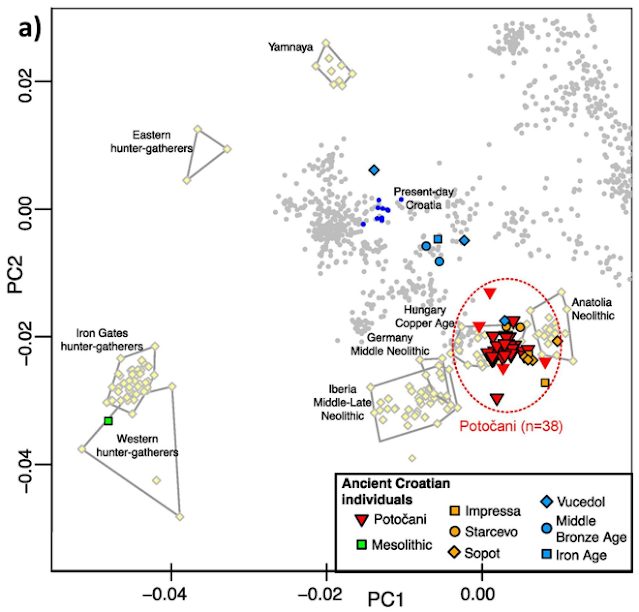
A new study of the remains of 38 people in a mass grave from 6200 years ago in Croatia provides evidence of the mass execution of the all or most of the residents of a small copper age farming villages who were predominantly descended from Anatolian Neolithic farmers. 

We don't know why it happened, but the fact that it did belies the myth that early farming civilizations were peaceful utopias.


Mario Novak and his colleagues have just published a paper entitled: Genome-wide analysis of nearly all the victims of a 6200 year old massacre. They sequenced the genome of 38 of the 41 individuals found in a mass grave 2m in diameter and 1m deep in Potočani, Croatia. 
. . .

Radiocarbon dating measurements showed that these skeletons date from 4200 BC. JC. corresponding to the Eneolithic (copper age) culture of Lasinja. Anthropological analyzes have shown that thirteen of these individuals (six children, three men and four women) presented with peri-mortem cranial injuries located on the side or back of the head which suggest a single summary execution event.

The genetic results indicate that all of these individuals show a very homogeneous ancestry. 
. . . 
On average, these individuals have 91% of farming ancestry from Anatolia and 9% of hunter-gatherer ancestry from the west. They have no ancestry at all from the pastoralists of the steppes. . . . These results are confirmed by the analysis of the haplogroups of the Y chromosome: G2, I2 and C-V20, and in particular the absence of the haplogroups R1a and R1b-M269. There are in particular six different paternal lineages. In addition, analysis of mitochondrial haplogroups identifies 30 different haplotypes suggesting a large community. . . . only eleven individuals present close relationships (up to the third degree), thus forming 4 families:

* a man, his two daughters and his nephew
* two sisters with a third cousin
* A father and his son
* a boy with his paternal aunt (or his half-sister)

This group of people does not therefore correspond to a single extended family because 70% of them have no family relationship. In addition, among all the individuals there are 20 female and 18 male. This massacre therefore does not correspond to the result of a battle but rather to the extermination of a village community made up of many different families.

Analysis of the homozygosity segments indicates that there is very little inbreeding among these individuals.
Via Bernard's blog (translated into English by Google).

Wednesday, March 10, 2021

Primordial Dark Hole Dark Matter Largely Ruled Out

Proposals for large dim objects such as brown dwarfs which are very dim from a detectable radiation perspective (called MACHOs), or dust or interstellar gas, made of ordinary matter, were ruled out as dark matter candidates long ago. So were ordinary neutrinos (called "hot dark matter").

There are some "out there" proposals that exotic electromagnetically neutral hadrons made of ordinary matter bound by the strong force (e.g. hexaquarks) could serve as dark matter if they were stable. But the strong circumstantial evidence that such hadrons are not stable (e.g., even a really heavy one would have a mass of less than 30 GeV or so and no evidence of stable heavy hadrons have been seen at the 14 TeV of the LHC),, and the lack of evidence of interactions with ordinary matter via the weak force in direct detection experiments also strongly disfavors this class of proposals at masses up to hundreds of GeVs.

Primordial black holes are the last significant proposal for dark matter particle candidates not requiring either particles beyond the Standard Model or gravitational effects beyond Newtonian gravity in the weak field (which is conventionally as a practical matter used to approximate weak field General Relativity in galaxy and galactic cluster and smaller scale cosmology settings by warm and cold dark matter cosmology theorists) to exist.

Small primordial black holes can be ruled out as dark matter candidates because they would decay due to Hawking Radiation too quickly for enough of them to survive to this point from the Big Bang to the current age of the Universe.

Large primordial black holes are ruled out by micro-lensing data and other means.

There is a window between those two constraints for asteroid sized primordial black holes to constitute dark matter, but the paper whose abstract appears below purports (convincingly) to close that gap.
The nature of dark matter (DM) is unknown. 
One compelling possibility is DM being composed of primordial black holes (PBHs), given the tight limits on some types of elementary particles as DM. There is only one remaining window of masses available for PBHs to constitute the entire DM density, 10^17 - 10^23 g. 
Here, we show that the kernel population in the cold Kuiper belt rules out this window, arguing in favor of a particle nature for DM.

Amir Sirajh, Abraham Loeb, "Eliminating the Remaining Window for Primordial Black Holes as Dark Matter from the Dynamics of the Cold Kuiper Belt" arXiv (March 8, 2021). 

To be clear, the paper doesn't rule out the possibility that primordial black holes (i.e. black holes initially formed by means other than the collapse of stars and subsequently by mergers of black holes with each other and by accreting other matter and energy on contact, in the time frame shortly after the Big Bang) exist at all. 

It merely rules out the hypothesis that primordial black holes are the exclusive or predominant part of the solution of explaining dark matter phenomena. Explanations other than that are needed to explain dark matter phenomena which are observed.

The Wikipedia article on Primordial Black Holes, linked above, provides additional recent constraints from the literature that bolster this conclusion:

Depending on the model, primordial black holes could have initial masses ranging from 10^−8 kg (the so-called Planck relics) to more than thousands of solar masses. However, primordial black holes originally having mass lower than 10^11 kg would not have survived to the present due to Hawking radiation, which causes complete evaporation in a time much shorter than the age of the Universe.  
Primordial black holes are non-baryonic and as such are plausible dark matter candidates. Primordial black holes are also good candidates for being the seeds of the supermassive black holes at the center of massive galaxies, as well as of intermediate-mass black holes.

Primordial black holes belong to the class of massive compact halo objects (MACHOs). They are naturally a good dark matter candidate: they are (nearly) collision-less and stable (if sufficiently massive), they have non-relativistic velocities, and they form very early in the history of the Universe (typically less than one second after the Big Bang). Nevertheless, tight limits on their abundance have been set up from various astrophysical and cosmological observations, so that it is now excluded that they contribute significantly to dark matter over most of the plausible mass range.

In March 2016, one month after the announcement of the detection by Advanced LIGO/VIRGO of gravitational waves emitted by the merging of two 30 solar mass black holes (about 6×10^31 kg), three groups of researchers proposed independently that the detected black holes had a primordial origin.[10][11][12][13]
Two of the groups found that the merging rates inferred by LIGO are consistent with a scenario in which all the dark matter is made of primordial black holes, if a non-negligible fraction of them are somehow clustered within halos such as faint dwarf galaxies or globular clusters, as expected by the standard theory of cosmic structure formation. The third group claimed that these merging rates are incompatible with an all-dark-matter scenario and that primordial black holes could only contribute to less than one percent of the total dark matter. The unexpected large mass of the black holes detected by LIGO has strongly revived interest in primordial black holes with masses in the range of 1 to 100 solar masses. It is however still debated whether this range is excluded or not by other observations, such as the absence of micro-lensing of stars, the cosmic microwave background anisotropies, the size of faint dwarf galaxies, and the absence of correlation between X-ray and radio sources towards the galactic center.

In May 2016, Alexander Kashlinsky suggested that the observed spatial correlations in the unresolved gamma-ray and X-ray background radiations could be due to primordial black holes with similar masses, if their abundance is comparable to that of dark matter.

In April 2019, a study was published suggesting this hypothesis may be a dead end. An international team of researchers has put a theory speculated by the late Stephen Hawking to its most rigorous test to date, and their results have ruled out the possibility that primordial black holes smaller than a tenth of a millimeter (7 × 10^22 kg) make up most of dark matter.[15][16]

In August 2019, a study was published opening up the possibility of making up all dark matter with asteroid-mass primordial black holes (3.5 × 10^−17 – 4 × 10^−12 solar masses, or 7.0 × 10^13 – 8 × 10^18 kg).[17]
<10> Bird, S.; Cholis, I. (2016). "Did LIGO Detect Dark Matter?". Physical Review Letters. 116 (20): 201301. arXiv:1603.00464. doi:10.1103/PhysRevLett.116.201301. 
<11> Clesse, S.; Garcia-Bellido, J. (2017). "The clustering of massive Primordial Black Holes as Dark Matter: Measuring their mass distribution with Advanced LIGO". Physics of the Dark Universe. 10 (2016): 142–147. arXiv:1603.05234.  doi:10.1016/j.dark.2016.10.002. 
<12> Sasaki, M.; Suyama, T.; Tanaki, T. (2016). "Primordial Black Hole Scenario for the Gravitational-Wave Event GW150914". Physical Review Letters. 117(6): 061101. arXiv:1603.08338. doi:10.1103/PhysRevLett.117.061101. 
<14> Kashlinsky, A. (2016). "LIGO gravitational wave detection, primordial black holes and the near-IR cosmic infrared background anisotropies". The Astrophysical Journal. 823 (2): L25. arXiv:1605.04023.  doi:10.3847/2041-8205/823/2/L25.
<15> "Dark matter is not made up of tiny black holes". ScienceDaily. 2 April 2019. Retrieved 27 September 2019.
<16> Niikura, H.; Takada, M.; Yasuda, N.; et al. (2019). "Microlensing constraints on primordial black holes with Subaru/HSC Andromeda observations". Nature Astronomy. 3 (6): 524–534. arXiv:1701.02151.  doi:10.1038/s41550-019-0723-1. 
<17> Montero-Camacho, Paulo; Fang, Xiao; Vasquez, Gabriel; Silva, Makana; Hirata, Christopher M. (2019-08-23). "Revisiting constraints on asteroid-mass primordial black holes as dark matter candidates". Journal of Cosmology and Astroparticle Physics. 2019 (8): 031. arXiv:1906.05950.  doi:10.1088/1475-7516/2019/08/031. 

The Wikipedia article goes on to note that: 

A variety of observations have been interpreted to place limits on the abundance and mass of primordial black holes: 
* Lifetime, Hawking radiation and gamma-rays: One way to detect primordial black holes, or to constrain their mass and abundance, is by their Hawking radiation. Stephen Hawking theorized in 1974 that large numbers of such smaller primordial black holes might exist in the Milky Way in our galaxy's halo region. All black holes are theorized to emit Hawking radiation at a rate inversely proportional to their mass. Since this emission further decreases their mass, black holes with very small mass would experience runaway evaporation, creating a burst of radiation at the final phase, equivalent to a hydrogen bomb yielding millions of megatons of explosive force.[21] 
A regular black hole (of about 3 solar masses) cannot lose all of its mass within the current age of the universe (they would take about 10^69 years to do so, even without any matter falling in). However, since primordial black holes are not formed by stellar core collapse, they may be of any size. A black hole with a mass of about 10^11 kg would have a lifetime about equal to the age of the universe. If such low-mass black holes were created in sufficient number in the Big Bang, we should be able to observe explosions by some of those that are relatively nearby in our own Milky Way galaxy. NASA's Fermi Gamma-ray Space Telescope satellite, launched in June 2008, was designed in part to search for such evaporating primordial black holes. Fermi data set up the limit that less than one percent of dark matter could be made of primordial black holes with masses up to 10^13 kg. Evaporating primordial black holes would have also had an impact on the Big Bang nucleosynthesis and change the abundances of light elements in the Universe. However, if theoretical Hawking radiation does not actually exist, such primordial black holes would be extremely difficult, if not impossible, to detect in space due to their small size and lack of large gravitational influence.

* Lensing of gamma-ray bursts: Compact objects can induce a change in the luminosity of gamma-ray bursts when passing close to their line-of-sight, through the gravitational lensing effect. The Fermi Gamma-Ray Burst Monitor experiment found that primordial black holes cannot contribute importantly to the dark matter within the mass range 5 x 10^14 – 10^17 kg.[22] A re-analysis, however, has removed this limit after properly taking into account the extended nature of the source as well as wave optics effects.[23]

* Capture of primordial black holes by neutron stars: If primordial black holes with masses between 10^15 kg and 10^22 kg had abundances comparable to that of dark matter, neutron stars in globular clusters should have captured some of them, leading to the rapid destruction of the star.[24] The observation of neutron stars in globular clusters can thus be used to set a limit on primordial black hole abundance. However, a detailed study of the capture dynamics has challenged this limit and led to its removal.[17]

* Survival of white dwarfs: If a primordial black hole passes through a C/O white dwarf, it may ignite the carbon and subsequently produce a runaway explosion. The observed white dwarf mass distribution can thus provide a limit on primordial black hole abundance. Primordial black holes in the range of ~10^16 – 10^17 kg have been ruled out for being a dominant constituent of the local dark matter density. Furthermore, the runaway explosion may be seen as a Type Ia supernova. Primordial black holes in the mass range 10^17–10^19  kg are limited by the observed supernova rate, though these bounds are subject to astrophysical uncertainties.[25] A detailed study with hydrodynamic simulations have challenged these limits and led to the re-opening of these mass ranges.[17]

* Micro-lensing of stars: If a primordial black hole passes between us and a distant star, it induces a magnification of these stars due to the gravitational lensing effect. By monitoring the magnitude of stars in the Magellanic Clouds, the EROS and MACHO surveys have put a limit on the abundance of primordial black holes in the range 10^23 – 10^31 kg. By observing stars in the Andromeda Galaxy (M31), the Subaru/HSC have put a limit on the abundance of primordial black holes in the range 10^19 - 10^24 kg. According to these surveys, primordial black holes within this range cannot constitute an important fraction of the dark matter.[26][27][16] However, these limits are model-dependent. It has been also argued that if primordial black holes are regrouped in dense halos, the micro-lensing constraints are then naturally evaded.[11] The micro-lensing technique suffers from the finite-size source effect and the diffraction when probing primordial black holes with smaller masses. Scaling laws were derived to demonstrate that the optical micro-lensing is unlikely to limit the abundance of primordial black holes with masses below ~10^18 kg in a foreseeable future.[17]

* Micro-lensing of Ia supernovae: Primordial black holes with masses larger than 10^28 kg would magnify distant type Ia supernova (or any other standard candle of known luminosity) due to gravitational lensing. These effects would be apparent if primordial black holes were a significant contribution to the dark matter density, which is constrained by current data sets.[28][29]

* Temperature anisotropies in the cosmic microwave background: Accretion of matter onto primordial black holes in the early Universe should lead to energy injection in the medium that affects the recombination history of the Universe. This effect induces signatures in the statistical distribution of the cosmic microwave background (CMB) anisotropies. The Planck observations of the CMB exclude that primordial black holes with masses in the range 100 – 10^4 solar masses contribute importantly to the dark matter,[30] at least in the simplest conservative model. It is still debated whether the constraints are stronger or weaker in more realistic or complex scenarios. 
* Gamma-ray signatures from annihilating dark matter: If the dark matter in the Universe is in the form of weakly interacting massive particles or WIMPs, primordial black holes would accrete a halo of WIMPs around them in the early universe.[31] The annihilation of WIMPs in the halo leads to a signal in the gamma-ray spectrum which is potentially detectable by dedicated instruments such as the Fermi Gamma-ray Space Telescope.[32]

At the time of the detection by LIGO of the gravitational waves emitted during the final coalescence of two 30 solar mass black holes, the mass range between 10 and 100 solar masses was still only poorly constrained. Since then, new observations have been claimed to close this window, at least for models in which the primordial black holes have all the same mass: 
* from the absence of X-ray and optical correlations in point sources observed in the direction of the galactic center.[33] 
* from the dynamical heating of dwarf galaxies[34] 
* from the observation of a central star cluster in the Eridanus II dwarf galaxy (but these constraints can be relaxed if Eridanus II owns a central intermediate mass black hole, which is suggested by some observations).[35] If primordial black holes exhibit a broad mass distribution, those constraints could nevertheless still be evaded. 
* from the gravitational micro-lensing of distant quasars by closer galaxies, allowing only 20% of the galactic matter to be in the form of compact objects with stellar masses, a value consistent with the expected stellar population.[36] 
* from micro-lensing of distant stars by galaxy clusters, suggesting that the fraction of dark matter in the form of primordial black holes with masses comparable to those found by LIGO must be less than 10%.[37]
Another hypothesis related to Primordial Black Holes would not ncessarily be ruled out:
In September 2019, a report by James Unwin and Jakub Scholtz proposed the possibility of a primordial black hole (PBH) with mass 5–15 M⊕, about the diameter of a tennis ball, existing in the extended Kuiper Belt to explain the orbital anomalies that are theorized to be the result of a 9th planet in the solar system.

Dark Matter and Dark Energy As General Relativity Integration Constants

This preprint is on the right track. 

Notoriously, the two main problems of the standard CDM model of cosmology are the cosmological constant and the cold dark matter, CDM. This essay shows that both the and the CDM arise as integration constants in a careful derivation of Einstein's equations from first principles in a Lorentz gauge theory. The dark sector of the universe might only reflect the geometry of a spontaneous symmetry breaking that is necessary for the existence of a spacetime and an observer therein.

Priidik Gallagher, Tomi Koivisto, "The Λ and the CDM as integration constants" arXiv (March 9, 2021).

From the body text:

General relativity is the local version of special relativity. Gravity is thus understood to be a gauge theory of the Lorentz group. 
The basic variable is then a Lorentz connection 1-form ω^a(b), which defines the covariant derivative D, and thereby the curvature 2-form R^a(b) = dω^a(b) + ω^a(c) ∧ ω^c(b) subject to the 3-form Bianchi identity DR^a(b) = 0 inherited from the Jacobi identity of the Lorentz algebra. 
Since the beginning, the role of translations in the inhomogeneous Lorentz group has been elusive. What has been clear is that, in order to recover the dynamics of general relativity, some extra structure is required besides the connection ω^a(b). The standard approach since Kibble’s work has been to introduce the coframe field e^a , another 1-form valued in Lorentz algebra. Only recently, the more economical possibility of introducing solely a scalar field τ^a , was put forward by Zlo´snik et al. Only then is gravity described by variables that are fully analogous to the fields of the standard Yang-Mills theory. The symmetry-breaking scalar τ a has been called the (Cartan) Khronon because it encodes the foliation of spacetime. The theory of Zlo´snik et al is pre-geometric in the sense that there exist symmetric solutions (say τ^a = 0) where there is no spacetime. Only in a spontaneously broken phase τ^2 < 0, there emerges a coframe field e^a = Dτ^a and further, if the coframe field is non-degenerate, a metric tensor g(µν)dx^µ ⊗ dx^ν = η(ab)e^a ⊗ e^b. In terms of the 2 fundamental fields, the Lorentz connection and the Khronon scalar, the theory realises the idea of observer space. 
A serendipitous discovery was that in the broken phase the theory does not quite reduce to general relativity, but to general relativity with dust. The presence of this “dust of time” could explain the cosmological observations without dark matter. In this essay, we shall elucidate how this geometrical dark matter appears as an integration constant at the level of field equations. In addition, we consider the next-to-simplest model by introducing the cosmological Λ-term. This will require another symmetry-breaking field, the (Weyl) Kairon σ^a , which turns out to impose unimodularity. 
The conclusion we wish to present is that a minimalistic gauge theory of gravity includes both the Λ and CDM, and they both enter into the field equations as integration constants in the broken phase. . . . 

the similar magnitude of the observed energy densities due to the Λ and due to the CDM could be the result of their common origin in the conformal geometry of the observer space.

Rather than unknown particles or modified gravity, the dark sector of the universe could be the manifestation of a spontaneous symmetry breaking that underpins the emergence of a metric spacetime. In a rigorous derivation of the Einstein’s field equations from a more fundamental, pre-geometric theory, both the Λ and the CDM appear as integration constants. Though spontaneous symmetry breaking has been considered as the origin for the difference between time and space, similar results to ours have not, to our knowledge, been arrived at in less minimalistic settings. 

Of the 12 real components of the complexified Lorentz connection ω a b, the 6 self-dual pieces +ω^a(b) account for the spin connection as usual, whereas 3 (the boosts −ω^I(0) in the τ^a = τδ^a(0) gauge) give rise to the spatial triad through e^a = Dτ^a in the broken phase. It remains to be seen whether the 3 remaining anti-self-dual rotations −ω^I(J) could be related to the SU(2)(L) connection in the particle sector, and whether the scalars τ^a and σ^a could be related to the Higgs field. Another speculation is that our formulation might provide an improved starting point for loop quantum gravity that is currently suffering from a “covariance crisis”. 

To conclude, we propose a theory behind the two main parameters of the standard ΛCDM model of cosmology. 

• 1st Λ problem, the sensitivity of gravity to vacuum energy, is resolved. 

• 2nd Λ problem, the observed value of Λ, is related to the age of the Universe. 

• 3rd Λ problem, the coincidence that m^2(P)Λ ∼ ρ, has a rationale in their dual origin. In particular, from the construction of the 3-form M^a we have that ∂τ ∼ √p m(P)/ρ, and ∂(µ)σ^µ ∼ 1/√Λ. The duality τ ∼ σ could explain the cosmic coincidence.

Tuesday, March 9, 2021

23 and Me Korea-Japan Glitch Fixed

When the home genetic testing firm 23andMe first provided reports for my wife, her parents, her sister, my children, and my nice and nephew who are children of her sister, the reports showed a significant share of Japanese ancestry. 

This would be a scandalous fact, if true, as it would indicate, in all likelihood, a child born from a Japanese father during Japanese occupation (from 1910 to 1945), or from a Korean man collaborating with the Japanese in that era who married a Japanese woman in connection with that event, something that came be to seen as dishonorable. 

The bite was particularly cutting in this case because my wife's mother's family, in particular, was part of the big business economic elite of the pre-Korean War Korean nation, and would have had lots of economic and social ties to members of the Japanese occupation elites as a result.

But while it wasn't absolute impossible that there was cryptic Japanese ancestry in the family, her parents family ancestry was know to them to be exclusively Korean in their parents and grandparents generations, at a minimum, so the percentages shown were impossible. Also, pretty much all other Koreans we knew who had done consumer genetic testing, were seeing the same thing.

The reality was a methodological artifact rooted in a historical reality that blind cluster analysis performed by computers couldn't grok. 

The modern Japanese people are the admixed product of the indigenous Japanese Jomon people (mostly with a sedentary fishing village based economic foundation) whose ancestors arrived on these islands on the order of 8,000 to 16,000 years ago, and the Yayoi soldier-rice farmers who arrived around 2,300 years ago by sea from Korea and conquered the Jomon and their land.

Modern Japanese people are 9-13% Jomon in origin (measured by autosomal genetics), although modern Japanese men are about 1/3rd Jomon in Y-DNA and a significantly smaller share of modern Japanese people are Jomon in mtDNA, which is inherited from mother to child. 

This mix of uniparental markers is quite surprising. Usually more maternal than paternal uniparental DNA survive by introgression into a conquering people from the people who conquerer them, as male soldiers or pioneers or explorers take local wives. The fact that there is virtually no Jomon linguistic substrate in the Japanese language also limits to the scope of the possible narratives that could cause this unual uniparental DNA marker mix to arise. The cultural process by which this happened in Japan starting around 2,300 years ago is still not well understood. 

A best guess would be that Yayoi soldiers recruited and then thoroughly assimilated local Jomon boys into their army who would leave few linguistic substrates due to their superior youthful language learning abilities. Then, the Yayoi brought wives for all of its soldiers and veterans, including Jomon boy recruits, from Korea, which was not far away, rather than taking local wives. Given the overall percentage of Jomon automsomal ancestry in the Japanese, most Japanese Jomon autosomal DNA probably derives from Jomon origin fathers rather than Jomon origin mothers. But, this is little more than an educated guess. 

Anyway, the bottom line is that modern Japanese people are predominantly Korean in remote genetic origin. Admittedly, the genetic makeup of Korea 2300 years ago was somewhat different than it is today. Also, there was significant later Chinese genetic introgression into Japan via wives imported from China to Japan for elite Japanese men for many centuries after the initial ethnogenesis of the Japanese people. This happened because Chinese wives were considered prestigious because China had the most sophisticated civilization in East Asia at the time. Strong ties to China also did have significant linguistic impact on the Japanese language.

But because the 23andMe database has more Japanese samples than Korean samples, and because there is heavy overlap between the two populations, a computerized blind cluster analysis by 23andMe assumed that many Koreans had Japanese admixture. 

In reality, however, unless someone has a significant minority of Jomon origin genes in their genome as a whole, someone with genes found in both Japanese people and Korean people almost certainly has no Japanese admixture, even if they have many genes that are common in Japanese people.

Eventually 23andMe figured this out, and in a December 2020 update, it now reports that my wife's parents and their descendants all have 100% Korean ancestry (even though my wife's father's Y-DNA haplogroup, O-CTS723 which is a subclade of O-M268, is one that was common among the Yayoi).

Now, the handling of their Korean origins still isn't perfect. 23andMe says that everyone in the family has localized Korean origins that are most likely in Seoul, South Korea. And, this is true as of the post-Korean War era in the 1950s. My wife's parents emigrated there during the Korean War (i.e. June 25, 1950-July 27, 1953) in their tweens or teens about fifteen years before moving to the United States. But, her parents lived the first half of their Korean lives in North Korea, where they were born, as did at least a couple of generations of their ancestors. Yet, 23andMe states that they have 0% North Korean origins. 

Still, two cheers for progress.

Sunday, March 7, 2021

A Story Of Leto

This is a little known classical Greek transgender myth, facilitated by the Titaness Leto (the mother of the twins Apollo and Artemis, by Zeus, and nemesis of Zeus's wife Hera) who was worshiped as a god of fertility and motherhood, often together with her twin children, and was probably derived from a pre-Greek Anatolian goddess of motherhood.
In Crete lived a couple, Galatea and Lamprus. When Galatea fell pregnant, Lamprus warned her that if the child turned out to be female, he would expose it. When Galatea gave birth, it proved indeed to be a girl. 
Galatea, fearing her husband, lied to him, telling him it was a boy she named Leucippus. But as years passed, Leucippus grew to be an exceptional beautiful girl, and her true sex could not be concealed. 
Galatea fled to the temple of Leto, and prayed to the goddess. Leto took pity in mother and child, and changed Leucippus into a boy. To celebrate this, the people at Phaestus sacrificed to Leto Phytia.
From Wikipedia citing Antoninus Liberalis, Metamorphoses 17.

Thursday, March 4, 2021

Long Distance Obsidian Trade In Pre-Columbian North America

I knew that there were long distance economic links in pre-Columbian America, but I was not aware that it extended to the fruits of hard rock mining.  

On the Scioto River south of Columbus, Ohio, archaeologists identified 300 pounds of Yellowstone obsidian in mounds built by the Hopewell people 2,000 years ago. It’s possible the obsidian was traded there by intermediaries, but MacDonald and some other archaeologists believe that groups of Hopewell made the 4,000-mile round trip, by foot and canoe, to bring back the precious stone.

Via John Hawks blog. 

Monday, March 1, 2021

The Ecological Impact Of Adolescent T-Rex Type Dinosaurs

There are small predator dinosaurs and huge predator dinosaurs (1000 kg to 8000 kg), but none with adult sizes between 100 kg and 1000 kg. 

Why?

Because that ecological gap was filled by adolescent dinosaurs that are the size of house cases when born but grow to the size of a city bus as an adult.
Because they were born from eggs, dinosaurs like T. rex necessarily were born small -- about the size of a house cat. This meant as they grew to the size of a city bus, these "megatheropods," weighing between one and eight tons, would have changed their hunting patterns and prey items. It's long been suspected by paleontologists that giant carnivorous dinosaurs would change behavior as they grew. But how that might have affected the world around them remained largely unknown.

"We wanted to test the idea that dinosaurs might be taking on the role of multiple species as they grew, limiting the number of actual species that could co-exist in a community," said Schroeder.

The number of different types of dinosaurs known from around the globe is low, particularly among small species.

"Dinosaurs had surprisingly low diversity. Even accounting for fossilization biases, there just really weren't that many dinosaur species," said Felisa Smith, professor of Biology at UNM and Schroeder's graduate advisor.

To approach the question of decreased dinosaur diversity, Schroeder and her coauthors collected data from well-known fossil localities from around the globe, including over 550 dinosaur species. Organizing dinosaurs by mass and diet, they examined the number of small, medium and large dinosaurs in each community.

They found a strikingly clear pattern:

"There is a gap -- very few carnivorous dinosaurs between 100-1000kg [200 pounds to one ton] exist in communities that have megatheropods," Schroeder said. "And the juveniles of those megatheropods fit right into that space."

Schroeder also notes that looking at dinosaur diversity through time was key. Jurassic communities (200-145 million years ago) had smaller gaps and Cretaceous communities (145-65 million years ago) had large ones.

"Jurassic megatheropods don't change as much -- the teenagers are more like the adults, which leaves more room in the community for multiple families of megatheropods as well as some smaller carnivores," Schroeder explained. "The Cretaceous, on the other hand, is completely dominated by Tyrannosaurs and Abelisaurs, which change a lot as they grow."

To tell whether the gap was really caused by juvenile megatheropods, Schroeder and her colleagues rebuilt communities with the teens taken into account. By combining growth rates from lines found in cross-sections of bones, and the number of infant dinosaurs surviving each year based on fossil mass-death assemblages, the team calculated what proportion of a megatheropod species would have been juveniles.

Schroeder explained that this research is important because it (at least partially) elucidates why dinosaur diversity was lower than expected based on other fossil groups. It also explains why there are many more very large species of dinosaurs than small, which is the opposite of what would be expected. But most importantly, she added, it demonstrates the results of growth from very small infants to very large adults on an ecosystem.
From Science Daily. The paper with its significance statement and abstract are as follows:
Not enough room

Modern carnivore communities include species that span a range of body sizes. For example, on the African savannah, there are small species (mongooses), medium species (wild dogs), and large species (lions). This variation reflects available prey sources that best suit each group. Carnivorous dinosaur communities, however, were missing species that fall into the middle, or mesocarnivore, group as adults. Schroeder et al. looked across communities, space, and time and found that this absence appears to have been driven by the distinctive biology of dinosaurs, in which giant adults start out as tiny hatchlings. Growing juvenile dinosaurs thus filled the other niches and limited trophic species diversity.

Abstract

Despite dominating biodiversity in the Mesozoic, dinosaurs were not speciose. Oviparity constrained even gigantic dinosaurs to less than 15 kg at birth; growth through multiple morphologies led to the consumption of different resources at each stage. Such disparity between neonates and adults could have influenced the structure and diversity of dinosaur communities. Here, we quantified this effect for 43 communities across 136 million years and seven continents. We found that megatheropods (more than 1000 kg) such as tyrannosaurs had specific effects on dinosaur community structure. Although herbivores spanned the body size range, communities with megatheropods lacked carnivores weighing 100 to 1000 kg. We demonstrate that juvenile megatheropods likely filled the mesocarnivore niche, resulting in reduced overall taxonomic diversity. The consistency of this pattern suggests that ontogenetic niche shift was an important factor in generating dinosaur community structure and diversity.
Katlin Schroeder, S. Kathleen Lyons, Felisa A. Smith. "The influence of juvenile dinosaurs on community structure and diversity." 371 (6532) Science 941 (2021). DOI: 10.1126/science.abd9220

Search for Heavy Higgs Bosons Comes Up Empty

The Large Hadron Collider's purge of beyond the Standard Model theories that predict new phenomena at energy scales from the electroweak scale (up to about 246 GeV) to about ten times that energy scale continues.

Diphoton decay outcomes were key in discovering the Standard Model Higgs boson, even though they make up a fairly small share of Higgs boson decays, because not many Standard Model particle decays produce them, so there are few backgrounds that have to be statistically deducted from what is observed and those that are seen are well defined. So, any unknown physical processes that produce them would be easy to see. And, some of the leading benchmark models for new physics that the LHC routine looks for produce them.

The ATLAS experiment at the Large Hadron Collider has largely ruled out electromagnetically neutral heavy Higgs bosons (which are predicted in all supersymmetric models and all models with more than one Higgs doublet) with masses from 160 GeV to 2800 GeV. Many supersymmetric "sparticles" also have spin-0 are are predicted in SUSY models to have diphoton decays as do models with neutral Z' bosons. They are ruled out for masses from 160 GeV to 2800 GeV as well. Spin-2 massive gravitons predicted by the the Randall–Sundrum model with masses of up to 4500 GeV are also ruled out. 

The absence of this evidence is a big problem, for example, for E6 exceptional group based grant unifications theories which are among the most popular grand unification theories:

Signatures of E6 include [an] extension of the Higgs sector; existence of neutral Z' gauge bosons at masses above the electroweak scale. . . ; the production of new vector-like quarks and leptons, and manifestations of the neutral fermion. . . through its mixing with other neutral leptons, giving rise to signatures of “sterile” neutrinos. Up to now, with the possible exception of weak evidence for sterile neutrinos there has been no indication of the extra degrees of freedom entailed by the 27-plet of E6.

The new diphoton search paper concludes that:

Searches for new resonances in high-mass diphoton final states with the ATLAS experiment at the LHC are presented. The searches use the full LHC Run 2 proton–proton collision dataset at a centre-of-mass energy of √ 𝑠 = 13 TeV, corresponding to an integrated luminosity of 139 fb−1 . The analyses are optimized to search for spin-0 resonances with masses above 200 GeV and for spin-2 resonances predicted by the Randall–Sundrum model with masses above 500 GeV.

The data are consistent with the Standard Model background expectation. In the spin-0 resonance search, the observed 95% CL upper limits on the fiducial cross-section times branching ratio for a narrow-width signal range from 12.5 fb at 160 GeV to about 0.03 fb at 2800 GeV.  In the spin-2 resonance search, the observed limits on the total cross-section times branching ratio for 𝑘/𝑀Pl = 0.1 range from 3.2 fb to about 0.04 fb for a graviton mass between 500 and 5000 GeV, and the RS1 graviton is excluded for masses below 4500 GeV for this coupling .

The February 26, 2021 pre-print whose vacuous abstract adds nothing to the quoted language from its conclusion above is here. 

The range of a force carried by a massive boson is inversely related to its mass. The range of the part of the nuclear binding force carried by pions (which are about 140 MeV in mass) is about 1.5 femtometer (about twice the size of a proton or neutron). 

So, the range of an RS1 graviton would be about 32,000 times smaller than the pion carried part of the nuclear binding force (and about 50 times smaller than the range of the weak force) and would never manage to get from even one quark to another within a proton, neutron, pion, or other hadron made up of quarks, and is also far too unstable to be a dark matter candidate. It would, however, provide a candidate for a milli-charged interaction with ordinary matter for a non-self-interacting dark matter candidate that interacted in a feeble non-gravitational way with ordinary matter at a strength much less than neutrinos.

Another pre-print carefully details the ways that the LHC has not been kind of composite Higgs boson models, which, generically, should produce some properties different from the Standard Model Higgs boson. Two tables from the paper summarize the experiment bounds from the CMS and ATLAS experiments on such deviations:

A portion of the abstract of a new preprint from BESIII also reminds us why we search:

The Standard Model (SM) of particle physics, comprised of the unified electro-weak (EW) and Quantum Chromodynamic (QCD) theories, accurately explains almost all experimental results related to the micro-world, and has made a number of predictions for previously unseen particles, most notably the Higgs scalar boson, that were subsequently discovered. As a result, the SM is currently universally accepted as the theory of the fundamental particles and their interactions. 
However, in spite of its numerous successes, the SM has a number of apparent shortcomings including: many free parameters that must be supplied by experimental measurements; no mechanism to produce the dominance of matter over antimatter in the universe; and no explanations for gravity, the dark matter in the universe, neutrino masses, the number of particle generations, etc. Because of these shortcomings, there is considerable incentive to search for evidence for new, non-SM physics phenomena that might provide important clues about what a new, beyond the SM theory (BSM) might look like.

Extensions of the Standard Model are likely to address some of these issues. Specifically:

* many free parameters that must be supplied by experimental measurements

* neutrino masses, and

* the number of particle generations.

But others issues are more likely to come from quantum gravity and/or cosmology developments:

* no mechanism to produce the dominance of matter over antimatter in the universe

* no explanations for gravity, and 

* the dark matter in the universe.

Sunday, February 28, 2021

North American Megafauna Extinction Driven Mostly By Younger Dryas

The evidence increasingly favors a larger role for the Younger Dryas climate event, and a smaller role for over hunting in North American megafauna extinctions. 

"Megafauna populations appear to have been increasing as North American began to warm around 14,700 years ago," states Stewart. "But we then see a shift in this trend around 12,900 years ago as North America began to drastically cool, and shortly after this we begin to see the extinctions of megafauna occur."

And while these findings suggest that the return to near glacial conditions around 12,900 years ago was the proximate cause for the extinctions, the story is likely to be more complicated than this.

"We must consider the ecological changes associated with these climate changes at both a continental and regional scale if we want to have a proper understanding of what drove these extinctions," explains group leader Huw Groucutt, senior author of the study. "Humans also aren't completely off the hook, as it remains possible that they played a more nuanced role in the megafauna extinctions than simple overkill models suggest."

Many researchers have argued that it is an impossible coincidence that megafauna extinctions around the world often happened around the time of human arrival. However, it is important to scientifically demonstrate that there was a relationship, and even if there was, the causes may have been much more indirect (such as through habitat modification) than a killing frenzy as humans arrived in a region.

From Science Daily.

The disappearance of many North American megafauna at the end of the Pleistocene is a contentious topic. While the proposed causes for megafaunal extinction are varied, most researchers fall into three broad camps emphasizing human overhunting, climate change, or some combination of the two. Understanding the cause of megafaunal extinctions requires the analysis of through-time relationships between climate change and megafauna and human population dynamics. To do so, many researchers have used summed probability density functions (SPDFs) as a proxy for through-time fluctuations in human and megafauna population sizes. SPDFs, however, conflate process variation with the chronological uncertainty inherent in radiocarbon dates. Recently, a new Bayesian regression technique was developed that overcomes this problem—Radiocarbon-dated Event-Count (REC) Modelling. 
Here we employ REC models to test whether declines in North American megafauna species could be best explained by climate changes, increases in human population densities, or both, using the largest available database of megafauna and human radiocarbon dates. Our results suggest that there is currently no evidence for a persistent through-time relationship between human and megafauna population levels in North America. There is, however, evidence that decreases in global temperature correlated with megafauna population declines.
Stewart, M., Carleton, W. C., Groucutt, H. S. "Climate change, not human population growth, correlates with Late Quaternary megafauna declines in North America." Nature Communications (February 16, 2021).  DOI: 10.1038/s41467-021-21201-8

Friday, February 26, 2021

Lepton Universality Not Violated In Top Quark Decays

Lepton universality is the Standard Model principle that electrons, muons, and tau leptons have identical properties except for mass. There have been some experimental anomalies in collider experiments that suggest that this principle is violated despite many other seemingly similar kinds of experiments where these anomalies are not seen.

An new analysis of top quark decays from ATLAS experiment data at the Large Hadron Collider (LHC)  is consistent with an absence of lepton universality violations. This further contributes to the difficulty of identifying any beyond the Standard Model physics that could give rise to the lepton universality anomalies observed in certain kinds of B meson decays, while not producing any signs of lepton universality violations in any other kinds of interactions.

About Newton

Everyone remembers Newton for his contributions to physics. 

But he made much of his fortune as the director of London's mint, making coins, and investing in businesses, after he got sick of being a professor at Cambridge, where he felt tormented as a Unitarian in a Trinitarian institution.