So, I am back from a couple of weeks in Greece, in Athens, the Cyclades, and Crete. Naturally, this got me thinking about a lot of issues of deep history. I'll start with a historical backgrounder.
The Eastern Mediterranean (image from here).
Any assessment of genetic or archaeological or linguistic evidence from Greece and historiography require one to consider the many confounding palimpsest layers in its past that must be considered and stripped away before considering older materials.
Greece had Neanderthals and the earliest modern humans in Europe (as expected almost definitionally as it is the most Southeastern part of Europe).
A One Paragraph Overview Of Holocene Era Greek History
Generally, the history of Greece is divided into the following periods:
- Neolithic Greece covering a period beginning with the establishment of agricultural societies in 7000 BC and ending in 3200/3100 BC,
- Helladic (Minoan or Bronze Age) chronology covering a period beginning with the transition to a metal-based economy in 3200/3100 BC to the rise and fall of the Mycenaean Greek palaces spanning roughly five centuries (1600–1100 BC),
- Ancient Greece covering a period from the fall of the Mycenaean civilization in 1100 BC to 146 BC spanning multiple sub-periods including the Greek Dark Ages (or Iron Age, Homeric Age), Archaic period, the Classical period and the Hellenistic period,
- Roman Greece covering a period from the Roman conquest of Greece in 146 BC to 324 AD,
- Byzantine Greece covering a period from the establishment of the capital city of Byzantium, Constantinople, in 324 AD until the fall of Constantinople in 1453 AD,
- Ottoman Greece covering a period from 1453 up until the Greek Revolution of 1821,
- Modern Greece covering a period from 1821 to the present.
Greece was near the birthplace of the Fertile Crescent Neolithic and had very early Neolithic communities.
Bronze Age Greece
Greeks metal age civilizations including the Minoan civilization were among the earliest, if not the earliest, in Europe, and were pre-Indo-European. A parallel, somewhat less advanced metal age culture arose on the Greek mainland.
Greece has one of the best documented transitions from the non-Indo-European to Indo-European cultures in prehistory with even some written attestation in the form of the Linear A to Linear B and
Eteocretan transitions in addition to rich oral legendary history documented not too long after fact, and contemporaneous Akkadian and Egyptian records.
Iron Age And Early Medieval Greece
In the Iron Age, Greece had periods of
Persian invasion and rule. Briefly, in the early Iron Age, before the Romans became ascendant, they had an ancient maritime colonial civilization that stretched from the Mediterranean coast in Spain to the Black Sea. Culturally and linguistically, "Ancient" and "Classical" Greece in the early Iron Age were in direct cultural continuity with the Mycenaean Greek society that fell during Bronze Age collapse.
The Roman Empire at its greatest extent, 117 CE, the time of Trajan's death (with its vassals in pink) via Wikipedia.
Fun fact: Emperor Hadrian, who is famous for his wall in Britain at something close to the Roman Empire's peak, also built an archway in new half of the city in Athens that survives today and is now at the center of the city. I checked it out in person the day before yesterday.
They spent four and a half centuries ruled by the Romans.
But, they are one of the best examples of a people who were conquered militarily but ended up culturally integrating and subsuming their conquerors to a great extent. When the Western Roman Empire collapsed, the Greek speaking Eastern Roman Empire survived and morphed into the Byzantine Empire centered in
Constantinople, which prevailed in Greece for another eleven centuries (although this was not uniform across all parts of Greece).
Ottoman and Venetian Greece In The Late Middle Ages And Early Modern Period
The division of the Byzantine Empire after the Fourth Crusade (1204-1261 CE) via Wikipedia. The purple territory is the Byzantine Empire proper and the rust colored states are Greek successor states of the Byzantine Empire. The green areas are parts of the Republic of Venice shown with the year that they joined the Republic of Venice. The Brown Sultanate is an immediate predecessor of the Ottoman Empire which would come into being a generation later.
The Byzantine Empire greatly reduced since the 7th century, in the face of an expanding Islamic Empire, lasted for eight centuries, but it was all downhill after 1261 CE, and finally imploded in 1453 CE, after being defeated by the
Ottoman Empire (1299-1922 CE).
The Republic of Venice in the 15th and 16th centuries via Wikipedia.

The Ottoman Empire at its greatest extent in Europe, under Sultan Mehmed IV via Wikipedia.
But, some of Greece resisted the Islamic expansion by becoming an integral part of the
Republic of Venice for many centuries with Heraklion, the current regional capital of Crete, becoming a Venice of the East (the understanding that the term "Oriental" originally referred to what is now often referred to as the "Near East" sunk in).
Eventually the Ottoman Empire did conquer Greece, but this left a remarkably thin lasting impression. Even the "Turkish delights" made famous by C.S. Lewis are called "Greek delights" everywhere in Greece which is allergic to Turkey with whom it has a tortured history of conflict that is ongoing. A
brief period of Greek absolute monarchy under Austro-Hungarian King Otto's brother-in-law (from 1832 to 1843 when he established a constitutional monarchy in which he remained king) left more of a lasting mark on the country than about four centuries of Ottoman Empire rule.
Most of Greece gradually became part of the Ottoman Empire in the 15th century. The Eastern Roman, the direct continuation to the ancient Roman Empire who ruled most of the Greek-speaking world for over 1100 years, had been fatally weakened since the sacking of Constantinople by the Latin Crusaders in 1204.
The Ottoman advance into Greece was preceded by a victory over the Serbs to its north. First, the Ottomans won at 1371 on the Maritsa River – where the Serb forces were led by the King Vukašin of Serbia, the father of Prince Marko and the co-ruler of the last emperor from the Serbian Nemanjic dynasty. This was followed by a draw in the 1389 Battle of Kosovo.
With no further threat by the Serbs and the subsequent Byzantine civil wars, the Ottomans captured Constantinople in 1453 and advanced southwards into Greece, capturing Athens in 1458. The Greeks held out in the Peloponnese until 1460, and the Venetians and Genoese clung to some of the islands, but by 1500 most of the plains and islands of Greece were in Ottoman hands. The mountains of Greece were largely untouched, and were a refuge for Greeks to flee foreign rule and engage in guerrilla warfare.
Cyprus fell in 1571, and the Venetians retained Crete until 1670. The Ionian Islands were only briefly ruled by the Ottomans (Kefalonia from 1479 to 1481 and from 1485 to 1500), and remained primarily under the rule of Venice.

Territorial evolution of Kingdom of Greece until 1947 CE via Wikipedia.
The territories in yellow, acquired in 1920, were ceded back to Turkey in 1923.
Eventually, staring with the proclamation of the Greek Revolution in October of 1821, the Greeks finally secure independence after a long hiatus (I'm not sure that Greece was ever a unified kingdom before this time, as opposed to a civilization of interacting balkanized city-states and small principalities, even in its Golden Age). This was a period of tremendous growth, urbanization and modernization, a bit like that of countries emerging from Eastern Europe and the Communist regimes in the 20th century. As explained
here:
The urban population tripled from 8% in 1853 to 24% in 1907. Athens grew from a village of 6000 people in 1834, when it became the capital, to 63,000 in 1879, 111,000 in 1896, and 167,000 in 1907.
In Athens and other cities, men arriving from rural areas set up workshops and stores, creating a middle class. They joined with bankers, professional men, university students, and military officers, to demand reform and modernization of the political and economic system. Athens became the center of the merchant marine, which quadrupled from 250,000 tons in 1875 to more than 1,000,000 tons in 1915. As the cities modernized, businessmen adopted the latest styles of Western European architecture.
This was actually the second rebirth of Athens, which was also entirely abandoned in favor of a more defensible neighboring island in the 400s BCE, following a Persian invasion. Athens is now home to about 4 million people, a third of the twelve million people in modern Greece, more than half of whom live in its three largest cities (only about 12% of the population lives permanently on its islands today, and most of those people live in urban settings as well).
With more than a century of territorial adjustments, Greece eventually reached something like its current boundaries. For example, as a result of the Balkan Wars of 1912–1913, most of
Epirus, southern
Macedonia,
Crete and the northern
Aegean islands were incorporated into the
Kingdom of Greece. Greece was divided internally between the major sides in World War I with the prevailing allies ousting the King and becoming ascendant.
Today's boundaries of Greece are the same as they were in 1919, except for the Dodecanese islands off the shore of Turkey ceded by Italy to Greece in 1947.
The 19th and 20th century brought major territorial realignments and mass migrations of people "ethnic cleansing" style with non-Greeks leaving independent Greece and Greeks with a handful of exceptions leaving Anatolia and the Black Sea region (something reminiscent of the mass migrations of Jews leading up to World War II and for those who survived the Holocaust, in its aftermath, to Israel and the United States, and also of the realignment of populations in South Asia following the partition of India and Pakistan).
At the end of the war, the Great Powers agreed that the Ottoman city of
Smyrna (
Izmir) and its hinterland, both of which had large Greek populations, be handed over to Greece.
The war was concluded by the
Treaty of Lausanne (1923), according to which there was to be a
population exchange between Greece and Turkey on the basis of religion. Over one million Orthodox Christians left Turkey in exchange for 400,000 Muslims from Greece. The events of 1919–1922 are regarded in Greece as a particularly calamitous period of history. Between 1914 and 1923, an estimated 750,000 to 900,000 Greeks died at the hands of the Ottoman Turks, in what many scholars have termed a
genocide.
World War II was not kind to Greece either, where it was a major area of active conflict, and a period of Nazi occupation left definite marks. Once restored to allied control,
civil war between nationalist and communist forces broke out (1944-1949) before World War II was even over, in the first conflict of the Cold War. Subsequent U.S. led
post-war Marshall Plan reconstruction efforts that flooded Athens or other major Greece cities with "International style" "brutalist" architecture that remains predominant in much of the mainland.
Neither the monarchy nor democratic nature of the constitutional monarchy
was uninterrupted:
Following the
National Schism during World War I and the subsequent
Asia Minor Disaster, the monarchy was deposed in March 1924 and replaced by the
Second Hellenic Republic. Between 1924 and 1935 there were in Greece twenty-three changes of government, a
dictatorship, and thirteen
coups d'etat. In October 1935, General
Georgios Kondylis, a former
Venizelist, overthrew the government and arranged for a
plebiscite to end the republic. On 3 November 1935, the official tally showed that 98% of the votes supported the restoration of the monarchy. The balloting was not secret, and participation was compulsory. As
Time described it at the time, "As a voter, one could drop into the ballot box a blue vote for George II and please General George Kondylis, or one could cast a red ballot for the Republic and get roughed up." George II returned to the Greek throne on 25 November 1935.
On 4 August 1936, the King endorsed the establishment of a
dictatorship led by veteran army officer
Ioannis Metaxas, signing decrees that dissolved the parliament, banned political parties, abolished the constitution, and purported to create the "
Third Hellenic Civilization." An Index of banned books during that period included the works of
Plato.
Greece got yet another military coup and military dictatorship (which abolished the constitutional monarchy once and for all)
in 1967 and lasted until 1974 when it fell to another coup that also precipitated a coup in Cyprus that led to the Turkish invasion of Cyprus whose consequences remain a point of tension that has not been fully resolved.
In 1967, the Greek military seized power in a
coup d'état, overthrowing the centre right government of
Panagiotis Kanellopoulos. It established the
Greek military junta of 1967-1974 which became known as the Régime of the Colonels. The junta government's accession to power lead to an isolation to Greece from European affairs and froze Greece's entry to the European Union. In 1973, the régime abolished the
Greek monarchy and in 1974, dictator
Papadopoulos denied help to the United States. After a second coup that year, Colonel
Ioannides was appointed as the new head-of-state.
But, democracy was ended and the end of the monarchy was confirmed, later in 1974, and Greece joined the E.U.
After the end of the military régime, democracy was restored.
The fall of the junta was followed by the metapolitefsi. Metapolitefsi was initiated when Konstantinos Karamanlis returned from self-exile in Paris at the invitation of the junta, to become interim prime minister on July 23, 1974 and later gained re-election for two further terms at the head of the conservative New Democracy Party. In August 1974, Greek forces withdrew from the integrated military structure of NATO in protest at the Turkish occupation of northern Cyprus.
In 1974, a referendum voted 69%–31% to confirm the deposition of King Constantine II. A democratic republican constitution came into force. Another previously exiled politician, Andreas Papandreou also returned and founded the socialist PASOK Party (Panhellenic Socialist Movement), which won the 1981 election and dominated Greek politics for almost two decades.
After the restoration of democracy, Greece's stability and economic prosperity improved significantly. Greece rejoined
NATO in 1980, joined the
European Union (EU) in 1981 and adopted the
euro as its currency in 2001.
This didn't bring happily ever after, however.
In 2009, a sovereign debt crisis flowing from a U.S. led global financial crisis hit Greece and the country was thrust into a state of extreme economic distress until about 2015. Everywhere in Greece there are abandoned half built homes and commercial buildings, the construction of which was derailed in that crisis, which have not completed and are covered with graffiti, some serving as homeless camps, as of August of 2019. Successive elections brought tidal waves of political change and also gave far right parties considerable power, although the far right parties and more democratic socialist leaning parties were swept out earlier this year in an election that brought a center-right party into power, and as I my visit, affairs had returned to relative normalcy.

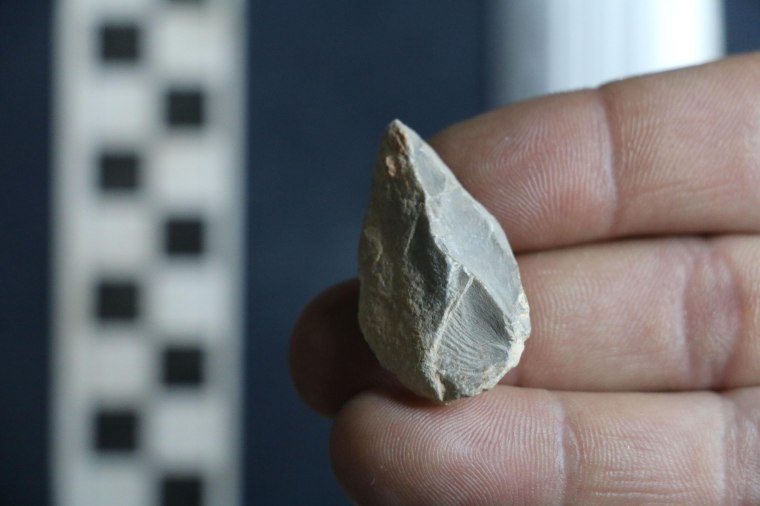 A shaped limestone point, one of the stone tools found at the Chiquihuite Cave in central Mexico that archaeologists think dates from around 30,000 years ago, before the last Ice Age.


