Showing posts with label technology. Show all posts

Wednesday, October 21, 2026

Thoughts On The Riemann Hypothesis

AI has purported to prove two new and improved versions of the quasi-Riemann hypothesis, as discussed at Quanta magazine and a Twitter thread discussing additional proofs (by humans) that flow from the new quasi-Riemann hypothesis proof.

What is the Riemann Hypothesis?

The Riemann hypothesis can be explained as follows (from the first link):


The Riemann hypothesis is about which values of s will make the zeta function equal zero.

But it is also about far more than how this particular function behaves. As Bernhard Riemann realized when he first made the conjecture in 1859, the function relates to patterns in the prime numbers — integers divisible only by 1 and themselves that many mathematicians call the “atoms of arithmetic.”

It’s long been known that as you move along the number line, the primes thin out. Riemann showed that exactly how the primes thin out is, in a sense, governed by the zeta function — in particular by the places where it equals zero.

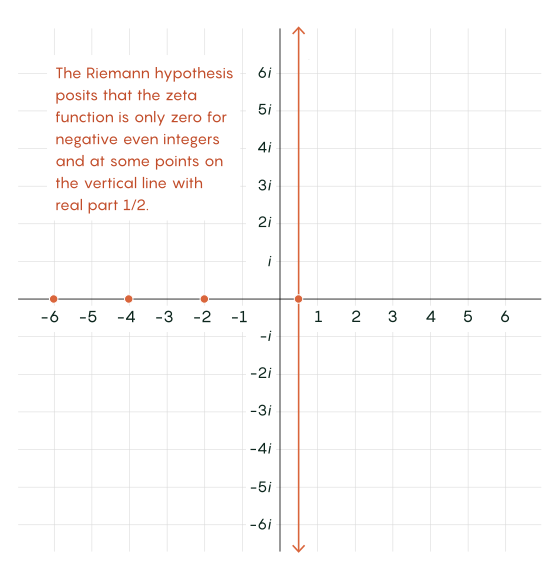
It’s straightforward to prove that if s is a negative even number (−2, −4, −6, …), then ζ(s) = 0. These are called trivial zeros. The Riemann hypothesis says that the only other zeros of the zeta function, called nontrivial zeros, occur when s has a real part of 1/2. That is, they should all be located on a vertical line:

If any nontrivial zero were to be found somewhere away from that vertical line, it would imply that the primes must form an extremely surprising pattern, one that has never been observed to date.

Just narrowing the area where the nontrivial zeros can appear has had huge ramifications. Riemann himself proved that nontrivial zeros of the zeta function can only be found in a vertical strip between zero and 1. Then, in 1896, two mathematicians showed that zeros could not lie on the edges of the strip. As a direct consequence, they were able to prove an important result called the prime number theorem, a formula for how quickly, on average, the primes thin out.

If the Riemann hypothesis holds, then mathematicians can guarantee that any deviations from the average given by the prime number theorem will always be small.

Mathematicians have numerically verified(opens a new tab) that the first 12 trillion nontrivial zeros are on the 1/2 line. But they can’t be sure the hypothesis holds for all the zeros, and even one solitary outlier would land like an earthquake. As Enrico Bombieri(opens a new tab) wrote in the paper(opens a new tab) laying out the Millennium Prize formulation of the problem: “The failure of the Riemann hypothesis would create havoc in the distribution of prime numbers.”
The connection between the zeta function and the primes was known before Riemann. In 1737, Leonhard Euler showed that for any complex number s, the zeta function is equivalent to another function that can be written entirely in terms of primes:
This brings us to the quasi-Riemann hypothesis. Where the Riemann hypothesis posits that all the nontrivial zeros are on the vertical line at 1/2, the “quasi” version just asks one to prove that they are all contained in a vertical strip that’s narrower than the known strip between zero and 1. The narrower the strip, the more one can say about how the primes are distributed.

What did AI recently prove? 

OpenAI announced two different versions of their quasi-Riemann hypothesis proof. The first version, dated September 30, 2026(opens a new tab), claimed to show that all nontrivial zeros must be between 1/8 and 7/8, and was formally verified using the Lean programming language. The second version, which was completed almost a week later(opens a new tab) (and is not yet formally verified), claimed to prove a weaker result: that the zeros must have a real part between 1/12 and 11/12. But while the first paper is 199 pages long, the second weighs in at a comparatively modest 49 pages.

More background

The Euler version makes it more obvious, but the zeta function is undefined and at s=0, and approaches a limit of infinity close to s=0.

Even this simple explanation for a relatively simple hypothesis (all the good ones are) begs the question of what a complex exponent of an integer even means (and I won't try to explain that here). Suffice it is say that this isn't trivially intuitive in the way that an integer exponent is, and that it is less intuitive than a non-integer real exponent is.

Commentary on the AI proof

First off, consider that the new proofs are less impressive than they seem. We already knew that the real part of the exponent s in a zeta function zero has to be more than 0 and less than  1. We knew that in 1896, one hundred and thirty years ago. Narrowing that range to greater than 1/12 and less than 11/12, or greater than 1/8 and less than 7/8 improves on that result, but it isn't that Earth shaking of an improvement over the status quo.

Ideas for breaking down the Riemann Hypothesis into subparts

Next, lets break this down and consider some points that would help prove the overall Riemann hypothesis. Some of them may already have been proven. All of them must be true if the Riemann Hypothesis is correct, which numerical methods strongly suggest.

* It would be nice to prove that for any given value of the imaginary part of s that there is only one zero.

* It would be nice to prove that for any given value of the real part of s that there are either zero or an infinite number of zeros.

* It would be nice to prove that, to produce a zero, the real part of s must be a rational number (a subset of the real numbers).

* It would be nice to prove that, to produce a zero, the imaginary part of s must be a whole number (i.e. a positive, non-zero, integer), or failing that, that it must be a positive rational number, or in between, a positive rational number related by some rule to the rational number that is the real part of s, or better still, a whole number related by some rule to the rational number that is the real part of s.

* It would be nice to prove that the imaginary part of s must be an odd number to produce a zero.

* It would be nice to prove that all values of s with a real part of 1/2 and an imaginary part which is a prime number of zeros. Keep in mind that the Riemann Hypothesis is an if and only if conjecture: it says that non-trivial zeros have a real part of 1/2 and an imaginary part that is prime, and it also says that there are no other non-trivial zeros. Proving the affirmative part standing alone would be a big deal, even without a proof that there are no other non-trivial zeros, but requires consideration of far fewer possibilities.

* Proof of the affirmative part of the Riemann Hypothesis would likely require that the term in the Euler infinite series definition of the zeta function where integer in the imaginary part of s is equal to the number that it is the exponent of is special somehow, because it cancels out all of the other terms of the infinite series (I don't think that a single term of either infinite series definitions of the zeta function can be zero by itself, but proving that would itself be a step).

* Proof of the negative part of the Riemann Hypothesis might start with a determination that the imaginary part of s can't produce a zero if it is even. 

* Proof of the negative part of the Riemann Hypothesis might establish that the imaginary part of s can't produce a zero if it has exactly two, or better yet, an even number, of prime factors.

* Proof the the negative part of the Riemann Hypothesis might establish that the imaginary part of s can't produce a zero if it has an odd number of prime factors greater than one.

* Proof of inability to produce a zero, in a given case, amounts to showing there are one or more terms of the infinite series that don't cancel out at that value.

* It would be nice to tie in the conclusion about trivial zeros of the zeta function to the conclusion about non-trivial zeros of the zeta function somehow.

Post Script

Of course, I'm not going to prove (or disprove) the Riemann Hypothesis. Complex analysis (i.e. the calculus of imaginary numbers) was my weakest subject as a math major in college, and I never formally studied number theory at all. 

And, I only scratch the surface of the most obvious ideas in a deeply reached and explored corner of mathematics.

But I had a long dentist appointment this morning and needed a distraction, so I thought about it then, and that's why I'm writing about it now.

Friday, October 9, 2026

AI Revolutionizes Math Research

The year 2026 will be remembered as the year that AI revolutionized mathematics research.

In August, AI made some real breakthroughs in some notable unsolved problems in mathematics, mostly involving disproof of conjectures by counterexample. But this week, Open AI published more than three hundred proofs of unsolved problems by various methods, that were significant although not quite as notable, across all major areas of mathematics on a single day (although a few of those proofs have been withdrawn or revised in response to comments).

Its single day results (rumored to be from an initial set of 400 problems), that probably took several months to put together and were just released all at once for drama. 

But its productivity on mathematical problems of this medium level of significance which are what the best human mathematics researchers might solve once every few years, rivals the productivity of the entire global mathematical research community over a time frame somewhere between many months and a few years.

The announcement this week leaves no doubt that AI will forever and profoundly change how mathematical research is done. We can expect a surge of mathematical breakthroughs for a few years as the backlog of AI solvable unsolved problems in mathematics are conquered and human mathematicians have to come up with new mathematics problems for humans and AI to solve together, in many cases probably building on the findings made in a new surge of proofs.

“If a human did this, it would be an instant Fields Medal, no questions asked.”

That’s how Alex Kontorovich, chair of the department of mathematics at Rutgers, responded to an A.I.-generated proof that OpenAI, the artificial intelligence giant, released on Tuesday.

And that single proof — worthy, in Dr. Kontorovich’s assessment on social media, of arguably the highest honor in the field of mathematics — was just one among more than 350 findings that the firm released that day, all at once.

Not all of them were quite so remarkable. But Martin Bridson, a mathematician at Oxford and the president of the Clay Mathematics Institute, which established the coveted Millennium Prize Problems, called OpenAI’s release “breathtaking.”

“Until very recently, it would have been impossible to imagine that the frontiers of mathematics could move so far in one day,” Dr. Bridson said.

If there had been any doubt that the leaps achieved by artificial intelligence this year would transform the discipline of mathematics, the tens of thousands of pages let loose on Tuesday have put that doubt to rest. The puzzles apparently conquered by OpenAI include crucial open questions in nearly every subfield of math, including algebra, number theory, theoretical computer science, mathematical logic and topology.

None of the proofs fully resolve any of the five remaining Millennium Prize Problems, which were designated at the turn of the century as a way of celebrating mathematics and its vast frontier of mysteries. But the trove of findings seemed to include results that make tangential or related progress on all of them. Perhaps the most significant result — the one Dr. Kontorovich was responding to — was a proof of the “quasi-Riemann hypothesis,” a conjecture related to the best known of the Millennium problems, the Riemann hypothesis, and a possible steppingstone of sorts to its resolution.

Ken Ono, a professor at the University of Virginia and the founding mathematician at Axiom Math, a math-focused artificial intelligence firm, wasn’t sure whether the quasi-Riemann solution would be a springboard for solving the original hypothesis. But he said that, as is expected with the original Riemann hypothesis, an encyclopedia of consequences would flow from this result, providing rich fodder for future breakthroughs. . . .

(As of Thursday, OpenAI had made a number of updates to the public online repository; withdrawing three papers and making fixes to several others. A spokeswoman said: “Where errors are identified, we will work to correct them promptly and withdraw papers if no fixes can be found. As with other research manuscripts, this is an iterative process.”) . . . .

For Bryna Kra, a mathematician at Northwestern University, problem No. 145 on the list was of great interest — “the Rokhlin problem on mixing implying higher order mixing,” which answers a question from the 1940s. “The writing, however, makes it impossible to understand,” said Dr. Kra, former president of the American Mathematical Society, who is among a group of mathematicians who are proactively working to chart a course for the field through this period of “uncertainty and seismic change,” as she described it. . . .

The French mathematician Jean-Pierre Serre, an emeritus professor at the Collège de France in Paris — who has won two of math’s top prizes, the Fields Medal and the Abel Prize, and celebrated his 100th birthday last month — was naturally attracted to finding No. 46 in OpenAI’s list, which solves positively a conjecture he made almost 70 years ago.

But Dr. Serre is conflicted about doing math with A.I. He uses the technology for things like references, and, with the help of friends, for chasing down hunches about errors. “Mathematicians take pleasure in doing maths in two different ways: learning and finding new things,” Dr. Serre said. “Hence a conflict: A.I. increases the first pleasure and lowers the second one. The problem is it may lower the pleasure too much; that is especially serious for young mathematicians.”

From the New York Times.

More analysis from Woit (a math professor at Columbia who blogs about and researches math, particle physics, and academic life) can be found here and here. Reacts from others are compiled here.

Tuesday, September 8, 2026

Where Do Grammatical Inflections Come From?

The maxim "today's morphology is yesterday's syntax," coined by linguist Thomas Givon, means that grammatical word endings and affixes (morphology) evolve over time from separate, independent words once used together in phrases and sentences (syntax).

Via Language Log. 

Vaguely related: Some karaoke machines display words sung with almost no gap between them as a single word (German style), which indeed does help in getting the phrasing of the words in a song that you don't know very well right. 

Thursday, September 3, 2026

Layers Of Language and Culture In West Eurasia (An Overview)

A useful way to think about the history and pre-history of Europe and West Asia since the Last Glacial Maximum is to frame it as a matter of techno-linguistic-cultural waves and layers.

The earliest layer is that of European, Levantine, and Caucasian hunter-gatherers, who are quite distinct and segregated populations from each other and not merely gradual clines of different degrees of genetic admixture. Prior to the Neolithic Revolution, Caucasian hunter-gathers and Levantine hunter-gathers were as distinctively different from each other (or more so) than an Irishman is from a man in China today, at a distance of a few hundred miles from each other or less, and while there was admixture during and after the Fertile Crescent Neolithic Revolution, the populations remained very genetically distinct until the Bronze Age, and remain distinguishable, genetically, even today.

Hunter-gather cultures in Anatolia and the Levant are just on the verge of transitioning to becoming Neolithic farmer cultures in sites like Göbekli Tepe and signs of proto-farming in the Levant, when the Younger Dryas climate event hits and postpones that breakthrough for a few thousand years after these false starts, until you get the Fertile Crescent Neolithic revolution.

The Fertile Crescent Neolithic Revolution collects crops and animals, which are native to different parts of the Fertile Crescent, to domesticate and then combined them into a Fertile Crescent Neolithic package over a few centuries (that was tweaked somewhat with a few more domesticated plants and animals in each direction it expanded , like the donkey added in Egypt and a few more crops in Greece and the Balkans), but still not fully merging ethnically (and probably not linguistically either) and instead remaining ethnically distinct first farmer cultures and populations.

The group of first farmers derived from an ethnicity known in ancient DNA circles as Caucasian hunter-gatherers heads east to bring herding and farming into West Asia. 

The group of first farmers in the Levant heads south to bring herding and farming into Egypt, Ethiopia, and the rest of North Africa. This branch can be associated with the Afro-Asiatic languages, although whether the Afro-Asiatic languages originated in the Neolithic Levant, or were a back reaction from some Northeast African hunter-gatherer language that dominated culturally over the original Levantine farmers and then expanded back to North Africa and the Levant from perhaps Ethiopia or upper Egypt, is hard to know.

The group of first farmers in Western Anatolia expands in two waves that split off from the same source West into Europe: the Linear Pottery Neolithic (LBK) farmers more or less to the north along central and eastern Europe's great rivers, and the Cardial Pottery (CP) farmers more or less along the northern coast of the Mediterranean. The archaeological record also suggest that the LBK farmers in turn had a fairly basal split into two distinct branches with different material culture traditions. Probably each of the three major components of the Western Anatolian first farmer traditions spoke different, related languages within a Western Anatolian first farmer language family.

As these first farmers expanded into the more agriculturally suitable areas that they encountered, they did so primarily as families that largely replaced the much more thinly populated existing hunter-gather populations (in many cases, the population density of farmers was as much as a hundred times greater than the hunter-gathers who had preceded them in the area and the farmers were also much more prone to stand their ground to protect their crops than to migrate away although early herders were more flexible and hunter-gathers transitioned to herding more easily than they transitioned to farming), although a small number of locals were integrated into each expanding first farmer population, mostly women taken as brides by first farmer men.

In most of Europe, societies in cultural continuity with these first farmers start to collapse. Maybe its due to unsustainable agricultural practices, maybe its due to natural climate changes. In the earlier stages of this decline, there is some introgression of people who were part of remaining European hunter-gather cultures (sometimes partially adopting herding), who had continued to persist in places unsuitable for Neolithic farming, mostly women, and some first farmer communities revert to herding and hunting and gathering almost entirely, largely abandoning farming.

A few places, like Sumerian, Egyptian, and highlands West Asian societies, that were some of the earliest adopters of the Fertile Crescent Neolithic Revolution start to innovate and adopt early metallurgy, proto-writing or a true written language, and larger scale political and social organizations with kings and high priests who are more than just chiefs and shamans of small tribes or bands. They ran kingdoms and established full fledged bureaucratically organized religious institutions.

The ergative language speaking linguistic groups of the highlands of Anatolia, the Zargos mountains, and the Caucasus mountains, and of Mesopotamia constitute one group of early metal age societies which emerged in specific communities that used their technological advantages of conquer societies that were stuck in the Neolithic farming era and didn't adopt as fast. These specific communities probably emerged from an ergative language first farmer society. 

The Ancient Egyptians were another early adopter of metal age technologies whose military, economic, and cultural influence spread its non-ergative language Afro-Asiatic substrate across an ergative language first farmer substrate that extended, at least, to parts of North Africa, either via the Southern coast of the Mediterranean, or via Iberia.

The Harappan culture in the Indus River Valley and Northeast India is a third early adopter of technological advances of Copper Age technology that manages, somehow, to become dominant with much division or warfare.

Meanwhile, Pontic Caspian steppe hunter-gathers who had adopted herding and domesticated the horse, and made advances in making practical use of simple animal pulled wheeled vehicles enjoyed a fruitful synthesis with nearby West Anatolian derived first farmers from the LBK branch of their expansion into Europe, probably in Sredny Stog, that gave rise to the first proto-Indo-Europeans. Maybe the farmers had early metallurgy already, maybe the herders borrowed it from neighboring societies like the Caucasians, or maybe it arose independently not long after the synthesis that created proto-Indo-European society. But, the Indo-Europeans were already a society of Bronze Age horsemen and charioteers before their main expansion. One of the earliest expansions from this PIE core is east into the Tarim Basin where they become the Tocharians.

When a large area arid climate event strikes West and South Eurasia from Ireland to the Middle East and North Africa to Harappan territory in South Asia, in a time frame that peaks around 2500 BCE to 1500 BCE with climate leading its impacts on the affected societies, societies that were still Neolithic farming societies or were less advanced entirely collapse, while societies that had advanced to the copper age or very early Bronze Age are weakened and vulnerable to conquest, but don't actually collapse.

Indo-Europeans expand in all directions into the vacuum as the climate event strains existing cultures. In most places that had not reached the metal age when this happened and had almost fully collapsed, the Indo-Europeans almost fully wiped out existing hunter-gather and first farmer men, while assimilating some of the women from the existing culture, in patriarchal clans. This was the story for the Corded Ware Culture, more or less in central and eastern Europe, and the story of the Bell Beaker culture invaders of Great Britain and Ireland.

In places where early metal age cultures were still standing and just weakened when they arrived, like the Harappan culture of South Asia that gave rise to Sanskrit speaking Indo-Aryan society (that briefly extended as far as the Mittani empire at the Hittite Empire's border, before it was replaced by the Indo-Iranian Zoroastrian culture), the Hattic culture of Anatolia which came to be ruled by the Hittites, and the Aegean (where they conquered the Greeks and Hattic-related Minoans but adopted considerable parts of local language and culture), and Basque Country (it isn't entirely clear if this is a first farmer society remnant or if it was a distant and first farmer substrate influenced far outpost of early metal aged culture, probably the latter), there was more give and take, with a greater substrate influence on the conqueror's language through substrate influence, on the conqueror's religious beliefs and identity, and other deep rooted aspects of local culture (like Harappan curry). Isolating geography in Sardinia, and in the highlands of the Italian Peninsula's Etruscans and the Alpine kin, and in the highlands of Basque country (possibly assisted by its cluster of RH negative blood types) resisted longer and were changed less by the Indo-Europeans, although most ultimately fell to them, aided by somewhat less collapsed societies with somewhat more advanced early metal aged cultures (and by adopting technologies from the Indo-Europeans who sought to conquer them).

Indo-European expansion wasn't unchecked, however. The Afro-Asiatic cultures of the Levant and Egypt managed to resist them as did Mesopotamia, which Afro-Asiatic people had conquered from the Sumerians before this collapse. Geography prevented them from expanding past the Tarim Basin into East Asia and Central Asia. In Europe's far Northeast, as far as what is now Finland, northern Sweden, the Baltic states, and much of what is now Russia, as well as (much later) Hungary, Uralic people arrived as a post-Indo-European layer, or arrived to replace hunter-gather-fishing populations that the Indo-Europeans either never reached or didn't manage to hold onto for very long.

Then, another climate event triggered Bronze Age collapse around 1200 BCE. This only slightly unsettles the division of the world between Indo-European societies and Afro-Asiatic ones, for example, with the migration of Mycenaean Greek sea people into the Southern Levant after being fended off by more robust Egypt, to become the Philistines.

During Bronze Age collapse and its immediate aftermath, the waves of migration and war in Europe and West Asia become intramural fights between Indo-European people beyond the standoff between the Bell Beaker Indo-Europeans in Western Europe (known for their archery) and their successors, and the Corded Ware people to their east in Europe and their successors (know for their battle axes), whose respective territories shifted only a little (most notably midway through the Bronze Age in the vicinity of Denmark) from about 2000 BCE to 1200 BCE.

As Bronze Age collapse struck, Anatolian Indo-Europeans and Greek Indo-Europeans fought the Trojan War until it all collapsed into the Greek Dark Ages. Around that time that the Greek dark ages ended and classical Greek civilization started to emerge, Celtic peoples expanded from somewhere around Czechia as far west as Ireland and as far southeast as Anatolia. As Europe and West Asia emerged from the dark ages, the Iron Age technologies that the Hittites has managed to prevent its neighbors from acquiring prior to Bronze Age collapse, became ubiquitous. Iron wasn't actually a superior metal for weapons to bronze, but it was easier to mass produce and almost as good (and in isolated communities in what is now Iran, high quality steel far superior to bronze or iron was invented, around 1000 BCE, only to be lost centuries later before it could be adopted by the Roman Empire or the Islamic Empire).

The Iron Age was followed by Greco-Roman classical civilization eventually leading to Greek conquests of West Asia up to India (only to ultimately lose most of this territory one way or another in several big installments), and to the Roman Empire at its peak that reached Hadrian's Wall in Britain, Romania, the Levant, Egypt, North Africa, Southern Europe, and Anatolia. This lasted until another climate event led to the Western Roman Empire's collapse. A century after Rome collapsed, the Islamic empire expanded into vast swaths of territory in North Africa, Southwest and West Asia, Iberia, Malta, and the Balkans and beyond into South Asia and Southeast Asia and the Sahel, while the Christian Byzantine empire held on for several more centuries as it gradually lost territory, until it fell entirely to what had morphed in several rounds of Islamic regime changes into an Ottoman Empire that absorbed and coopted into Islam, Turkic invaders with origins in Southeast Asia, with the little interruption of the Mongol Empire along the way.

While the Islamic empire expanded, non-Muslim Europe collapsed with Germanic, Slavic, and Uralic tribes roaming about Europe in the migration period (giving rise to Hungary whose Magyar rulers swiftly converted from being pagans to Christians), Charlemagne and feudal lords running Europe in a fig leaf of a Holy Roman Empire under the Pope and launching several largely futile Crusades into the Levant, Viking raiders plundered Europe and briefly settled in North American only to collapse there and retreat (one branch of Vikings became the founding dynasty of and rulers of Russia's slavs), the Mongol Empire spanning from Persia to Korea before collapsing in the 13th century, multiple waves of the Black Plague ravaging Europe from its source in the east, missionaries re-Christianizing Europe from Ireland to the east until the last pagans of Europe are in the Urals and almost everyone else has nominally become Catholic by the late 11th century CE, and monastic orders doing what they could to preserve classical civilization for the thousand years of the Middle Ages that ended with the Columbian Exchange as Iberians and other Europeans colonized the Americas, with the Renaissance that finally restored classical Roman levels of technology and social order, with the Protestant Reformation, and with the end of the Reconquest of Iberia from the Moors. I'll end this survey with the start of this early modern period around 1500 CE.

Now, I'm writing this post from memory, which is partially why I've left out some things, particularly in West Asia and the details in far Northeast Europe and North Asia. I've omitted the stories of the Armenians, the Kurds, and the Druze. I skipped the process by which the Sumerian language was replaced by a succession of Semitic languages in Southwest Asia and Mesopotamia's trade ties to the Indus Valley Civilization and the eastern coast of Africa. I haven't adequately covered the history of the Caucuses. I've left out the fairly well understood history of the Jewish people after the fall of the Second Temple around 70 CE and haven't said enough about the Phoenicians and the Punic people. I haven't discussed the rise of Christianity during the Roman Empire or the demise of Zoroastrianism and polytheistic paganism. I haven't explored the connections between the Jewish, Christian and Muslim accounts of Southwest Asia's history through the legendary histories of their holy texts and the historical realities. Nor have I discussed why the Bronze Age is so full of what I call "legendary history" that is a mix of fiction and fact in purportedly fictional accounts that is so predominant across cultures in this era. I've left out the expansion around the time of the domestication of the camel that gave rise to the Berber people. I've barely touched on the repopulation of Europe by hunter-gathers from basically three refuges after the Last Glacial Maximum. I haven't mentioned the Silk Road or the history of Central Asia before and after the Mongols. I didn't cover how pottery made its way from the coasts of China and Japan about 16,000 years ago, over thousands of year to produce the transition from the pre-pottery Neolithic in the Levant to the pottery Neolithic of Europe and the Levant, or how the Black Plague got to Europe. I omitted the trans-Saharan slave trade, and Roman, Greek, Egyptian, Anatolian, Germanic and Viking slavery practices.

But the point isn't to cover all of  the details. That would take a book, not a blog post. It is to provide an overarching framework into which the details can fit and be better understood. And, of course, this post only minimally touches upon history and pre-history become its title's West Eurasian scope, even though there was lots going on in the rest of the world which is much less well known. Africa, for example, didn't start to fall decisively behind the rest of the world technologically and economically until perhaps five or six hundred years ago, and it took quite a while before the gaps became as stark as they are today (a process that only really started in earnest around the time of the trans-Atlantic slave trade that started after the time period covered by this post).

Actually, to be honest, I'd started trying to frame the issues presented by the origins, cultures, and linguistic history of Greece, West Asia and Southwest Asia up through the early Iron Age, and ended up going a little further afield with a forward outlining Western Civilization from its earliest roots which would be about ten pages in print. I did touch on that and frame it in a narrative (admittedly one that is sometimes hotly contested by legitimate academics even in the present). But, I can refocus on that in a more detailed and referenced manner in a future post. 

Friday, May 15, 2026

How Common Are Hallucinated Citations In Academic Papers?

Academic papers written with AI that contain hallucinated citations are on the rise.
Large language models (LLMs) are known to generate plausible but false information across a wide range of contexts, yet the real-world magnitude and consequences of this hallucination problem remain poorly understood. 
Here we leverage a uniquely verifiable object - scientific citations - to audit 111 million references across 2.5 million papers in arXiv, bioRxiv, SSRN, and PubMed Central. We find a sharp rise in non-existent references following widespread LLM adoption, with a conservative estimate of 146,932 hallucinated citations in 2025 alone. 
These errors are diffusely embedded across many papers but especially pronounced in fields with rapid AI uptake, in manuscripts with linguistic signatures of AI-assisted writing, and among small and early-career author teams. At the same time, hallucinated references disproportionately assign credit to already prominent and male scholars, suggesting that LLM-generated errors may reinforce existing inequities in scientific recognition. Preprint moderation and journal publication processes capture only a fraction of these errors, suggesting that the spread of hallucinated content has outpaced existing safeguards. Together, these findings demonstrate that LLM hallucinations are infiltrating knowledge production at scale, threatening both the reliability and equity of future scientific discovery as human and AI systems draw on the existing literature.
Zhenyue Zhao, Yihe Wang, Toby Stuart, Mathijs De Vaan, Paul Ginsparg, Yian Yin, "LLM hallucinations in the wild: Large-scale evidence from non-existent citations" arXiv:2605.07723 (May 8, 2026).

Friday, September 5, 2025

Medieval Supernova

Astronomy is one of the oldest sciences. Advanced scientific astronomy calculation instruments were in existence in the Greek classical period and megalithic solar observatories came into existence independently shortly after agriculture was invented in multiple places. There is even evidence of astronomy being done in a stone temple in Anatolia built before agriculture was invented. By around Y1K, astronomy was taught in universities, and was done in a quite scientific manner in multiple civilizations around the globe. Prior to the Renaissance, however, it was all done with the naked eye. 

The remnant of the historical supernova SN 1181 is under discussion: While the previously suggested G130.7+3.1 (3C58) appears too old (3000-5000 yr), the unusual star IRAS 00500+6713 with a surrounding nebula (Pa-30) has an expansion age not inconsistent with a SN Iax explosion in AD 1181 under the assumption that neither acceleration nor deceleration occurred. 
Previously, only reports from China and Japan were known, pointing to an event near the northern circumpolar region. Any further reports from other cultures can therefore be highly relevant. 
We present here an Arabic poem in praise of Saladin by the contemporaneous author Ibn Sanā' al-Mulk (Cairo, Egypt). We re-date its composition to between Dec 1181 and May 1182. It contains a new bright star, which can be identified as SN 1181. The poem also provides new and independent information on the object type (called `najm' for `star'), location on sky (in or near the Arabic constellation al-Kaff al-Khabīb, lit. the henna-dyed hand (five bright stars in Cassiopeia), and brightness (brighter than alpha Cas, 2.25 mag). 
In addition, we present another Arabic text on SN 1006, also from Cairo, by the historian al-Maqrīzī, probably based on the contemporaneous al-Musabbihī
J.G. Fischer, H. Halm, R. Neuhäuser, D.L. Neuhäuser, "New Arabic records from Cairo on supernovae 1181 and 1006" arXiv:2509.04127 (published August 19, 2025 at 346 Astronomical Notes e70024).

Monday, June 16, 2025

Population Replacement In The Columbian Highlands

In Europe, the first farmers of Europe, derived from Western Anatolian farmers, largely replaced Europe's original hunter-gatherers (who actually show continuity between the periods before and immediately after the Last Glacial Maximum), and in turn, received very substantial genetic admixture from late Copper Age/early Bronze Age Indo-Europeans from more or less where Ukraine is today. This diluted both first farmer ancestry, and the already highly diluted European hunter-gather ancestry that was admixed into those first farmer populations. In some places, like Britain, the population replacement of first farmers by Indo-Europeans was nearly complete.

Something similar apparently happened in East and Southeast Asia.

A new study established that the Americas did not break from this pattern, with some of its early agriculturists replacing pre-existing hunter-gatherer populations in a similarly genocidal pattern. If anything, this replacement was even more complete.

Sometime between 4000 BCE and 0 CE, in the Columbian highlands, probably coinciding with a new archaeological culture whose artifacts appear around 1000 BCE to 800 BCE, a millennium after maize cultivation began around 1800 BCE (but possibly before the full blown ceramic culture emerged), a clade of indigenous South American hunter-gatherers (with ancestry dating back to the initial wave of human settlement of South America) were replaced by a different group of indigenous South Americans.

The 1800 BCE date is from A. Gómez, et al., "A Holocene pollen record of vegetation change and human impact from Pantano de Vargas, an intra-Andean basin of Duitama, Colombia." 145 Rev. Palaeobot. Palynol. 143–157 (2007) (full paper available here), and really only definitively points to deforestation and Amaranth cultivation at that point in the highlands of Columbia.

From Wikipedia.

The population that replaced them, which is genetically linked to the speakers of Chibchan languages and probably originated in Central America, has remained the dominant population of the region in genetic continuity with their ancestors since this population replacement occurred, although later populations admixed with them and brought new languages in some parts of the region. 

There is no evidence that anyone from the pre-agricultural, pre-ceramic culture that was replaced in the Columbian highlands survived, or even significantly admixed with surviving populations.

The new agriculturalist culture did not really come into its own archaeologically until 1000 BCE to 800 BCE, so we can't know for sure if the replacement took place suddenly (although the lack of admixture between the new and old populations suggests that it did) or more gradually, or how long after maize cultivation, a thousand years earlier than this culture's pots appeared, the population replacement happened. 

Conservatively, it happened in some short time period between 1800 BCE and 800 BCE (about 3,000 to 4,000 years after it happened in Europe). Realistically, it probably happened on the later side of that time range when other components of the emerging farmer culture, like pottery and possibly other key domesticated plants and/or animals, joined with improved maize cultivation to give rise to a technologically dominant new culture.

The introduction and discussion sections of a new study released May 28, 2025 in the journal Scientific Advances by Kim-Louise Krettek, et al., explain that:

Genetic studies on ancient and present-day Indigenous populations have substantially contributed to the understanding of the settlement of the Americas. Those studies revealed that the population ancestral to non-Arctic Native Americans derives from a genetic admixture between ancient East Asian and Siberian groups somewhere in North-East Asia before 20,000 years before the present (yr B.P.). Around 16,000 yr B.P., after its arrival in North America, this genetic ancestry split into two lineages known as northern Native American and southern Native American. While northern Native American ancestry is largely confined to ancient and current populations of North America, the southern Native American lineage expanded further south and constitutes the main ancestry component of ancient and present-day Indigenous South Americans. 
Southern Native American ancestry diversified within North America into at least three sublineages, i.e., one related to the Clovis-associated Anzick-1 individual from western Montana (USA), one found in ancient California Channel Islands individuals and the last one representing the main ancestry source of modern-day Central and South Americans.  
Each of these sublineages provided a wave of ancestry into the gene pool of ancient South Americans. Individuals from Chile and Brazil dating back to around 12,000 and 10,000 yr B.P., respectively, were more genetically related to the Anzick-1 genome than individuals from the eastern Southern American coast, Southern Cone and the Andes from 10,000 yr B.P. onward. In addition, the California Channel Islands ancestry was found in the Central Andes by 4200 yr B.P. and became widespread in the region thereafter. However, the exact timing of these population movements into the southern subcontinent remains largely unsolved to date. 
The Isthmo-Colombian area, stretching from the coast of Honduras to the northern Colombian Andes, is critical to understanding the peopling of the Americas. Besides being the land bridge between North and South America, it is at the center of the three major cultural regions of Mesoamerica, Amazonia, and the Andes. At the time of European contact, the region was inhabited by a complex mosaic of human populations, mainly speakers of Chibchan, Chocoan, Carib, and Arawakan languages. 
Among those populations, those who were speakers of Chibchan languages were the most widespread in the region in terms of demography, cultural diversity, and territorial distribution. Chibchan is a language family with multiple, highly distinct branches, many of which are still spoken today in different regions of the Isthmo-Colombian area. The homeland and antiquity of the Proto-Chibchan language and the ancestor of all Chibchan languages remain subjects of debate. High intrafamily variation in terms of lexicon and grammar suggests that the language family is ancient and began diversifying several thousand years ago. The locus of that incipient diversification, however, is still uncertain. Most scholars believe that this protolanguage began to diversify in Lower Central America, where the largest number of these languages is spoken today. However, some evidence suggests that Proto-Chibchan might have originated in South America and then diversified in Central America at a much later date. 
Genetic studies of ancient and present-day Isthmo-Colombian Indigenous populations revealed a distinctive ancestry component primarily associated with speakers of Chibchan languages. However, whereas mitochondrial DNA (mtDNA) studies suggested a migration of Chibchan-related ancestry from Central America into Colombia and Venezuela, genome-wide studies favored an opposite, south-to-north population movement. According to the latter model, speakers of Chibchan languages from Central America are not direct descendants of the first settlers in the region but, instead, derive from a more recent back migration from South to Central America. 
The southernmost region of the Isthmo-Colombian area is the Altiplano Cundiboyacense (hereafter Altiplano). This plateau with an average altitude of 2600 m in the Eastern Cordillera of the Colombian Andes was inhabited by ancient hunter-gatherer groups from the Late Pleistocene. During the Early and Middle Holocene phases of the Preceramic period (~11,500 to 4000 yr B.P.), populations on the Altiplano underwent multiple cultural transformations, most notably increased sedentism and a transition from a hunter-gatherer subsistence to the introduction of horticultural practices and forest management. However, it was not until the early Late Holocene, ~3800 yr B.P., that the first clear evidence of maize cultivation appeared. 
During the subsequent Formative period (~3000 to 1000 yr B.P.), a distinct type of pottery emerged on the Altiplano that is referred to as the Herrera ceramic complex, also known in the literature as the Herrera period (2800 to 1200 yr B.P.). It is still highly debated whether Herrera-associated groups on the Altiplano derived from an in situ development of local hunter-gatherers or were a consequence of population dispersals into the region. 
Around 1200 yr B.P., a cultural phase, known as the Muisca period, began on the Altiplano and lasted until the imposition of the Hispanic Colonial regime in the mid-16th century. Most available evidence is suggestive of population continuity with the preceding Herrera period. The Muisca period is characterized by a relatively continuous process of demographic growth, development of agriculture and trade, and social and political complexification. These factors played a considerable role in shaping the Muisca culture and gave rise to the Chibchan-speaking population that dominated the Altiplano until European colonization. 
While several studies have reported mtDNA data from ancient Colombian individuals, genome-wide data from this region are still entirely lacking to date. In this study, we generated mtDNA and genome-wide data of 21 ancient individuals from two areas of the Altiplano (Bogotá plateau and Los Curos). Our data, spanning a time transect between around 6000 and 500 yr B.P., provide an opportunity to explore several key questions: 
(i) Which southern Native American genetic ancestry do Preceramic individuals from the Altiplano derive from? 
(ii) Were the cultural transformations associated with the Herrera and Muisca periods accompanied by migrations and demographic changes? 
(iii) How is the genetic ancestry observed in speakers of Chibchan languages related to that of ancient individuals from the Altiplano? 
(iv) What are the genetic relationships between the generated ancient genomes and the existing genomic data of present-day Indigenous communities from Colombia and neighboring regions?

In this study, we generated genome-wide data from 21 individuals spanning a time transect of almost 6000 years from the Altiplano, which represents the southern edge of the Isthmo-Colombian area. Our findings contribute to a better understanding of the population history of this area, a key region in the peopling process of South America. We show that the hunter-gatherer population from the Altiplano dated to around 6000 yr B.P. lack the genetic ancestry related to the Clovis-associated Anzick-1 genome and to ancient California Channel Island individuals, suggesting their affiliation to the southern Native American lineage that became the primary source of ancestry of South Americans by 9000 yr B.P. 
However, unlike ancient genomes from the Andes and the Southern Cone that are associated with the same wave of ancestry, the analyzed Preceramic individuals from Colombia do not share distinct affinity with any ancient or modern-day population from Central and South America studied to date. Colombia_Checua_6000BP can thus be modeled as a previously undescribed distinct lineage deriving from the radiation event that gave rise to multiple populations across South America during its initial settlement. 
The cultural transition between the Preceramic and Herrera periods is associated with a seemingly complete replacement of the local genetic profile. This challenges the model where local hunter-gatherers developed in situ as suggested by morphometric studies and an ancient mtDNA time transect. Instead, our study provides evidence for a major genetic turnover on the Altiplano occurring after 6000 yr B.P. but before 2000 yr B.P. Since the mechanisms and precise temporal scale of this replacement event remain uncertain, we cannot directly associate it with the emergence of maize cultivation ~3800 yr B.P. However, our data do support the archaeological hypothesis that the introduction of pottery associated with the Herrera ceramic complex was mediated through population dispersals. 
Our results show that the incoming genetic ancestry on the Altiplano is related to ancient and present-day populations speaking Chibchan languages from Central America. This can be explained most parsimoniously by Chibchan-related migrations from Lower Central America to South America, rather than back-migration to the isthmus. 
A separate study found evidence for a previously unknown south-to-north expansion of Chibchan-related ancestry from Lower Central America into the Mayan territories of Belize by 5600 yr B.P. Therefore, rather than modeling Central American populations associated with Chibchan languages as deriving from a mixture between North and South American ancestries, these results are consistent with an origin of Chibchan-related ancestries in Lower Central America, followed by bidirectional gene flow toward both Meso- and South America. This model of an original “Chibchan homeland” in Central America is supported not only by mtDNA studies on present-day populations who speak Chibchan languages but also from linguistic observations, indicating that the isthmus region exhibits the highest diversity within this language family. 
From an archaeological perspective, the Chibchan-related ancestry is first identified in 2000-year-old individuals associated with Herrera ceramics. In addition, previously sequenced Ceramic-associated individuals from Venezuela dated to 2400 yr B.P. also showed a high affinity to Central American populations speaking Chibchan languages. Despite the similar ancestry pattern and temporal frame, the two populations do not appear to form a simple sister group. This could be in line with linguistic evidence that suggests multiple, distinct Chibchan language expansions into South America, but additional studies will be necessary to further clarify this issue. 
After the arrival of the Chibchan-related ancestry, which completely reshaped the genetic landscape of the region, we find evidence of a long period of genetic continuity in the genetic profile of the local populations for over 1500 years (from at least 2000 to 500 yr B.P.). The stability in genetic ancestry encompasses the end of the Herrera period and the beginning of the Muisca period. This points to a scenario in which populations speaking languages from the Chibchan lineage would have settled the Altiplano before the emergence of traits normally associated with the Muisca culture, and it shows that this cultural transition took place without a substantial migration from regions with a distinct genetic ancestry composition. In addition, such a genetic continuity extends through different cultural phases within the Muisca period and persists until the Spanish colonization. Colonial linguistic documentation established that Muisca people spoke a now extinct Chibchan language. Our findings not only confirm their genetic link with speakers of Chibchan languages from Central America but also suggest that ancestral Chibchan languages, possibly basal to the Magdalenic branch that gave rise to the documented Muisca language, might have already been spoken on the Altiplano during the pre-Muisca Herrera period. 
While the representation of Indigenous populations in our dataset is certainly not exhaustive, the observed spatial pattern in the genetic affinity of post-2000 yr B.P. ancient Colombians with present-day Indigenous populations raises questions regarding the uneven distribution of populations speaking Chibchan languages across the Isthmo-Colombian area at the time of the Hispanic colonization, also referred to as a Chibchan “archipelago”. 
One possible explanation is that this distribution resulted from separate dispersals from Central America to different locations of northern South America rather than a single expansion wave, as suggested by the internal branching pattern of the Chibchan language family. However, it is also possible that the initial spread was more widespread and got later fragmented by post-Chibchan migration and admixture events. The observation that Chibchan-affiliated populations from northern Colombia have a significantly reduced genetic affinity to post-2000–yr B.P. ancient Colombians than to Lower Central Americans supports the role of population admixture in shaping the genetic diversity of northern South America.

Also, while the earlier South American hunter-gatherer clade that went extinct probably dated to the founding wave of the modern humans in South America, they did not have notable Australasian or Melanesian ancestry, disfavoring the existence of a dramatically genetically distinct founding population of the Americas that preceded the main founding wave of modern humans and has Australasian or Melanesian genetic affinities that ancient.

Monday, June 9, 2025

Ancient UP Agriculture

Drone based LIDAR has made a major new find in North America:
A new study has found that a thickly forested sliver of Michigan’s Upper Peninsula is the most complete ancient agricultural location in the eastern United States. The Sixty Islands archaeological site is recognized as the ancestral home of the Menominee Nation. Known to the members of the tribe as Anaem Omot (Dog’s Belly), the area is a destination of pilgrimage, where remains of the settlement date to as far back as 8,000 B.C.

Located along a two-mile stretch of the Menominee River, Sixty Islands is defined by its cold temperatures, poor soil quality and short growing season. Although the land has long been considered unsuitable for farming, an academic paper published on Thursday in the journal Science revealed that the Menominee’s forbears cultivated vast fields of corn and potentially other crops there.
From the New York Times.

I'll update if time permits after reading the full paper.

Monday, May 12, 2025

Interstellar Travel In The Galaxy's Core

Interstellar travel at speeds slower than light isn't really viable in human lifetimes from Earth, but it would be in many cases in the center of the Milky Way galaxy where the distances between stars are ten to a hundred times smaller, on average. So, a trip to the next solar system could take as little as four years at 1% of the speed of light, which is fast, but not technologically unattainable.
If we lived in the center of the Milky Way, we would look up at a sky thick with stars, up to 1 million times denser than we’re used to seeing. The closest star to our Sun is about four light-years away. In the center of the galaxy, stars are only 0.4 to 0.04 light-years apart. In the inner 10,000 light-year region of the Milky Way, the galaxy’s spiral arm structure transitions into a dense, spherical “bulge” of stars. At its heart — and the dominant force in that area of the galaxy — is a supermassive black hole approximately 4 million times the mass of the Sun, called Sagittarius A* (pronounced Sagittarius A star).
[T]he average distance between any two stars in our galaxy. . . . [is] about 5 light years, which is very close to the 4 light year distance between our Sun and Alpha Centauri.

In the central part of some galaxies, interstellar distances average as little as 0.008 light years to 0.013 light years. So, one could travel from one star to the next there in 8-13 years at only 0.1% of the speed of light (about 300 km/s). And, even in very dense galaxies it is rare for stars to collide:
Even at these high star densities, collisions are rare. Globular clusters have stars in their centers called “blue stragglers,” which astronomers think are new, massive stars formed by the collision of two old, lower-mass stars. Fewer than one in every 10,000 globular-cluster stars are blue stragglers, which suggests how rare stellar collisions are even in these extreme environments.

These collisions would take place only over billions of years. 

Friday, March 14, 2025

Cave Paintings Track Mating And Birthing Cycles Of Prey

A study from 2023, that has come to my attention, convincingly argues that symbolic marking in cave painting of animals made by European hunter-gatherers track the number of lunar months after the start of their year, that the animals the markings are associated with have their mating season and birthing season. The paper is:

Bacon et al., "An Upper Palaeolithic Proto-writing System and Phenological Calendar" (2023) DOI: 10.1017/S0959774322000415

Related video here. 

Monday, December 9, 2024

Clovis People Used Bones Of Small Predators For Needles

The Clovis people (who are not the first indigenous American culture, although they are derived from the Founding population of the Americas whose main wave of expansion came about fifteen hundred years earlier) are known for the spears that they used to hunt big game in North America before the Younger Dryas event wiped out their culture. But to survive in North America, they also needed needles to make clothing so they could function in this relatively cool region.

Tiny artifacts unearthed at a Wyoming site where a mammoth was butchered 13,000 years ago are revealing intriguing details about how the earliest Americans survived the last ice age.

Archaeologists found 32 needle fragments made from animal bone buried almost 15 feet (nearly 5 meters) underground at the La Prele site in Converse County. They are not the earliest eyed needles in the archaeological record, but for the first time scientists have been able to identify what the needles were made of by analyzing protein information contained in the bone collagen. The results were not what they expected.

“We had assumed they would be made out of bison or mammoth bone, which comprise most of the animal bones found at La Prele and other sites of its age in the High Plains and Rocky Mountains of North America,” said Wyoming state archaeologist Spencer Pelton, lead author of a new study on the needles published November 27 in the scientific journal PLOS ONE.

Instead, the needles were created from the bones of red foxes, bobcats, mountain lions, lynx, the now-extinct American cheetah, and hares or rabbits, the study found.

“It was extremely surprising that these needles were made out of small carnivores,” Pelton said.

From CNN. 

Wednesday, October 9, 2024

The Nobel Prize In Chemistry In 2024

Commentators have noted the AI trend in both the physics and the chemistry awards this year. 

The Nobel Prize in Chemistry was awarded on Wednesday to three scientists for discoveries that show the potential of advanced technology, including artificial intelligence, to predict the shape of proteins, life’s chemical tools, and to invent new ones.

The laureates are: Demis Hassabis and John Jumper of Google DeepMind, who used A.I. to predict the structure of millions of proteins; and David Baker of the University of Washington, who used computer software to invent a new protein.

From the New York Times. 

Tuesday, October 8, 2024

This Year's Nobel Prizes In STEM

The Nobel Prize in Physics for 2024 was awarded to John J. Hopfield and Geoffrey E. Hinton for their work in using machine learning methods (specifically, neural networks, a form of artificial intelligence) to solve physics problems. 

Both my son and his girlfriend currently work in the AI industry (and my brother and my daughter both work in the larger IT industry), so this is highly relevant to me personally. The large language models (LLMs) used in my own industry, law, are getting dramatically better by the year, but are still not ready for prime time and are prone to making things up and reaching absurd conclusions.

The prize in Physiology or Medicine went to Victor Ambros and Gary Ruvkun for their discovery of microRNA, which helps determine how cells develop and function. 

The Nobel prize in chemistry will be awarded tomorrow.

Tuesday, May 7, 2024

The First Farmers Of Cyprus Were Mostly Anatolian

Neolithic Cyprus was settled from Turkey, not Greece, by a sister population to the first farmers of Europe, very early in the Fertile Crescent derived Neolithic era. 
Archaeological evidence supports sporadic seafaring visits to the Eastern Mediterranean island of Cyprus by Epipaleolithic hunter-gatherers over 12,000 years ago, followed by permanent settlements during the early Neolithic. The geographical origins of these early seafarers have so far remained elusive. 
By systematically analysing all available genomes from the late Pleistocene to early Holocene Near East (c. 14,000–7000 cal BCE), we provide a comprehensive overview of the genetic landscape of the early Neolithic Fertile Crescent and Anatolia and infer the likely origins of three recently published genomes from Kissonerga-Mylouthkia (Cypriot Late Pre-Pottery Neolithic B, c. 7600–6800 cal BCE). These appear to derive roughly 80% of their ancestry from Aceramic Neolithic Central Anatolians residing in or near the Konya plain, and the remainder from a genetically basal Levantine population. 
Based on genome-wide weighted ancestry covariance analysis, we infer that this admixture event took place roughly between 14,000 and 10,000 BCE, coinciding with the transition from the Cypriot late Epipaleolithic to the Pre-Pottery Neolithic A (PPNA). Additionally, we identify strong genetic affinities between the examined Cypro-LPPNB individuals and later northwestern Anatolians and the earliest European Neolithic farmers. 
Our results inform archaeological evidence on prehistoric demographic processes in the Eastern Mediterranean, providing important insights into early seafaring, maritime connections, and insular settlement.
Alexandros Heraclides, et al., "Palaeogenomic insights into the origins of early settlers on the island of Cyprus" 14 Scientific Reports 9632 (April 26, 2024) (open access).

Some comments about early pottery

Pottery appears to have been an East Asian innovation, that arose prior to farming and herding in sedentary fishing based communities like the Jomon and people with similar lifestyles in what is now China and Korea, that gradually migrated to the West across North Asia, mostly arriving in West Asia and Europe after herding and farming had been developed there.

Also, it is worth noting that Western anthropologists use the term "Neolithic" to refer to the commencement of widespread use of domesticated plants and animals, while Soviet and post-Soviet anthropologists use the term "Neolithic" to refer to the commencement of widespread use of pottery.

Tuesday, April 23, 2024

Old News: The Spread Of The Neolithic Revolution In Europe

This map from 2006 has largely withstood the test of time. 

Some key observations that might otherwise be forgotten or overlooked:

* The initial Fertile Crescent Neolithic saw different crops and animals domesticated by genetically distinct modern human populations in different places across the Fertile Crescent. The Neolithic Revolution only expanded once the domesticated plants and animals found at various locations within the Fertile Crescent were consolidated into a single combined package of domesticates. 

* The European Neolithic revolution shared a common origin from Western Anatolia, to the Acreamic Neolithic in Crete, to Thessalia in Greece, to the rest of Greece and the Balkans, before forking off into Mediterranean and terrestrial European branches. The Fertile Crescent Neolithic package added some secondary domesticates in the process of this shared early expansion.

* The Western Mediterranean Neolithic (a.k.a. Cardial Pottery), was several centuries earlier than the early LBK (a.k.a. Linear Pottery) Neolithic in central Europe.

* The LBK Neolithic in central Europe started off in only the best land for farming, mostly along major rivers, and then expanded later into arable, but less optimal farming land.

* There was a mass migration of herders derived from the Mediterranean Neolithic the migrated along a narrow stretch of land, roughly in Eastern France, from Southern France towards central Europe at about the same time as the early LBK.

* As late as 4900 BCE large swaths of Europe had still not experienced the Neolithic Revolution and were still inhabited by European hunter-gatherers whose ancestors had migrated to Europe in the Mesolithic era.

* The Neolithic Revolution in Egypt, West Asia, and the Indus River Valley, were derived from the Fertile Crescent Neolithic Revolution as well, but are not shown on the map below.  These Neolithic expansions also picked up some secondary domesticated plants and animals along the way, like the donkey which was domesticated in Egypt. In Egypt, the Neolithic Revolution increased the population density in the Nile Basin by roughly a hundred-fold.

Source: Detlef Gronenborn, "Ancient DNA from the First European Farmers in 7500-Year-Old Neolithic Sites", 312 Science (June 30, 2006).

Monday, February 19, 2024

Orichalcum

Archaeologists have finally found examples of and deciphered a Bronze Age alloy associated with the lost city of Atlantis called "Orichalcum."

This insight, in my view, this is quite consistent with my leading candidate for Atlantis which is the capital city of Tartessos. Their Paleo-Hispanic language is by default an isolate but seems closer to Basque than to any Indo-European language, despite some Celtic borrowings and the use of a Phoenician derived script and their culture's adoption of Phoenician religious practices.

A group of naval archeologists has uncovered two hundred ingots spread over the sandy seafloor near a 2,600-year-old shipwreck off the coast of Sicily. The ingots were made from orichalcum, a rare cast metal that ancient Greek philosopher Plato wrote was from the legendary city of Atlantis.

A total of 39 ingots (metal set into rectangular blocks) were, according to Inquisitr, discovered near a shipwreck. BBC reported that another same metal cache was found. 47 more ingots were found, with a total of 86 metal pieces found to date.

The wreck was discovered in 1988, floating about 300 meters (1,000 ft) off the coast of Gela in Sicily in shallow waters. At the time of the shipwreck Gela was a rich city and had many factories that produced fine objects. Scientists believe that the pieces of orichalcum were destined for those laboratories when the ship sank.

Sebastiano Tusa, Sicily’s superintendent of the Sea Office, told Discovery News that the precious ingots were probably being brought to Sicily from Greece or Asia Minor.

Tusa said that the discovery of orichalcum ingots, long considered a mysterious metal, is significant as “nothing similar has ever been found.” He added, “We knew orichalcum from ancient texts and a few ornamental objects.”

According to a Daily Telegraph report, the ingots have been analyzed and found to be made of about 75-80 percent copper, 14-20 percent zinc and a scattering of nickel, lead, and iron.

The name orichalucum derives from the Greek word oreikhalkos, meaning literally “mountain copper” or “copper mountain”. According to Plato’s 5th century BC Critias dialogue, orichalucum was considered second only to gold in value, and was found and mined in many parts of the legendary Atlantis in ancient times.

Plato wrote that the three outer walls of the Temple to Poseidon and Cleito on Atlantis were clad respectively with brass, tin, and the third, which encompassed the whole citadel, “flashed with the red light of orichalcum”.

The interior walls, pillars, and floors of the temple were completely covered in orichalcum, and the roof was variegated with gold, silver, and orichalcum. In the center of the temple stood a pillar of orichalcum, on which the laws of Poseidon and records of the first son princes of Poseidon were inscribed.

For centuries, experts have hotly debated the metal’s composition and origin.

According to the ancient Greeks, orichalcum was invented by Cadmus, a Greek-Phoenician mythological character. Cadmus was the founder and first king of Thebes, the acropolis of which was originally named Cadmeia in his honor.

Orichalcum has variously been held to be a gold-copper alloy, a copper-tin, or copper-zinc brass, or a metal no longer known. However, in Vergil’s Aeneid, it was mentioned that the breastplate of Turnus was “stiff with gold and white orachalc” and it has been theorized that it is an alloy of gold and silver, though it is not known for certain what orichalcum was.

Orichalcum is also mentioned in the ‘Antiquities of the Jews’ (1 st century AD) – Book VIII, sect. 88 by Josephus, who stated that the vessels in the Temple of Solomon were made of orichalcum (or a bronze that was like gold in beauty).

Today, some scholars suggest that orichalcum is a brass-like alloy, which was made in antiquity the process of cementation, which was achieved through the reaction of zinc ore, charcoal and copper metal in a crucible.

The latest discovery of the orichalcum ingots that had laid for nearly three millennia on the seafloor may finally unravel the mystery of the origin and composition of this enigmatic metal.

From Archaeology World.