Monday, December 7, 2020

Hard Predictions About Quantum Gravity

One of the challenges of distinguishing between classical and quantum theories of gravity is how to distinguish the two experimentally. A new paper make a precise generic prediction about quantum gravity theories that could do just that. 

Specifically, gravitational interactions that are present in quantum gravity, but not in classical gravity should trigger a transition from "coherent" to "decoherent" behavior in light and massive particles propagating through space at a precisely quantifiable distance that is a function of particle velocity for massive particles and a function of frequency for photons.

These are measurable properties of particles (at least statistically) and the distances involved reasonably susceptible to measurement.

The paper is as follows:

arXiv:2012.02288 [pdfother]
Wave optics of quantum gravity for light and particles
Comments: 16 pages
Subjects: General Relativity and Quantum Cosmology (gr-qc); High Energy Astrophysical Phenomena (astro-ph.HE)

Effects of the quantum gravity under Minkowsky space-time background are considered. It is shown that despite the absence of the full theory of quantum gravity, very concrete and definite predictions could be made for the influence of the quantum gravitational fluctuations on the propagation of the particles and light. It is shown that the operator of the gravitational potential in a vacuum has the correlator <0|Φ̂ (r)Φ̂ (r)|0>δ(rr)/M3p. As a result, nonrelativistic massive particle waves lose their coherence at a distance proportional to the fourth degree of the particle velocity. Coherent electromagnetic wave attenuates due to metric fluctuations inversely proportionally to the fifth degree of a frequency.

Effective Neutrino Species N(eff) Determined With Higher Precision

For technical reasons, if there are exactly three kinds of neutrinos, as the Standard Model of Particle Physics provides, the effective number of neutrino species Neff that we expect to see in astronomy measurements is slightly more than 3. A new paper calculates the expected value to record high precision.

Towards a precision calculation of Neff in the Standard Model II: Neutrino decoupling in the presence of flavour oscillations and finite-temperature QED

We present in this work a new calculation of the standard-model benchmark value for the effective number of neutrinos, NSMeff, that quantifies the cosmological neutrino-to-photon energy densities. The calculation takes into account neutrino flavour oscillations, finite-temperature effects in the quantum electrodynamics plasma to (e3), where e is the elementary electric charge, and a full evaluation of the neutrino--neutrino collision integral. We provide furthermore a detailed assessment of the uncertainties in the benchmark NSMeff value, through testing the value's dependence on (i) optional approximate modelling of the weak collision integrals, (ii) measurement errors in the physical parameters of the weak sector, and (iii) numerical convergence, particularly in relation to momentum discretisation. Our new, recommended standard-model benchmark is NSMeff=3.0433±0.0002, where the nominal uncertainty is attributed predominantly to errors incurred in the numerical solution procedure, augmented by measurement errors in the solar mixing angle sin2θ12.
Comments:31 pages, 6 figures. Prepared for submission to JCAP
Subjects:High Energy Physics - Phenomenology (hep-ph); Cosmology and Nongalactic Astrophysics (astro-ph.CO)
Report number:CPPC-2020-10
Cite as:arXiv:2012.02726

Sunday, December 6, 2020

If Mountain Lions Can Do It?

An otherwise banal radio station newsfeed notes that a mountain lion (who had a tracking device) traveled 558 miles from Tamaya, New Mexico to Mesa Verde National Park in Colorado over the course of five months that included some break time.
Squeaks, the “sub-adult” male mountain lion outfitted with a GPS tracker decided to leave New Mexico and head to a new home in Colorado, hitting almost 3,000 destinations on the way.

Squeaks started in Tamaya in New Mexico and headed to the Florida River in Durango, stopping to enjoy before moving on. He faced challenges like HW550, large agricultural fields and low density areas, but finally was spotted in Marcos, Colorado in late September.

After his long journey of over 500 miles, Squeaks has now settled in Mesa Verde National Park…for now.
It is a good context in which to put migrations of pre-modern human hunter-gatherers and herders who were similar in size, in lethality, and in their place in the food pyramid. 

Realistic models of pre-modern, pre-horseback migrations over land do not have to limit themselves to distances of a few miles per year.

The Genetics Of The First Farmers Of Europe

Analysis of 15 ancient DNA samples from Western Anatolia and Southern Germany suggests that the first farmers of Europe had less European hunter-gatherer introgression than previously believed and were only a sister population to the first Central Anatolian farmers.
While the Neolithic expansion in Europe is well described archaeologically, the genetic origins of European first farmers and their affinities with local hunter-gatherers (HGs) remain unclear. 
To infer the demographic history of these populations, the genomes of 15 ancient individuals located between Western Anatolia and Southern Germany were sequenced to high quality, allowing us to perform population genomics analyses formerly restricted to modern genomes. 
We find that all European and Anatolian early farmers descend from the merging of a European and a Near Eastern group of HGs, possibly in the Near East, shortly after the Last Glacial Maximum (LGM). 
Western and Southeastern European HG are shown to split during the LGM, and share signals of a very strong LGM bottleneck that drastically reduced their genetic diversity. 
Early Neolithic Central Anatolians seem only indirectly related to ancestors of European farmers, who probably originated in the Near East and dispersed later on from the Aegean along the Danubian corridor following a stepwise demic process with only limited (2-6%) but additive input from local HGs.

Our analyses provide a time frame and resolve the genetic origins of early European farmers. They highlight the impact of Late Pleistocene climatic fluctuations that caused the fragmentation, merging and reexpansion of human populations in SW Asia and Europe, and eventually led to the world's first agricultural populations.
Nina Marchi, et al., "The mixed genetic origin of the first farmers of Europe" bioRxiv (November 23, 2020) doi: https://doi.org/10.1101/2020.11.23.394502

Ancient DNA Rumors From Eurogenes

Davidski at Eurogenes dishes rumors on upcoming academic journal publications in 2021: 

Based on what I've heard from various reliable sources, here are some predictions about what we might see:

- the search for the Proto-Indo-European homeland will shift west to the North Pontic steppe

- on the other hand, the search for the Proto-Uralic homeland will move deep into Siberia

- the key role of the Single Grave (westernmost Corded Ware) culture in the population history of Western Europe will finally get some attention

- following on from the above, Y-haplogroup R1b-L51 will be revealed as a Single Grave marker

- the idea that the Pontic-Caspian steppe was colonized by migrants from Mesopotamia during the Bronze Age will be put to bed, and, ironically, we'll instead learn that there was a significant influx of steppe ancestry into ancient Mesopotamia

- Old Kingdom Egyptians will come out less Sub-Saharan African than present-day Egyptians.

All of these rumors are conclusions that are already predicted and suggested by existing data. 

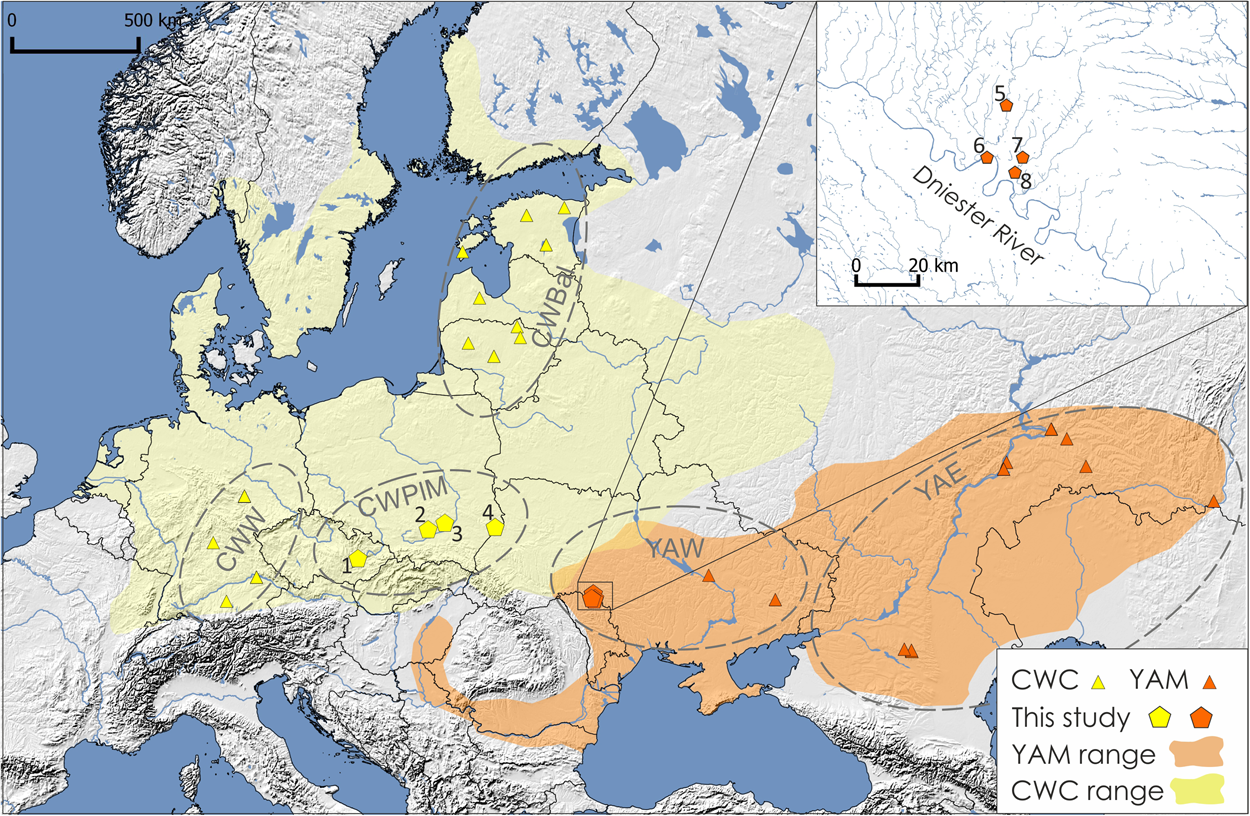
Image linked in the comments:

Figure 1

Location of archaeological sites used in this study. Extent of the Corded Ware culture (CWC) region and the Yamnaya horizon (YAM) are marked in yellow and orange, respectively. Groups of Corded Ware culture, including western (CWW), eastern (CWPlM) and Baltic (CWBal), and groups of Yamnaya horizon including western (YAW) and eastern (YAE), are marked in circles. Numbers represent archaeological sites from which analyzed individuals came from: (1) Držovice; (2) Malżyce; (3) Książnice; (4) Hubinek; (5) Klembivka; (6) Porohy; (7) Pidlisivka; (8) Prydnistryanske. The map was created using QGIS 2.12.2.


From here.


Thursday, December 3, 2020

My Genetic Ancestry In A Nutshell

23 and Me and updated its ancestry algorithm. In my case, any changes from the previous estimates in this report were very subtle. 

I have Y-DNA haplogroup E-V13 (from my father) and mtDNA haplogroup H1b (from my mother). My autosomal ancestry using the regional assignment algorithm of the service is as follows:


The trace ancestry is from Southern India:

The service says this about that population:
Home to the Malayali (meaning “people of the mountains”), Kerala has been at the heart of a thriving international spice trade for millennia, becoming one of India’s most diverse and prosperous states. This genetic signature reaches high levels among Christian communities who live in Kerala, a large number of whom immigrated to the United States during the last century.
I suspect that this trace ancestry is a false positive. 

The reports assigns time depths to these major ancestry components in addition to localizing some of them.

The lion's share of my non-Finnish ancestry (including all of the Scandinavian ancestry) is from my father who is genetically, something of a Northern European mutt. I do have genealogically confirmed Irish ancestry on my father's side from a marriage that took place in Northwest Ohio, although I don't know precisely where in Ireland. My father's predominant ancestry according to genealogical sources is proximately from Lutheran Germany (it was called Prussia in 1847 at the time my patrilineal ancestor migrated to the U.S. to avoid being conscripted into the military). The relatively small amounts of Italian and Scandinavia admixture are traceable to pre-emigration admixture event in Europe, probably during the 18th century.

The regional localization of my Finnish ancestry (which is all on my mother's side) is quite striking as it is very close to the place from which my actual ancestors in Finland originate a little later in the 19th century. It looks more recent than the known date of immigration of my Finnish ancestors because my mothers ancestors all come from an endogamous Finnish community in the Upper Peninsula of Michigan that was a subset of the community in Finland from which they originally migrated to the U.S.

I have less than 2% Neanderthal DNA, but I still have more Neanderthal DNA than 78% of 23 and Me customers. 

I previously made a deep dive into what kind of narrative is likely to be associated with Y-DNA E-V13 at this blog, which can be found here.

My mtDNA haplogroup H1b is common in the 23 and Me sample (one in 130 customers). According to the service:
Your maternal line stems from a branch of H1 called H1b. The common ancestor of haplogroup H1b lived approximately 5,000 to 7,000 years ago in southwestern Europe. Her maternal-line ancestors had been among the former inhabitants of continental Europe, but massive glacial ice sheets during the last great peak of the cold at the end of the Ice Age pushed them out of the continental interior. They sheltered for thousands of years in warmer refuges along the Mediterranean. Then, as the Ice Age faded away, they re-emerged and migrated north.

While the woman who gave rise to H1b probably lived in southern France or the Iberian Peninsula, her descendants are most frequently found among eastern Europeans. Women carrying H1b journeyed eastward from southwestern Europe, passed north of the Italian Alps and entered present-day Slovakia. From there, H1b spread north throughout the region surrounding the Baltic Sea and the Volga-Ural area of Russia. Members of H1b also moved into southeastern Europe to Ukraine, the Balkans, and the Caucasus Mountains.
Previous posts on my personal genome from April 27, 2015, and April 6, 2015.

My Wife

My wife is 99.9% Japanese and Korean, with a possible 0.1% trace ancestry from Central and South Asia (from her mother's side). 

Both her parents immigrated from what is now North Korea (the partition was a recent event when they migrated to the U.S. in the 1960s) and have deep ancestry there. Notwithstanding this fact, 23 and Me states that South Korean ancestry is a "Highly Likely Match" and states that North Korean ancestry is not detected. This obvious fail is no doubt due to the small number of North Korean samples in the database.

The service also suggests that my wife has 7.6% Japanese ancestry (75% from her father suggesting that my wife would have a single great-great grandparent on his side, and 25% from her mother, suggesting that my wife would have a Japanese ancestor a generation or two more remote than that on her mother's side). This ancestry, according to the service, dates to sometime in the range from 1760 to 1850. At least some of this is probably an artifact of flaws in the ancestry matching algorithm, related to the fact that the non-Jomon ancestors of the Japanese very likely originated in the Korean Peninsula but Japan makes up more of the sample than Korea, although those flaws are significantly less severe than they used to be.

Her mtDNA haplogroup C5 is atypical for a Korean where it is found in 0.1% of tested Koreans (a point discussed here), although I suspect that the frequency is higher in North Korea, which is closer to the geographical homeland of that mtDNA haplogroup. My working hypothesis, given the relevant historical context and her mother's family background, is that she has a remote Mongol Princess matrilineal ancestor, from ca. 1250 CE, which may also be the source of trace Central Asian ancestry.

Wednesday, December 2, 2020

Seeing The Forest In The Study Of Pre-History

Roughly half of the posts of this blog are related to the study of pre-history leaking into the historic era and the present at times. 

For the study of pre-history to be interesting, satisfying, comprehensible, and even at times useful, the student needs to be able to the forest level big picture and not just the tree level details.

What are we looking for at the big picture, forest level?

1. A Credible Narrative Story Of The Genus Homo.

The foundation of everything else one derives from the study of pre-history is a narrative level understanding of the story of the human species and its archaic predecessors. This continues up through not just the point at which the first writing appears, but also up to the point at which reliable, literal, comprehensive written accounts of what happened in the past appear. This happens at different times in different places and in different domains.

In this context, a narrative is a story of a people or peoples. It is a possible, plausible, sequential description of actual groups of people who respond to conflicts and pressures and in a cause and effect manner.

To be credible, it needs to be supported by credible evidence. A narrative's credibility is greatly improved and the narrative is more robust, when that story is supported: 

* by multidisciplinary lines of evidence that are consistent with each other to within the tolerances of the uncertainties in what we know, 

* by independent sources of evidence within the same discipline, ideally by more than one group of independent researchers, 

*when it is not contradicted by any credible evidence that can't be explained by tweaking the narrative, 

* when it stands the test of time after it has been published, and 

* when it is consistent with the historical, anthropological, linguistic, biological, climatological, and logical process that have been established by other means.

It is important to have some level of narrative from start to finish, but more detail, which can be a product of advances in research and more advanced study and doesn't take away from the necessity of first having a strong grasp of the higher level narrative.

For example, you need the context of the bare bones Out of Africa narrative to understand the prehistory of the Americas.

While it isn't logically necessary for this to be the case, in reality, the human narrative can be well understood in broad migrations and admixtures that happen mostly in punctuated waves of coherent peoples with a common origin who are genetically similar, share culture that is expressed though a language, one or a small number of religions which are revealed for example in rituals related to the dead, kinship practices, a technological package including means of subsistence and characteristic art and artifacts, and stories which may or may not be transmitted down to us in more or less fragmentary forms depending on the circumstances. 

We can't always find evidence about all of these elements, but we can always reasonable assume that all of them existed in a coherent form at the time whether or not we can learn what they were. We can also have some sense of what the missing pieces about which we have no direct evidence for a particular people were like by analogy to similarly situated ancient and modern peoples about which we do have evidence.

Biogeographic Regions

It is useful to study prehistory in biogeographic regions, often on the scale of large portions of continents and associated nearby islands defined by watersheds, mountain ranges, jungles, deserts, and similar geographic barrier boundaries, that have for long periods of prehistory and/or history, been distinct. 

Key regions include sub-Saharan Africa (sometimes broken into West Africa, East Africa, the Congo basin, Southern Africa and Madagascar and other Indian Ocean islands), North Africa and the Sahara, the greater Nile River basin, Southwest Asia (also known as the Middle East) sometimes divided into the Levant, Mesopotamia (i.e. the Tigress and Euphrates River Valley), and Arabia, West Asia (i.e. Anatolia and Iran and sometimes also the Caucuses Mountains), Europe (with various subdivisions thereof), Central Asia, South Asia, Southeast Asia (mainland and island), Melanesia, Australia, Oceania, North Asia (often distinguishing the Spice Road area at its southern boundary), North America (often distinguishing Pacific, Northern and Southwestern and Southeastern areas or certain watersheds), Meso-america, the Caribbean, and South America. I frequently tag the entire region of the Americas using the ethnocentric term "New World" without intending a non-descriptive connotation.

Prehistoric Eras

It is useful to study prehistory for particular functionally defined eras within those biogeographic regions or across biogeographic regions that are distinct but interact with each other. At the forest level this means:

* The pre-modern human era. This era starts at the chimpanzee-hominin split around 7-13 million years ago, to the evolution of Homo Erectus around 2 million years ago, to the evolution of anatomically modern humans around 300,000 years ago in Africa with the earliest representatives leaving Africa around 125,000 years ago and the main wave of modern humans ancestral to modern humans alive today leaving Africa around 75,000 to 50,000 years ago.

A partially overlapping era is the Middle Paleolithic era which is associated mostly with archaic Neanderthals and Denisovans, and with modern humans in and out of Africa prior to the Upper Paleolithic era.

* The Upper Paleolithic era. This era starts around 75,000 to 50,000 years ago, with the main wave of modern humans leaving Africa and parallel mass migrations within Africa. The older date is often linked to the Toba eruption and from the appearance of litmus test modern human technologies like the use of bone tools, more refined stone tools like flint spear and arrowhead points, and the use of bows and arrows. The more recent date is often inferred from the analysis of human population genetics. Historically, this was often thought of as the appearance of behaviorally modern humans, although that interpretation, while held by some scholars, is no longer a consensus one.

Within the Upper Paleolithic, important landmarks are the migration of modern humans across the Wallace line to Australia and Melanesia around 50,000 years ago, the migration of modern humans into Europe coinciding with the beginning of the extinction of Neanderthals from about 45,000 to 30,000 years ago, the emergence of distinct West Eurasian and East Eurasian populations of modern humans around 40,000 years ago, the era before and after the Last Glacial Maximum around 20,000 years ago, the first pre-Neolithic pottery of about 16,000 years ago in East Asia, the migration of the founding population of the Americas into North and South America from Beringia around 15,000 years ago, the Younger Dryas event around 12,900 years ago, and the Mesolithic in the several thousand years before the Holocene era when hunter-gatherers start to repopulate Europe from their Last Glacial Maximum refugia.

* The Holocene era. The Holocene era starts around 10,000 years ago. The main division of Holocene era peoples are Neolithic, Copper Age (a.k.a. Eneolithic a.k.a. Chalcolithic) which is sometimes bundled into the early Bronze Age, the Bronze Age and the Iron Age. The divide between the Bronze Age and the Iron Age is often placed at Bronze Age collapse ca. 1200 BCE, even though the Iron Age doesn't really start in earnest for a century or three after that, emerging from the pre-classical, post-Bronze Age, dark ages. (Classical refers mostly to Greco-Roman Iron Age civilization.) The Neolithic era radiates at the technological package spreads from the several independent places where it originates reaching different places at different times. The Copper Age starts around 3500 BCE with the early Bronze Age starting a few centuries later and becoming fully expressed by about 2500 BCE. There is a major civilizational disruption around 2200 to 2000 BCE associated with the 4.2 kiloyear climate event.

The Holocene era is associated with the earliest Neolithic Revolutions during which modern humans domestic plants and animals so that they can transition from being hunter-gatherers to stone tool using farmers and herders. Confusingly, in East Eurasia, and in Russian scholarship, pottery predates this food production revolution and the initial use of pottery is often used to define the Neolithic era, while in the Fertile Crescent and in Western scholarship, the Neolithic is usually defined by the food production revolution which predates the use of pottery.

Some scholars recognize the Anthropocene era. This is the era in which modern humans start to influence the environment and climate decisively relative to other animals) coinciding roughly with the post Last Glacial Maximum Mesolithic era and continuing to the present.

The Iron Age coincides with the beginning of the historic era in some contexts, after which the historic eras of the Middle Ages (roughly from the fall of the Western Roman Empire in the 400s CE to the Renaissance and Reformation in the late 1400s), early modern period (starting with the Renaissance and Reformation), and modern era (roughly starting with the Enlightenment in the 18th century) follow. Other time periods within what is mostly the historic era that I frequently reference include the Migration Period, Y1K (i.e. the vicinity of 1000 CE), and the divide between pre-Columbian and post-Columbian eras in the New World (at 1492 CE, but also descriptively dated from first contact with something European sourced or driven).

2. How Did The Narrative Impact The Modern World

A second major forest level objective of the study of prehistory is to understand how prehistory has impacted our life in modern times. 

This could involve, for example, evolutionary and prehistoric understandings of human genetic variation, or the relationship of attested language families to each other. This can pull the study of prehistory into its causal consequences in the historic era, especially in the immediately adjacent oldest historic periods, usually with a bridge period (often from the Bronze Age and first reduced to writing in the Iron Age) of legendary history where there are written accounts of the past that are somewhat fantastical and merge fact and fiction.

3. Developing An Inventory Of What Has Happened In Humanity's History That Did Not Have A Big Impact On The Modern World

Studying the prehistory of moribund or extinct peoples, languages, and cultures helps us understand the range of what is people for humanity, even if as it happened, those particular peoples or what they did, didn't have a direct influence of much note on the modern world.

For example, it is helpful to know if there were instances where herding and farming were developed and then abandoned (which appears to have largely happened, for example, in Neolithic Ireland) before being readopted.

4. Understanding Historical Human Processes.

By analyzing at a forest level the narratives, modern impacts, and possibilities exposed by the study of prehistory, allow us to see larger patterns and understand how the long term, big picture course of history unfolds.

When two peoples meet, do they make war, do they respect each other's boundaries, do the blend, is one subjugated to the other culturally, do the admix and if so in what manner? Under what conditions does htis play out one way or another?

How much of history appears to be driven by climate, by technology, by economics, and geography, and how much does it appear to be driven by the contingent decisions of particular individuals? What technologies are developed many times independently and what technologies are developed only once or rarely and spread widely?

How do new cultures and new biogeographic phenotypes emerge?