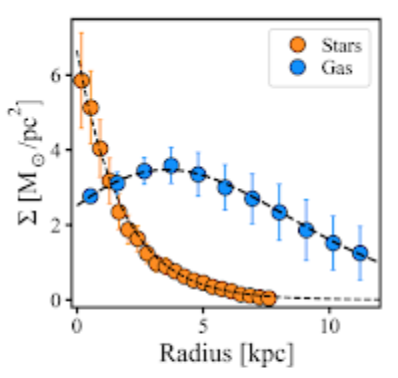
We make rotation curve fits to test the superfluid dark matter model. Our aim is to investigate whether superfluid dark matter provides satisfactory fits to galactic rotation curves with reasonable stellar mass-to-light ratios. We fitted the superfluid dark matter model to the rotation curves of 169 galaxies in the SPARC sample. We found that the mass-to-light ratios obtained with superfluid dark matter are generally acceptable in terms of stellar populations. However, the best fit mass-to-light ratios have an unnatural dependence on the size of the galaxy in that giant galaxies have systematically lower mass-to-light ratios than dwarf galaxies. A second finding is that the superfluid often fits the rotation curves best when the superfluid's force does not closely resemble that of Modified Newtonian Dynamics (MOND). In that case, we can no longer expect superfluid dark matter to reproduce the phenomenologically observed scaling-relations that make MOND appealing. If, on the other hand, we consider only solutions whose force approximates MOND well, then the total mass of the superfluid is in tension with gravitational lensing data. We conclude that even the best fits with superfluid dark matter are still unsatisfactory.
Wednesday, January 26, 2022
Superfluid Dark Matter Has Some Issues
String Theory Is Still Vaporware
Woit explains convincingly that even string theorists know that string theory has no foreseeable observational basis, and that the theoretical arguments currently being advanced are wanting as well.
Friday, January 21, 2022
What Is The Weak Gravity Conjecture?
The review article is 120 pages long, but the abstract and introduction alone are very helpful in providing a grounding in what the weak gravity conjecture is, and why it matters.
The Weak Gravity Conjecture holds that in a theory of quantum gravity, any gauge force must mediate interactions stronger than gravity for some particles.
This statement has surprisingly deep and extensive connections to many different areas of physics and mathematics. Several variations on the basic conjecture have been proposed, including statements that are much stronger but are nonetheless satisfied by all known consistent quantum gravity theories.
We review these related conjectures and the evidence for their validity in the string theory landscape.
We also review a variety of arguments for these conjectures, which tend to fall into two categories: qualitative arguments which claim the conjecture is plausible based on general principles, and quantitative arguments for various special cases or analogues of the conjecture.
We also outline the implications of these conjectures for particle physics, cosmology, general relativity, and mathematics.
Finally, we highlight important directions for future research.
Wednesday, January 19, 2022
Do We See The Expansion Of The Universe In Titan's Orbit?
Saturn's moon Titan's orbit gets about a four and a half inches a year further from Saturn each year, plus or minus an inch or so, according to an ultra-precise measurement by the Cassini probe.
There are all sorts of factors that could account for this, so assuming that the overall expansion of the Universe, which is such a tiny consideration at this distance scale, could account for this effect seems like a long shot. On the other hand, a back of napkin calculation suggests that the observed effect is of the right order of magnitude to be explained by it.
So, while this is interesting enough observation to make note of for future reference, I don't necessarily take it too seriously.
Recently it was found from Cassini data that the mean recession speed of Titan from Saturn is v=11.3±2.0 cm/yr which corresponds to a tidal quality factor of Saturn Q≅100 while the standard estimate yields Q≥6⋅10^4. It was assumed that such a large speed v is due to a resonance locking mechanism of five inner mid-sized moons of Saturn.
In this paper, we show that an essential part of v may come from a local Hubble expansion, where the Hubble-Lemaıtre constant H(0) recalculated to the Saturn-Titan distance D is 8.15 cm/(yr D). Our hypothesis is based on many other observations showing a slight expansion of the Solar system and also of our Galaxy at a rate comparable with H(0). We demonstrate that the large disproportion in estimating the Q factor can be just caused by the local expansion effect.
Cycles Of Activity In The Sun Support The Existence Of Planet 9
Planet 9 is currently a hypothetical planet the orbital parameters of which are based on anomalous orbits of Kuiper Belt objects.
The orbital parameters are such that, if Planet 9 exists, the theory of solar barycentric dynamics would be profoundly altered. We show that, with Planet 9 included in the solar system, barycentric theory is a much more effective predictor of solar activity on the decadal, centennial and millennium time scales. In particular the most elementary quantity of barycentric theory, the Sun to planet barycentre distance, is more coherent with decadal solar activity cycles and grand solar activity minima than barycentric distance without Planet 9 included. Further, barycentric theory including Planet 9 contains strong components at periods corresponding to the Hallstaatt and Gleissberg cycles whereas barycentric theory without Planet 9 shows no evidence of these cycles.
A challenge that emerged during this study was the absence of the strongest component in barycentric theory, the Jose component at ~ 178 year period, from the spectra of millennium scale solar activity. This conundrum was solved by demonstrating that, during the transformation from solar motion to solar activity, the Jose component in solar motion was, in the spectrum of solar activity, split into multiple sidebands due to phase modulation by lower frequency cycles.
The excellent fit to solar activity at multiple time scales by barycentric theory with Planet 9 included is itself supporting evidence for the existence of Planet 9, specifically by providing an estimate of the current heliographic longitudinal location and orbital period.
Wednesday, January 12, 2022
Old Modern Human Remains Older Than Previously Believed
A partial H. sapiens skull and associated skeletal parts found in 1967 in the Kibish rock formation along Ethiopia’s Omo River date to at least around 233,000 years ago, pushing back the age of the fossils by 36,000 years or more. An age well exceeding 200,000 years for the Ethiopian fossils, known as Omo 1, fits with recent fossil discoveries suggesting that H. sapiens evolved across Africa starting roughly 300,000 years ago.
Why Is Galaxy AGC 114905 Weird?
The authors do the right thing and worry about the inclination, checking to see what it would take to be consistent with either LCDM or MOND, which is about i=11º in stead of the 30º indicated by the shape of the outer isophote.they “find it unlikely that we are severely overestimating the inclination of our UDG, although this remains the largest source of uncertainty in our analysis.” I certainly agree with the latter phrase, but not the former. I think it is quite likely that they are overestimating the inclination. I wouldn’t even call it a severe overestimation; more like par for the course with this kind of object. . . .So the bottom line is that I am not convinced that the uncertainty in the inclination is anywhere near as small as the adopted ±3º.
He places this analysis in the context of a long career of analyzing these issues in these kinds of galaxies, demonstrating first, that even modest inclination issues do indeed have a material effect, and secondly, that the magnitude of typically measurement errors in determining the correct inclination are often quite large.
Along the way, he also points to two other potential problems that are not entirely unrelated.
Is A Model Assuming A Thin Axisymmetric Disk Sound?
One is that the modeling is based upon an axisymmetric thin disk galaxy which is a spherical cow model in a case like this one with a highly irregular shape (see the image below from the 2021 paper), that doesn't work very accurately in a galaxy like this one that is outside the model's range of applicability.
This messy morphology is typical of very low surface brightness galaxies – hence their frequent classification as Irregular galaxies. Though messier, it shares some morphological traits with the LSB galaxies shown above. The central light distribution is elongated with a major axis that is not aligned with that of the gas. The gas is raggedy as all get out. The contours are somewhat boxy; this is a hint that something hinky is going on beyond circular motion in a tilted axisymmetric disk.
Is This Galaxy Out Of Equilibrium?
The modeling exercise is good, but it assumes “razor-thin axisymmetric discs.” That’s a reasonable thing to do when building such a model, but we have to bear in mind that real disks are neither. The thickness of the disk probably doesn’t matter too much for a nearly face-on case like this, but the assumption of axisymmetry is extraordinarily dubious for an Irregular galaxy. That’s how they got the name.
In the context of Deur's approach, the three dimensional shape of a mass distribution is critical to causing the gravitational effects that make the toy-model MOND theory work.
In a spherically symmetric mass distribution, a system will have no inferred dark matter and no MOND-like gravitational effects.
In an axisymmetric thin disk, he concludes that the self-interaction of the gravitational field gives rise to a MOND-like second order effect that declines as 1/r instead of 1/r^2 with radius, which becomes material when the first order 1/r^2 Newtonian term gets small in very weak gravitational fields.
As applied to this situation, what Deur's approach implies is that if AGC 114905 is a quite thick disk relative to its radius, compared to the theoretical ideal of an axisymmetric thin disk that produces MOND-like behavior, that the non-1/r^2 second order gravitational effects should be weaker, and that the dark matter proportion that one would expect to infer when trying to fit AGC 114905 into a dark matter particle model would be smaller. So, the thickness of the disk may be more important to the accuracy of the analysis than McGaugh, working from a MOND-like frame of reference, would expect.
From the 2021 Paper
Another way that an analysis along the lines of Deur's approach could impact the result is that if AGC 114905 has a high proportion of gas and other interstellar media relative to stars, and if the interstellar medium within AGC 114905 is quite close to spherically symmetric, even if the stars are aligned in more of a disk-like arrangement, this could be a big deal.
This would reduce the inferred dark matter proportion that would be expected, since the second order gravitational effect would arise only as to the proportion of the mass in the galaxy that is in stars, rather than all of the matter in the galaxy, and it might even weaken the second order effects between the stars, effectively diluting them. This kind of scenario doesn't seem implausible in the case of this particular galaxy.
Now, the effect of the disk thickness, interstellar gas proportion, and interstellar gas distribution shape in a Deur style analysis still wouldn't be sufficient to bring AGC 114905 to the point of having no inferred dark matter proportion, that the article concludes that it has.
However thick and gas dominated it may be, and whatever the distribution of the gas in the galaxy might be, AGC 114905 still isn't actually spherically symmetric, so there should be, a priori, some inferred dark matter proportion.
But this Deur style analysis might make it possible to support a gravitational theory based explanation of AGC 114905 with a significantly smaller error in inclination angle than would be possible without this contributing factor to the analysis, allowing for a much less dramatic underestimation of the inclination angle error than would be necessary otherwise to explain this outlier case.
Tuesday, January 11, 2022
Is Ainu Part Of A Larger "Austric" Language Family?
A TreeMix analysis places the Jomon as an offshoot of the Hoabinhian people (a Mesolithic wave of people in Southeast Asia and Southern China ca. 12,000 to 10,000 BCE), with the Kusunda people (who are hunter-gathers in Western Nepal who historically spoke a language that is an isolate and were animistic religiously) as an intermediate population.Y-DNA haplogroup D has a cryptic distribution found in isolated pockets across Asia including Siberia and Tibet that tends to favor a Northern route origin.The mtDNA haplogroups N9b and M7a also tell story so deep in history (both are very basal in the Eurasian mtDNA tree and derived from African mtDNA haplogroup L3) that it is hard to reconstruct. Both mtDNA M and mtDNA N show distributions that tend to favor a Southeast Asian route to Japan, but perhaps this is because the northern bearers of this haplogroup went extinct, and were then almost fully replaced in the Last Glacial Maximum.
More up to date genetic data certainly favors the Austric hypothesis of this paper over an Altaic hypothesis, that the paper's authors reject on linguistic grounds.
But the genetic data is really agnostic between the possibility that the Ainu language is a language isolate, and the hypothesis that it could have a common source proto-language with the Austroasiatic and Austronesian languages that have "homelands" in Southeast Asia and Southern China.
The genetically and archaeologically supported time frame in which the Jomon people were isolated from mainland East Asia tends to favor, instead, the language isolate hypothesis, because the common language family connection of an "Austric" language family that would be consistent with the archaeological and genetic evidence would be deeper in the past than the common protolanguages shared by any other linguistically reconstructible language families.
If the word lists are as solid as claimed by the authors of this paper, the common ancestor of the Austric languages should have started to break up into the predecessors of the modern language families something like 3,000 to 6,000 years ago, or so (a time depth comparable to the one separating the most distinct of the Indo-European languages from each other, for example), rather than the at least 15,000 years of isolation suggested by genetic data and paleoclimate data (about the time depth probably uniting the pre-Columbian Native American languages of the Americas other than the language families that include the Na-Dene and Inuit languages, i.e. AmerInd, that are impossible to unite in their modern forms with linguistic information alone by any common linguistic characteristics).
On the other hand, as fishermen who had some outposts of their civilization as distant as the Ryukyu Islands, it is conceivable that they could have had maritime trade with East Asia that could have resulted in language shift, although the genetic data for the Jomon and Ainu people while supporting some links to Northeast Asia, do not support significant cultural or population genetic ties to Southern China and beyond from about 15,000 years ago to about 3,000 years ago).
Linguistic Evidence
Franciscus Kuiper was the first to suggest that Nihali may be unrelated to any other Indian language, with the non-Korku, non-Dravidian core vocabulary being the remnant of an earlier population in India. However, he did not rule out that it may be a Munda language, like Korku. Kuiper suggested that Nihali may differ from neighbouring languages, such as Korku, mostly in its function as an argot, such as a thieves' cant. Kuiper's assertions stem, in part, from the fact that many oppressed groups within India have used secret languages to prevent outsiders from understanding them.Linguist Norman Zide describes the recent history of the language as follows: "Nihali's borrowings are far more massive than in such textbook examples of heavy outside acquisition as Albanian." In this respect, says Zide, modern Nihali seems comparable to hybridised dialects of Romani spoken in Western Europe. Zide claims that this is a result of a historical process that began with a massacre of Nihalis in the early 19th century, organised by one of the rulers of the area, supposedly in response to "marauding". Zide alleges that, afterwards, the Nihalis "decimated in size", have "functioned largely as raiders and thieves ... who [have] disposed of ... stolen goods" through "outside associates". Zide adds that Nihali society has "long been multilingual, and uses Nihali as a more or less secret language which is not ordinarily revealed to outsiders" and that early researchers "attempting to learn the language were, apparently, deliberately rebuffed or misled".
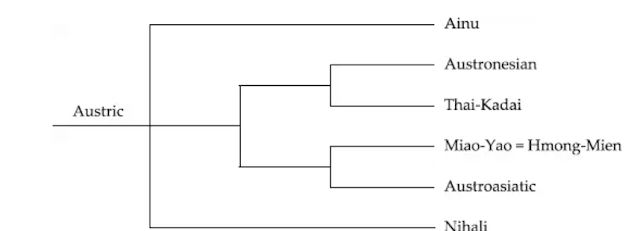
There have been several attempts to solve the question of the genetic affiliation of the Ainu language of Hokkaido, formerly spoken also in Sakhalin and the Kuril islands. Apart from some inadequate or unlikely proposals there are two principal serious hypotheses: (1) Altaic, or more inclusively ‘Euroasiatic’ (Nostratic), as advocated for instance by Ramstedt, Koppelmann, Street, Patrie, Krippes, and Greenberg (with Ruhlen); and (2) Austronesian and Austroasiatic (plus Thai-Kadai and Miao-Yao, together Austric): e.g., Gjerdman, Sternberg, Murayama, and Vovin. Physical anthropology has been ambiguous on this question, in some aspects favoring a Northeast Asian, in others a Southeast Asian origin of the Ainu. The authors of the present article prefer (2), the Austric hypothesis, assuming an internal structure of the Austric macro-phylum consisting of Austro-Thai (Austronesian + Kadai), Miao-Austroasiatic (Hmong-Mien + Austroasiatic), and the peripheral remnants Nihali (in India) and Ainu. This article contains eighty-eight etymologies that the authors believe are strong evidence for the Austric affinity of the Ainu language. The lexical material includes personal pronouns, lower numerals, and other core basic vocabulary. Most importantly, this article is intended to stimulate discussion of the position of Ainu in genetic classification.
The Ainu language is known from Hokkaido, Sakhalin and the Kuril islands (where it is now extinct). According to toponymy, Ainu was also formerly spoken on Honshu (Hudson 1994, 242–44), and apparently on other islands of the Japanese archipelago, probably even as far as the Ryukyu Islands, where, for example, place-names of the type Pira correlate with Ainu pira “rock” (Kagami 1962; Beleňkaja 1964). There are surprising biological similarities between Ainu and the Ryukyans, especially visible on new-born children (Levin 1971, 197; Hudson 1994, 247), supported by evidence of molecular genetics (Cavalli-Sforza et al. 1994, 232).
[Ed. History attests that a language in the Ainu language family was probably spoken in the Northern part of Honshu, the main Japanese island, until about 1000 CE, and modern Japanese people have a significant minority component of Ainu-like, Jomon-like ancestry arising from an admixture event ca. 1000 BCE with a Manchurian-like Yayoi population from Korea.]
There have been several attempts to solve the question of the genetic affiliation of the Ainu language. Aside from some attempts at comparison which are rather romantic (with Hebrew [!] by Batchelor), or give quite unsystematic results, e.g. with Indo-European by Naert (1958, 1961), Lindquist (1960) or Van Windekens (1961) — see critical reviews of Benveniste (1960), Dolgopolsky (1963), Tailleur (1961), Refsing [ed.] (1998); or with ‘Palaeo-Eurasian’, i.e. ‘Caucasian’, Basque, Yenisseian, Burushaski, plus some Amerindian languages, by Tailleur (1963, 1968), there are two main competing hypotheses:
(1) Altaic: first mentioned by Ramstedt; further defended e.g. by Street, Language 38[1962], 92–99; Patrie 1982 (critically reviewed e.g. by Helimski 1984); and more extensively in the ‘Euroasiatic’ concept including Altaic, Nivkh, Uralic, Indo-European etc.: Koppelmann1928, 1933; Ruhlen 1987, 131–32 and 1994, 16–20; Krippes, Ural-Altaische Jahrbücher 61 [1989],149–51; Greenberg 2000–2002;(2) Austronesian and Austroasiatic (plus Thai-Kadai and Miao-Yao, together Austric): 1926, 1960; Sternberg 1929, 1933; Murayama 1992a, 1992b, 1993; Vovin 1993 (cf. thereview of Sidwell 1996).Our research supports the Austric hypothesis. . . .Ainu (and Nihali, in India) may represent peripheral remnants of this Austric macro-phylum (see Bengtson 1996, Blažek 1996). The following scheme depicts their mutual relations: In physical anthropology the Ainu type has generally been included in the Mongoloid subspecies. On the basis of DNA evidence, the genetic taxonomy of Cavalli-Sforza et al. (1988,6003; 1992, 5621; 1994, 231–32) postulates a ‘Northeast Asian’ branch, comprising the Ainu, Japanese, and Koreans, along with Tibetans, North Chinese, and others. Similar results were obtained by classical methods of physical anthropology (Alekseev & Trubnikova 1984, 88). On the other hand, some undoubtedly very archaic features, such as the Ainus’ profuse body hair, and characteristic Sundadont dentition, point to relations with Southeast Asia (Alekseev & Trubnikova 1984, 94–96; Turner 1989). We might also mention the remarkable closeness of gene frequencies between the Ainu people and the aborigines of Taiwan, for example IGKC,KM (1&1,2), P1(1) or RH, haplotype cDE (Cavalli-Sforza et al. 1994, 385–86, 425–26). The connection of the ancestors of the Ainu people with Southeast Asia was thoroughly argued by Sternberg (1929).The earliest known presence of modern man in the Japanese archipelago is estimated at 30,000 years BP (e.g., Utanobori on Hokkaido, or Osinovka on Sakhalin: see Golubev & Lavrov1988, 206, 220). At 11.000 years BP the first ceramic artifacts appear (Cavalli-Sforza et al. 1994, 202, have this as early as 12.700 BP; in any case, it is the world’s first appearance of ceramics).The style of pottery changed ca. 10.000 BP, which is thought to indicate the advent of the Jômon culture (remarkably, on Sakhalin this technology was delayed by 2.000 years, comparedwith Hokkaido — see Golubev & Lavrov 1988, 225). The contemporary Ainu people are very probably the descendants of the creators of the Jômon culture (cf. Hudson 1994, 244; Cavalli-Sforza et al. 1994, 203, 232). About 400 BC a new population came to Kyushu from the Korean peninsula, the bearers of the culture called Yayoi. They brought a developed rice agriculture and an Altaic language (Proto-Japanese). The closest relative of Old Japanese was the language of the old Korean kingdom, Koguryŏ (cf. Hudson 1994, 246–47).
. . .Conclusion
Following the great specialist in Austronesian (and African) languages, Otto Dempwolff, we assume that the preceding list of lexical parallels between Ainu and the Austric languages represents the first step in the inductive phase of the demonstration of genetic relationship (really a continuation of the first steps taken by Gjerdman, et al.). The following step (already begun, for example, by Norquest, 1998) consists of the formulation of regular phonetic correspondences, which should be verified during the deductive phase. We believe that future progress in comparative and historical Austric linguistics will lead to the complete demonstration of the membership of Ainu within the Austric macro-phylum (along with Austronesian, Thai-Kadai, Miao-Yao, Austroasiatic, and probably also Nihali). If our article helps to stimulate discussion of the position of Ainu in genetic classification, it has served its purpose.
Monday, January 10, 2022
Medieval Warhorses Weren't Big
Shockingly, medieval warhorses weren't as huge and amazing as depicted in TV and movie accounts, although they were still highly valued at the time.
Medieval warhorses are often depicted as massive and powerful beasts, but in reality many were no more than pony-sized by modern standards. . . . Horses during the period were often below 14.2 hands high. . . . Researchers analysed the largest dataset of English horse bones dating between AD 300 and 1650, found at 171 separate archaeological sites.
From here.
Unsurprisingly Matter And Antimatter Respond To Gravity In The Same Way
The standard model of particle physics is both incredibly successful and glaringly incomplete. Among the questions left open is the striking imbalance of matter and antimatter in the observable universe, which inspires experiments to compare the fundamental properties of matter/antimatter conjugates with high precision. Our experiments deal with direct investigations of the fundamental properties of protons and antiprotons, performing spectroscopy in advanced cryogenic Penning trap systems. For instance, we previously compared the proton/antiproton magnetic moments with 1.5 parts per billion fractional precision, which improved upon previous best measurement by a factor of greater than 3,000.
Here we report on a new comparison of the proton/antiproton charge-to-mass ratios with a fractional uncertainty of 16 parts per trillion. Our result is based on the combination of four independent long-term studies, recorded in a total time span of 1.5 years. We use different measurement methods and experimental set-ups incorporating different systematic effects.The final result, −(𝑞/𝑚)𝑝/(𝑞/𝑚)𝑝¯=1.000000000003(16), is consistent with the fundamental charge–parity–time reversal invariance, and improves the precision of our previous best measurement by a factor of 4.3. The measurement tests the standard model at an energy scale of 1.96 × 10^−27 gigaelectronvolts (confidence level 0.68), and improves ten coefficients of the standard model extension.
Our cyclotron clock study also constrains hypothetical interactions mediating violations of the clock weak equivalence principle (WEPcc) for antimatter to less than 1.8 × 10^−7, and enables the first differential test of the WEPcc using antiprotons. From this interpretation we constrain the differential WEPcc-violating coefficient to less than 0.030.
Looking For Blogroll Suggestions
Every now and then I pay attention to the layout of this blog.
Many of the links in my blogroll are stale, and I plan on migrating them to a permanent "page" of stale science blogs.
This would also be a natural time for me to add new blogs or webpages to my blogroll at the same time.
I'd welcome any suggestions in the comments for active (at least a few posts a year) blogs or reference webpages that regularly address the subject matter of this blog.
Friday, January 7, 2022
Connecting The Dots In The Expansion From The Steppe
Mobility and migrations are key factors for understanding cultural change. Since the advent of mobility isotopes and especially ancient DNA studies, this fact is in no prehistoric periods so obvious as in the Early Neolithic of the 7th/6th millennium BC and the Copper Age/Early Bronze Age transition of the 4th/3rd millennium BC.
However, especially for the 3rd millennium BC, there is no consensus on the scale, size, extent, directions, and speed of events. We likewise lack good conceptualisations and explanations for the mechanisms behind people moving.
Here, an attempt is being made to describe essentials of four events in which archaeology and genetic studies regard recognisable quantities of peoples moving westwards: 1) Yamnaya; 2) Early Corded Ware; 3) Later Corded Ware; and 4) ‘steppe’ Bell Beaker.
Emphasised is the importance of the geography in the understanding of regional transmissions. Particularly discussed are the roles of versatile/volatile boundaries of the Eastern European forest-steppe region between the Dnieper and Dniester rivers for the formation of Corded Ware, and of the Central European Upper Rhine river region in the border triangle of France, Germany and Switzerland for "steppe" Bell Beaker users.
Highlighted are also possible origins of the typical gender-differentiated burial custom of Corded Ware and Bell Beaker cultures in the north-Pontic Zhivotilovka-Volchansk group; the importance of Bohemia and the Elbe river in the earliest spread and first consolidation of Corded Ware users; and the "Beakerisation" of central and southern France rather happening from the east than from the Iberian peninsula.
Thursday, January 6, 2022
Stars Form Much Faster Than Previously Assumed
There may be two factors at work in explaining the "impossible early galaxy observations" discussed in my previous post at this blog.
One of the factors, discussed in that post, is that gravitational based explanations of dark matter phenomena suggest that stars form galaxy structures much more quickly than they do in a cold dark matter paradigm.
Yesterday's new paper suggests that there is also a second factor at work which has nothing to do with the dark matter and dark energy phenomena debates.
Stars form much more quickly from clouds of hydrogen gas than historically assumed, because magnetic fields in those clouds of hydrogen gas are much weaker than they were previously believed to be. There are plausible reasons for this to be the case, although it isn't yet clear which one of these reasons is actually the cause of this reality.
But, this second factor is still a much less important one than the gravity v. dark matter distinction in my previous post, because it takes much longer for galaxies to coalesce from individual stars (on the order of hundreds of millions or billions of years) than it does for stars to form from hydrogen gas. The "classical view" is that it takes about ten million years for a typical star to form, while this observations suggests that one million years is closer to the mark. This difference is a mere rounding error relative to the time required to form a galaxy from individual stars.
Astronomers have long thought it takes millions of years for the seeds of stars like the Sun to come together. Clouds of mostly hydrogen gas coalesce under gravity into prestellar cores dense enough to collapse and spark nuclear fusion, while magnetic forces hold matter in place and slow down the process. But observations using the world’s largest radio telescope are casting doubt on this long gestational period. Researchers have zoomed in on a prestellar core in a giant gas cloud—a nursery for hundreds of baby stars—and found the tiny embryo may be forming 10 times faster than thought, thanks to weak magnetic fields.“If this is proven to be the case in other gas clouds, it will be revolutionary for the star formation community,” says Paola Caselli from the Max Planck Institute for Extraterrestrial Physics, who was not involved with the research.
Studying star birth and the tug of war between gravity and magnetic forces has been a challenge because the magnetic fields can be 100,000 times weaker than Earth’s. The only direct way to detect them comes from a phenomenon called the Zeeman effect, in which the magnetic fields cause so-called spectral lines to split in a way that depends on the strength of the field. These spectral lines are bright or dark patterns where atoms or molecules emit or absorb specific wavelengths of light. For gas clouds, the Zeeman splitting occurs in radio wavelengths, so radio telescopes are needed. And the dishes must be big in order to zoom in on a small region of space and reveal such a subtle effect. . . .
In a study published today [January 5, 2022] in Nature, researchers report a magnetic field strength of 4 microgauss—no stronger than in the outer layer. “If the standard theory worked, the magnetic field needs to be much stronger to resist a 100-fold increase in cloud density. That didn’t happen,” says Di Li, the chief scientist of FAST who led the study.“The paper basically says that gravity wins in the cloud: That’s where stars start to form, not in the dense core,” Caselli adds. “That’s a very big statement.”The finding implies that a gas cloud could evolve into a stellar embryo 10 times quicker than previously thought, says lead author Tao-Chung Ching of the Chinese Academy of Sciences’s National Astronomical Observatories.
From here. The paper and its abstract are as follows:
Magnetic fields have an important role in the evolution of interstellar medium and star formation.
As the only direct probe of interstellar field strength, credible Zeeman measurements remain sparse owing to the lack of suitable Zeeman probes, particularly for cold, molecular gas.
Here we report the detection of a magnetic field of +3.8 ± 0.3 microgauss through the HI narrow self-absorption (HINSA) towards L1544 —a well-studied prototypical prestellar core in an early transition between starless and protostellar phases characterized by a high central number density and a low central temperature.
A combined analysis of the Zeeman measurements of quasar HI absorption, HI emission, OH emission and HINSA reveals a coherent magnetic field from the atomic cold neutral medium (CNM) to the molecular envelope. The molecular envelope traced by the HINSA is found to be magnetically supercritical, with a field strength comparable to that of the surrounding diffuse, magnetically subcritical CNM despite a large increase in density.
The reduction of the magnetic flux relative to the mass, which is necessary for star formation, thus seems to have already happened during the transition from the diffuse CNM to the molecular gas traced by the HINSA. This is earlier than envisioned in the classical picture where magnetically supercritical cores capable of collapsing into stars form out of magnetically subcritical envelopes.
[T]he molecular envelope of the L1544 core traced by HINSA is at least 13 times less magnetized relative to its mass compared with its ambient CNM. This is different from the ‘classic’ theory of low-mass star formation, which envisions the transition from magnetic subcriticality to supercriticality occurring as the supercritical core forms out of the magnetically supported (subcritical) envelope. Our results suggest that the transition from magnetic subcriticality to supercriticality occurs earlier, during the formation of the molecular envelope, favouring the more rapidly evolving scenario of core formation and evolution for L1544 over the slower, magnetically retarded scenario. In other words, by the time that the molecular envelope is formed, the problem of excessive magnetic flux as a fundamental obstacle to gravitational collapse and star formation is already resolved.
They state that their result shows that the reduction in magnetic flux relative to mass occurs earlier than envisioned in the “classical” theory of star formation, but the discussion of this is rather limited (lines 141-149). Yet this is THE astrophysical result of the paper. They should briefly describe the “classical” prediction, namely that mass/flux is reduced by gravity driving neutrals through the ions and magnetic field by a process called ambipolar diffusion. They should explicitly state exactly why their result is contrary to this prediction; that is, what is the argument that the regime sampled by the H I self-absorption is not gravitationally contracting with ambipolar diffusion producing a subcritical region as in the “classical” theory. Further, they should briefly suggest how their result might be explained theoretically if ambipolar diffusion does not.
Two major possibilities are (1) formation of molecular clouds by flows along flux tubes (i.e., Vazquez Semadeni et al., MNRAS 414, 2511, 2011) and (2) magnetic reconnection (i.e., Lazarian et al., ApJ 757, 154, 2012).
In (1), for a relatively small distance along a flux tube, as sampled by a small telescope beam, initially there will be little mass and λ will be measured to be highly subcritical. As mass flows into the region of the cloud (not due to gravity but due to colliding interstellar flows), λ (again as sampled in a small telescope beam) increases. Thus clouds start out as atomic and subcritical and accumulate mass over large distances to become molecular and supercritical as they evolve, becoming self-gravitating at about the same time.
In (2), as the amplitude of turbulence as well as the scale of turbulent motions decrease from the envelope to the core of a cloud, the diffusion of the magnetic field is faster in the envelope. As a result, the magnetic flux trapped during the collapse in the envelope is being released faster than the flux trapped in the core, resulting in much weaker fields in envelopes than in cores.
Both of these “non-classical” theories would seem capable of explaining the observational result of this paper.
Wednesday, January 5, 2022
Gravitational Alternatives To Dark Matter Predict Early Galaxies
The James Webb Space Telescope which was successfully launched on Christmas Day 2021 is optimized for observing the near infrared and mid-infrared range of light, which should capture light from galaxies and galaxy clusters from about 13 billion years ago.
The LambdaCDM Standard Model of Cosmology predicts quite late formation of galaxies and galaxy clusters as demonstrated, for example, by De Lucia & Blaizot (2007). But MOND-based theories and the gravitational self-interaction based approach of Alexander Deur, predict much earlier galaxy formation.
Less impressive telescopes suggest that galaxies were starting to form very early on. This is called the "Impossible Early Galaxy Problem", first described in those terms in Steinhardt et al. (2016), and confirmed in Franck (2017). But the JWST will make that evidence much more clear one way or the other.
The Impossible Early Galaxy Problem is a major blow to the LambdaCDM model, because it starkly contradicts this model not only at the "small scale" level of individual galaxies, but at the "large scale structure" scale of cosmology as a whole. (Another major cosmology scale challenge is the 21cm absorption signal observed by EDGES at cosmic dawn, which is consistent with no dark matter.)
A new post at Triton Station by Stacy McGaugh examines this from a MOND perspective, citing, for example, Sanders (1998), Sanders 2001, and Skordis & Złośnik (2021) (among other things, reproducing the cosmic microwave background power spectrum often touted as the crowning accomplishment of the LambdaCDM model). Alexandre Deur also has a 2021 article on point:
We check whether General Relativity's field self-interaction alleviates the need for dark matter to explain the universe's large structure formation. We found that self-interaction accelerates sufficiently the growth of structures so that they can reach their presently observed density. No free parameters, dark components or modifications of the known laws of nature were required. This result adds to the other natural explanations provided by the same approach to the, inter alia, flat rotation curves of galaxies, supernovae observations suggestive of dark energy, and dynamics of galaxy clusters, thereby reinforcing its credibility as an alternative to the dark universe model.
Analyzing Ancient DNA From Central Ukraine
The majority of Cucuteni–Trypillia settlements consisted of high-density, small settlements (spaced 3 to 4 kilometers apart), concentrated mainly in the Siret, Prut and Dniester river valleys.During its middle phase (c. 4000 to 3500 BCE), populations belonging to the Cucuteni–Trypillia culture built the largest settlements in Neolithic Europe, some of which contained as many as three thousand structures and were possibly inhabited by 20,000 to 46,000 people.One of the most notable aspects of this culture was the periodic destruction of settlements, with each single-habitation site having a lifetime of roughly 60 to 80 years. The purpose of burning these settlements is a subject of debate among scholars; some of the settlements were reconstructed several times on top of earlier habitational levels, preserving the shape and the orientation of the older buildings. One particular location; the Poduri site in Romania, revealed thirteen habitation levels that were constructed on top of each other over many years.
Farmers arrived in the Balkans during the 7th millennium BCE and then dispersed along two main routes: along the shores of the Mediterranean and along the shores of the Danube. Unlike Central Europe, Eastern Europe including Ukraine, Moldova, Romania and Western Russia, did not adopt agriculture until 4500 BCE. The Cucuteni-Trypillia cultural complex brings together different cultures of the Middle Neolithic in Eastern Europe, which flows into the Black Sea. . . .Pere Gelabert and his colleagues have just published a paper entitled: Genomes From Verteba Cave Suggest Diversity Within The Trypillians In Ukraine. They sequenced the genome of twenty ancient individuals from the Verteba cave in Ukraine belonging to the Cucuteni-Trypillia culture, most of which are dated between 3770 and 3670 BCE. . . .However, one individual is dated to the Early Bronze Age: 1952 to 1774 BCE. and another from the Late Bronze Age: 980 to 948 BCE. Among these twenty individuals, there are eight women and twelve men. The mitochondrial haplogroups of the Neolithic individuals are T2b, H, HV, K1, N1, J1, U5 and T2c. The Early Bronze Age individual is mtDNA HV and the Late Bronze Age individual is mtDNA T2. The men are from the Y chromosome haplogroup: G2a, I2, and C1a. The two Bronze Age individuals are women. . . .[In a principal component analysis of autosomal DNA] Farmers in the Cucuteni-Trypillia culture are located in close proximity to other Neolithic European farmers such as those in the LBK culture. The Final Bronze Age individual is located close to individuals of the Bell Beaker culture of the Czech Republic, Hungary and Poland, and the Early Bronze Age individual close to individuals of the Corded Ware culture, with a high proportion of steppe ancestry.The authors then performed an analysis with the ADMIXTURE software. Individuals of the Cucuteni-Trypillia culture have a high proportion of the yellow component characteristic of Anatolian farmers. They also show a low proportion of hunter-gatherer components from the west (in red), but also hunter-gatherer components from the east and the Caucasus (in light and dark purple):

The genetic profile of the Early Bronze Age individual is similar to that of the Corded Culture individuals and that of the Late Bronze Age individual is similar to that of the Hungarian Campaniforme. These results are confirmed by the f3 statistic.
The use of the f4 statistic and the qpAdm software shows that the farmers of the Cucuteni-Trypillia culture have a low proportion of steppe ancestry (on average 7%). The relatively high proportion of hunter-gatherer ancestry from the west (up to 18%) is probably linked to the resurgence of this ancestry in the Middle Neolithic.
The transition to agriculture occurred relatively late in Eastern Europe, leading researchers to debate whether it was a gradual, interactive process or a colonization event. In the forest and forest-steppe regions of Ukraine, farming appeared during the fifth millennium BCE, associated with the Cucuteni-Trypillian Archaeological Complex (CTCC, 4800-3000 BCE).
Across Europe, the Neolithization process was highly variable across space and over time. Here, we investigate the population dynamics of early agriculturalists from the eastern forest-steppe region based on analyses of 20 ancient genomes from the Verteba Cave site (3789-980 BCE). The results reveal that the CTCC individuals’ ancestry is related to both western hunter gatherers and Near Eastern farmers, lacks local ancestry associated with Ukrainian Neolithic hunter gatherers and has steppe ancestry. An Early Bronze Age individual has an ancestry profile related to the Yamnaya expansions but with 20% ancestry related to the other Trypillian individuals, which suggests admixture between the Trypillians and the incoming populations carrying steppe-related ancestry. A Late Bronze Age individual dated to 980-948 BCE has a genetic profile indicating affinity to Beaker-related populations, detected close to 1,000 years after the end of the Bell Beaker phenomenon during the Third millennium BCE.
Monday, January 3, 2022
A Slight Genetic Tweak Is The Difference Between Mammal Saliva and Snake Venom
A new study shows that mammalian saliva and snake venom have a common genetic source and differ due to relatively modest differences in the evolution of that gene. The paper is:
Unsolved Physics Problems
As we begin a new year, it is helpful to consider what is on our plate, not just in one's personal and professional lives, but in the disciplines we are interested in. In physics, these include the following.
* Determine the seven Standard Model parameters related to neutrinos with greater precision (especially the neutrino masses and the CP violating parameter of the PMNS matrix).
* Rule out non-standard interactions and sterile neutrino hypotheses further.
* Determine how neutrino mass arises (Majorana, Dirac, other, and in any scenario, how this happens).
* Determine how to determine the entire hadron spectrum from first principles, especially scalar mesons, axial vector mesons, and hadrons with four or more valance quarks.
* Are free glueballs possible?
* Determine if there are any relatively stable hadrons other than protons and bound neutrons (some people have suggested that there may be such a hexaquark, but most are skeptical of this possibility).
* Determine if there is a hypothetical upper limit to the scale of hadrons beyond which there is not sufficient energy to bind additional quarks.
* Determine if lepton universality is a correct Standard Model law of physics, and if not, to develop a phenomenological understanding of the deviations from it and the mechanism behind that deviation.
* Do the sphaleron interactions of the Standard Model actually happen?
* Is the value of the QCD coupling constant zero or non-zero in the limit of zero momentum transfer?
* Determine which of the leading predictions for the anomalous magnetic moment of the muon (muon g-2) is closest to being correct.
* Determine the source of dark matter phenomena (probably some subtle tweak to the laws of gravity)
* Determine the magnitude and source of dark energy phenomena (probably the laws of gravity combined with understated uncertainty in measurements of it)
* Resolve the Hubble tension or determine that it arises from new physics.
* Determine if the LP & C relationship, that the sum of the squares of the fundamental particle masses in the Standard Model is equal to the Higgs vacuum expectation value continues to hold at greater precision.
* Determine if Koide's rule for charged leptons continues to hold true.
* Identify better phenomenological relationships between the Standard Model experimentally measured parameters.
* Determine with greater precision, all Standard Model experimentally measured physical parameters.
* Determine how gravity affects the high energy running of the parameters of the Standard Model.
* Improve the precision with which we known Newton's constant "G".
* Better develop means of calculating Standard Model physics parameters that do not rely on infinite series approximations.
* Determine if there are aspects of string theory that can be salvaged in the absence of supersymmetry and supergravity.
* Bring about greater recognition that the LambdaCDM Standard Model of Cosmology is beyond salvaging.
* Better determine the critical maximum mass of a neutron star without turning into a black hole with greater precision, both theoretically and observationally, and in so doing, determine more about whether neutron stars contain matter other than ordinary but highly compressed neutrons.
* Determine if Planet 9 exists in our solar system, and if so, where it is and what properties it has.
* Determine if four neutron resonances (basically element-0) can be created in laboratories and exist briefly (two, three and five neutron resonances cannot be created in this way).
* Precisely what triggers wave function collapse?
* Is gravity quantum or classical? Is a quantum gravity transmitted by a carrier boson or a function of the discreteness of space-time?
* Is entanglement really a non-local phenomena? Is physics causal?