Friday, May 16, 2025

A Claimed Major Advance In QCD Calculations

This paper makes some big claims. Let's see if it will be published and if others agree that it works. The author doesn't appear to currently be an academic physicist, but has 34 physics preprints over many years, mostly on renormalization and running parameters, and some with co-authors.
We introduce Scale Factorized-Quantum Field Theory (SF-QFT), a framework that performs path-integral factorization of ultraviolet (UV) and infrared (IR) momentum modes at a physical scale Q∗ before perturbative expansion. 
This approach yields a UV-finite effective action whose Wilson coefficients Ci(Q) and coupling aeff(Q) are fixed by matching to experiment. Because the two-loop β-function is universal in massless QCD, aeff(Q) evolves with a scheme-independent equation, with higher-order β-coefficients absorbed into the Ci. 
Applying SF-QFT to the inclusive ratio Re+e− gives RSF−QFT(31.6GeV) = 1.04911 ± 0.00084, in excellent agreement with experiment (Rexp(31.6GeV) = 1.0527 ± 0.005) while requiring orders of magnitude fewer calculations than a conventional four-loop MS-bar approach. 
We find universal algebraic recursion relations that generate all higher-order contributions without additional Feynman diagrams, yielding scheme-invariant predictions with remarkable convergence. SF-QFT provides a rigorous proof for the existence of a positive mass gap in Yang-Mills theory, resolving one of the Millennium Prize Problems by demonstrating how non-perturbative effects emerge naturally from the path-integral factorization. 
For QED, the same formalism integrates out high-energy modes above Q∗, producing scheme-independent predictions for the electron anomalous magnetic moment with unprecedented precision (a(theory)(e) = 0.001 159 652 183 56(76)). 
SF-QFT heralds a paradigm shift in quantum field theory, replacing the pursuit of ever-higher loop orders with a unified framework that handles both perturbative and non-perturbative physics while maintaining manifest gauge invariance and eliminating renormalization ambiguities.
Farrukh A. Chishtie, "Scale Factorized-Quantum Field Theory (SF-QFT): An innovative framework for yielding scale and scheme invariant observables" arXiv:2505.09947 (May 15, 2025).

As an aside, per Wikipedia, the value in the new paper of 0.001 159 652 183 56(76) compares to the current state of the art anomalous magnetic moment calculations and measurements as follows:

As of 2016, the coefficients of the QED formula for the anomalous magnetic moment of the electron are known analytically up to  and have been calculated up to order :

The QED prediction agrees with the experimentally measured value to more than 10 significant figures, making the magnetic moment of the electron one of the most accurately verified predictions in the history of physics. (See Precision tests of QED for details.)

The current experimental value and uncertainty is:

So, this new paper exceeds the experimentally measured value by 3.9 sigma, while the state of the art five loop calculation (which is admittedly far more cumbersome to calculate) exceeds the experimentally measured value by 1.4 sigma. Realistically, the uncertainty in the new calculation method is really about two or three times greater than claimed, even though a nine or ten significant figure precision calculation is still pretty impressive.

Thursday, May 15, 2025

2801 Posts (And A Question)

My previous post was number 2800 at this blog, which is one week short of 14 years old today, so I'm averaging just slightly over 200 posts a year, which is not quite 4 posts a week.

The question, which I'm musing over and want to post now so I don't let it slip my mind, because it's interesting (even though I'm not yet ready to answer it) is:

What would be the most shocking and revolutionary scientific discovery you can think of that is possible, but currently seems unlikely to you?

To be clear, I mean scientific discoveries and not technological break throughs with existing scientific knowledge or highly foreseeable and expected new scientific discoveries. So, for example, vast improvements in quantum computing, or discovering a cure for some major kind of cancer, don't count.

Also, the answer to this question has a subjective element. 

For example, the majority view among astrophysicists is that some form of dark matter particle which is beyond the Standard Model exists, so discovering one wouldn't be all that surprising to them. But this would be much more surprising to me, as I believe that dark matter phenomena are much more likely to have a cause rooted in some sort of gravitational effect.

Perhaps the most shocking discovery, to me, in the last few years, has been the discovery of human footprints in New Mexico dated to 22,000 years ago (well inland, close in time to but prior to the Last Glacial Maximum that was a barrier to settlement further south, and 8,000 years earlier that the southern migration of the primary human population of the Americas). These Progenitors, however, failed to thrive and left very few definitive traces of their presence.

Feel free to add you own answers to this question in the comments.

Tuesday, May 13, 2025

Another Dark Matter Particle Model

Overview: An Improvement But Worse Than MOND

Another day, another dark matter particle model. 

This time, a spin-0 massive scalar boson and a spin-1 massive vector boson. Unsurprisingly with the additional degree of freedom that two bosonic dark matter particles can provide relative to single dark matter particle models, it can fit the data a little better than most one parameter dark matter particle models.

The authors "fix the vector boson mass µV = 9 × 10^−26 eV across all galaxies[.]" They allow "the scalar boson mass to vary in the range µS ∈ [10^−10, 10^−16] eV." [Ed. I have converted the MeV units used in the paper for the scalar boson mass to eV units for ease of comparison.]

The vector boson mass is (as is typical of ultralight bosonic dark matter models) of the same order of magnitude as the mass-energy of a typical graviton (for which there is also an obvious theoretical basis for gravitons to vary in mass-energy), suggesting a convergence towards the predictions of a gravitationally based explanation for dark matter phenomena with properties similar to a massless tensor (spin-2) graviton.

The second scalar bosonic dark matter particle found in dark matter sub-halos, however, has less of a clear analog for that mass scale, although the behavior of a scalar boson and a tensor boson have a lot of similarities. The authors of the paper note that:"The origin of this second DM source is unknown, which somehow points to a limitation of the model."

The model doesn't explain why the mass of the scalar bosonic dark matter candidate varies in average mass by a factor of a million from one galaxy to another, despite the fact that all of the bosonic dark matter of both types is assumed to be in its ground state in every galaxy, which is necessary for it to produce the assumed halos shapes. 

To be charitable, however, the number of sub-halos times the mass of each sub-halo could be addressed by varying the number of sub-halos rather than the mass of the dark matter particles in each sub-halo. 

But this would create a different problem. The size of each dark matter sub-halo in the model is basically a function of the mass of the scalar bosonic dark matter candidate (related to its reduced Compton wave length), but not all dark matter sub-halos that are inferred from rotation dynamics and gravitational lensing are the same size.

With three parameters: a fixed vector dark matter particle mass, a scalar dark matter particle mass which can be fit to the data on a galaxy by galaxy basis, and a factor to scale the total amount of dark matter to the total galaxy mass on a case by case basis, with a basically fixed and well-motivated formula for the halo and sub-halo shapes, this model it does almost as well at fitting a galactic rotation curve as a much simpler single fixed parameter MOND model with no parameters that vary from galaxy to galaxy, as shown in the figures below from the paper, although eyeballing it (I've seen the MOND fits to the rotation curves of many similar galaxies many times), it doesn't look like quite as tight a fit.

This model can't predict the total mass of the galaxy from the luminous matter distribution in the way that MOND does, without also resorting to the Tully-Fischer relationship to which MOND is equivalent. And, this model doesn't provide any theoretical explanation for the systemic variation in the mass-luminosity ratio from one galaxy to the next that MOND does.

Given the additional two degrees of freedom in this two type bosonic dark matter model, it's Chi-square fit should have a Chi-square fit two better than a MOND fit, which would be very tight indeed, instead of being sightly worse.

This model also, at least point, has been tested in a much narrower domain of applicability than MOND. It has basically only been tested in selected spiral galaxies in the SPARC sample, while MOND has been fit to essentially all galaxies of all shapes from smallest to largest. MOND doesn't work quite right in galaxy clusters, but this model hasn't been tested in galaxy clusters, so it provides nothing to compare to there. And, while simple extensions of MOND have been fit neatly to the cosmic microwave radiation background (CMB), and there are single particle type dark matter models that have been fit to the CMB, I have not yet seen a two particle type dark matter fit to the CMB and I'm not even really sure who that would work when one of the dark matter particle types has a mass that varies by a factor of a million from one galaxy to the next.

This is an improvement over models that took fifteen or so free parameters to fit galactic rotation curves as well as MOND, that I blogged about quite a few years ago, which still wasn't really any more predictive than this model. But, it is also definitely a work in progress that has multiple problems to solve before it is an attractive dark matter particle model that fits all of the data well.

The Paper

The introduction to the paper explains the model more fully:
Observations of galaxy and galaxy cluster rotation curves reveal a striking deviation from classical expectations. Instead of exhibiting a Keplerian decline, the measured velocities remain unexpectedly flat, extending far beyond the visible boundaries of galaxies. This persistent flatness, commonly known as the Rotation Curves (RC) problem, constitutes a critical argument in favor of non-baryonic dark matter (DM). Various theories have been proposed to explain these anomalies. Some authors have suggested modifications to Newtonian gravity, while others advocate for the existence of invisible, non-interacting DM. The early observations of the Coma cluster together with more precise measurements of galaxy RC during the 1970s reinforced the DM hypothesis. Freeman’s model of spherical halos introduced the concept of a linearly increasing mass function, and subsequent studies have mapped DM halos exceeding quantitatively the observable galactic regions. 

The possibility that galactic halos could be composed of bosonic DM has also been investigated in several works. In particular, models incorporating an ultralight axion-like particle have attracted much attention, as they naturally give rise to DM halos modeled as Newtonian Bose-Einstein Condensates. The Scalar Field Dark Matter model, which is consistent with the ΛCDM paradigm, predicts large-scale phenomena that align with linear-order perturbations. By employing ground state solutions of the Schrödinger-Poisson (SP) system—the only stable configuration where all bosonic particles reside in the lowest energy state—these models successfully reproduce the observed RC. Stability analyses further confirm that while the ground state is robust against gravitational perturbations, excited state configurations remain inherently unstable. 

Models in which a bosonic field minimally coupled to gravity acts as a source of DM are directly linked with bosonic stars. These can be primarily classified into scalar boson stars (BS) and Proca stars (PS), which are localized, regular, horizonless solutions modeled by massive, free or self-interacting, complex scalar and vector fields bound by gravity, respectively. Recent advances have expanded this framework to include ProcaHiggs stars (PHS), where complex vectors interact with real scalars to yield richer dynamics. Moreover, investigations into multi-field configurations have led to the development of multi-state boson stars and ℓ-bosonic stars, thereby broadening the spectrum of viable models. 

Ed. Proca theories were initially devised as massive photon theories. They don't actually describe the behavior of photons well, but does provide the propagators for massive spin-1 bosons, which include the W and Z bosons of the Standard Model.

The vector boson dark matter candidate is essentially a sterile Z boson (i.e. one that unlike the Z boson doesn't interact via the weak force) that is 35 orders of magnitude less massive than a Z boson. The scalar bosonic dark matter candidate is a massive spin-0 boson, much like a sterile Higgs boson (i.e. one that doesn't interact via any non-gravitational force), but 21 to 27 orders of magnitude less massive than the Standard Model Higgs boson. The vector dark matter candidate is about 9 to 15 orders of magnitude less massive than the scalar dark matter candidate.

The primary dark matter halo component has to be less massive than the subhalo dark matter component, because the size of the Bose-Einstein condensate boson star distribution of a less massive bosonic dark matter candidate is large enough to extend across the entire galaxy, while the size of the Bose-Einstein condensate boson start distribution of a more massive bosonic dark matter candidate is only large enough to extend across a dark matter subhalo which is much smaller than a galaxy. 

The theoretical feasibility of bosonic stars has been extensively examined, particularly regarding their formation mechanisms, stability conditions, and dynamical behavior. While initially conceptually conceived as static and spherically symmetric objects, modern studies now routinely explore rotating configurations that manifest as axisymmetric, spinning solutions in both scalar and vector forms. Their versatility in emulating a range of astrophysical objects—including neutron stars, black holes, and intermediate-mass bodies—renders them a powerful tool in astrophysical modeling, allowing to explore the effect of purely gravitational entities. 

This paper explores the modeling of galactic DM halos using bosonic fields, extending the study initiated in [68] and addressing two open issues identified in that work. First, the previous analysis changed the properties of the vector field for each galaxy instead of treating it as a single DM candidate; and second, it introduced an additional dark component without a clear physical justification. As in [68] we employ bosonic vector fields coupled to gravity to represent the primary galactic halo, thus enhancing RC fits when combined with ordinary matter contributions. 
A significant modification in the present work, which addresses the first open issue, is that we now fix the vector boson mass to a specific scale relevant to the problem, allowing only for the field frequency to vary, thereby identifying constraints on this parameter. Regarding the second issue, in [68] the extra component was introduced through an ad-hoc mathematical adjustment, lacking physical motivation and coherence across the configurations. 
Here, we provide a physically meaningful explanation by employing a subhalo model consisting of a scalar bosonic field coupled to gravity to represent intermediate galactic structures. An illustration of our model is depicted in Fig. 1. 
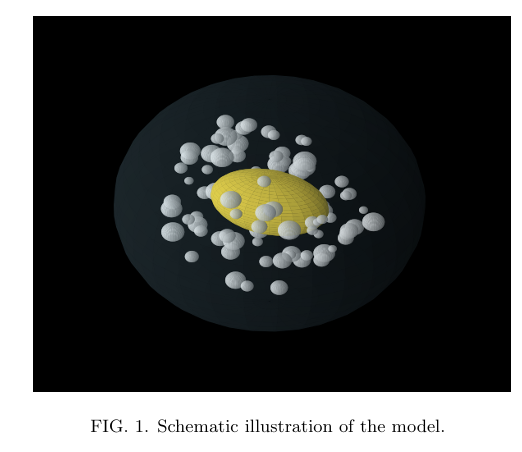
It consists of the following components: the luminous matter contribution, represented by a yellow ellipsoid (the galaxy); a quasispherical main halo formed by rotating vector bosonic matter extending beyond the galaxy, shown in dark grey; and a set of spherical subhalos modeled as scalar boson star-like structures, depicted in light grey. As we show in this paper, this model significantly improves the RC fits presented in [68], in addition to provide a physically justified framework for them.

The structure of the paper is as follows: In Section II we introduce the theoretical framework for the bosonic fields we employ in our model, along with key clarifications regarding the rescalings and physical units used. Section III details how the individual contributions to the RC are obtained from both luminous and DM systems. In particular, this section discusses the model for DM subhalos under the assumption that they could be formed by a distribution of boson stars. Next, in Section IV we compare our model predictions with observational data, using the same sample of galaxies employed in [68]. This section also provides a quantitative assessment of our new model against the fits reported in [68]. A discussion of this study is presented in Section V along with our conclusions. Additional information on the equations of motion for the scalar and vector bosonic models is provided in Appendix A.

Are these models converging on the massless spin-2 graviton, with varying energies, as a dark matter particle that is really just a gravitational explanation for dark matter phenomena?

One wonders what a model with a single massive tensor dark matter particle with continuous range of masses from about 10^-26 eV to 10^-10 eV with masses distributed in something like a power law (or just an empirical estimate of the frequency of gravitational waves at each frequency which might have a lumpy and gappy distribution) fitted to the distribution of gravitational wave strengths observed by gravitational wave detectors would look like. This wide variation of graviton mass-energies is natural and expected in a graviton as dark matter candidate model.

A galaxy length wave-length would be something on the order of 10^-24 Hertz (which is basically undetectable with current gravitational wave detectors), while some rare phenomena could generate gravitational waves with much shorter wave lengths as indicated in the chart shown below from Wikipedia:

The sensitivity rang of existing gravitational wave observatories is shown in this chart from Wikipedia:


This would put the stochastic background gravitational wave wavelengths in the same vicinity as the scalar dark matter particles in the paper's model, while the vector dark matter particles would be far, far below the frequencies that existing gravitational wave observatories can detect in a far noisier background.

If the frequency range of gravitational waves has a very low floor value similar to that of the vector dark matter candidate in the paper, and there is a big gap between that floor value and the low frequency stochastic background, however, this could be a reasonable fit to the two type bosonic dark matter model in the paper.

But, Einstein's Field Equations are structured in a manner that does not depict gravitational waves and/or graviton which have mass-energy (but not rest mass) as possible sources on the right hand side in the stress-energy tensor, and also obscures their self-interactions which are hidden within the many non-linear differential equations on the left hand side. 

So, while the cumulative impact of graviton mass-energy and non-perturbative gravitational self-interactions is potentially significant in galaxy scale or larger systems, it is systemically ignored because it is very hard to extract from Einstein's Field Equations and is negligible in the strong field systems relative to first order general relative effects, like those seen in mergers of compact objects like stars and black holes, in inspiraling binary systems, where purely perturbative approximations like the Post-Newtonian approximations work well.

One way to overcome this would be to use a massive graviton model with a range of masses comparable to the range of graviton mass-energies, which have been better developed theoretically, instead, and to consider qualitatively and in order of magnitude quantities, how that model would behave differently if all of the gravitons were traveling at exactly the speed of light, rather than the slightly below the speed of light speed of a true massive graviton with a slight rest mass with that speed itself varying slightly based upon graviton mass.

Deur's gravitational work has used somewhat similar modeling, although using massless scalar gravitons, and ignoring the differences between scalar and tensor fields (which are quite plausibly comparatively small). And, I suspect that Deur's model would closely approximate this massive graviton model (and the real world data). But, I don't have the general relativity and mathematical expertise necessary to test this myself.

Physical Constants Have Remained Unchanged For 7.2 Gyr

A new paper determines from astronomy measurements that there have been no changes to the electromagnetic coupling constant (a.k.a. the fine structure constant), to the proton-electron mass ratio, or to another property of the proton called the proton g-factor, in the last 7.2 billion years. The constraints on any change in that time period are very tight.

This confirms all prior studies of this type.

Monday, May 12, 2025

Interstellar Travel In The Galaxy's Core

Interstellar travel at speeds slower than light isn't really viable in human lifetimes from Earth, but it would be in many cases in the center of the Milky Way galaxy where the distances between stars are ten to a hundred times smaller, on average. So, a trip to the next solar system could take as little as four years at 1% of the speed of light, which is fast, but not technologically unattainable.
If we lived in the center of the Milky Way, we would look up at a sky thick with stars, up to 1 million times denser than we’re used to seeing. The closest star to our Sun is about four light-years away. In the center of the galaxy, stars are only 0.4 to 0.04 light-years apart. In the inner 10,000 light-year region of the Milky Way, the galaxy’s spiral arm structure transitions into a dense, spherical “bulge” of stars. At its heart — and the dominant force in that area of the galaxy — is a supermassive black hole approximately 4 million times the mass of the Sun, called Sagittarius A* (pronounced Sagittarius A star).
[T]he average distance between any two stars in our galaxy. . . . [is] about 5 light years, which is very close to the 4 light year distance between our Sun and Alpha Centauri.

In the central part of some galaxies, interstellar distances average as little as 0.008 light years to 0.013 light years. So, one could travel from one star to the next there in 8-13 years at only 0.1% of the speed of light (about 300 km/s). And, even in very dense galaxies it is rare for stars to collide:
Even at these high star densities, collisions are rare. Globular clusters have stars in their centers called “blue stragglers,” which astronomers think are new, massive stars formed by the collision of two old, lower-mass stars. Fewer than one in every 10,000 globular-cluster stars are blue stragglers, which suggests how rare stellar collisions are even in these extreme environments.

These collisions would take place only over billions of years. 

Will A Next Generation Collider See A Sphaleron?

Overview

A new pair of preprints, whose abstracts and citations are set forth below, examine the sphaleron energy threshold with newly updated experimental values of Standard Model physical constants and rigorous calculations, and its other properties. This tells experimentalists very specifically where to look and what to look for when trying to observe a Standard Model sphaleron interaction.

The sphaleron interaction is the only time in the Standard Model of Particle Physics that baryon number and lepton number are not simultaneously conserved. 

But it requires extremely high collider energies to form in detectable numers (an order of magnitude greater collider energy than the nominal energy levels is required because the energy of the interaction must be confined so compactly, so a collider energy of something on the order of 91 TeV is needed to confidently assert that they have been discovered).

Not Yet Observed Standard Model Phenomena

The two biggest predictions of the Standard Model of Particle Physics that haven't been observed yet are the sphaleron and the failure to definitively observe pure glueballs (a strong force bound hadron with no quarks) and certain other hadrons predicted to exist in Standard Model quantum chromodynamics (QCD). 

Standard Model Hadron Predictions Not Yet Seen

Current experiments have more than enough energy to produce glueballs, which are predicted to have masses on the order of 0.5 GeV to 3 GeV in their ground states (while the LHC can create energies up to 14,000 GeV), at some experimentally observed mesons have been provisionally identified as likely glueballs. 

But identifying them definitively against other possible explanations of glueball-like resonances is challenging, since they are electromagnetically neutral, color charge neutral, don't interact via the weak force at the tree-level, and are bosons with integer spins shared by mesons in overlapping mass ranges. Glueballs have a natural tendency to blend into mesons with the same quantum numbers, resulting in mixed hadron resonances.

A similar issue applies to some of the heaviest hadrons predicted by the Standard Model but not yet definitively identified with resonances observed at sufficient statistical significance. But the most massive of these have ground states with masses of 20 GeV or less, and a few new ones are identified every year these days. Observing the last few is mostly just a matter of time.

Similarly, the project of identifying the underlying structure of hadron resonances other than simple pseudo-scalar valence quark-antiquark mesons and simple three valence quark baryons, is progressing one hard won resonance identification at a time with no sweeping explanations for large groups of resonances whose structures do not have a consensus explanation. 

There are even hints of exceeding improbable, short lived, and rare ultrahigh energy toponium (i.e. a meson made up of a top quark and anti-top quark with a mass on the order of 340 to 350 GeV), which would also be enhanced at a next generation higher energy particle collider, with a 73 TeV collider energy with a very large number of collisions, being a key threshold to detect this highly improbable resonance. It is rare not just because it takes high energies, but also because of the high risk that the valence top quark and valence anti-top quark necessary to form one would decay or annihilate with each other, before the quarks could hadronize into the most massive theoretically possible simple quark-antiquark meson. Toponium is almost guaranteed to be seen at a next generation collider along the lines of the LHC but more powerful.

Sphalerons

A sphaleron, in contrast, is basically the only major Standard Model prediction that is not yet confirmed, with an energy scale about 730 times that of a Higgs boson, that requires a bigger accelerator to confirm or rule out, even though the nominal sphaleron energy of 9.1 TeV is less than the 14 TeV peak energy of the LHC.

Analysis

To be clear, this study does not alter the long standing conclusion that sphaleron interactions cannot explain the baryon asymmetry of the universe (i.e. the extreme excess of matter over anti-matter in quarks, which is also true of charged leptons), although it does tweak estimates of what percentage of baryon asymmetry this interaction can explain with Standard Model physics.

I put even odds on whether sphalerons actually exist or not. A mathematically consistent modification of the Standard Model that would make baryon number and lepton number conserved symmetries of the Standard Model, which would make sphalerons impossible, would have almost no important phenomenological consequences for anything other than (i) baryogenesis and leptogenesis in the first few seconds after the Big Bang, which we don't really understand yet anyway and which could be explained without any baryon number and lepton number violations in other ways, such as a mirror universe model, and (ii) the presence or absence of sphaleron decay signatures in ultrahigh energy collider experiments. 

Non-detection of sphalerons would also disfavor a wide variety of grand unified theories (GUTs) and Theories of Everything (TOEs), which usually permit violations of baryon number and lepton number, which makes phenomena like proton decay, which is forbidden in the Standard Model of Particle Physics, rare but possible.

But, detecting sphalerons as predicted would also be a triumph for the Standard Model taken to the extremes of its domain of applicability.

The Standard Model prediction is that there would be a desert of new physics (within or beyond the Standard Model) at energies above those where a sphaleron are observed.

The Papers

The electroweak sphaleron is a static, unstable solution of the Standard Model classical field equations, representing the energy barrier between topologically distinct vacua. 

In this work, we present a comprehensive updated analysis of the sphaleron using current Standard Model parameters with the physical Higgs boson mass of m(H)=125.1 GeV and m(W)=80.4 GeV, rather than the m(H)=m(W) approximation common in earlier studies. The study includes: (i) a complete derivation of the SU(2)×U(1) electroweak Lagrangian and field equations without gauge fixing constraints, (ii) high-precision numerical solutions for the static sphaleron configuration yielding a sphaleron energy E(sph)≃9.1 TeV, (iii) an analysis of the minimum energy path in field space connecting the sphaleron to the vacuum (a 1D potential barrier as a function of Chern-Simons number), and (iv) calculation of the sphaleron single unstable mode with negative eigenvalue ω^2=−2.7m(W)^2, providing analytical fits for its eigenfunction. 

We find that using the measured Higgs mass modifies the unstable mode frequency, with important implications for baryon number violation rates in both early universe cosmology and potential high-energy collider signatures. These results provide essential input for accurate lattice simulations of sphaleron transitions and precision calculations of baryon number violation processes.
Konstantin T. Matchev, Sarunas Verner, "The Electroweak Sphaleron Revisited: I. Static Solutions, Energy Barrier, and Unstable Modes" arXiv:2505.05607 (May 8, 2025).
We present a comprehensive analysis of electroweak sphaleron decay dynamics, employing both analytical techniques and high-resolution numerical simulations. 

Using a spherically symmetric ansatz, we reformulate the system as a (1+1)-dimensional problem and analyze its stability properties with current Standard Model parameters (m(H)=125.1 GeV, m(W)=80.4 GeV). We identify precisely one unstable mode with eigenvalue ω^2 ≃ −2.7m(W)^2 and numerically evolve the full non-linear field equations under various initial conditions. Through spectral decomposition, we quantify the particle production resulting from the sphaleron decay. 

Our results demonstrate that the decay process is dominated by transverse gauge bosons, which constitute approximately 80% of the total energy and multiplicity, while Higgs bosons account for only 7-8%. On average, the sphaleron decays into 49 W bosons and 4 Higgs bosons. The particle spectra consistently peak at momenta k ∼ 1−1.5m(W), reflecting the characteristic size of the sphaleron. 

Remarkably, these properties remain robust across different decay scenarios, suggesting that the fundamental structure of the sphaleron, rather than specific triggering mechanisms, determines the decay outcomes. These findings provide distinctive experimental signatures of non-perturbative topological transitions in the electroweak theory, with significant implications for baryon number violation in the early universe and potentially for high-energy collider physics.
Konstantin T. Matchev, Sarunas Verner, "The Electroweak Sphaleron Revisited: II. Study of Decay Dynamics" arXiv:2505.05608 (May 8, 2025).

Tuesday, May 6, 2025

A Notable Life In Quantum Physics

Chien-Shiung Wu was one of the pioneers of quantum mechanics and high energy physics, and was a female Chinese physicists in an era where women still made up only a tiny percentage of scientists in the field. 

If something remembers you with a speech like this, one hundred and ten years after you were born, when you have long passed away, then you did something right in life.
In 1950, Chien-Shiung Wu and her student published a coincidence experiment on entangled photon pairs that were created in electron-positron annihilation. This experiment precisely verified the prediction of quantum electrodynamics. 
Additionally, it was also the first instance of a precisely controlled quantum entangled state of spatially separated particles, although Wu did not know about this at the time. 
In 1956, Wu initiated and led the so-called Wu experiment, which discovered parity nonconservation, becoming one of the greatest experiments of the 20th century. 
As Chen Ning Yang said, Wu's experiments were well known for their precision and accuracy. Experimental precision and accuracy manifested Wu's scientific spirit, which we investigate here in some detail. 
Yu Shi, "Scientific Spirit of Chien-Shiung Wu: From Quantum Entanglement to Parity Nonconservation" arXiv:2504.16978 (May 31, 2022) (This paper is the translated transcript of the speech the author made at the International Symposium Commemorating the 110th Anniversary of the Birth of Chien-Shiung Wu, on May 31, 2022 in Chinese. The above abstract is the translation of the original abstract of the speech.)

She earned her undergraduate degree in physics (which had a thesis requirement at the time) in China in 1934, prior to the Maoist Revolution, and earned a PhD working under a professor only three years older than her who had studied under Madame Curie, and under the first female PhD in Physics in China, who earned that degree at the University of Michigan (where I also earned my graduate degree). Wu earned her PhD at the University of California at Berkley in 1940 (thirty years before my father earned his PhD at Stanford).
Wu was admitted by the University of Michigan to study at her own expense, and was financially supported by her uncle. On her way to Michigan, Wu visited Berkeley, where she was so impressed, especially by Ernest O. Lawrence’s cyclotron, that she wanted to stay in Berkeley. The cyclotron had been invented by Lawrence, so it was an ideal place for studying physics. Another important factor that influenced Wu’s decision was that she cared a lot about gender equality, and there was gender discrimination at the University of Michigan. In addition, there were a lot of Chinese students at the University of Michigan at the time, and Wu didn’t want her socializing be dominated by fellow Chinese students. So she stayed in Berkeley. Her decision reflected her devotion to physics as a woman.
She then taught at Smith (from which my sister-in-law graduated), and then Princeton, and then she worked at Columbia University as part of the Manhattan Project. 

She was highly productive (publishing more than fifty papers in the early 1950s when a huge share of U.S. women were homemakers in the Baby Boom), and her early post-war research agenda involved the verification of Fermi’s theory of β decay.

Chien-Shiung Wu served as the President of the American Physical Society from 1975 to 1976.
James W. Cronin, who won the 1980 Nobel Prize for his discovery of charge conjugation-parity (CP) nonconservation, once said, “The great discovery of Chien-Shiung Wu started the golden age of particle physics.” 

She continued to publish through at least 1980, and died in February of 1997. The author of the paper had met her.

Current LHC SUSY Exclusions

Supersymmetry, and its further elaboration, string theory, have turned out to be the biggest wrong turns in the history of high energy physics. They produced a few mathematical insights and better understandings of some deeper points about the Standard Model of Particle Physics along the half century journey, but ultimately these theories and these lines of inquiry were dead ends.  These theories continue to receive academic and experimental attention now, mostly because so many tenured physicists built their careers on these theories before their flaws became apparent.

(In due time, I expect that concepts like dark matter, dark energy, and cosmological inflation in astrophysics will similarly be found to have been plausible, but ultimately mistaken wrong turns, as well. Indeed, supersymmetry was originally one of several important reasons that dark matter particles received wider popularity as an explanation of dark matter phenomena and that the LambdaCDM model of cosmology gained wide initial acceptance, because it provided dark matter particle candidates that were well-motivated at the time, in roughly the right quantities in a thermal freeze out scenario in what was called the "WIMP miracle" until observational and experimental evidence ruled it out.)   

Supersymmetry is a theoretical framework in physics that suggests the existence of a symmetry between particles with integer spin (bosons) and particles with half-integer spin (fermions). It proposes that for every known particle, there exists a partner particle with different spin properties. There have been multiple experiments on supersymmetry that have failed to provide evidence that it exists in nature. If evidence is found, supersymmetry could help explain certain phenomena, such as the nature of dark matter and the hierarchy problem in particle physics. . . . 
There is no experimental evidence that either supersymmetry or misaligned supersymmetry holds in our universe, and many physicists have moved on from supersymmetry and string theory entirely due to the non-detection of supersymmetry at the LHC.
From Wikipedia (the emphasis in bold is mine). The chart below related to the theory sets forth the components of supersymmetry in one of its simpler forms (placing some of the terms used in the material quoted below in a clearer context):


A preprint of a commissioned review article for the Encyclopedia for Particle Physics, submitted on May 3, 2025 by Hyun Min Lee, entitled "Supersymmetry and LHC era" updates the experimental bounds on supersymmetry (SUSY) theories based upon the Large Hadron Collider (LHC) data. 

The author tries to paint this limitations in a positive light for supersymmetry, but the hard basic facts are that supersymmetry is now all but dead as a viable explanation of the real world, and that supersymmetric particles (a.k.a. "sparticles") don't exist.

Some of articles' more specific conclusions are as follows:
[T]he gluino masses up to about 2.4 TeV and the squark masses up to about 1.8 TeV have been ruled out by ATLAS. Similar limits from CMS can be also found. . . . stop masses up to about 1250 GeV have been ruled out from ATLAS data and there are similar bounds on the stop mass from CMS. . . . the mass ranges up to about 700 GeV for sleptons and about 1200 GeV for chargino or heavier neutralino have been excluded.

Some supersymmetric models are inconsistent with the current W boson mass (apart from the anomalous and deeply flawed CDFII measurement that is 7 sigma from the global average measurement of more recent and more precise experiments and from the other experiment at Tevatron). For example, this constrains the slepton mass.

More supersymmetric models are inconsistent with the agreement between the experimental value of muon g-2 and the Lattice QCD prediction for its value (rather than the flawed "white paper" value which is 5.2 sigma from the experimental value). The white paper estimate of the muon g-2 deviation from the Standard Model expectation is about 2.5 ± 0.5 * 10^-9, while the Lattice QCD prediction which is confirmed by more recent experimental date is closer to 0.5 * 10^ -9. The paper examine several supersymmetric particle parameter models at values from 1.56 to 2.24 * 10^-9 noting that:

In the left of Fig.3, we present three benchmark models which are consistent with the muon g−2 anomaly within1σ (Model II and III) or 2σ (Mode I) in general gauge mediation.We listed the masses for electroweak superpartners in general gauge mediation and the predictions for ∆aµ and ∆MW. In particular, ModelIII is also consistent with the W boson mass measured by CDFII within1σ. 

In the right plot of Fig.3, we also show the general independent mass parameters for superpartners, namely, m˜ qL ≃m˜ uR ≃m˜ dR, M1, M2, M3, m˜ lL and m˜ eR. 

The paper doesn't even try to devise a set of parameters of supersymmetry with the much smaller muon g-2 anomaly that the overwhelming evidence suggests is actually the case when the Standard Model expectation is calculated correctly. It does note, however that:

There are two typos [sic] of supersymmetric interactions relevant for the muon g−2. One Yukawa type interaction of the muon is to a neutral scalar ϕ with mass mϕ and a charged fermion F with charge −1 and mass mF . . . . Another Yukawa type interaction of the muon is to a charged scalar χ with charge −1 and mass mχ and a neutral fermion λ with mass mλ[.]

So, given the actual muon g-2 consistency between experiment and the predicted Standard Model value, the mass of the superpartners on the order of 400 GeV in the Model I scenario would have to be much higher. It would probably have to be at least in the 800s GeV, if not more, as estimated by me using linear interpolation from the other models in what is actually a non-linear relationship that probably sets the lower bounds even higher.

We comment on the dark matter candidates and collider signatures with electroweak superpartners in the benchmark models. 

In Model I, the neutralino is the LSP, so it can be a dark matter candidate. In this case, due to small splitting between the slepton masses and the neutralino mass, the decay products of the sleptons may be composed of soft jets or leptons (See the left plot in Fig. 4). If the gravitino is lighter than the neutralino, then it can be a dark matter candidate, but displaced decays of the neutralino can lead to distinct signatures at the LHC (See the right plot in Fig. 4 for the results from ATLAS). 

On the other hand, in Model II and III, smuon or sneutrino is the LSP, so there is no dark matter candidate within the MSSM. However, if the gravitino is lighter than the sleptons, the MSSM LSP is long-lived, decaying into a pair of the gravitino and charged leptons(neutrinos) at the displaced vertex from the production point (See the right plot in Fig. 5 for the results from ATLAS). In all the benchmark models, the heavier neutralinos or charginos have been searched for from their prompt decays, as shown in the left plot of Fig. 5.

The paper doesn't connect the dots, but because we know from direct dark matter detection experiments that there is no supersymmetric particle consistent with being a dark matter particle in anything approximating these mass ranges, that the paper's Model I's lightest supersymmetric particle (LSP) cannot be a dark matter candidate.

Proton decay also rules out much more of the SUSY parameter space if one doesn't resort to Baroque convolutions in the theory to suppress it:

In the minimal SU(5) unification with TeV-scale masses for superpartners, the dimension-5 operators generated at the mass scale of the colored Higgisnos are problematic for the proton lifetime. Even in the scenarios with split masses between colored and non-colored superpartners in general gauge mediation, the problem remains because of a large decay rate of the proton coming from the stop, the light stau and the Higgsinos in loops. However, the problem of the proton lifetime can be solved when the model is embedded in the orbifold GUTs where the Higgsino wavefunctions get suppressed at the orbifold fixed point, so do the dimension-5 operators for the proton decays.

Finally, not to put too fine a point on it, but there is absolute zero positive experimental evidence for supersymmetry or superpartners, despite the fact that looking for them was what the LHC was optimized to do. The exclusions are only as low as they are due to the constraints of the instrumentation to explore higher energies.

The bottom line is that supersymmetry is absent up to the TeV level, and the non-detection of proton decay, the lack of a muon g-2 anomaly, and the W boson mass all disfavor it at masses for superpartners at least up to the 10s of TeVs level.

Supersymmetry doesn't address the hierarchy problem is was devised to address, doesn't provide a dark matter candidate, doesn't explain any well established anomalies in the observational or experimental data. In general, supersymmetry no longer well-motivated as a beyond the Standard Model theory.

Moreover, because supersymmetry is a low energy approximation of the lion's share of string theories given serious examination by theoretical physicists, these experimental bounds also strongly disfavor string theory.

Of course, supersymmetry advocates and string theory advocates can try, as they have many times  over the last fifty years or so since it was proposed in the late 1960s and early 1970s, to move the goalposts of their predictions for its parameters "just around the corner" from the experimental limits that rule out or strongly disfavor it to values that can't yet be ruled out, even though these parameter values would no longer address anything that motivated this theoretical approach in the first place. 

But, increasingly, "just around the corner" means energy scales that cannot be reached even at the next generation of particle collider, but which might be reached at the next generation particle collider after that one, maybe several decades in the future.

Footnote

Another preprint today looks at dark matter particle candidates whose properties are strongly fixed by existing measurements in an SU(6) Grand Unified Theory (GUT) model. 

The allowed parameters for these dark matter candidates, however, are ruled out by astrophysics observations (the single digit plus TeV mass candidates are too massive to be directly ruled out by direct dark matter experiments).

Finally, yet another preprint today also considers a two component dark matter particle model suggested by a different GUT, which is ruled out by direct dark matter detection experiments, unless the GUT is twisted in a manner specifically designed to overcome this problem that otherwise has no observational or theoretical motivation. This elaborated version of the GUT does create a theoretical basis for neutrino mass, but also establishes a dark matter candidate that is ruled out by astronomy evidence, even though it isn't ruled out by direct dark matter detection experiments or high energy physics experiments.

Dark Matter


From here.

Thursday, May 1, 2025

Kana v. Kanji In Japanese Writing

The use of kanji (Chinese characters) relative to kana (a phonetic script) in Japanese, has slowly and steadily declined in the Japanese language. 

This graph shows the percentages of A words of Sinitic derivation written in kana, B words of Sinitic derivation written with kanji, C words of Japanese derivation written with kanji, and D words of Japanese derivation written in kana over the years 1879-1968. As you might expect, words in A increase very slightly. B shrinks linearly and a bit more rapidly. The ratio of C/D shrinks quite a bit[.]

There is every reason to believe that this trend has continued from 1968 to the present. 

MONG

MONG is another notable modified gravity explanation of dark matter, with this paper focusing on the intra cluster medium, a relatively novel observable to examine modified gravity proposals. The focus on gravitational self-energy is also notable, as is the fact that this is not a "lone wolf" paper.
In view of the negative results from various dark matter detection experiments, we had earlier proposed an alternate theoretical framework through Modification of Newtonian Gravity (MONG). Here, the Poison's equation is modified by introducing an additional gravitational self-energy density term along with the usual dark energy density term. 
In this work we extend this model to account for the presence of low-density gas at high temperatures (10^8 K) in the intra cluster medium (ICM) by estimating the velocities to which particles will be subjected by the modified gravitational force. Considering that the ICM is under the influence of the cluster's gravity, particle velocities of the ions in the ICM must be balanced by the cluster's gravitational force. The particle velocities obtained for various clusters from their temperature profiles match the velocity produced by the MONG gravitational force. Thus, the increase in the gravitational potential at the outskirts of galaxies balances the thermal pressure of the ICM, maintaining hydrostatic equilibrium without invoking DM. 
The effect of MONG on the angular momentum of galaxies is also studied by obtaining a scaling relation between the angular momentum and the mass of a galaxy. MONG predicts a higher dependence on mass in comparison to the Lambda-CDM model. This increased dependence on mass compensates for the halo contribution to the angular momentum. The angular momentum from MONG for galaxies from the SPARC database is compared to the halo angular momentum by a Chi-square fit technique. The correlation coefficient is found to be unity, showing a replicable result.
Louise Rebecca, Dominic Sebastian, C Sivaram, Kenath Arun, "Modification of Newtonian Gravity: Implications for Hot Gas in Clusters and Galactic Angular Momentum" arXiv:2504.21021 (April 22, 2025).