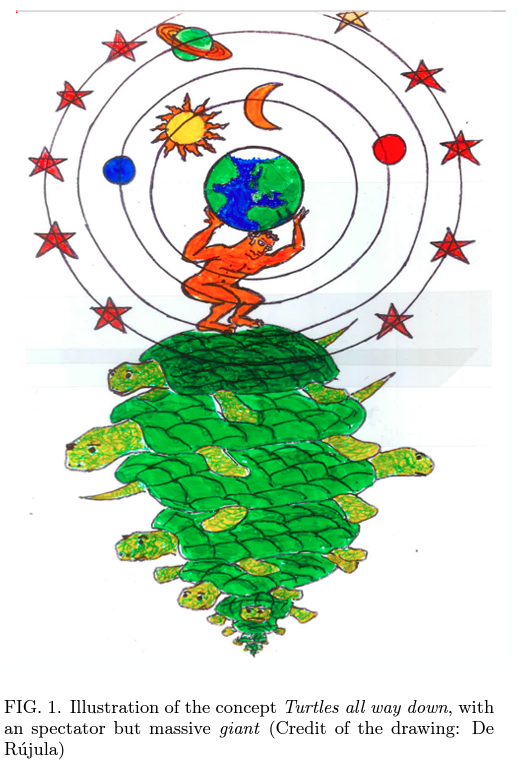
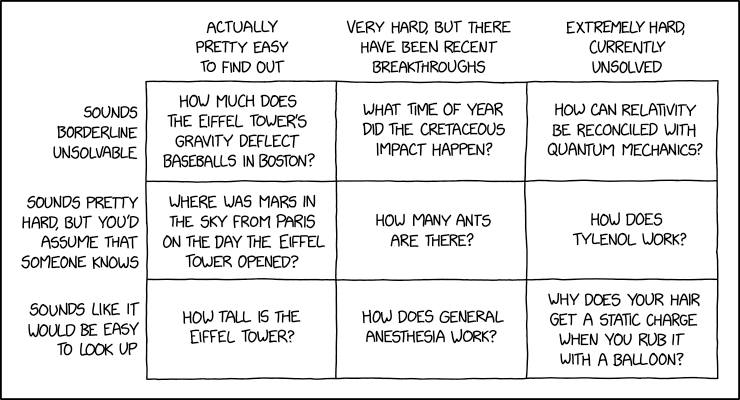
From here.

Red River (Japanese: 天は赤い河のほとり, Hepburn: Sora wa Akai Kawa no Hotori; lit. 'The Sky Is on the Banks of the Red River'), also known as Anatolia Story, is a Japanese manga series written and illustrated by Chie Shinohara. The series was published by Shōgakukan in their Sho-Comi magazine from January 1995 to June 2002 and was collected in 28 tankōbon volumes. It is published in English in North America by Viz Media. An anime television series adaptation produced by Tatsunoko Production is set to premiere in July 2026.
As of March 2019, the manga had over 20 million copies in circulation, making it one of the best-selling manga series. In 2001, Red River won the Shogakukan Manga Award for the shōjo category.
From Wikipedia.

I read this manga series when my children were in middle school, basically in the early twenty-tens, not long after I began this blog, as one of the first really epic manga series that I'd read. American comics and graphic novels have almost no sub-genre that approximates this series.
It is back on my radar screen because the first episode of an anime based upon this manga series was released today, and so far, so good. It is a pretty faithful and successful adaptation so far.
Why am I writing about it here?
Because this manga series was instrumental in spurring my interest in prehistory, anthropology, and historical linguistics, in a story that brought the late Bronze Age Hittite Empire to life and contributed a lot to me caring about all of these fields. Some of my own writing on the Hittites can be found here.
And honestly, while it has fictional and magical elements, much like Bronze Age legendary history works actually written at or within a few centuries of that time period, by and large, this series has stood the test of time and is broadly consistent with what archaeologists, anthropologists, ancient historians, and historical linguistics scholars still believe now.
What all of those disciplines lack, however, that historical fiction like this can provide, is synthesis, relatability, and meaning. Academic scholars tend to focus in on tiny details and cower from providing a larger narrative or connecting the dots for fear of being wrong. But doing so takes away the joy and allure of that once captivated the people who are doing the work and keeps them motivated enough to continue to do so. Historical fiction can give the dry piecemeal reconstructions life and a "vibe" allowing you to feel some sense of what life was like back then.
The fictional account does so in ways big and small. For example, while the dialog is in Japanese (and translated into English in the versions I consume), this series retains enough of the historically accurate Hittite proper names to make those names relatable and not so intimidating, when you encounter them as you study the actual history of the Hittite people, a culture the remains the source of pivotal and important open questions in the broader picture of the Bronze Age and Indo-European linguistics.
Even the magical and supernatural and religious aspects of the story, while not actually things that happened in the past, are largely consistent with the religious and metaphysical worldviews of the people who lived in that era in Anatolia.
I would add at least a couple more.
There are false problems that ask "why doesn't the universe act like I think (for no good reason) that it should?" This includes the hierarchy problem, the strong CP problem, the baryon asymmetry of the universe, and all research invoking the concept of "naturalness."
And, there are contradictory data problems, where one asks why multiple measurements of the same thing (in your current theory) are producing irreconcilable results. These have included the proton radius puzzle, the data based calculation of muon g-2, the measurement of the mean lifetime of unbound neutrons, the reanalysis of CDF data to determine the W boson mass that produced an anomalous result, and the Hubble tension. Usually, in these cases, the answer is that somebody screwed up in one or both of the experiments (at a minimum by overstating the uncertainty in the result), or the theoretical analysis involved, but sometimes, the theory that said the measurements should be the same was wrong.
High energy biology is the subject of several science fiction treatments that I can recall.
I'm somewhat surprised by the large number of astro-theology papers, but my own cross-check revealed 1,390 astro-theology hits on Google Scholar.
The absence of "high-energy theology" hits is also a surprise given that the Big Bang theory was proposed by a Vatican physicist.

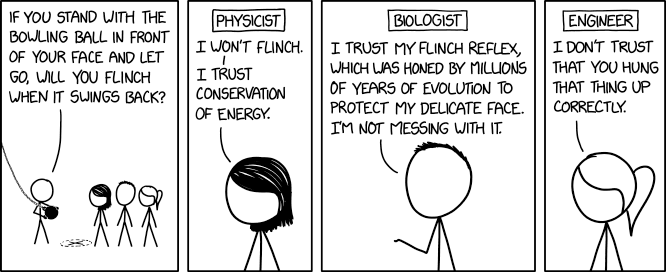
Premed: "Does this count for a physics credit? Can we shorten the string so I can get it done faster? And can we do one where it hits me in the face? I gotta do a thing for first aid training right after?"
From here.

In all seriousness, beware of taking any one statistical test too seriously. All of them have vulnerabilities that can make them misleading.