Saturday, December 31, 2022

Keeping Up With The AI Competition

My method is a little different, and I have no patience for podcasts, but still, our robot overlords will catch up someday.


Thursday, December 29, 2022

Mehmed v. Vlad

A historical fiction account of the real historical Vlad the Impaler, who became a model for Count Dracula is long overdue. But Netflix has risen to the occasion in season two of "Rise of Empires Ottoman" entitled "Mehmed v. Vlad".

I don't know if it will be well done or not, but the trailer looked good and the historical tale of a man who lived on both the Christian and the Muslim side of the conflict between the Ottoman Empire and the Hoy Roman Empire in the 15th century is one worth telling.

Tuesday, December 27, 2022

Genetics Favor Domestication Of Cats In The Near East

The genetics point to a history of cat domestication that fits conventional wisdom in zoology from non-genetic evidence.

Cat domestication likely initiated as a symbiotic relationship between wildcats (Felis silvestris subspecies) and the peoples of developing agrarian societies in the Fertile Crescent. As humans transitioned from hunter-gatherers to farmers ~12,000 years ago, bold wildcats likely capitalized on increased prey density (i.e., rodents). Humans benefited from the cats’ predation on these vermin. To refine the site(s) of cat domestication, over 1000 random-bred cats of primarily Eurasian descent were genotyped for single-nucleotide variants and short tandem repeats. The overall cat population structure suggested a single worldwide population with significant isolation by the distance of peripheral subpopulations. The cat population heterozygosity decreased as genetic distance from the proposed cat progenitor’s (F.s. lybica) natural habitat increased. Domestic cat origins are focused in the eastern Mediterranean Basin, spreading to nearby islands, and southernly via the Levantine coast into the Nile Valley. Cat population diversity supports the migration patterns of humans and other symbiotic species

Sara M. Nilson, et al. "Genetics of randomly bred cats support the cradle of cat domestication being in the Near East." 129 (6) Heredity 346 (2022) DOI: 10.1038/s41437-022-00568-4

Friday, December 23, 2022

The Aztec Calendar Worked

Everywhere that agriculture was invented modern humans developed accurate calendars to guide them regarding when to plant and harvest their crops.
Without clocks or modern tools, ancient Mexicans watched the sun to maintain a farming calendar that precisely tracked seasons and even adjusted for leap years.
From Science Daily citing: 

Exequiel Ezcurra, Paula Ezcurra, Ben Meissner. "Ancient inhabitants of the Basin of Mexico kept an accurate agricultural calendar using sunrise observatories and mountain alignments." 119 (51) Proceedings of the National Academy of Sciences (2022) DOI: 10.1073/pnas.2215615119

Thursday, December 22, 2022

Another Global Constraint On BSM Physics

The Standard Model cannot explain the dominance of matter over anti-matter in our universe. This imbalance indicates undiscovered physics that violates combined CP symmetry. 
Many extensions to the Standard Model seek to explain the imbalance by predicting the existence of new particles. Vacuum fluctuations of the fields associated with these new particles can interact with known particles and make small modifications to their properties; for example, particles which violate CP symmetry will induce an electric dipole moment of the electron (eEDM). The size of the induced eEDM is dependent on the masses of the new particles and their coupling to the Standard Model. To date, no eEDM has been detected, but increasingly precise measurements probe new physics with higher masses and weaker couplings. 
Here we present the most precise measurement yet of the eEDM using electrons confined inside molecular ions, subjected to a huge intra-molecular electric field, and evolving coherently for up to 3 seconds. Our result is consistent with zero and improves on the previous best upper bound by a factor ∼2.4. Our sensitivity to 10^−19 eV shifts in molecular ions provides constraints on broad classes of new physics above 10^13 eV, well beyond the direct reach of the LHC or any other near- or medium-term particle collider.
Tanya S. Roussy, et al., "A new bound on the electron's electric dipole moment" arXiv:2212.11841 (December 22, 2022).

Native American Solstice Ceremonies

Coyote Gulch has republished a nice short take on Native American solstice celebrations and their ancient roots. The account notes that Native American architecture frequently aligned with the astronomical calendar and makes this observation early on:
The winter solstice is the day of the year when the Northern Hemisphere has the fewest hours of sunlight and the Southern Hemisphere has the most. For indigenous peoples, it has been a time to honor their ancient sun deity. They passed their knowledge down to successive generations through complex stories and ritual practices.

An Insight Into QCD Math Has The Potential To Rock QCD Phenomenology

It isn't often that you see this many bold claims in a five page Letter.  I think, for example, that this paper's conclusion implies that there is now no mechanism by which baryon number and lepton number violation can occur in the Standard Model. But this terse Letter could be more clear than it is on this point.

Also important is the fact that the analysis is done at the level of generality of nonabelian gauge theories generally, a category that includes not only QCD but also quantum gravity, potentially displacing roadblocks in theory development in that field.
We show that the topological charge of nonabelian gauge theory is unphysical by using the fact that it always involves the unphysical gauge field component proportional to the gradient of the gauge function. The removal of Gribov copies, which may break the Becchi-Rouet-Stora-Tyutin symmetry, is irrelevant thanks to the perturbative one-loop finiteness of the chiral anomaly. The unobservability of the topological charge immediately leads to the resolution of the Strong CP problem. We also present important consequences such as the physical relevance of axial U(1) symmetry, the θ-independence of vacuum energy, the unphysicalness of topological instantons, and the impossibilities of realizing the sphaleron induced baryogenesis as well as the chiral magnetic effect. The unphysical vacuum angle and the axial U(1) symmetry also imply that the CP phase of the Cabibbo-Kobayashi-Maskawa matrix is the sole source of CP violation of the standard model.
Nodoka Yamanaka, "Unobservability of topological charge in nonabelian gauge theory" arXiv:2212.10994 (December 21, 2022) (Letter. It will be followed by a full paper. Slides explaining graphically the discussion are given in this https URL).

Wednesday, December 21, 2022

The Triumphant Standard Model

The Standard Model Is Triumphant

The most notable apparently observational deviation from the Standard Model, apparent lepton universality violations in B meson decays, have disappeared with better data and more rigorous analysis. 

This is a capstone to the complete triumph of the Standard Model in modern high energy physics despite the myriad beyond the Standard Model (BSM) physics proposals made in papers filed on arXiv every business day.

If there are no lepton universality violation, as the new LHCb results would tend to show, 

AND there is no muon g-2 anomaly, as new lattice computations of the SM prediction for muon g-2 are increasingly showing, 

AND the Higgs boson is just the SM Higgs boson (which is confirmed ever more tightly every few months by new LHC data),

AND there are no non-standard neutrino interactions or sterile neutrinos (which experiments are tending to show and which I won't discuss again in this post although I have blogged about this many times), 

THEN, there is less and less room for BSM physics at energy scales that can be tested experimentally at current colliders or next generation colliders (i.e. up to the hundreds of TeV energy scale).

The State of the Muon g-2 "Anomaly"

The g-2 discrepancy could simply be a problem with the theory prediction (and I think that's the most likely explanation). There are two different methods for the calculation, one is in agreement with the experimental values.

Muon g-2 (i.e. the magnetic moment of the muon, minus two, and divided by two) is the sum of an electromagnetic contribution (QED) (the lion's share with negligible uncertainty), a weak force contribution (a modest contribution with a very small uncertainty), and a strong force (QCD) contribution which is small but not insignificant given current experimental precision in measuring muon g-2 that has a comparatively huge uncertainty.

The consensus value of the QED plus weak force contribution to SM prediction for muon g-2 in units of 10^-11 is:

116,584,872.53 ± 1.01 (with most of the uncertainty coming from the weak force contribution)

In the Theory Initiative analysis the QCD amount is 6937(44) which is broken out into two parts: hadronic vacuum polarization (HVP) = 6845(40), which is a 0.6% relative error, and hadronic light by light (HLbL) = 98(18) which is about a 20% relative error.

The calculation from the Theory Initiative of the SM prediction (which mixed experimental data for parts of the HVP calculation and lattice computations for other parts of the HVP calculations) is in tension with the experimental measurement.

But, the first principles lattice calculation of the HVP part of the SM prediction for muon g-2 by the BMW group is consistent with the experimental results (see below for the actual values times 10^-11):

Fermilab (2021): 116,592,040(54)
Brookhaven's E821 (2006): 116,592,089(63)
Combined measurement: 116,592,061(41)
Theory Initiative calculation: 116,591,810(43)
BMW calculation: 116,591,954(55)
Combined measurement - Theory Initiative: 251(59)
Combined measurement - BMW: 107(69)

Essentially all of the subsequent work has confirmed the BMW calculation in parts that have been replicated, especially the HVP "window", which is a key subcomponent of the overall HVP contribution that is somewhat easier to calculate. Some of these papers have even narrowed down to some extent where the discrepancy between the two SM predictions is coming from. See, e.g., https://arxiv.org/abs/2212.09340 and https://arxiv.org/abs/2212.10490

In addition, on the day that the new muon g-2 experimental results was released a new calculation of the hadronic light by light contribution to the muon g-2 calculation was also released on arXiv which doesn't seem to be part of the BMW calculation. This increases the contribution from that component from 92(18) x 10^-11 to 106.8(14.7) x 10^-11. This boost of 14.8 in the overall QCD component isn't as big as the BMW HVP calculation's impact on it, but the two combined narrow the gap even more.

With these two SM calculation refinements the discrepancy between the combined measurement and the BMW plus new HLbL prediction is about 85(68) x 10^-11, so barely more than a 1 sigma difference.

Why care?

Because muon g-2 is an indirect global measure of the consistency of the SM with experiment that is sensitive to new or different particles and/or forces at scales into the TeV to tens of TeVs (or more if the deviation from the SM is really strong) scale, because all three SM forces and all SM particle parameters contribute to it to some extent.

If the SM in consistent with experiment at the parts per billion or ten billion level, then there is basically no room for BSM physics that don't cancel out in the muon g-2 calculation at the energy scales of the next generation collider.

For example, it is basically impossible to have SUSY with 1-10 TeV scale sparticles without tweaking muon g-2. Likewise, adding leptoquarks to the SM, which have been a popular BSM physics explanation for hints of lepton universality violations (which now seem to be basically ruled out) should also tweak muon g-2.

What do we know about how strong the fit of what we observe to the SM Higgs is?

Scientists haven't established beyond all doubt that the Higgs boson we have seen is the SM Higgs boson yet, but every few months since it has been discovered the constraints on differences from the SM Higgs have gotten smaller and more restricted. The data has also ruled out many hypotheses for additional Higgs bosons.

There is basically no data that is contrary to the predictions of the SM Higgs hypothesis made about 50 years ago (subject to determining its mass), and for a given Higgs boson mass the properties of the SM Higgs boson are completely predetermined with no wiggle room at all down to parts per ten million or better.

The global average value for the mass of the Higgs boson is currently 125.25±0.17 GeV, a relative accuracy of about 1.4 parts per thousand.

There is also basically no data strongly suggesting one or more additional BSM Higgs bosons (although there is a bit of an anomaly at 96 GeV), even though BSM Higgs bosons aren't directly ruled out yet above the hundreds of GeVs. BSM Higgs bosons are also allowed in pockets of allowed parameter spaces at lower masses if the properties of the hypothetical particles are just right. For example, new Higgs bosons with a charge of ± 2 are ruled out at masses up to about 900 GeV, and so are many other heavy Higgs boson hypotheses. Indirect constraints also greatly limit the parameter space of BSM Higgs bosons unless they have precisely the right properties (which turn out to be not intuitively plausible or well-motivated theoretically).

The data strongly favor the characterization of the observed Higgs boson as a spin-0 particle, just like the SM Higgs boson, and strongly disfavors any other value of spin for it.

The data is fully consistent at the 0.6 sigma level with an even parity SM Higgs boson, see here, while the pure CP-odd Higgs boson hypothesis is disfavored at a level of 3.4 standard deviations. In other words, the likelihood that the Higgs boson is not pure CP-odd is about 99.9663%.

A mix of a CP-odd Higgs boson and a CP-even Higgs boson of the same mass is (of course) harder to rule out as strongly, particularly if the mix is not equal somehow and the actual mix is more CP-even than CP-odd. There isn't a lot of precedent for those kinds of uneven mixings, however, in hadron physics (i.e., the physics of composite QCD bound particles), for example.

Eight of the nine Higgs boson decay channels theoretically predicted to be most common in a SM Higgs of about 125 GeV have been detected. Those channels, ranked by branching fraction are:

b-quark pairs, 57.7% (observed)
W boson pairs, 21.5% (observed)
gluon pairs, 8.57%
tau-lepton pairs, 6.27% (observed)
c-quark pairs, 2.89% (observed May 2022)
Z boson pairs, 2.62% (observed)
photon pairs, 0.227% (observed)
Z boson and a photon, 0.153% (observed April 2022)
muon pairs, 0.021 8% (observed)
electron-positron pairs, 0.000 000 5%

All predicted Higgs boson decay channels, except gluon pairs, with a branching fraction of one part per 5000 or more have been detected.

Decays to gluon pairs are much harder to discern because the hadrons they form as they "decay" are hard to distinguish from other background processes that give rise to similar hadrons to those from gluon pairs at high frequencies. Even figuring out what the gluon pair decays should look like theoretically due to QCD physics, so that the observations from colliders can be compared to this prediction, is very challenging.

The total adds 99.9518005% rather than to 100% due to rounding errors, and due to omitted low probability decays including strange quark pairs (a bit less likely than muon pairs), down quark pairs (slightly more likely than electron-positron pairs), up quark pairs (slightly more likely than electron positron pairs), and asymmetric boson pairs other than Z-photon decays (also more rare than muon pairs).

The Higgs boson doesn't decay to top quarks, but the measured top quark coupling is within 10% of the SM predicted value in a measurement with an 18% uncertainty at one sigma in one kind of measurement, and within 1.5 sigma of the predicted value using another less precise kind of measurement.

The Particle Data Group summarizes the strength of some of the measured Higgs boson couplings relative to the predicted values for the measured Higgs boson mass, and each of these channels is a reasonably good fit relative to the measured uncertainty in its branching fraction.

Combined Final States = 1.13±0.06
W W∗= 1.19±0.12
Z Z∗= 1.01±0.07
γγ= 1.10±0.07
bb= 0.98±0.12
μ+μ−= 1.19±0.34
τ+τ−= 1.15+0.16−0.15
ttH0Production = 1.10±0.18
tH0production = 6±4

The PDG data cited above predates the cc decay and Zγ channel discovery made this past spring, so I've omitted those from the list above in favor of the data from the papers discovering the new channels.

One of these papers shows that the branching fraction in the Zγ channel relative to the SM expectation is μ=2.4±0.9. The ratio of branching fractions B(H→Zγ)/B(H→γγ) is measured to be 1.5+0.7−0.6, which agrees with the standard model prediction of 0.69 ± 0.04 at the 1.5 standard deviation level. 

The branching fraction of the cc channel isn't very precisely known yet, but isn't more than 14 times the SM prediction at the 95% confidence level.

The Higgs boson self-coupling is observationally constrained to be not more than about ten times stronger than the SM expected value, although it could be weaker than the SM predicted value. But the crude observations of its self-coupling are entirely consistent with the SM expected value so far. This isn't a very tight constraint, but it does rule out wild deviations from the SM paradigm.

The width of the Higgs boson (equivalently, its mean lifetime) is consistent to the best possible measurements with the theoretical SM prediction for the measured mass. The full width Higgs boson width Γ is 3.2+2.8−2.2MeV, assuming equal on-shell and off-shell effective couplings (which is a quite weak assumption). The predicted value for a 125 GeV Higgs boson is about 4 MeV.

There are really no well motivated hypotheses for a Higgs boson with properties different from the SM Higgs boson that could fit the observations to date this well.

For a particle that has only been confirmed to exist for ten and a half years, that's a pretty good set of fits. And, the constraints on deviations from the SM Higgs boson's properties have grown at least a little tighter every year since its discovery announced on July 4, 2012.

Higgs, W, and Z boson properties as constraints on BSM physics

This reasonably good fit of the observed properties of the Higgs boson to the properties it is predicted to have in SM at its measured mass is especially notable because the decay properties and couplings of the Higgs boson, like muon g-2, are good global tests of the SM, although not as comprehensive muon g-2, and not extending to BSM phenomena in excess of about 62.5 GeV (half the Higgs boson mass), which is a much lower threshold than the muon g-2 indirect exclusion which is in the TeVs.

Any BSM particle that couples to the Higgs boson in proportion to its rest mass, as the SM Higgs boson is predicted to do, with a mass between about 1 GeV and 62.5 GeV would have thrown off the branching fractions of the Higgs boson that have been observed to date dramatically. On the other hand, a new BSM massive fundamental particle that coupled to the Higgs boson in proportion to its rest mass with a mass of less than 20 MeV would not discernibly change the properties of the Higgs boson observed to date at all.

All quarks, charged leptons, and massive fundamental bosons in the Standard Model get their mass from the Higgs mechanism and couple to the Higgs boson (the source of the neutrino masses is unknown at this time), so it would be surprising to see some new massive fundamental particle that got its mass in some other manner.

In the same way, W and Z boson decays are sufficiently close to the SM predicted values that we can be confident that there are no particles that couple to the weak force with the strength that SM particle that do so, at any rest mass whatsoever from 0 to 45 GeV.

Incidentally, all known massive fundamental particles in the SM (quarks, charged leptons, neutrinos, W bosons, Z bosons, and Higgs bosons) couple to the weak force with the same "weak force charge" strength, and none of the zero rest mass fundamental particles in the SM (i.e. photons and gluons) couple directly to the weak force in the SM.

The number of SM "left handed" neutrinos that exist, for example, must be exactly three in the mass range from 0 to 45,000,000,000 eV. We know that none of the SM neutrinos can have an absolute mass of more than about 1 eV from direct measurements of lightest neutrino mass together with neutrino oscillation data. Indirect cosmology limits combined with neutrino oscillation based mass differences putting the upper limit on the mass of the most massive neutrino eigenstate closer to 0.07 eV at 95% confidence.

There are no good theoretical motivations for a hypothetical fourth generation Standard Model neutrino to be so profoundly more massive than neutrinos in the three known generations of Standard Model fermions. This is why searches for BSM neutrinos almost entirely focuses on new "sterile" a.k.a. "right handed" neutrinos.

And, since mathematical consistency in the SM calls for generations of new fermions to always include an up-type quark, a down-type quark, a charged lepton, and a neutrino, the non-existence of a SM left-handed neutrino at masses up to 45 GeV pretty much rules out the possibility that any fourth generation SM fermions exist.

Tuesday, December 20, 2022

The Sumerian Roots Of the Menorah

The Old European Culture blog in yet another thought provoking post muses on possible Sumerian roots of the Menorah in Jewish culture. 

Lepton Universality Violations Have Disappeared With Improved LHC Data

It looks like the tensions suggesting lepton universality violations in B meson decays (contrary to the Standard Model prediction) have disappeared with improved amounts of data and improved data quality at the LHC, according to two preprints released today, in another glorious (but unexciting) victory for the Standard Model of Particle Physics.

The first simultaneous test of muon-electron universality using B+→K+ℓ+ℓ− and B0→K∗0ℓ+ℓ− decays is performed, in two ranges of the dilepton invariant-mass squared, q2. The analysis uses beauty mesons produced in proton-proton collisions collected with the LHCb detector between 2011 and 2018, corresponding to an integrated luminosity of 9 fb−1. Each of the four lepton universality measurements reported is either the first in the given q2 interval or supersedes previous LHCb measurements. The results are compatible with the predictions of the Standard Model.
LHCb collaboration, "Test of lepton universality in b→sℓ+ℓ− decays" arXiv:2212.09152 (December 18, 2022) (All figures and tables, along with any supplementary material and additional information, are available at this https URL (LHCb public pages)).
A simultaneous analysis of the B+→K+ℓ+ℓ− and B0→K∗0ℓ+ℓ− decays is performed to test muon-electron universality in two ranges of the square of the dilepton invariant mass, q2. The measurement uses a sample of beauty meson decays produced in proton-proton collisions collected with the LHCb detector between 2011 and 2018, corresponding to an integrated luminosity of 9 fb−1. A sequence of multivariate selections and strict particle identification requirements produce a higher signal purity and a better statistical sensitivity per unit luminosity than previous LHCb lepton universality tests using the same decay modes. Residual backgrounds due to misidentified hadronic decays are studied using data and included in the fit model. Each of the four lepton universality measurements reported is either the first in the given q2 interval or supersedes previous LHCb measurements. The results are compatible with the predictions of the Standard Model.
LHCb collaboration, "Measurement of lepton universality parameters in B+→K+ℓ+ℓ− and B0→K∗0ℓ+ℓ− decays" arXiv:2212.09153 (December 18, 2022) (All figures and tables, along with any supplementary material and additional information, are available at this https URL (LHCb public pages).

The announcement of the result generated this meme:

Saturday, December 17, 2022

LHC To Announce Its Lepton Universality Violation Results On Tuesday

Experimental results tending to show lepton universality violations (i.e. a different probability for decays to tau leptons, muons, and electron-positron pairs respectively, mass-energy conservation permitting) are the most notable experimental anomalies from Standard Model predictions outstanding right now in high energy physics. 

But the statistical significance is merely a tension that may fade with a major new data point like the one to be announced on Tuesday, and there isn't a good explanation for why it isn't seen in other phenomena that should involve the same intermediate W boson decay driven processes.

Measurements of 𝑅(𝐾) and 𝑅(𝐾∗) with the full LHCb Run 1 and 2 databy Renato Quagliani (EPFL - Ecole Polytechnique Federale Lausanne (CH))

In this seminar we present the first simultaneous test of muon-electron universality in 𝐵+→𝐾+ℓ+ℓ− and 𝐵0→𝐾∗0ℓ+ℓ− decays, known as 𝑅(𝐾) and 𝑅(𝐾∗), in two regions of di-lepton invariant mass squared.

The analysis operates at a higher signal purity compared with previous analyses and implements a data-driven treatment of residual hadronic backgrounds. The analysis uses the full LHCb Run 1 and 2 data recorded in 2011-2012 and 2015-2018, corresponding to an integrated luminosity of 9 fb−1. This analysis is the most sensitive lepton universality test in rare b-decays and the results obtained supersede the previous LHCb measurements of 𝑅(𝐾) and 𝑅(𝐾∗0).

Tuesday, December 13, 2022

Old Water

It is a pretty clever trick to figure out how old many of the water molecules on Earth are as this paper does.
Water is crucial for the emergence and evolution of life on Earth. Recent studies of the water content in early forming planetary systems similar to our own show that water is an abundant and ubiquitous molecule, initially synthesized on the surfaces of tiny interstellar dust grains by the hydrogenation of frozen oxygen. Water then enters a cycle of sublimation/freezing throughout the successive phases of planetary system formation, namely, hot corinos and protoplanetary disks, eventually to be incorporated into planets, asteroids, and comets. The amount of heavy water measured on Earth and in early forming planetary systems suggests that a substantial fraction of terrestrial water was inherited from the very first phases of the Solar System formation and is 4.5 billion years old.
Cecilia Ceccarelli, Fujun Du, "We Drink Good 4.5-Billion-Year-Old Water" arXiv:2212.05441, 18 Elements 155 (December 11, 2022).

Friday, December 9, 2022

Particle Physics Funding


New mtDNA Clade Discovered

I missed this paper when it came out, but found it now that it has won an editor's choice award, as one of its authors explained at their blog.

As background, the Sandawe people in whom the new clade is found, are East African desert/savanna hunter-gatherers who speak a click language, while the Mbuti people, in whom the sister mtDNA clade L5 is found, are African pygmies found in the Congo jungle (their ancestral language was lost,  mostly to Bantu languages, before it was ever attested).

Archaeological and genomic evidence suggest that modern Homo sapiens have roamed the planet for some 300–500 thousand years. In contrast, global human mitochondrial (mtDNA) diversity coalesces to one African female ancestor (“Mitochondrial Eve”) some 145 thousand years ago, owing to the ¼ gene pool size of our matrilineally inherited haploid genome. Therefore, most of human prehistory was spent in Africa where early ancestors of Southern African Khoisan and Central African rainforest hunter-gatherers (RFHGs) segregated into smaller groups. Their subdivisions followed climatic oscillations, new modes of subsistence, local adaptations, and cultural-linguistic differences, all prior to their exodus out of Africa. Seven African mtDNA haplogroups (L0–L6) traditionally captured this ancient structure—these L haplogroups have formed the backbone of the mtDNA tree for nearly two decades. 
Here we describe L7, an eighth haplogroup that we estimate to be ~ 100 thousand years old and which has been previously misclassified in the literature. In addition, L7 has a phylogenetic sublineage L7a*, the oldest singleton branch in the human mtDNA tree (~ 80 thousand years). We found that L7 and its sister group L5 are both low-frequency relics centered around East Africa, but in different populations (L7: Sandawe; L5: Mbuti). Although three small subclades of African foragers hint at the population origins of L5'7, the majority of subclades are divided into Afro-Asiatic and eastern Bantu groups, indicative of more recent admixture. A regular re-estimation of the entire mtDNA haplotype tree is needed to ensure correct cladistic placement of new samples in the future.
Maier, P.A., Runfeldt, G., Estes, R.J. et al. "African mitochondrial haplogroup L7: a 100,000-year-old maternal human lineage discovered through reassessment and new sequencing." Sci Rep 12, 10747 (June 22, 2022) (open access). https://doi.org/10.1038/s41598-022-13856-0

Thursday, December 8, 2022

The Latest CKM Matrix Fit

The CKM matrix, which can be reduced to four parameters, quantifies the likelihood of quarks transforming into different kinds of quarks in W boson mediated weak force interactions. The latest global fit of those Standard Model parameters are as follows:


This can be compared to the August 2022 values from the global fit of the Particle Data Group's review article:

The Gravitational Apple Tree


From here.

A New Branch Of The Tree Of Life

It is not every day that a new branch of organism at a level even higher than that of kingdoms is discovered.
The tree of life is a useful diagram for understanding the relationships between different forms of life, present and extinct. The trunks are made up of three broad groups called domains – Bacteria, Archaea and Eukaryota – which then branch into kingdoms such as animals and fungi. From there the branches become more and more specific until you reach individual species.

The new discovery adds quite a major bough to the tree – Provora. These lifeforms make up a category informally called a “supergroup,” which sits below domains and can contain multiple kingdoms.

“This is an ancient branch of the tree of life that is roughly as diverse as the animal and fungi kingdoms combined, and no one knew it was there,” said Dr. Patrick Keeling, senior author of the study.

Members of the Provora supergroup are tiny organisms that the team describes as the “lions of the microbial world.” That’s because they prey upon other microbes, and within their ecosystem they’re relatively rare. The supergroup is further divided into two clades – the “nibblerids,” which use tooth-like structures to nibble chunks off their prey, and the “nebulids,” which engulf their prey whole.

The team discovered this new kind of life in samples taken from around the world, including the coral reefs in Curaçao, sediment from the Black and Red seas and water from the Pacific and Arctic oceans. . . .

“In the taxonomy of living organisms, we often use the gene ‘18S rRNA’ to describe genetic difference,” said Dr. Denis Tikhonenkov, first author of the study. “For example, humans differ from guinea pigs in this gene by only six nucleotides. We were surprised to find that these predatory microbes differ by 170 to 180 nucleotides in the 18S rRNA gene from every other living thing on Earth. It became clear that we had discovered something completely new and amazing.”
From New Atlas.
Molecular phylogenetics of microbial eukaryotes has reshaped the tree of life by establishing broad taxonomic divisions, termed supergroups, that supersede the traditional kingdoms of animals, fungi and plants, and encompass a much greater breadth of eukaryotic diversity. The vast majority of newly discovered species fall into a small number of known supergroups. 
Recently, however, a handful of species with no clear relationship to other supergroups have been described, raising questions about the nature and degree of undiscovered diversity, and exposing the limitations of strictly molecular-based exploration. 
Here we report ten previously undescribed strains of microbial predators isolated through culture that collectively form a diverse new supergroup of eukaryotes, termed Provora. The Provora supergroup is genetically, morphologically and behaviourally distinct from other eukaryotes, and comprises two divergent clades of predators—Nebulidia and Nibbleridia—that are superficially similar to each other, but differ fundamentally in ultrastructure, behaviour and gene content. 
These predators are globally distributed in marine and freshwater environments, but are numerically rare and have consequently been overlooked by molecular-diversity surveys. In the age of high-throughput analyses, investigation of eukaryotic diversity through culture remains indispensable for the discovery of rare but ecologically and evolutionarily important eukaryotes.
Denis V. Tikhonenkov, et al., "Microbial predators form a new supergroup of eukaryotes" Nature (December 7, 2022).

Tuesday, December 6, 2022

Did Archaic Hominins Use Fire?

A new study suggests that Homo naledi, an archaic hominin probably not directly ancestral to modern humans or Neanderthals or Denisovans, with remains found in a South African cave, used fire, according to an account from the Washington Post.

We were already pretty sure that Neanderthals also used fire, so it isn't a distinctly modern human innovation. But Neanderthals are fairly close to modern humans (so much so that non-African humans generally have Neanderthal admixture in their genomes) and had larger brains than modern human do, while Homo naledi is one of our more remote archaic hominin relatives and was smaller brained than modern humans.

Ancient DNA From 2000 BCE Hair Of A Herder In Sudan

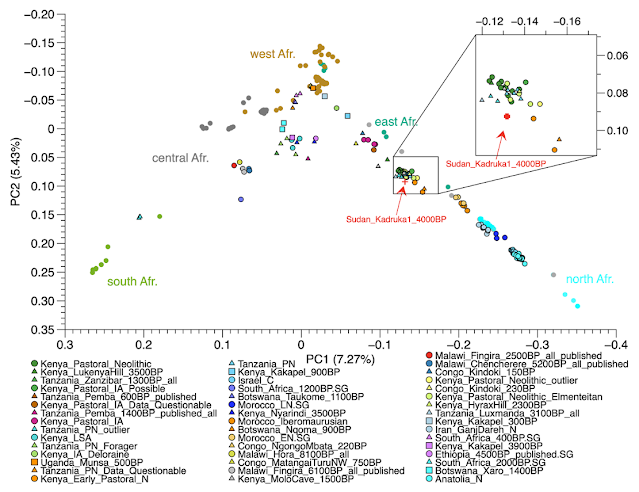
A new study has analyzed ancient DNA and other chemical features of hair from an individual who died around 2000 BCE and was interred in Sudan. The open access source paper is here. As Bernard explains at this blog (at the link):

This individual is dated 4033 years in the Kerma period which succeeds the Neolithic.

A recent study on the diet of individuals buried in Kadruka cemeteries showed that these individuals ate dairy products from cows or sheep, C3-type plants such as beans, cowpeas, cassava, soybeans, rice or barley, or animals eating type C3 plants. The early proliferation of the pastoral economy visible in the Kerma culture of northern Sudan has been proposed as a potential source for the spread of pastoralism in East Africa. . . .
The results show that the ancient individual from northern Sudan is located close to the ancient pastors of East Africa, particularly Kenya and Tanzania, also dated 4000 years ago. Moreover, the f3 statistic shows that this individual from Sudan has the most genetic affinity with the ancient individuals of the Levant, the ancient individuals of North or East Africa, or the current populations of North Africa or the Horn of Africa.

These results suggest that the pastoral economy has spread in Africa along the banks of the Nile, towards the south.
Monday, December 5, 2022

Ancient DNA From Sri Lanka

The samples are only mtDNA and are from roughly 3500 BCE and 7500 BCE respectively, both predating the South Indian Neolithic Revolution. Both are mtDNA haplogroups generally associated with higher proportions of Ancient Ancestral South Indian autosomal DNA in modern populations and less old ancient DNA samples.

As expected, continuity from pre-farming times is greater for mtDNA which passes from mother to child, than for Y-DNA for which modern South Asia shows dramatic change from pre-farming eras, since in South Asia, genetic change was associated with conquest by male dominated groups that took local wives more often than colonization by gender balanced families.

Sri Lanka is an island in the Indian Ocean connected by the sea routes of the Western and Eastern worlds. Although settlements of anatomically modern humans date back to 48,000 years, to date there is no genetic information on pre-historic individuals in Sri Lanka. 
We report here the first complete mitochondrial sequences for Mesolithic hunter-gatherers from two cave sites. The mitochondrial haplogroups of pre-historic individuals were M18a and M35a. Pre-historic mitochondrial lineage M18a was found at a low prevalence among Sinhalese, Sri Lankan Tamils, and Sri Lankan Indian Tamil in the Sri Lankan population, whereas M35a lineage was observed across all Sri Lankan populations with a comparatively higher frequency among the Sinhalese. Both haplogroups are Indian derived and observed in the South Asian region and rarely outside the region.


A. S. Fernando, et al., "The mitochondrial genomes of two Pre-historic Hunter Gatherers in Sri Lanka" J Hum Genet (November 30, 2022). https://doi.org/10.1038/s10038-022-01099-w