Monday, November 14, 2016

Some of the genes humans got from Neanderthals were good.

Our ancestors picked up one of the particularly virulent strains of the HPV retrovirus that causes genital warts and cervical cancer when they had sex with Neanderthals. But, the genes that modern human received into its gene pool via Neanderthal hybrid individuals also enhanced the selective fitness of non-African modern humans in their new non-African environment in some important respects including immunity genes. In contrast, many other genes that we received from Neanderthals impaired selective fitness in modern humans, and were quickly purged from the modern human gene pool via natural selection.

Neanderthals (who were light pigmented relative to the Cro-Magnon modern humans that they encountered as a result of adaptation to their more northerly range) also provided some of the pigmentation genes now found in modern humans (although many of the pigmentation genes in Northern Europeans evolved independently and convergently in modern humans). Another kind of modern human with whom we admixed, the Denisovans, appear to have been a source of high altitude adaptations that are common in Tibetans and other Himalayan peoples and appear to have provided a different and additional set of novel immunity related genes.

Quick Physics Hits

* Torsion fields interacting with an expanded Higgs doublet could be a dark matter candidate.

* Erik Verlinde is known for his conjecture that gravity is an emergent property of the entanglement of particles via quantum mechanics, providing a natural and parsimonious first principles theory of quantum gravity. Several of his new talks on the subject are mentioned in the link. Peter Woit has also chimed in on this work, saying he doesn't understand the argument being made and doesn't see a case comparing it with the empirical evidence yet.

* The DUNE experiment, which is just getting started, should be able to shed light on the "two major unknowns in neutrino oscillation physics. These are [the] octant of θ23 (i.e. if θ23 is <45∘ or >45∘) and Dirac CP phase δCP."

* The 4gravitons blog has correspondence from one of the authors of a paper casting doubt on the strength of the evidence for dark energy and cosmic acceleration, which argues that the strength of the evidence is overstated by the use of inappropriate statistical methods by its proponents. They still find evidence for it, but at a slightly less than 3 sigma significance as opposed to the more than five sigma discovery level of significance claimed by supporters of the theory. Thus, even if there is dark energy or a positive cosmological constant, its magnitude may be smaller than previously claimed. This would tend to bring the amount of dark energy in the universe closer to the magnitude of the component of the total make up of the universe attributed to dark matter, heightening the so called "coincidence problem" and tending to favor theories in which dark matter and dark energy phenomena have a common source.

* Sabine Hossenfelder joins Steve Weinberg in expressing concern that the definition of a measurement that collapses the wave function in quantum mechanics is not yet satisfactory. As she explains:
My misgivings of quantum mechanics are pretty much identical to the ones which Weinberg expresses in his lecture. The axioms of quantum mechanics, whatever interpretation you chose, are unsatisfactory for a reductionist. They should not mention the process of measurement, because the fundamental theory should tell you what a measurement is.
She is a fan of superdeterminism.

* We have a good model for explaining the exclusive leptoproduction of the neutral rho meson, which in confirmed experimentally. It is normally theorized as a blend of an up and antiup quark meson and a down and anti-down quark meson. It is a vector meson (spin-1, negative P parity and negative C parity) that has a mass of 775.49±0.34 MeV/c2.

It swiftly (in a mean lifetime of about 4.5 x 10⁻²⁴ seconds) decays to a positively charged and negatively charged pion pair (which it does 99.9% of the time, while decaying to a pair of electrons or pair of muons 0.05% of the time each (possibly in an interaction that also involves an additional photon) with the helicity predicted by the Standard Model and QCD.

The neutral rho meson is one of several mesons that carry the residual strong force that binds nucleons in atoms.

* In contrast, we struggle to explain the decay of a boson called X(3915) with QCD and the Standard Model. As the abstract of a November 11, 2016 preprint by P. Gonzales explains:
Strong decays of X(3915) are analyzed from two quark model descriptions of X(3915), a conventional one in terms of the Cornell potential and an unconventional one from a Generalized Screened potential. We conclude that the experimental suppression of the OZI allowed decay X(3915)→DD⎯⎯⎯⎯ might be explained in both cases as due to the momentum dependence of the decay amplitude. However, the experimental significance of the OZI forbidden decay X(3915)→ωJ/ψ could favor an unconventional description.
The myth that the Standard Model fully explains all experimental observations is particularly exaggerated in the case of QCD, which there are lots of unexplained anomalies like this one. But, nobody has proposed an alternative that does a consistently better job in all circumstances (although there are some alternatives to Standard Model QCD that seem to do a better job in particular kinds of circumstances). It is also hard to say what true Standard Model QCD really predicts, because everyone uses approximations of it in practice because the Standard Model equations cannot, in general, be solved analytically in most circumstances that present themselves in real life. Existing methods get quite close to reality up to the limited accuracy of current calculations, but they don't reliably and consistently explain all observations in anything approaching a straightforward manner.

* The search for flavor changing neutral currents, which violate the Standard Model's conservation of baryon number and/or lepton number, continues to come up empty and produces every tighter constraints. One way to more accurately search for lepton number violation is to develop a more accurate Standard Model prediction for a process that provides most of the background in searches for lepton number violation in muon decays, which happens to predict a smaller background than lower order calculations had suggested. The same approach can also provide a template for predicting the tau lepton decays that contribute to the background in lepton number violation searches.

Together with neutrinoless beta decay searches and proton decay searches, the evidence is overwhelming that baryon number and lepton number are perfectly conserved in Nature. But, tightening these limits is important because they constrain beyond the Standard Model physics, where there is a powerful desire in formulating grand unified theories (GUTs) and theories of everything (TOEs) to allow baryon number and lepton number violations, because without doing so, it is impossible to explain baryogenesis, leptogenesis, and the matter-antimatter asymmetry of the universe, if you assume that the Big Bang originated from pure energy.

No Standard Model process explains how the current universe could arise from that initial state, however, largely because of baryon number conservation, lepton number conservation, and the absence of any sufficiently strong CP violating process that treats matter and antimatter different to a strong enough degree. Naively, the Standard Model predicts that a universe starting from a pure energy state should give rise to equal amounts of matter and antimatter in the universe, separately on both the quark side of the ledger and the lepton side. 

So, either (1) the prediction of a pure energy initial condition for the Big Bang are false (something that has always been entirely possible), or (2) the existence of new processes that do not conserve these quantities at energies beyond the domain of applicability of the Standard Model (in which case highly sensitive high energy collider experiments might glimpse them). 

My own pet theory to resolve this is that the Big Bang gave rise to two separated universes, our own and another dominated by antimatter in which time and thermodynamics move away from the Big Bang (in the opposite direction relative to each other of arrow of time and thermodynamics in our universe), with the "bang" in the Big Bang caused by matter-antimatter collisions at this point of intersection as antimatter tries to make its way back through the singularity and matter tries to make its way forwards from the universe on the other side of the Big Bang. (Something I recognize has no real solid support, but which is parsimonious and simply compared to many of the equally speculative alternatives.)
Sunday, November 13, 2016

An Exceptional Opportunity At The Perimeter Institute

The Perimeter Institute is a real cutting edge center for innovative physics research that I have the greatest respect for as a likely source of world changing breakthroughs. Some readers of my blog may be well suited to the following opportunity (via 4gravitons whose author is employed there):
Perimeter’s PSI program is now accepting applications for 2017. It’s something I wish I knew about when I was an undergrad, for those interested in theoretical physics it can be an enormous jump-start to your career. Here’s their blurb: 
Perimeter Scholars International (PSI) is now accepting applications for Perimeter Institute for Theoretical Physics’ unique 10-month Master’s program. Features of the program include: 
All student costs (tuition and living) are covered, removing financial and/or geographical barriers to entry.  
Students learn from world-leading theoretical physicists – resident Perimeter researchers and visiting scientists – within the inspiring environment of Perimeter Institute. 
Collaboration is valued over competition; deep understanding and creativity are valued over rote learning and examination. 
PSI recruits worldwide: 85 percent of students come from outside of Canada. 
PSI takes calculated risks, seeking extraordinary talent who may have non-traditional academic backgrounds but have demonstrated exceptional scientific aptitude. 
Apply online at http://perimeterinstitute.ca/apply. 
Applications are due by February 1, 2017.

Friday, November 11, 2016

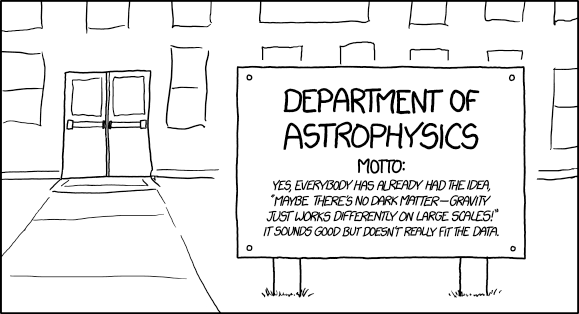
xkcd on dark matter v. gravity modification


The motto is typical but not very accurate. Modified gravity theories arguably fit the data better and some modified gravity theories work better than others. More importantly, it is very hard to get dark matter particle theories to fit the data.

Monday, November 7, 2016

Out of Africa Details Continue To Evade Resolution

Eurogenes calls attention to a new conference paper out humanity's out of Africa dispersals.
When and how modern humans left the African continent is still a debated question. 
Recently, three projects have analysed new genetic data from modern populations in Papua New Guinea and Australia, which has provided new insights on this topic. I will present analyses from one of these publications (Malaspinas et al. 2016), and compare results with findings from the two other projects (Mallick et al. 2016, Pagani et al. 2016). Here, we used MSMC2, a novel computational framework to analyse the distribution of times to the most recent common ancestor along multiple sequences. 
We find that all non-African populations that we analysed, including Australians, experienced a very similar population bottleneck in the past, consistent with only one out-of-Africa migration for all extant non-African populations. At the same time, we find evidence that some African populations are more distantly related to Australians than to Eurasian populations, and we show that this result is robust to haplotype phasing errors and archaic introgression. 
We interpret our result as evidence for gene flow between some Africans and Eurasians after the initial split, which is also consistent with results from other population genetic methods. Our analysis suggests that in order to understand human dispersal out of Africa, we need to better understand ancient population substructure within Africa, which is an important direction for future research.
Stephan Schiffels, "Analysing Australian genomes to learn about early modern human dispersal out of Africa, Human Dispersals in the Late Pleistocene - Interdisciplinary Approaches Towards Understanding the Worldwide Expansion of Homo sapiens" (Human Dispersals in the Late Pleistocene - Interdisciplinary Approaches Towards Understanding the Worldwide Expansion of Homo sapiens conference, November 2016).

Much of the "hot debate" revolves around archaeological evidence of a modern human presence as early as 125,000 years ago in Arabia, at least 100,000 years ago in the Levant, and some time prior to the Toba volcanic eruption of 75,000 years ago in India. And, there is evidence of modern human admixture in the ancient DNA of Altai Neanderthals that would have to date from at least 100,000 years ago, and the is also some evidence of modern humans or modern human hybrids in China well before the 50,000 to 65,000 years before present date expected for modern humans in Australia, Papua New Guinea and Southeast Asia based upon existing archaeological data.

But, both mutation rate DNA estimates, and linkage disequilibrium methods from ancient DNA have suggested a most common recent out of Africa ancestor for Eurasians of closer to 50,000 years ago than 75,000 years ago, and certainly not 100,000 to 125,000 years ago. Some argue that this reflects an "out of Africa that failed". 

Another possibility is that the single wave Out of Africa population was confined to Arabia or some other small geographic area that was a single population genetic unit until the most recent common ancestor date. 

Another possibility is massive dilution of earlier waves of modern humans that has eliminated almost all genetic trace of them (which is one possible interpretation of this paper).

Also, while most modern humans may derive from one wave, and the Y-DNA DE split seems to be close in time to the Y-DNA CF split that includes the vast majority of non-Africans, sampling issues may be hiding a northern route Y-DNA DE and D associated population that could have been another out of Africa wave. This is further complicated by increasingly credible suggestions of northern route expansions into Eurasia by modern humans, with a light archaeological footprint and genetic traces of which may have been largely erased by Ice Age of the Last Glacial Maximum around 20,000 years ago.

Given the seemingly contradictory and unresolved state of the evidence, understanding modern human out of Africa migrations during pre-history may take a lot longer to figure out.

How Would A Lull In Collider Physics Impact Theoretical Physicists?

The author of the blog 4gravitons in my sidebar is a theoretical physicists whose subfield figures out more efficient ways to do quantum physics calculations, which are particularly a barrier to progress in quantum chromodynamics (QCD) and quantum gravity, although the issues he and his colleagues explore are remote from these applications and often study calculations in simplified or more general versions of the equations in question than the ones that are actually a part of the Standard Model.

The time has come for a new collider that would provide power to probe energies greater than those found at the Large Hadron Collider that is the current global state of the art, and both China and Europe are investigating potential successors. But, that is an immensely expense venture. Between construction cost an $1 billion a year of operating costs, the planned LHC run will cost $13-$14 billion, and any more powerful future collider would cost more.

Given the lack of any strong indications of new physics beyond the discovery of the Higgs boson and confirmation that it is quite close to the Standard Model Higgs boson at the LHC, it is quiet plausible (and maybe even a good idea from a policy perspective) to put the next collider on hold for a while.

If that happens, however, it not only puts thousands of collider physicists out of work, it also impacts the job prospects of theoretical physicists, and that is what the author of 4gravitons ponders in a recent post. Interestingly, he suggests that out of work collider physicists may have more good substitute forms of employment for their lost jobs than folks in his subfield do.

I am more of an optimists but don't disagree that theoretical physicists need to immediately begin rethinking their funding sources if they are to weather this possible transition well.

In the short run, I am inclined to think that election results will matter more than decisions on new colliders in China or Europe since the major political parties in the United States have different attitudes towards federal funding of science.

There doesn't seem to be any serious effort in the U.S. to build a new collider in the U.S., something that hasn't been seriously considered since the Superconducting Super Collider project to be located in Texas was cancelled in 1993. The Tevatron collider in Illinois was once one of the leading colliders in the world but went off line in 2011. So, for the last five years, domestic collider work has been pretty much limited to lower energy experiments like Jefferson Labs in Virginia (which is, for example, home to the GlueX experiment), and rehashing old Tevatron data resulting in a variety of post-script papers over the past few years.

A Love Letter To Quantum Mechanics

It isn't Valentine's Day, but Lubos Motl has posted a love letter lauding the aesthetic beauty of quantum mechanics.

Monday, October 31, 2016

Extinct Australian Megafauna Were Very Impressive

In honor of Halloween it is a good time to do a post about monsters. Australia still has plenty of them, but before the megafauna extinction that took place when humans arrived there (and got worse when the humans were joined by an Australian's best friend, the dingo), there were a lot more very impressive monsters and giant animals in Australia.

One of those was Zygomaturus trilobus whom the linked article's authors call Ziggy for short.

Ziggy had a big tusk tooth.


Ziggy was also quite large and rather bear-like.

Remains of Ziggy's kind have been found over man places in Australia (the map also shows the distribution of other extinct megafauna).


Happy Halloween!

The Latest In The Dark Matter v. Modified Gravity Debate

Sabine Hossenfelder's latest post at her blog Backreaction reports on some of the latest volleys in the particle dark matter v. modified gravity debate that I have been following for many years at this blog. She does a good job at summing up the competing perspectives involved:
In its simplest form the concordance model has sources which are collectively described as homogeneous throughout the universe – an approximation known as the cosmological principle. In this form, the concordance model doesn’t predict how galaxies rotate – it merely describes the dynamics on supergalactic scales.

To get galaxies right, physicists have to also take into account astrophysical processes within the galaxies: how stars form, which stars form, where do they form, how do they interact with the gas, how long do they live, when and how they go supernova, what magnetic fields permeate the galaxies, how the fields affect the intergalactic medium, and so on. It’s a mess, and it requires intricate numerical simulations to figure out just exactly how galaxies come to look how they look. 
And so, physicists today are divided in two camps. In the larger camp are those who think that the observed galactic regularities will eventually be accounted for by the concordance model. It’s just that it’s a complicated question that needs to be answered with numerical simulations, and the current simulations aren’t good enough. In the smaller camp are those who think there’s no way these regularities will be accounted for by the concordance model, and modified gravity is the way to go.
The simulations of particle dark matter can now reproduce MOND-like relationships that exist in the actual data, but only with considerable fine tuning of the models and many degrees of freedom. MOND-like models, in contrast, only add one or two parameters to the equations of gravity in most cases (which may be derivable from existing physical constants like the Hubble constant and the speed of light). 

New LHC Data Coming This December; Inflation Theory Inventor Now Doubts Theory

Peter Woit's blog reports a couple of notable recent developments:

* First, we can expect new results from the LHC in mid-December reporting on the 2016 experimental date from the LHC which has now recorded lots of data from collisions at 13 TeV energies:
The 2016 LHC proton-proton run is now over, with delivered (41.07 CMS/38.4 ATLAS) and recorded (37.82 CMS/35.5 ATLAS) luminosities (in inverse fb) far above the goal for this year of 25. Together with last year’s data, the experiments now have 41.63 (CMS) and 39.4 (ATLAS) inverse fb recorded at 13 TeV, close to the LHC design energy of 14 TeV. It is likely that preliminary results will be reported at an “end-of-year jamboree” in mid-December, with more to come at the winter conferences.
This experimental data will help physicists determine if the world continues to fit the Standard Model or if there is significant evidence of beyond the Standard Model physics.

Since the new data are from close to peak LHC energies and are substantial enough to draw preliminary conclusions, this is the last moment when there is any real possibility that something dramatically new is likely to appear in the data.

After that, the LHC's reports are likely to be more about reducing statistical error that can confirm or disprove previous findings and make them more precise, and less about finding any radically new phenomena that are observable at the LHC because they have a cutoff energy scale that is below the peak energies that the LHC is capable of probing.

* Second, one of the inventors of the notion of cosmological inflation now things that this theory in its current form is a failure.
Paul Steinhardt gave a colloquium at Fermilab last month with the title Simply Wrong vs. Simple. In it he explained “why the big bang inflationary picture fails as a scientific theory” (it doesn’t work as promised, is not self-consistent and not falsifiable). This is a complicated topic, but Steinhardt is an expert and one of the originators of the theory, so if you want to understand the problems of some common arguments for inflation, watching this talk is highly recommended. Steinhardt’s talk was part of a Fermilab workshop, Simplicity II.
Of course, finding problems with cosmological inflation theory does not imply that a good alternative to explain that phenomena that the theory sought to explain is available. But, as a paper he co-authored late last year explains, he has identified a couple of viable alternatives to the "classic" inflationary paradigm that he helped to establish, which are called "bouncing theories."
The results from Planck2015, when combined with earlier observations from WMAP, ACT, SPT and other experiments, were the first observations to disfavor the "classic" inflationary paradigm. To satisfy the observational constraints, inflationary theorists have been forced to consider plateau-like inflaton potentials that introduce more parameters and more fine-tuning, problematic initial conditions, multiverse-unpredictability issues, and a new 'unlikeliness problem.' Some propose turning instead to a "postmodern" inflationary paradigm in which the cosmological properties in our observable universe are only locally valid and set randomly, with completely different properties (and perhaps even different physical laws) existing in most regions outside our horizon. By contrast, the new results are consistent with the simplest versions of ekpyrotic cyclic models in which the universe is smoothed and flattened during a period of slow contraction followed by a bounce, and another promising bouncing theory, anamorphic cosmology, has been proposed that can produce distinctive predictions.
Anna Ijjas, Paul J. Steinhardt "Implications of Planck2015 for inflationary, ekpyrotic and anamorphic bouncing cosmologies" (30 Dec 2015).

As the introduction to that article explains (emphasis added):
The Planck2015 [1] and Planck2013 [2] observations, combined with the results by the Wilkinson Microwave Anisotropy Probe (WMAP), Atacama Cosmology Telescope (ACT) and South Pole Telescope (SPT) teams have shown that the measured spatial curvature is small; the spectrum of primordial density fluctuations is nearly scale-invariant; there is a small spectral tilt, consistent with a simple dynamical mechanism that caused the smoothing and flattening; and the fluctuations are nearly gaussian. These features are all consistent with the simplest textbook inflationary models. At the same time, Planck2015 also confirmed that r, the ratio of the tensor perturbation amplitude to the scalar perturbation amplitude, is less than 0.1, a result that virtually eliminates all the simplest textbook inflationary models. The development is notable because, as emphasized by Ijjas et al. [3], it is the first time that the classic inflationary picture has been in conflict with observations. 
The results have led theorists to consider alternative plateau-like inflationary models whose parameters can be adjusted to reduce the expected value of r while retaining all the rest of the classic predictions. However, as we explain in this brief review, the remaining models raise new issues. They require more parameters, more tuning of parameters, more tuning of initial conditions, a worsened multiverse-unpredictability problem, and a new challenge that we call the inflationary ‘unlikeliness problem.’ 
One response to these problems has been that they should be ignored. The classic inflationary picture should be abandoned in favor of an alternative ‘postmodern’ inflationary picture that allows enough flexibility to fit any combination of observations. The classic and postmodern inflationary pictures are so different that they ought to be viewed as distinct paradigms to be judged separately. 
A more promising response to Planck2015 has been to develop “bouncing” cosmologies in which the largescale properties of the universe are set during a period of slow contraction and the big bang is replaced by a big bounce. For example, a new, especially simple version of ekpyrotic (cyclic) cosmology has been identified that fits all current observations, including nearly Gaussian fluctuations and small r [4–7]. Also, anamorphic bouncing cosmologies have been introduced that use yet different ways to smooth and flatten the universe during a contracting phase and generate a nearly scale-invariant spectrum of perturbations [8]. 
We will first review the problems that Planck2015 imposes on classic inflation, the version that most observers consider. We will briefly discuss the conceptual problems of initial conditions and multiverse that have been known and unresolved for decades. Then we will turn to the tightening constraints resulting from Planck2015 and other recent experiments. We will review and critique postmodern inflation that some theorists now advocate. Finally, we will turn to the promising new developments in bouncing cosmologies, both ekpyrotic and anamorphic approaches.
The review article follows with a nice brief introduction to "classic" inflation theory, before exploring other topics.

Oldest Pottery Now From China Rather Than Japan

Until recently, the oldest pottery every discovered, dated from 16,500 years ago from the Jomon culture in Japan. But, it has now been outdone by older pottery from Southern China (citing Science News citing the June 29, 2012 edition of the Journal Science - this is not breaking news, just something that caught my attention recently).

In West Eurasia, farming and proto-farming predated the invention (or adoption as the case may be, there is strongly suggestive evidence that pottery is a technology that migrated to West Eurasia across the North Asian steppe) of pottery, so the earliest phases of the Fertile Crescent Neolithic revolution are called "Pre-Pottery Neolithic" or "Pre-Ceramic Neolithic." In the case of the Fertile Crescent Neolithic, carpentry was actually the handmaiden of the Neolithic, while pottery came later (query if wooden containers may have provided models for later ceramic ones).


Context for the illustration can be found at the Bell Beaker Blog.

In East Asia, hunter-gatherer populations had pottery before farming was invented. As noted previously at this blog:
Japan was first inhabited by hominins about 30,000 years ago, and about 16,000 years ago, an archaeological culture known as the Jomon arose either due either to new migration or to in situ cultural development of Japan's existing inhabitants. The timing is after the Last Glacial Maximum (LGM), ca. 20,000 years before present, at which Japan was at its most easily accessible in modern human times due to low sea levels, at around the time that the wild fluctuation in climate the followed the LGM started to stabilize somewhat.[10]
The Jomon were fishermen who also hunted and gathered food. The sedentary lifestyle associate with fishing based subsistence allowed the Jomon to become the first culture to develop pottery. . . . There is even suggestive evidence that implies that all pottery in Eurasia is derived from the Jomon invention of that craft.[12]

According to [13]:
The upper Paleolithic populations, i.e. Jomon, reached Japan 30,000 years ago from somewhere in Asia when the present Japanese Islands were connected to the continent. The separation of Japanese archipelago from the continent led to a long period (∼13,000 – 2,300 years B.P) of isolation and independent evolution of Jomon. The patterns of intraregional craniofacial diversity in Japan suggest little effect on the genetic structure of the Jomon from long-term gene flow stemming from an outside source during the isolation. The isolation was ended by large-scale influxes of immigrants, known as Yayoi, carrying rice farming technology and metal tools via the Korean Peninsula. The immigration began around 2,300 years B.P. . . .
The timeline in Okinawa is potentially consistent in broad brush strokes with the rest of Japan (the oldest human remains are 32,000 years old), but the archaeological record is thinner (there is no archaeological record indicating a human presence of any kind from 18,000 to 6,000 years ago), rice farming arrives only many centuries after the Yayoi do, and earliest historical mention of Okinawa in surviving written documents is from 607 CE.
In the case of Japan's Jomon culture that made a lot of sense. The Jomon culture subsisted on fishing, which, while not farming and herding since it involves collection of wild animals for food, does allow for a relatively sedentary lifestyle in which spending time to manufacture something too fragile to travel well makes sense. This fit the same pattern as Finland and the vicinity, where a relatively sedentary fishing culture also developed pottery before agriculture. (Notably, flour predates agriculture all over the world, because flour made from wild plants, unlike ceramic pottery, travels well.)

The South Chinese example also pre-dated farming and herding.
Pottery making got off to an ancient, icy start in East Asia. Pieces of ceramic containers found in a Chinese cave date to between 19,000 and 20,000 years ago, making these finds from the peak of the last ice age the oldest known examples of pottery.


OLDEST POT This pottery fragment and others found near it in a Chinese cave date to 20,000 years ago, making them the oldest known examples of pottery making.
SCIENCE/AAAS
This new discovery suggests that hunter-gatherers in East Asia used pottery for cooking at least 10,000 years before farming appeared in that part of the world, say archaeologist Xiaohong Wu of Peking University in Beijing, China, and her colleagues. Cooking would have increased energy obtained from starchy foods and meat, a big plus in frigid areas with limited food opportunities, the researchers report in the June 29 Science.
It isn't obvious in the South Chinese case what circumstances made it possible for the hunter-gatherers there to stay in the same place for long enough periods of time to make manufacturing these fragile containers worthwhile that wasn't present in the case of other pre-Neolithic people.

Perhaps the conditions of the Last Glacial Maximum confined them to a geographically compact refuge that required them to rely on storing hunted and gathered food, rather than simply moving on during lean periods. It could also be that a shortage of wood in that area made resort to a ceramic alternative, which may have been considered inferior to wood at the time, necessary.

We also don't know if the South Chinese pottery technology is in continuity with later use of pottery in Asia, or if the technology was lost at some point (perhaps in the Mesolithic era when migration became viable again when food supplies were short) only to be reinvented later. The date associated with the South Chinese pottery would not be inconsistent with it being a source for the earliest Jomon pottery in Japan, about 3,500 years later.

How Long Ago Did Homo Naledi Roam Southern Africa?

H. naledi is the most recent branch of the genus Homo that has been discovered, with remains collected in a cave crypt in South Africa. But, neither ancient DNA nor a reliable radioactive method date of the samples has been possible to date, so scientists have had to resort to old fashioned guesstimating based upon observed features of the H. naledi remains to estimate their age. 

In any case, any time estimate would only establish a point in time at which the species existed at that location, because there is only a single site that appears to involve individuals who died at roughly the same time, plus or minus a few centuries.

For example, despite the evidence that Khoi-san hunter-gatherers who now live nearby had archaic admixture of a type different than Neanderthals and Denisovans from an event definitely in the last 0.1 million years and probably in the last 0.01 million years, the 2.5 million to 0.9 million time depth of H. naledi makes this species a pretty poor candidate for the source of that admixture, although the admixture could have involved a species descended from H. naledi. But, the crypt could have been created at any time in a range from shortly before H. naledi became extinct, to shortly before it evolved as a new species.

There is at least one inaccuracy in the story below. Homo erectus dates to more like 2.0-2.1 million years ago in Africa, rather than 1.8 million years as stated. There are examples of H. erectus in Asia from 1.9 million years ago and the species almost certainly evolved first in Africa somewhat before that date.
Evolutionary trees of ancient hominids statistically reconstructed from skull and tooth measurements indicate that H. naledi lived around 912,000 years ago, say paleoanthropologist Mana Dembo of Simon Fraser University in Burnaby, Canada, and her colleagues. That’s a provisional estimate, since researchers have yet to date either H. naledi’s bones or the sediment in which some of its remains were excavated. 
The new statistical age estimate, described by Dembo’s group in the August Journal of Human Evolution, challenges proposals that H. naledi’s remains come from early in Homo evolution. Researchers who first studied H. naledi bones retrieved from an underground cave in South Africa noted similarities of the skull and several other body parts to early Homo species dating to between 2.5 million and 1.5 million years ago (SN: 10/3/15, p. 6). 
A comparison of H. naledi skull measurements to those of 10 other hominid species, conducted by paleoanthropologist J. Francis Thackeray of the University of the Witwatersrand in Johannesburg, reached the same conclusion. H. naledi lived roughly 2 million years ago, Thackeray proposed in the November/December 2015 South African Journal of Science. 
Dembo disagrees. Her team tested which of 60,000 possible evolutionary trees best fit skull and tooth measurements of H. naledi, 20 other hominid species, gorillas and chimpanzees. The new analysis keeps H. naledi in the genus Homo. But it’s still unclear which of several hominid species — including Homo sapiens, Homo floresiensis (or “hobbits”) and Australopithecus sediba (SN: 8/10/13, p. 26) — is most closely related to the South African species. 
Dembo’s team found no signs that bones assigned to H. naledi represent a variant of Homo erectus, as some scientists have argued. H. erectus originated about 1.8 million years ago in Africa and rapidly spread to West Asia. But Dembo’s statistical model assumes that H. erectus skulls and teeth vary in shape throughout Africa and Asia much less than they actually do, says paleoanthropologist Christoph Zollikofer of the University of Zurich. Bones assigned to H. naledi most likely represent a form of H. erectus, he argues. 
Further statistical comparisons that include measurements of limb and trunk bones may help to clarify H. naledi’s evolutionary relationships, Dembo says. 
Based on geological dates for all hominids except H. naledi, the researchers also calculated the rate at which each species’ skull and tooth features evolved over time. Those results enabled the researchers to estimate H. naledi’s age. 
“Homo naledi might be less than a million years old,” Dembo says. She considers that estimate “reasonably robust,” since ages calculated for other hominids in the analysis often fell close to dates gleaned from fossil and sediment studies. In a few cases, though, statistical and geological age estimates differed by 800,000 years or more.
From Science News.

John Hawks has some interesting recent H. naledi remarks, mostly in response to Thackeray's paper, in connection with the published response from his team cited below.

The Science News story cites the following papers:

* M. Dembo et al. The evolutionary relationships and age of Homo naledi: an assessment using dated Bayesian phylogenetic methods. Journal of Human Evolution. Vol. 97, August 2016, p. 17. doi: 10.1016/j.jhevol.2016.04.008.

* J. Hawks and L. Berger. The impact of a date for understanding the importance of Homo naledi. Transactions of the Royal Society of South Africa. Vol. 71, issue 2, 2016. doi: 10.1080/0035919X.2016.1178186.

* J.F. Thackeray. Estimating the age and affinities of Homo naledi. South African Journal of Science. Vol. 111, November/December 2015, p. 3. doi: 10.17159/sajs.2015/a0124.

Friday, October 28, 2016

A New Precision Charm Quark Mass Estimate

We determine the charm quark mass m̂ c from QCD sum rules of moments of the vector current correlator calculated in perturbative QCD at Order (α̂s3). Only experimental data for the charm resonances below the continuum threshold are needed in our approach, while the continuum contribution is determined by requiring self-consistency between various sum rules. Existing data from the continuum region can then be used to bound the theoretic uncertainty. Our result is m̂ c(m̂ c)=1272±8~MeV for α̂s(MZ)=0.1182.
Jens Erler, Pere Masjuan, and Hubert Spiesberger, "Charm Quark Mass with Calibrated Uncertainty" (26 Oct 2016).

This almost as precise as you can get (or at least that it is worth trying to get) under greater precision in measurements of α̂s (i.e. the strong force coupling constant) is available. The paper correctly cites the PDG value for that constant, but omits the margin of error in that measurement which is α̂s(MZ)=0.1182(12). Any greater precision in the charm quark mass would provide only spurious accuracy.

How does this compare to existing global averages?
The c-quark mass corresponds to the ``running'' mass mc (μ = mc) in the MS¯ scheme. We have converted masses in other schemes to the MS¯ scheme using two-loop QCD perturbation theory with αs(μ=mc) = 0.380.38±0.03±0.03. The value 1.27±0.03 GeV for the MS¯ mass corresponds to 1.67±0.07 GeV for the pole mass.
Thus, the precision of this estimate is about four times the global average. 

Extinct Tasmanian Tiger's Brain Analyzed

This is like something out of a Steampunk novel or Jurassic Park. Cool!
The last known Tasmanian tiger (Thylacinus cynocephalus) - aka the thylacine - died in 1936. Because its natural behavior was never documented, we are left to infer aspects of its behavior from museum specimens and unreliable historical recollections. Recent advances in brain imaging have made it possible to scan postmortem specimens of a wide range of animals, even more than a decade old. Any thylacine brain, however, would be more than 100 years old. 
Here, we show that it is possible to reconstruct white matter tracts in two thylacine brains. For functional interpretation, we compare to the white matter reconstructions of the brains of two Tasmanian devils (Sarcophilus harrisii). We reconstructed the cortical projection zones of the basal ganglia and major thalamic nuclei. The basal ganglia reconstruction showed a more modularized pattern in the cortex of the thylacine, while the devil cortex was dominated by the putamen. Similarly, the thalamic projections had a more orderly topography in the thylacine than the devil. These results are consistent with theories of brain evolution suggesting that larger brains are more modularized. Functionally, the thylacine's brain may have had relatively more cortex devoted to planning and decision-making, which would be consistent with a predatory ecological niche versus the scavenging niche of the devil.
Gregory S. Berns, Ken W.S. Ashwell, "RECONSTRUCTION OF THE CORTICAL MAPS OF THE TASMANIAN TIGER AND COMPARISON TO THE TASMANIAN DEVIL" (October 26. 2016).
doi: http://dx.doi.org/10.1101/083592

Inuit Body Fat Gene Derived From Denisovans

A new pre-print finds that a gene that enhances selective fitness in Arctic Inuits related to body fat (which is protective in cold temperatures) has origins in the Denisovan genome. The only prior instance of likely selective fitness enhancing Denisovan introgression (of which I am aware) was of high altitude adaptation genes in Tibetans. Among other things, this suggests non-Melanesians experienced Denisovan introgression in the area where Denisovan remains were found, even if this ancestry was subsequently highly diluted.
A recent study conducted the first genome-wide scan for selection in Inuit from Greenland using SNP chip data. Here, we report that selection in the region with the second most extreme signal of positive selection in Greenlandic Inuit favored a deeply divergent haplotype that is closely related to the sequence in the Denisovan genome, and was likely introgressed from an archaic population. The region contains two genes, WARS2 and TBX15, and has previously been associated with adipose tissue differentiation and body-fat distribution in humans. We show that the adaptively introgressed allele has been under selection in a much larger geographic region than just Greenland. Furthermore, it is associated with changes in expression of WARS2 and TBX15 in multiple tissues including the adrenal gland and subcutaneous adipose tissue, and with regional DNA methylation changes in TBX15.
Fernando Racimo, et al., "Archaic adaptive introgression in TBX15/WARS2" (October 27, 2016).
 doi: http://dx.doi.org/10.1101/033928 .

(Note that earlier versions of the article were released quite a few months ago.)

Thursday, October 27, 2016

mtDNA U3a1

A blog post by Maju calls attention to the interesting mtDNA clade, U3a1, an example of which turned up in ancient Basque mtDNA from ca. 1300 BCE, as part of a quite small sample of ancient mtDNA from Basque Country.

A page on mtDNA U3 from Family Tree DNA reveals this about the clade (emphasis added):
mtDNA haplogroup U3 is present in low percentages throughout Europe and Western Asia. It is an ancient haplogroup arising over 30,000 year ago from the very old haplogroup U. It rises to its greatest frequencies in the Near East and Southern Caucasus, that is the mountainous area of Western Iran, Georgia, Armenia, Azerbaijan, Turkey, Syria, Jordan and Iraq, where the percentages vary between 4 and 8 percent. Currently U3 can be divided into three subclades, U3a, U3b and U3c. The latter is a subclade of the original U3ac and split off from U3a 1000's of years ago. All three subclades occur in the above mentioned areas with the exception of Turkey and Armenia, where U3c appears to be absent and U3a is very rare, those countries being dominated by U3b. 
In Europe U3 is still common in Bulgaria and the eastern most islands of the Mediterranean Sea, Cyprus, Rhodes, Crete, where percentages rise to 3 or 4 percent, but becomes rarer and rarer as one moves west with one exception. Again Bulgaria, the Greek mainland and Etruscan Italy are dominated by U3b, whereas the Mediterranean Islands and the rest of Italy have all three subclades. 
The one exception is one sub-branch of subclade U3a called U3a1 which appears to have originated in Europe. At least at this point no instance of this clade has been observed in the Mid-East. This sub-branch dominates U3 in Western Europe especially along the Atlantic coast making up over 60% of U3 in these areas with frequencies rising to as high as 1% of the total population in Scotland and Wales and as high as 3 or 4% in Iceland. Also well over half of this sub-subclade is made up of one version of U3a1 called U3a1c, with a change at 16356, and which accounts for most of the distribution along the coastline from Norway to Northern Portugal. 
U3 also occurs along the North African coast which borders the Mediterranean. The subclade U3b dominates the eastern countries including Egypt and Ethiopia, whereas both U3a (in its older form found in the Near East) and U3b occur in the Berber occupied areas from Libya through Morocco, where again the percentage rises to as high as 1% of the total population. 
There are isolated pockets in the Near East where U3 occurs at a very high percentage of the population; U3 makes up 16% of the Adegei in the Northern Caucasus, about 18% of Iraqi Jews around Baghdad, 39% of Jordaneans of the Dead Sea Valley, 11% of the Qashqai in Southwest Iran (note these people speak a dialect closely related to Azerbaijani of the Caucasus) 17% in one study of Luri in the Western Zagros, 12% on the Greek island of Rhodes and also among the Romani (Gypsies) of Poland, Lithuania and Spain where percentages vary from nearly 40% to as high as 55%. 
Most of these groups show little variance with one or two sub-haplotypes dominating and appear to be due to founder effects and genetic drift in a small population. This is especially true of the Adegei and the Romani. Again the one exception is the Western Iranian mountains (Zagros) where both the Luri and the Qashqai show not only high percentages but also a high degree of variance including both U3a and U3b with U3c occurring nearby. . . .  
Although the distinction is largely made in the coding region, the subclades U3a, U3b and U3c can usually be distinguished in the HVR1 Region. U3a can almost always be recognised by the presence of 16390A (or simply "390A"). And U3c can almost always be recognised by the presence of 16193T and 16249C. Whereas U3b will have neither of these patterns. The common European subclade U3a1 can only be determined through a full test including the coding region, although U3a1c along the Atlantic coast can usually be recognised by a change at 16356C along with 16390A. Sometimes U3a1c will still be erroneously labeled as U4 by FTDNA and in some early studies, as 16356C is the defining marker of U4, but U3a1c can be distinguished from U4 by the presence of 16343G along with 16356C. 
It is interesting that wherever U3 can be observed both U3a and U3b is also generally observed in the same area although as pointed out above the ratios vary considerably. U3 can be observed as far east as Western Siberia and Southeast into Pakistan, Afghanistan and Northern India but in very low frequencies. U3c, an older version of U3ac, covers quite a surprising wide area given its extreme rarity. It can be observed from South of the Caspian Sea all the way over through the Mediterranean countries to the West Coast of Europe including Scotland. Currently it is believed that U3 entered Europe for the first time during the Neolithic movement of peoples 8 or 9 thousand years ago probably mainly through the Eastern Mediterranean but also up the Danube Valley from the Black sea. It appears to have been embedded within the larger population located somewhere in the mountainous areas surrounding the Levant from before 30,000 ybp and when these populations began to increase and spread about 18 or 20 thousand years ago there was left from the constant appearance of new clades and the going extinct of those already existing only 2 versions of U3: U3b and U3ac, which had been diverging from each other for 1000's of years. 
The distribution of mtDNA U3a1 shows a great deal of similarity with the distribution of mtDNA V, both of which are found in Berbers, Iberians and Scandinavians and generally track close to the Atlantic Coast. This is suggestive of a possible Mesolithic (or Epi-Paleolithic if you will), period of expansion after the Last Glacial Maximum and before the Neolithic Revolution as a minor component of a mix within a population that also included mtDNA V.

This migration would have been separate from the main, perhaps Neolithic, stream that crossed the Balkans and spread further into Italy with the Etruscans, which had both U3a and U3b.

The alternative hypothesis (and, of course, both could have happened, they aren't necessarily inconsistent) is that mtDNA U3a1 was spread during the Bell Beaker era which is a good fit to its high frequency in Scotland and Wales and Iceland.

There seems to be an implication, however, that the mtDNA U3a in Berbers is not U3a1, let alone U3a1c, which which imply that U3a1 could have been perhaps an Iberian mutation spread by Bell Beakers, with remaining U3 clades perhaps tracing to the earlier Mesolithic era.

Of course, my tendency to associate a shared Berber and European presence with the Mesolithic era driven in part by the high frequency of mtDNA V in the Saami of Finland, may not actually be justified.

After all, based on the phylogeny of the leading Berber Y-DNA clade and linguistic evidence, the ethnogenesis of the Berber language and people may date only to 3700 BCE, making it one of the youngest Afro-Asiatic languages, although mtDNA clade in the Berber people would likely have older origins than its Y-DNA clade as male dominated conquests like the Berber one seems to have been tend to have much more modest impacts on mtDNA clades in the conquered population. Berber ethnogenesis is not much older than Bell Beaker ethnogenesis, so it could be the Bell Beaker influences could still have penetrated the Berber founding population before it had completed its expansion. If Berbers originated on the eastern side of the Sahara around the time that it was becoming arid due to the climate change event that brought it to its current state, and then migrated west, the Berbers of far northwest Africa may have arrived quite a few centuries after Berber ethnogenesis, although obviously this would not be true if Berber migration was instead from west to east.

In the bigger picture, based upon haplotype diversity, the Western Zargos mountains look like a likely place of origin for mtDNA U3. The distribution of U3a also suggests that it made it was to Iberia and beyond to the Atlantic Coast via a maritime route that stopped on Mediterranean islands and Southern Italy.

The fact that the subclade associated with the Atlantic Coast is predominantly the very specific mtDNA U3a1c also suggests that this clade has a much shallower time depth than mtDNA 3a's split thousands of years ago.

Monday, October 24, 2016

New ATLAS top quark mass measurements

ATLAS has released new top quark mass measurements using the dilepton and all hadronic channels.

The measurement in the all hadronic channel is:
mtop = 173.80 ± 0.55(stat.) ± 1.01(syst.) GeV is measured, where the systematic uncertainty is dominated by the hadronization modelling (0.64 GeV) and the jet energy scale (0.60 GeV).
The measurement in the dilepton channel is:
mtop = 172.99 ± 0.41(stat.) ± 0.74(syst.) GeV is obtained, where the systematic uncertainty is dominated by the jet energy scale (0.54 GeV). 
This result is combined with the ATLAS top-quark mass measurements in the single-lepton and dilepton channels performed at √ s = 7 TeV [4] using the Best Linear Unbiased Estimate method [5]. The combined measurement gives a combined top-quark mass value of: mtop = 172.84 ± 0.34(stat.) ± 0.61(syst.) GeV. 
A new CMS measurement of the top quark mass in a new channel with low precision was released in August.  A new CMS measurement of the top quark mass in an old, more precise channel was released in March.

Sunday, October 23, 2016

About Time Scale In The Standard Model

The linked video is a powerful illustration of the notion of different orders of magnitude of scale from the human scale on up.

It doesn't go the other direction and only looks at distance, however.

Since I am often guilty of lumping all small time intervals into the tiny "ephemeral" category, I'll do penance by touching on the remarkable orders of magnitude differences is decay rates in particle physics.

There are actually huge disparities of scale between the mean lifetimes of various fundamental particles and hadrons (27 orders of magnitude from the shortest lived to the longest lived unstable particle to be exact). It is hard to get you head around numbers like that. It is particularly hard to do when humans have no ability to consciously distinguish between all but the two or three longest time periods involved.

To help you do so, let's look at all of mean lifetimes for fundamental particles and hadrons that have been measured experimentally, from longest to shortest in mean lifetimes (all data via Wikipedia) in terms of a scale where the mean lifetime of a W boson (the shortest lived particle, tied with the Z boson) is set arbitrarily at 1 W second, which can make this easier to understand (below the break).


Saturday, October 22, 2016

New Data Weakens Case For Dark Energy

This new result is highly unexpected, but seems credible. And, even a modest tweak to existing data could reduce the estimated proportions of "dark energy" substantially.
Five years ago, the Nobel Prize in Physics was awarded to three astronomers for their discovery, in the late 1990s, that the universe is expanding at an accelerating pace. 
Their conclusions were based on analysis of Type Ia supernovae - the spectacular thermonuclear explosion of dying stars - picked up by the Hubble space telescope and large ground-based telescopes. It led to the widespread acceptance of the idea that the universe is dominated by a mysterious substance named 'dark energy' that drives this accelerating expansion. 
Now, a team of scientists led by Professor Subir Sarkar of Oxford University's Department of Physics has cast doubt on this standard cosmological concept. Making use of a vastly increased data set - a catalogue of 740 Type Ia supernovae, more than ten times the original sample size - the researchers have found that the evidence for acceleration may be flimsier than previously thought, with the data being consistent with a constant rate of expansion. . . . 
'However, there now exists a much bigger database of supernovae on which to perform rigorous and detailed statistical analyses. We analysed the latest catalogue of 740 Type Ia supernovae - over ten times bigger than the original samples on which the discovery claim was based - and found that the evidence for accelerated expansion is, at most, what physicists call "3 sigma". This is far short of the "5 sigma" standard required to claim a discovery of fundamental significance. 
There is other data available that appears to support the idea of an accelerating universe, such as information on the cosmic microwave background - the faint afterglow of the Big Bang - from the Planck satellite. However, Professor Sarkar said: 'All of these tests are indirect, carried out in the framework of an assumed model, and the cosmic microwave background is not directly affected by dark energy. Actually, there is indeed a subtle effect, the late-integrated Sachs-Wolfe effect, but this has not been convincingly detected. 
'So it is quite possible that we are being misled and that the apparent manifestation of dark energy is a consequence of analysing the data in an oversimplified theoretical model - one that was in fact constructed in the 1930s, long before there was any real data. A more sophisticated theoretical framework accounting for the observation that the universe is not exactly homogeneous and that its matter content may not behave as an ideal gas - two key assumptions of standard cosmology - may well be able to account for all observations without requiring dark energy. Indeed, vacuum energy is something of which we have absolutely no understanding in fundamental theory.'
From here.

More precision measurements that can test the data independently are on the way in the near future to confirm and disfavor the dark energy concept.
The ‘standard’ model of cosmology is founded on the basis that the expansion rate of the universe is accelerating at present — as was inferred originally from the Hubble diagram of Type Ia supernovae. There exists now a much bigger database of supernovae so we can perform rigorous statistical tests to check whether these ‘standardisable candles’ indeed indicate cosmic acceleration. Taking account of the empirical procedure by which corrections are made to their absolute magnitudes to allow for the varying shape of the light curve and extinction by dust, we find, rather surprisingly, that the data are still quite consistent with a constant rate of expansion.
J.T. Nielsen, A. Guffanti an S. Sarkar, "Marginal evidence for cosmic acceleration from Type Ia supernovae" 6 Scientific Reports 35596 (October 21, 2016) (open access).

Thursday, October 20, 2016

Academic Linguists Cannot Agree On Whether Adverbs Exist

Notwithstanding the universal recognition of the categories by grammar textbooks, there is a dispute within the linguistic academy over whether, empirically, adverbs are really a separate kind of word, or if they are part of the same category as adjectives.

Who knew?