Thursday, March 13, 2025

Early Homo Erectus In Spain And Where It Fits In The Larger Narrative

Overview

Anthropologists have found partial Homo erectus remains in Spain from 1.1-1.4 million years ago, adding to 1.97 million year old Homo erectus remains in Grăunceanu, Romania, and 1.77-1.85 million year old Homo erectus remains in Dmanisi, Georgia. 

Homo erectus first appears in Africa. Outside of Africa, Homo erectus remains are most often found in Indonesia and China, dating from around 108,000 years ago in Southeast Asia, back to about 70,000 years after this species evolved in Africa. 

Homo erectus went extinct in most of the world around 1,000,000 years ago, but persisted longer in Southeast Asia and possibly in East Asia, and relict populations of Homo erectus probably admixed with Denisovans at some point when both species existed. A major population bottleneck described below, probably took place in Homo erectus starting around 930,000 years ago, but it didn't result in the complete extinction of the species. Homo erectus was probably extinct by the time that modern humans first ventured beyond South Asia (not long after the Toba eruption ca. 75,000 years ago). It is plausible that the Toba eruption, followed by first contact with modern humans, may have led to the final extinction of Homo erectus, to the final extinction of H. floresiensis and H. luzonensis, and also to the extinction of Denisovans over most of their range (with the last relict Denisovans in Tibet probably going extinct in connection with their contacts with modern humans in this remote place).

We know that Homo erectus evolved in Africa rather than Eurasia, because that is where the species that Homo erectus evolved from, mostly likely H. habilis, but possibly some other African archaic hominin, was located at the time, and not just because the oldest Homo erectus remains are found there.
The oldest identified H. erectus specimen is a 2.04 million year old skull, DNH 143, from Drimolen, South Africa, coexisting with the australopithecine Paranthropus robustus. H. erectus dispersed out of Africa soon after evolution, the earliest recorded instances being H. e. georgicus 1.85 to 1.78 million years ago in Georgia and the Indonesian Mojokerto and Sangiran sites 1.8 to 1.6 million years ago.
(The quoted Wikipedia summary hasn't been updated to reflect the Romanian discovery announced earlier this year.)

Half a million years and a few hundred meters away from this site, there are Homo antecessor remains, from a time when Homo erectus had gone extinct in Europe, almost 700,000 years before Homo erectus went extinct in Asia.

The New Discovery

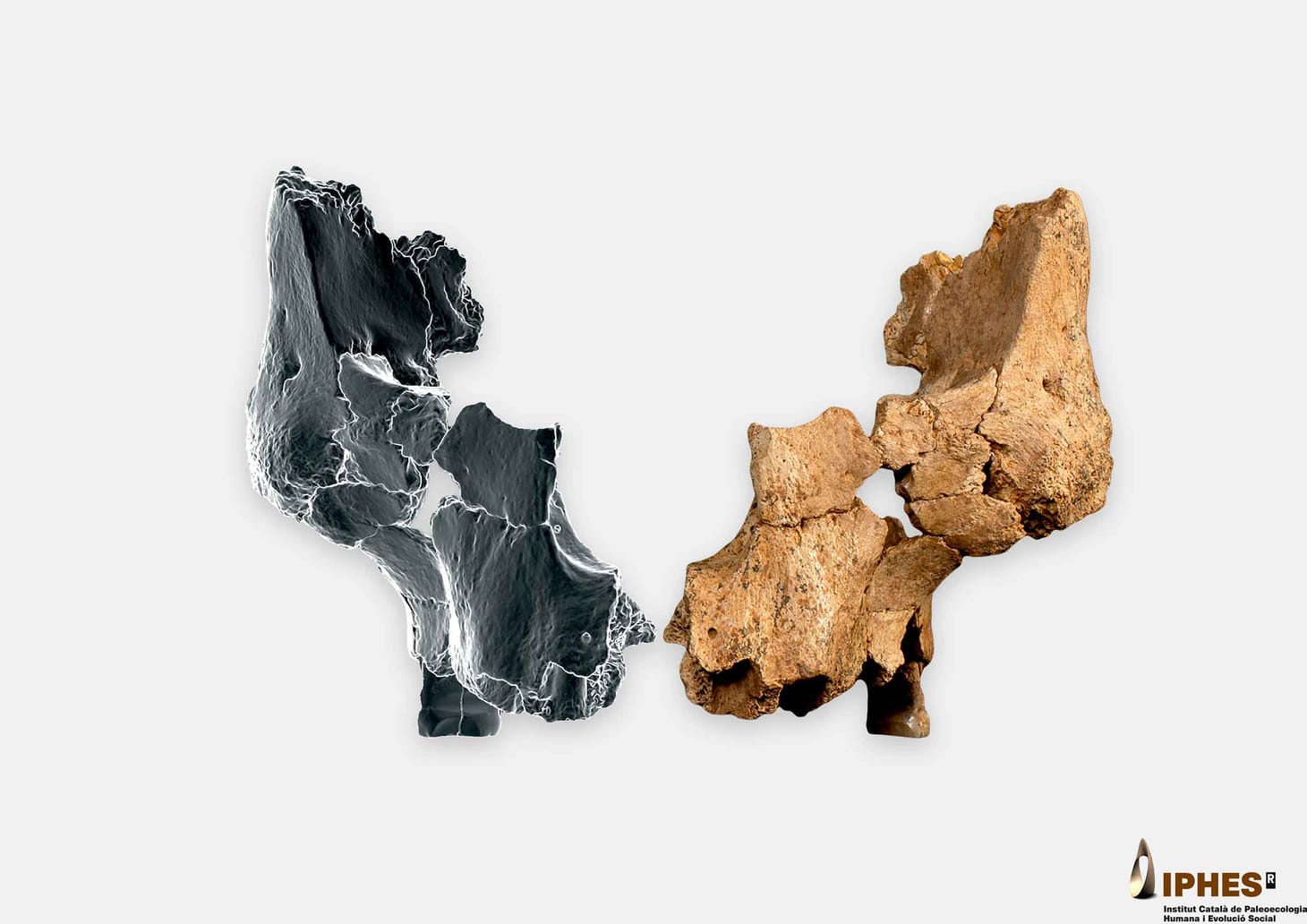
ATE7-1 fossil face (right) with mirrored 3D model (left). Credit: Maria D. Guillén / IPHES-CERCA / Elena Santos / CENIEH
When the global timeline passed one million years ago, more than half the span of hominin presence in Eurasia had already passed by. The earliest archaeological evidence in Eurasia is more than two million years old—found in places like Shangchen, China, and the Dawqara Formation of Jordan. Just this year Grăunceanu, Romania, joined the list of early archaeological traces of hominins in Europe, dating to an estimated 1.97 million years ago.

Still, I think about the threshold of one million years ago quite often. The number of sites in Eurasia with hominin evidence before one million years ago has grown quite large. It would have been hard to imagine this in 1990, when many scientists wondered if any sites in Eurasia were really older than this. Today there are many. And yet, the number of sites with fossils of hominins is quite a lot smaller than the number with stone artifacts or cutmarked animal bones. Most are in China or Indonesia, in addition to the exceptional site of Dmanisi, Georgia.

In western Europe there may be only two such sites, both in Spain: Sima del Elefante and Barranco Léon.

This week Rosa Huguet and collaborators have reported on a significant new addition to this very humble record. In work at Sima del Elefante in 2022, excavators uncovered a fragmentary facial skeleton, designated as ATE7-1. The estimated age of this fossil face is between 1.4 million and 1.1 million years ago. The new fossil joins two other hominin fossils from this cave deposit, within the same range of ages, a finger bone and a fragment of the front portion of a mandible with several worn teeth, ATE9-1. These fossils have been previously published, the mandible in 2008.

None of these fossils provide much to go on. Huguet and coworkers compared the facial anatomy of ATE7-1 with fossil faces attributed to Homo erectus from Dmanisi, Georgia, and Sangiran, Indonesia. They also compared the face to fossils from Gran Dolina, Spain, attributed to Homo antecessor. This site is located only a few hundred meters from Sima del Elefante but represents hominins and stone artifacts from around 780,000 years ago—as much as a half million years or more later than Sima del Elefante.

The ATE7-1 face is more like most H. erectus faces than either is like the later Gran Dolina fossils.

From John Hawks.

Context


Where does this discovery fit in the larger narrative of archaic hominin evolution?

Neanderthals, Denisovans, and modern humans (i.e. Homo sapiens) all share a Homo erectus ancestor and probably also at least one intermediate archaic hominin ancestor that evolved from Homo erectus.

The oldest archaeological evidence of modern humans, which is, order of magnitude consistent with age estimates for the most recent common ancestor of all modern human uniparental Y-DNA and mtDNA lineages, is about 300,000 years ago in Africa. Modern humans first left Africa around 125,000 to 100,000 years ago, and did so via the Middle East rather than Iberia. But the lion's share of non-African modern humans appear to be descended from a later wave of modern human expansion out of Africa about 50,000-74,000 years ago, with the lion's share of that wave closer to 50,000 years ago than 74,000 years ago. Neanderthal populations largely stalled this expansion into Europe until about 40,000 years ago. One or more of the hominin populations of Southeast Asia, and the jungles of Southeast Asia, probably stalled modern human expansion via the Southern route into Asia until around the time of the Toba eruption around 74,000 years ago (with the eruption possibly weakening these barriers and possibly also creating a reason for the modern humans of South Asia to expand to the Southeast).

The oldest Neanderthal remains are about 430,000 years old. Neanderthals were moribund by 40,000 years ago (with modern human Cro-Magnon people entering Europe around the same time that Neanderthals became extinct and overlapping with them for periods of a thousand or two thousand years or so in any one place), with the final relict population going extinct around 29,000 years ago. The leading explanations for Neanderthal extinction include a wave of volcanic eruptions, climate change, and the growing superiority of modern human hunter-gatherers due to their cultural evolution (e.g. stone technologies and the domestication of dogs) and/or genetic evolution. The range of Neanderthals extended from Northern Wales to the Middle East to South Asia and the Altai Mountains. There was significant Neanderthal admixture with modern humans, probably around 50,000-100,000 years ago (the latest estimates tend to favor a more recent date) in the vicinity of the Middle East or Iran (leaving a DNA legacy in all non-African modern humans), and there was also a more modern admixture with Altai Neanderthals (leaving a DNA legacy in Asian modern humans). Non-Africans today have up to 2% Neanderthal DNA, with Asians having a little more than Europeans, although ancient DNA from modern humans in ancient Eurasia, much closer to Neanderthal admixture sometimes have higher percentages of Neanderthal admixture. Neanderthals had bigger brains than modern humans, but also a more static material culture and less diverse range of hunting prey heavily concentrated around large megafauna (suggesting reduced brain plasticity and less ability to adapt culturally rather than genetically), with modern humans also relied on a wider array of smaller prey like rabbits, smaller birds, fish, and other seafood. At the time of first contact with modern humans, the effective population size of Neanderthals was about ten times smaller than the effective population size of modern human Cro-Magnons, and the effective Neanderthal effective population size ranged from about 3,000-12,000 throughout their existence and was fractured into multiple more or less isolated regional subpopulations.

Wikipedia says this about the extinction of Neanderthals:
The extinction of Neanderthals was part of the broader Late Pleistocene megafaunal extinction event. Neanderthals were replaced by modern humans, indicated by the near-complete replacement of Middle Palaeolithic Mousterian stone technology with modern human Upper Palaeolithic Aurignacian stone technology across Europe (the Middle-to-Upper Palaeolithic Transition) from 41,000 to 39,000 years ago. Iberian Neanderthals possibly persisted until about 35,000 years ago, modern human expansion perhaps impeded by the Ebro River. Neanderthals in Gibraltar may have survived as late as 28,000 years ago at Gorham's Cave. The dating of these late Iberian sites is contested.

Historically, the cause of extinction of Neanderthals and other archaic humans was viewed under an imperialistic guise, with the superior invading modern humans exterminating and replacing the inferior species.
When sapiens began to expand and spread, he eliminated the other contemporary races [including Neanderthals] just as the white man drove out the Australian aborigines and the North American Indians.
— Ernst Mayr, 1950

The assimilation of Neanderthal populations into modern human populations had long been hypothesised with supposed hybrid specimens, and was revitalised with the discovery of archaic human DNA in modern humans. Similarly, the Châtelperronian industry of central France and northern Spain may represent a culture of Neanderthals adopting modern human techniques, via acculturation. Other ambiguous transitional cultures include the Italian Uluzzian industry, and the Balkan Szeletian industry.

Aside from competition with modern humans, Neanderthal extinction has also been ascribed to their low population as well as the resulting mutational meltdown, making them less adaptable to major environmental changes (specifically Heinrich event 4) or new diseases.

The admixture between modern humans and Neanderthals went in both directions. And, some of the late archaeological tool cultures of Neanderthal, which coincide with the arrive of modern humans in Europe, may reflect the increased brain plasticity of hybrid Neanderthal-modern human individuals.


Denisovans (named after the cave in the Altai where the type remains were discovered) probably existed from at least 285,000 years ago to about 25,000 years ago, general in Asia to the east of the Neanderthal range from Altai and Tibet to Southeast Asia, and overlapping with the Neanderthal range in the Altai region. High altitude adaptation DNA admixed from Denisovans are found in Tibetans. Trace levels of Denisovan admixture are found in mainland Southeast Asia and East Asia, and in island Southeast Asia up to the Wallace Line. Modern humans with Australian aboriginal ancestry or Papuan ancestry or Filipino negrito ancestry have substantial Denisovan ancestry (up to 6%) in addition to their Neanderthal ancestry (up to 2%). Presumably, the Denisovan-modern human admixture whose legacies exist in Australian aborigines, Papuans, Filipino negritos, and mainland Southeast Asians and East Asians must have occurred around the time of first contact between the first wave of modern humans in Asia around 50,000 to 75,000 years ago, and was then greatly diluted by subsequent waves of modern human migration west of the Wallace line in Asia. Also, Denisovans presumably went extinct within a thousand or two thousand years or so of first contact with modern humans (which took place much later in Tibet than almost everywhere else).

The exact path from Homo erectus to modern humans, Neanderthals, and Denisovans (and possibly other now extinct archaic species derived from Homo erectus) is a matter of ongoing investigation and debate.
Denisovan mtDNA diverged from that of modern humans and Neanderthals about 1,313,500–779,300 years ago; whereas modern human and Neanderthal mtDNA diverged 618,000–321,200 years ago. Krause and colleagues then concluded that Denisovans were the descendants of an earlier migration of H. erectus out of Africa, completely distinct from modern humans and Neanderthals.

However, according to the nuclear DNA (nDNA) of Denisova 3—which had an unusual degree of DNA preservation with only low-level contamination—Denisovans and Neanderthals were more closely related to each other than they were to modern humans. Using the percent distance from human–chimpanzee last common ancestor, Denisovans/Neanderthals split from modern humans about 804,000 years ago, and from each other 640,000 years ago. 
Using a mutation rate of 1×10^−9 or 0.5×10^−9 per base pair (bp) per year, the Neanderthal/Denisovan split occurred around either 236–190,000 or 473–381,000 years ago respectively. Using 1.1×10^−8 per generation with a new generation every 29 years, the time is 744,000 years ago. Using 5×10^−10 nucleotide site per year, it is 616,000 years ago. Using the latter dates, the split had likely already occurred by the time hominins spread out across Europe. 
H. heidelbergensis is typically considered to have been the direct ancestor of Denisovans and Neanderthals, and sometimes also modern humans. Due to the strong divergence in dental anatomy, they [i.e. Denisovans] may have split before characteristic Neanderthal dentition evolved about 300,000 years ago.

The more divergent Denisovan mtDNA has been interpreted as evidence of admixture between Denisovans and an unknown archaic human population, possibly a relict H. erectus or H. erectus-like population about 53,000 years ago. Alternatively, divergent mtDNA could have also resulted from the persistence of an ancient mtDNA lineage which only went extinct in modern humans and Neanderthals through genetic drift. Modern humans contributed mtDNA to the Neanderthal lineage, but not to the Denisovan mitochondrial genomes yet sequenced. The mtDNA sequence from the femur of a 400,000-year-old H. heidelbergensis from the Sima de los Huesos Cave in Spain was found to be related to those of Neanderthals and Denisovans, but closer to Denisovans, and the authors posited that this mtDNA represents an archaic sequence which was subsequently lost in Neanderthals due to replacement by a modern-human-related sequence.
The intermediate species that is the most recent common ancestor of Neanderthals, Denisovans, and modern humans probably arose not long after a genetic bottleneck which has been inferred from modern DNA. This genetic bottleneck probably occurred in the clade of H. erectus which is ancestral to modern humans. As one secondary source explaining this notes:
Between 930,000 and 813,000 years ago, something nearly ended humanity before it even began. A mysterious bottleneck reduced the human breeding population to just 1,280 individuals, pushing our ancestors to the brink of extinction for an astonishing 117,000 years. 
Scientists have long puzzled over a gap in the African and Eurasian fossil records, and now, a team of researchers may have found the answer. Using a groundbreaking method called FitCoal, they analyzed the genomes of 3,154 modern humans to reconstruct ancient population sizes. What they found was staggering. Nearly 99% of early humans vanished, likely due to extreme climate events such as glaciations, severe droughts, and the collapse of ecosystems.

The world was changing. Glaciation, extreme droughts, and collapsing ecosystems made survival nearly impossible. Food sources vanished, and so did most of our ancestors. Those who remained – just a tiny fraction of the original population – fought to endure in a harsh and unpredictable environment. 
But against all odds, they survived. And in doing so, they may have changed the course of human evolution forever. Scientists believe this bottleneck could have led to the merging of two ancestral chromosomes, forming what we now know as chromosome 2 – a key feature that separates modern humans from other primates.

Around 813,000 years ago, the climate began to shift. Our ancestors may have mastered fire, allowing them to cook food, stay warm, and fend off predators. Populations rebounded, and from that tiny group of survivors, the future of humanity was born. 
This discovery reshapes our understanding of human history, and raises new questions. Where did these survivors live? How did they overcome such extreme conditions? Did this struggle push human intelligence to evolve faster?
The paper that is the basis for this account is Wangjie Hu, et al., "Genomic inference of a severe human bottleneck during the Early to Middle Pleistocene transition" 381(6661) Science 979-984 (August 31, 2023). Its abstract materials state:
Editor’s summary 
Today, there are more than 8 billion human beings on the planet. We dominate Earth’s landscapes, and our activities are driving large numbers of other species to extinction. Had a researcher looked at the world sometime between 800,000 and 900,000 years ago, however, the picture would have been quite different. Hu et al. used a newly developed coalescent model to predict past human population sizes from more than 3000 present-day human genomes (see the Perspective by Ashton and Stringer). The model detected a reduction in the population size of our ancestors from about 100,000 to about 1000 individuals, which persisted for about 100,000 years. The decline appears to have coincided with both major climate change and subsequent speciation events. —Sacha Vignieri 
Abstract 
Population size history is essential for studying human evolution. However, ancient population size history during the Pleistocene is notoriously difficult to unravel. In this study, we developed a fast infinitesimal time coalescent process (FitCoal) to circumvent this difficulty and calculated the composite likelihood for present-day human genomic sequences of 3154 individuals. Results showed that human ancestors went through a severe population bottleneck with about 1280 breeding individuals between around 930,000 and 813,000 years ago. The bottleneck lasted for about 117,000 years and brought human ancestors close to extinction. This bottleneck is congruent with a substantial chronological gap in the available African and Eurasian fossil record. Our results provide new insights into our ancestry and suggest a coincident speciation event.

The proposed climate event was part of the Mid-Pleistocene Transition. Some key aspects of this, in places where Homo erectus reached, were as follows:

Europe

In Europe, the MPT was associated with the Epivillafranchian-Galerian transition and may have led to the local extinction of, among other taxa, Puma pardoides, Megantereon whitei, and Xenocyon lycaonoides. The prevalence of ungulates adapted for grazing increased in the Mediterranean region after the "0.9 Ma event". The northern North Sea Basin was first glaciated during the MPT. The increased intensity of transgressive-regressive cycles is recorded in northern Italy.

Asia

The cooling brought about by the MPT increased westerly aridity in the western Tarim Basin. East Asian Summer Monsoon (EASM) precipitation declined. Grasslands expanded across the North China Plain as forests contracted.

During the MPT, the Indian Summer Monsoon (ISM) decreased in strength. In the middle of the MPT, there was a sudden decrease in denitrification, likely due to increased solubility of oxygen during lengthened glacial periods. After the MPT, the Bay of Bengal experienced increased stratification as a result of the strengthening of the ISM, which resulted in increased riverine flux, inhibiting mixing and creating a shallow thermocline, with stratification being stronger during interstadials than stadials. Paradoxically, variability in Δδ18O in the Bay of Bengal between glacials and interglacials decreased following the MPT.

Africa

In Central Africa, detectable floral changes corresponding to glacial cycles were absent prior to the MPT. Following the MPT, a clear cyclicity became evident, with interglacials being characterised by warm and dry conditions while glacials were cool and humid.

According to one of the leading papers on the 0.9 Ma Event, closely associated with the Homo erectus genetic bottleneck:

The Early-Middle Pleistocene Transition (EMPT) (ca. 1.4–0.4 Ma) represents a fundamental transformation in the Earth's climate state, starting at 1.4 Ma with a progressive increase in the amplitude of climatic oscillations and the establishment of strong asymmetry in global ice volume cycles. The progressive shift from a 41kyr–100kyr orbital rhythm was followed by the first major build-up of global ice volume during MIS 24-22, the so-called “0.9 Ma event”. The Vallparadís Section (Vallès-Penedès Basin, NE Iberian Peninsula) is one of the few Pleistocene series in Europe that spans the onset of the transition (from 1.2 to 0.6 Ma), thus representing a pivotal array of localities to investigate the effect of glacial dynamics on environmental conditions in Southern Europe. Here we inspect the effects of the EMPT on terrestrial ecosystems by examining the dietary adaptations (through dental meso- and microwear patterns) of fossil ungulates from the Vallparadís Section dated before and after the “0.9 Ma event”. Results show a steady presence of open grasslands before MIS 22 and more humid conditions at MIS 21. Both before and after MIS 22, a consistent presence of ungulates with long-term patterns that point to a grazing or grass-rich mixed feeding behaviour is observed, while noticeably, short-term patterns point to increased seasonality right after the “0.9 Ma event” glacial period. This increment of seasonality may have had an important effect on the Mediterranean habitats leading to recurring changes in the quality of plant resources available to large herbivores, which in response periodically adopted more mixed feeding behaviours widening their dietary breadth to consume also sub-optimal food items during adverse seasons.
In particular, during this event, global ice volumes increased substantially, and the Northern Hemisphere experienced increased seasonality and aridity, and surface sea temperatures in the North Atlantic reached their lowest values during the EMPT at this time. Also, grasslands expanded across the North China Plain as forests contracted.

This hypothesis is model dependent, could be impacted by sources of systemic error, like the possible much later extinction of Homo erectus populations derived from the same source population, later hard genetic sweeps of Homo erectus source genes, the effective extinction of modern humans arising from other clades of Homo erectus at some much later time, a lack of consideration of Neanderthal or Denisovan genes in the analysis, and a complete lack of ancient Homo erectus genomes. 

Also, in understanding this narrative one has to recognize that genetics researchers call an "effective population" of 1,280 individuals could have involved a census population at any one time that was many times larger than that. And, this is still about five times as large as the effective population size of the founding population of the Americas, for example. So, the bottleneck wasn't quite as extreme as some popular accounts of it would imply.

But the oldest examples of the species Homo antecessor does first appear in Europe, shortly after this inferred bottleneck, and there are no Homo erectus remains in Europe during or after the time of this inferred bottleneck.

Homo antecessor (Latin "pioneer man") is an extinct species of archaic human recorded in the Spanish Sierra de Atapuerca, a productive archaeological site, from 1.2 to 0.8 million years ago during the Early Pleistocene. Populations of this species may have been present elsewhere in Western Europe, and were among the first to settle that region of the world, hence the name. The first fossils were found in the Gran Dolina cave in 1994, and the species was formally described in 1997 as the last common ancestor of modern humans and Neanderthals, supplanting the more conventional H. heidelbergensis in this position. H. antecessor has since been reinterpreted as an offshoot from the modern human line, although probably one branching off just before the modern human/Neanderthal split.

Despite being so ancient, the face is unexpectedly similar to that of modern humans rather than other archaic humans—namely in its overall flatness as well as the curving of the cheekbone as it merges into the upper jaw—although these elements are known only from a juvenile specimen. Brain volume could have been 1,000 cc (61 cu in) or more, but no intact braincase has been discovered. This is within the range of variation for modern humans. Stature estimates range from 162.3–186.8 cm (5 ft 4 in – 6 ft 2 in). H. antecessor may have been broad-chested and rather heavy, much like Neanderthals, although the limbs were proportionally long, a trait more frequent in tropical populations. The kneecaps are thin and have poorly developed tendon attachments. The feet indicate H. antecessor walked differently than modern humans.

H. antecessor was predominantly manufacturing simple pebble and flake stone tools out of quartz and chert, although they used a variety of materials. This industry has some similarities with the more complex Acheulean, an industry which is characteristic of contemporary African and later European sites. Groups may have been dispatching hunting parties, which mainly targeted deer in their savannah and mixed woodland environment. Many of the H. antecessor specimens were cannibalised, perhaps as a cultural practice. There is no evidence they were using fire, and they similarly only inhabited inland Iberia during warm periods, presumably retreating to the coast otherwise.

Meanwhile:

Homo heidelbergensis (also H. erectus heidelbergensis, H. sapiens heidelbergensis) is an extinct species or subspecies of archaic human which existed from around 600,000 to 300,000 years ago, during the Middle Pleistocene. Homo heidelbergensis was widely considered the most recent common ancestor of modern humans and Neanderthals, but this view has been increasingly disputed since the late 2010s.

In the Middle Pleistocene, brain size and height were comparable to modern humans. Like Neanderthals, H. heidelbergensis had a wide chest and robust frame.

Fire likely became an integral part of daily life after 400,000 years ago, and this roughly coincides with more permanent and widespread occupation of Europe (above 45°N), and the appearance of hafting technology to create spears. H. heidelbergensis may have been able to carry out coordinated hunting strategies, and consequently they seem to have had a higher consumption of meat.

It is debated whether or not to constrain H. heidelbergensis to only Europe or to also include African and Asian specimens, and this is further confounded by the type specimen (Mauer 1) being a jawbone, because jawbones feature few diagnostic traits and are generally missing among Middle Pleistocene specimens.

H. heidelbergensis was subsumed in 1950 as a subspecies of H. erectus but today it is more widely classified as its own species. H. heidelbergensis is regarded as a chronospecies, evolving from an African form of H. erectus (sometimes called H. ergaster).

At least three other archaic hominin species overlapped with hominins from the H. erectus era or later.

H. floresiensis and H. luzonensis may have been regional variations of the same species and show similarities with each other. The most plausible theory of their phylogenetic position, in my view, is that both of them were sub-species of H. habilis, and may have left Africa, either independently, or together with either H. erectus, the Denisovan ancestor, or Denisovans themselves. H. floresiensis and Denisovans (and possibly the earliest modern humans to arrive there as well) may have co-existed on the island of Flores, Indonesia (which is past the Wallace line) at some point in  time. There are no remains of H. floresiensis, H. luzonensis, H. habilis, or any other archaic hominins before H. erectus disperses from Africa. 

H. naledi was a South African archaic hominin species that flourished from 335,000 to 226,000 years ago, that was probably not directly ancestral to modern humans or any other non-African archaic hominins, but would have co-existed in time (and possibly space) with the earliest modern humans in Africa.

A November 6, 2024 post at this blog recapped some other possible non-African archaic hominins who existed at the same time that modern humans did: 

Notably the remains of the Red Deer Cave People of China from 14,000 years ago (a few thousand years before the start of the Holocene era) are genetically modern humans and are not archaic hominins despite some of their seemingly archaic features. See also here.

I am also inclined to think that they may yet be a small relict population of small archaic hominins in a remote Indonesian jungle on the island of Sumatra and perhaps Flores as well, where these cryptids, called Orang Pendek, locally, have been attested but not definitively confirmed to still exist. I discuss this further at this post.

Homo floresiensis (discovered in 2003) are commonly known as "hobbits" and have been found on the island of Flores. Their phylogeny is disputed, but I find the theory that they are an asian branch of H. habilis to be most convincing. H. luzonesis (discovered in 2007) is similar and contemporaneous, but found further east in the Philippines and is supported by a less complete archaeological record. Both of these diminutive species are found in association with late Pleistocene tools and "oriental fauna".

Personally, being more of a lumper than a splitter, I'm inclined to see H. floresiensis and H. luzonesis as sub-species variations of the same species ("race" within that species to use some outdated terminology), and likewise to see H. longi, H. juluensis, and Denisovans as sub-species variations of the Denisovan species. The Hualongdong archaic hominin fossils ... could be a hybrid individual, perhaps a Neanderthal-Denisovan hybrid individual (something that has precedent in a Denisovan cave DNA sample).

Academic anthropologists, in contrast, tend to be splitters, in part, because it is cool and career advancing to discover and name your own archaic species, in part because the data is so fragmentary that grouping different fragmentary remains in a clade presumes relationships between the remains that aren't solidly proven, and in part, because it is easy to underestimate how much morphological diversity is possible within a single species if populations of it exposed to different environmental conditions.

H. longi a.ka. "dragon man" dates to an earlier time period (still contemporaneous with modern humans in Africa) in China and Manchuria, was discovered in 1933, and has been hypothesized to be a sister clade to Neanderthals, Denisovans, and modern humans, and a descendant of the pre-modern human hominin species H. antecessor due in part to basal archaic features in the skull.

H. juluensis (literally "big heads") is contemporaneous H. longi, and beyond that time frame into the time frame of H. floresiensis and was discovered from 1976-1979 in China and Tibet. The authors assign this specimen along with Xiahe and Penghu fossils, to the Denisovan species (a sister clade to Neanderthals and modern humans) based upon comparisons of their fossil teeth and rough geographic proximity. H. juluensis is found in association with early Paleolithic tools and remains of Paleoarctic fauna. But they have larger brain cases than H. longi. A previous suggestions of the link between H. longi and the Denisovan species are discussed here and here at this blog. At least one Denisovan tooth has been found in Laos dated to 131,000 years ago.

The article also discusses the Hualongdong archaic hominin fossils that "date to the late Middle Pleistocene (~300,000 years BP) and display a mosaic of characteristics that cannot be easily fitted into any one lineage," although they are closer to H. longi and H. juluensis. This individual could be a hybrid between these two subspecies, with H. erectus, or with a Neanderthal who was far east of his usual range.

Prior to 2021, H. longi and H. juluensis tended to be classified as H. erectus (remains of which start to appear at a much greater time depth in Asia) or as archaic modern humans.

The Narmada and Maba partial skulls, especially the latter, are suggestively associated with Neanderthals by the article.

These Asian archaic species also overlap in time with the Southern African archaic hominin clade H. naledi which is a sister clade to the modern human ancestors and to the common ancestor of modern humans, Neanderthals, and Denisovans, but is not actually among our ancestors. As I explained at the link, this species "is basically a story from The Silmarillion of hominin evolution. It is entertaining, especially for hard core human evolution fans, but it doesn't really advance the plot."

A small number of papers reported genetic evidence in modern Africans of admixture with an archaic hominin "ghost species" in Africa, but subsequent papers have explained this "ghost species" signal as a methodological artifact that merely arises from population structure in early modern human Africans (see also here). But there may have been relict archaic hominins that did not admix with modern humans in Africa that were also contemporaneous with modern humans, at least, early on.

The question of whether behaviorally modern humans started showing advanced behavior around 70,000-50,000 years ago (at the dawn of the Upper Paleolithic era and close in time to the Out of Africa event for modern humans), was associated with an evolutionary leap in their brains is an open and unresolved question. See also here (addressing the question of what made modern humans genetically distinct from archaic hominins).

Is CP Violation In The CKM Matrix A Gravitational Effect?

A long standing possibility is that CP violation, which arises in the Standard Model only from CP violating phases of the CKM matrix (for quarks) and PMNS matrix (for leptons) might have a cause independent of the fermion generation changes that the other three parameters of the CKM matrix and PMNS matrix, respectively, describe. Thus, the CKM matrix and PMNS matrixes may each simply represent the combined effects arising from two different causes.

The new preprint, whose abstract is below, considers the possibility that CP violation in the CKM matrix arises, in whole or in part, from gravitational effects.

If so, the CKM matrix might run with both the strength of the gravitational field in the vicinity of the particles undergoing CP violating interaction and also with the energy scale of the interaction.

The claim that this explanation can fit the data on CP violation and post-dict its magnitude entitles this hypothesis to a closer look, even though it would seem to violate the strong equivalence principle of General Relativity (much like the external field effect in MOND seems to) which is particularly concerning because the author considers gravity only in the Newtonian approximation. The claimed CPT violation of this theory is also a big ask.

This proposal appeals to the reductionist trend in physics and makes a dent in both finding a derived origin for one of the currently only experimentally determined fundamental constants of the Standard Model, and in finding connections between the Standard Model and gravity.

This proposal is also attractive because it could theoretically be tested, with high precision measurements of Earth based colliders where the strength of the surface gravitational field is different, with space or lunar based collider experiments, or with "natural experiments" based upon astronomy observations or comic rays with particles that start to decay at different altitudes.

In sum, while this is a pretty radical proposal that is unlikely to work out, it deserves at least a closer look, relative to many other less promising radical hypotheses.
The impact of earth's gravity on neutral mesons dynamics is analyzed. The main effect of a Newtonian potential is to couple the strangeness and bottomness oscillations with the quark zitterbewegung oscillations. This coupling is responsible for the observed CP violation in the three types of experiments analyzed here: (i) indirect violation in the mixing, (ii) direct violation in the decay to one final state and (iii) violation in interference between decays with and without mixing. 
The three violation parameters associated with these experiments are predicted in agreement with the experimental data. The amplitude of the violation is linear with respect to the strength of gravity so that this new mechanism allows to consider matter dominated cosmological evolutions providing the observed baryon asymmetry of the universe.
Jean-Marcel Rax, "Gravity induced CP violation in mesons mixing, decay and interference experiments" arXiv:2503.09465 (March 12, 2025).

The body text in the introduction further clarifies the proposal stating that:
Since the first observation of long-lived kaons decays into pairs of charged pions, reported sixty years ago by Christenson, Cronin, Fitch and Turlay [1], many complementary observables associated with flavored neutral mesons CP violation (CPV) have been identified, measured and interpreted. The canonical framework of interpretation is the standard model (SM) through the adjustment between the Kobayashi-Maskawa (KM) complex phase and the experimental values of the violation parameters. In this study, we focus on the most documented and clearest experimental evidence of CPV and we demonstrate that gravity induced CPV provides a pertinent framework to interpret these experiments and to predict the violation parameters, as a function of earth’s gravity, in agreement with the experimental data. As a consequence, far from any massive object, i.e. in a flat Lorentzian space-time, the Cabibbo-KobayashiMaskawa (CKM) matrix must be considered free from any CPV phase as CPV effects are just gravity induced near massive objects like earth.
The same author appears to have first introduced this concept in a paper from May 27, 2024 (also currently not published). The 2024 paper's abstract is as follows:
The impact of earth's gravity on neutral kaons oscillations is analyzed. The main effect of a Newtonian potential is to couple the strangeness oscillation and the strange quarks zitterbewegung. This coupling is responsible for the observed CP violations. 
Gravity induced CP violation is in fact a CPT violation with T conservation rather than a T violation with CPT conservation, but the finite lifetime of the short-lived kaons induces a rotation of the imaginary CPT parameter such that it becomes real and the effect is observed as a CP and T violation. Both indirect and direct violation parameters are predicted in agreement with the experimental data.
The authors only two other papers, also both in 2024, also develop related ideas from slightly different perspectives.

The 2025 paper goes further by making some phenomenological calculations apply the 2024 theory to some specific kinds of high energy physics experimental data.

The author does not appear to have any actually published papers yet, but he is affiliated with the science faculty of a legitimate university in Paris, France, and the papers generally conform, at first glance at least, in character and citation practice to legitimate publications involving this kind of research (which surprisingly few crackpot papers do).

Wednesday, March 12, 2025

A Neutrino Oscillation And Mass Parameter Recap

Slowly but surely, the precision with which we know the neutrino oscillation parameters is improving, with one of the five parameters now reaching the subpercent level.
We perform an updated global analysis of the known and unknown parameters of the standard 3ν framework as of 2025. The known oscillation parameters include three mixing angles (θ12,θ23,θ13) and two squared mass gaps, chosen as δm^2=m2^2−m1^2>0 and Δm^2=m23−1/2(m1^2+m2^2), where α=sign(Δm^2) distinguishes normal ordering (NO, α=+1) from inverted ordering (IO, α=−1). 
With respect to our previous 2021 update, the combination of oscillation data leads to appreciably reduced uncertainties for θ23, θ13 and |Δm^2|. In particular, |Δm^2| is the first 3ν parameter to enter the domain of subpercent precision (0.8% at 1σ). We underline some issues about systematics, that might affect this error estimate. 
Concerning oscillation unknowns, we find a relatively weak preference for NO versus IO (at 2.2σ), for CP violation versus conservation in NO (1.3σ) and for the first θ23 octant versus the second in NO (1.1σ). We discuss the status and qualitative prospects of the mass ordering hint in the plane (δm^2,Δm(ee)^2), where Δm(ee)^2=|Δm^2|+1/2α(cos(θ12)^2−sin(θ12)^2)δm^2, to be measured by the JUNO experiment with subpercent precision. 

We also discuss upper bounds on nonoscillation observables, including the effective νe mass mβ in β-decay, the effective Majorana mass mββ in 0νββ decay, and the total ν mass Σ in cosmology. 
We report mβ < 0.50 eV (2σ) from 3H [KATRIN] data and mββ < 0.086 eV (2σ) from 76Ge, 130Te and 136Xe data, accounting for parametrized nuclear matrix element covariances. 
Concerning Σ, current results show tensions within the standard ΛCDM cosmological model, pulling Σ towards unphysical values and suggesting possible model extensions. We discuss representative combinations of data, with or without augmenting the ΛCDM model with extra parameters accounting for possible systematics (lensing anomaly) or new physics (dynamical dark energy). The resulting 2σ upper limits are roughly spread around the bound Σ < 0.2 eV within a factor of three (both upwards and downwards), with different implications for NO and IO scenarios. Bounds from oscillation and nonoscillation data are also discussed in the planes charted by pairs of (mβ, mββ,Σ) parameters. 

Francesco Capozzi, et al., "Neutrino masses and mixing: Entering the era of subpercent precision" arXiv:2503.07752 (March 10, 2025).

Analysis

The estimates of the preference for a normal mass ordering of the three neutrino masses, and of CP violation in neutrino oscillation are probably low considering all of the data and hints out there in the literature. I have very little doubt that both of those will ultimately turn out to be correct, with the CP violation parameter likely to be near maximal.

Other reviews have favored a second octant v. a first octant value for θ23. The true quadrant is very much an open question. 

As I understand it, mβ < 0.50 eV is the upper bound on the absolute value of the lightest neutrino mass from heavy hydrogen decades directly measured in the KATRIN experiment, and mββ < 0.086 eV is the upper bound on the Majorana mass of the lightest neutrino mass state from neutrinoless double beta decay experiments. The KATRIN result is now outdated as previously reported at this blog. The new limit is actually 0.45 eV. This pushes the limit on the sum of the three neutrino masses to 1.41 eV in a normal hierarchy and 1.46 eV in an inverted hierarchy, a bound which is more than ten times weaker than the cosmology based bounds, but is much less model dependent and has fewer sources of potential systemic error.

The details of the paper's findings are spelled out in greater detail in its tables.

The bounds on the minimum frequency of neutrinoless double beta decay (which implies Majorana neutrinos and has not yet been detected) also continues to get longer.  


The limit on the sum of neutrino masses Σ is conservative with many other papers reaching a lower value. This data also tends to favor a normal ordering of neutrino masses in which the sum of neutrino masses Σ is less than about 0.1 eV, which several data combinations placing two sigma bounds below that threshold.

Monday, March 10, 2025

Hard To Explain In LambdaCDM, Trivial In MOND

Trying to explain the result described in the paper below in the LambdaCDM paradigm with tidal stripping of dark matter is really a stretch. If the dark matter particles are stripped, where do they go? Why is dark matter differentially stripped relative to regular matter? And, why is this observation only being explained in retrospect, rather than predicted in advance?

But, in the MOND paradigm, the transition of a galaxy from a more extended and dispersed spiral form to a more compact lenticular galaxy automatically and naturally results in weak inferred dark matter phenomena. This observation was expected back in 1983 when it was first formulated. This is because, in the MOND paradigm, lenticular galaxies are expected to have less inferred dark matter phenomena than spiral galaxies, because more of their matter is within the critical MOND acceleration region.
We present the high-sensitivity and large-scale atomic hydrogen (HI) observations towards lenticular (S0) galaxy NGC 4111 using the Five-hundred-meter Aperture Spherical Radio Telescope (FAST). The column density map shows that NGC4111 and seven other different types of galaxies share a huge HI gas complex. The data also suggest that NGC 4111 is interacting with seven galaxies. Moreover, we identified a rotating gas disk associated with NGC 4111 from the HI complex. Still, the HI disk rotation direction has deviated from its stellar disk about 34.2∘, indicating that the NGC 4111 galaxy is undergoing a transition from a spiral galaxy to an S0 galaxy by the tidal interactions. 
The obtained dark matter-to-stellar mass ratio of NGC4111 is 3.1±0.7, which is lower than the average value of the Local Universe, implying that the interactions may strip its dark matter. Our results suggest that in a galaxy group environment, tidal interactions have a significant effect on galaxy features.
Mei Ai, et al., "Formation of the dark-matter deficient S0 galaxy NGC 4111 under the tidal interactions" arXiv:2503.05171 (March 7, 2025).

Alexander The Great's "Fish Eaters"

Sailing thence they sailed without stop all night andday, and after a voyage of eleven hundred stades they got past the country of the Fish-eaters, where they had been much distressed by want of food. They did not moor near shore, for there was a long line of surf, but at anchor, in the open. The length of the voyage along the coast of the Fish-eaters is a little above ten thousand stades. 
These Fish-eaters live on fish; and hence their name; only a few of them fish, for only a few have proper boats and have any skill in the art of catching fish; but for the most part it is the receding tide which provides their catch. 
Some have made nets also for this kind of fishing; most of them about two stades in length. They make the nets from the bark of the date-palm, twisting the bark like twine. And when the sea recedes and the earth is left, where the earth remains dry it has no fish, as a rule; but where there are hollows, some of the water remains, and in this a large number of fish, mostly small, but some large ones too. They throw their nets over these and so catch them. 
They eat them raw, just as they take them from the water, that is, the more tender kinds; the larger ones, which are tougher, they dry in the sun till they are quite sere and then pound them and make a flour and bread of them; others even make cakes of this flour. Even their flocks are fed on the fish, dried; for the country has no meadows and produces no grass. 
They collect also in many places crabs and oysters and shell-fish. There are natural salts in the country; from these they make oil. Those of them who inhabit the desert parts of their country, treeless as it is and with no cultivated parts, find all their sustenance in the fishing but a few of them sow part of their district, using the corn as a relish to the fish, for the fish form their bread. 
The richest among them have built huts; they collect the bones of any large fish which the sea casts up, and use them in place of beams. Doors they make from any flat bones which they can pick up. But the greater part of them, and the poorer sort, have huts made from the fishes' backbones.
Arrian, Indica, 29 via this Wikipedia article.

Note that the word translated as "corn" is a reference to the original European plant with that name, and not to New World Maize that which came to be known by the name of the original European plant, which only arrived 1800 years later than this account.

Sunday, March 9, 2025

A New Muon g-2 EW Calculation

The 2020 Theory Initiative White Paper value for the weak force contribution to muon g-2 was 153.6(1.0) × 10^−11. 

This improved calculation produces a best fit value that is 0.8 x 10^−11 larger (which brings the total value of muon g-2 slightly closer to the experimental value), and has a 60% smaller uncertainty (which is always an improvement even if it is a slight one). 

The new calculation is consistent with the old one at the one sigma level.

A precise evaluation of the electroweak contribution to the anomalous magnetic moment of the muon requires control over all aspects of the Standard Model, ranging from Higgs physics, over multi-loop computations for bosonic and (heavy-)fermion diagrams, to non-perturbative effects in the presence of light quarks. Currently, the dominant uncertainties arise from such hadronic effects in the vector-vector-axial-vector three-point function, an improved understanding of which has recently emerged in the context of hadronic light-by-light scattering. Profiting from these developments as well as new perturbative and non-perturbative input for the charm contribution, we obtain a(EW)(μ) = 154.4(4) × 10^−11.
From Martin Hoferichter, Jan Lüdtke, Luca Naterop, Massimiliano Procura, Peter Stoffer, "An improved evaluation of the electroweak contribution to (g−2)μ" arXiv:2503.04883 (March 6, 2025).

The previous state of the art gap between experiment and the SM calculation was 6.5 ± 41.3. This development reduces the gap to about 5.7 ± 41.2 (which is about 0.14 sigma). 

In other words, the experimentally measured value of muon g-2 (which has parts per 10 million precision) is perfectly consistent with the leading Standard Model predictions for the value of muon g-2 and there is basically no room for beyond the Standard Model physics that can perceptibly impact muon g-2.

It also reduces the EW share of the QED + EW component of the uncertainty in the total result from about 90% to 80%.

Thursday, March 6, 2025

A Muon g-2 Update

A new preprint recaps developments in establishing the Standard Model prediction for muon g-2 (my own latest recap, with more detail, is in a November 12, 2024 post and shows that the state of the art SM prediction is just 0.2 sigma from the experimental result). 

A 2020 "white paper" using a "data driven" model, showing a five sigma discrepancy between theory and experiment was badly wrong, because the data is relied upon was subtly flawed, or understated the uncertainty of its results.

New Lattice QCD calculations which corroborate each other, and some new experimental data to contribute to a data driven model, show that, in fact, it is extremely likely that there is no statistically significant difference between ultra-precise experimental measurements of muon g-2 and the best available calculation of the Standard Model predicted value of it.

[T]he final result for 𝑎𝜇 from the Muon g-2 experiment is expected in Spring 2025, preceded by a new Theory White Paper. 
A further measurement of 𝑎𝜇 is planned at J-PARC@KEK using a very different technique with a compact magnetic ring and low momentum 𝜇+. Data-taking should start in 2028 with 2 years of running needed to reach a result with ∼ 2°ø the uncertainty of Muon g-2.

Wednesday, March 5, 2025

Late Linguistic Arrivals To Europe

Hungarian entered the Carpathian Basin at the tail end of the 9th century and Finnish and its congeners arrived in the Baltic region around the same time [Ed. some scholars, however, date it to much earlier in the 1st Millennium BCE], ultimately both from the southern Urals (hence Uralic) and Turkey, formerly populated by speakers of numerous Anatolian (ergo, IE) languages, including Lydian, Carian, and Hittite, the first IE tongue, which were overlaid by Turkic speakers from the distant east beginning in the 11th century.

Note, however, that between the era in which Anatolian language were spoken in what is now Turkey, and the 11th century dominance of the Turkic language, there were also other languages spoken there, including Greek, Persian (which is moderately related to its fellow Indo-Iranian Kurdish languages, which are first attested in the 9th century but are surely at least somewhat older) and Armenian, all of which are also Indo-European languages, as well as the Semitic Arabic language, which was first spoken by significant numbers of people in Anatolia (and also in Iberia) in the 7th century.


Other languages also arose or first appeared in Europe in the Middle Ages.

The Indo-Aryan (i.e. Sanskrit derived) language(s) of the Romani people, a remote branch of the Indo-European language not previously found in Europe arrived in the 9th to 14th centuries. The Semitic influenced Germanic Yiddish language arose roughly the 9th century. The Semitic Maltese language also didn't come into being until the Middle Ages, arising roughly the 11th century.

Basque is the only remaining non-Indo-European language in Europe which was present there prior to the Middle Ages, although others, such as Etruscan, which was last attested in the 1st century, survived into the Roman era.

Friday, February 28, 2025

The Intra-African Slave Trade And Its Consequences

Contrary to some "Afro-Centric" educators, Egypt is darker skinned and has more sub-Saharan ancestry (as confirmed by modern and ancient DNA) now than it did in the classical era and in earlier times.

What happened?


A lot of sub-Saharan Africans were forced into slavery and delivered to the Middle East and North Africa (including Egypt) during the Middle Ages.

Tuesday, February 25, 2025

Back To Genetics Basics

For those of you who are new to this, here is a nice illustration of how different kinds of human DNA work (from DNA Explained).


Evolution In Human Pigmentation In Europe

As recently as 2500 years ago, many Europeans were a lot less white. 

The colour of eyes, hair, and skin among Eurasians and Africans is no longer a mystery. The evolution of light skin, hair, and eyes in Eurasia occurred over thousands of years, influenced by natural selection of genes and complex migration, reveals a new preprint study.

“The shift towards lighter pigmentation turned out to be slower than expected, with half of the individuals showing dark or intermediate skin colours well into the Copper and Iron Ages,” wrote the researchers in the study.

Researchers from the University of Ferrara, Italy, have used ancient DNA evidence to understand the natural colour of skin, eyes, and hair in humans from Eurasia. The study analysed DNA samples ranging from 45,000 to 1,700 years old, representing about 34 countries. . . .

[T]he first humans in Eurasia were dark-skinned and dark-haired, originating from warm climates. These darker-skinned humans had more melanin—a pigment that blocks the UV rays the body uses to produce vitamin D—compared to their lighter-skinned kin in the evolutionary cycle. Vitamin D, in turn, is crucial for bone health and strengthening the immune system, as well as aiding calcium absorption and muscle function. . . .

By the Iron Age (1200 BC to 500 BC), light-skinned people became as common as dark-skinned ones, with gene flow being the major driver of change, as noted by the researchers in the study.

The Neolithic farmers from Anatolia, present-day Turkey, “profoundly changed the genetic makeup of populations,” write the researchers, leading to a “population turnover”.

These farmers had two key advantages over the local hunter-gatherers: a stable food supply ensured by farming and animal herding, and a lighter skin tone. A lighter skin tone is better adapted to northern regions where the intensity of UV rays is low, as low melanin content in lighter skin helps produce more vitamin D. These advantages enabled the farmers’ population to grow at a faster rate than the local hunter-gatherers, causing a major shift in the appearance of Europeans.

However, the migration of Neolithic farmers was not the sole cause of the transformation of skin colour in Europe. The researchers have attributed this transformation to a localised process of migration and interbreeding of different isolated populations.

From here.

This excerpt doesn't call out a couple of other significant factors, however, and the analysis seems a bit muddled. And, like many papers in this genre, its technical analysis is strong, but its review of the literature and ability to put their own results in that context is weak.

There was massive population replacement in Europe in the Neolithic era as farmers with ancestors predominantly in Western Anatolia expanded in a southern Cardial Pottery wave and a northern LBK wave surged into Europe starting ca. 6000 BCE in the Southeast, and finishing about 4000 BCE in the Northwest and Southwest. The amount of Mesolithic European hunter-gatherer ancestry was quite modest by the time that this had run its course. So attributing light skin to Anatolian farmer ancestry is problematic. 

The closest modern proxy for Anatolian farmer ancestry is found in the people who are native to Sardinia, depicted below (from here):


Modern Anatolians have had, on average, perhaps 10% Turkic admixture due to events taking place in the Middle Ages, also experienced significant admixture from the Eastern highlands of Iran and the Caucuses during the Copper Age, and some modest Indo-European admixture with Hittite and Greek and Persian invasions from the Bronze Age to the Iron Age. So, modern Anatolians look less like the first farmers of Europe than Sardinians do.

In most Europeans, other than Sardinians and some far northern Scandinavians, this was followed by the significant demographic shift associated with the migration of light skinned, dark eyed Indo-Europeans with ancestral roots in the vicinity of modern day Ukraine to Europe, largely in the Copper Age and Bronze Age, with something close to modern admixtures in place by around the time of Bronze Age collapse in 1200 BCE, prior to the Iron Age. In some places, like the British Isles, the demographic turnover was quite rapid (maybe a century or two) and almost total.

Also, the blue eye pigment mutation that arose once, probably around 4000 BCE in far Northern Europe, probably among some of the last European hunter-gatherers (although a recent discovery suggests that it existed in very low frequencies that mutation rate analysis misses almost twice as long ago), impacted the pigmentation phenotype. As indicated by the quoted material above, they would have been quite dark skinned despite their blue eyes. This does seem to be discussed in the paper itself, even though it isn't really discussed in the article quoted above about the paper.

The modern Northern European pigmentation phenotype didn't really come together until blue eyed Northern European farmers and herders admixed with lighter skinned Indo-Europeans.

The discussion of the paper also seems to understate the importance of human evolution based upon selective fitness, which was definitely an important factor that has been documented in multiple studies of ancient DNA over time, and is ongoing. Pigmentation genes have been some of the stronger sites of selective fitness based evolution in the European gene pool.

Neanderthals would have been lighter skinned than European hunter-gatherers for the entire time that they co-existed in Europe, although light skin and light colored eyes in modern Europeans is not believed to be a product of Neanderthal admixture.

The pre-print and its abstract are as follows:
Light eyes, hair and skins probably evolved several times as Homo sapiens dispersed from Africa. In areas with lower UV radiation, light pigmentation alleles increased in frequency because of their adaptive advantage and of other contingent factors such as migration and drift. However, the tempo and mode of their spread is not known. Phenotypic inference from ancient DNA is complicated, both because these traits are polygenic, and because of low sequence depth. 
We evaluated the effects of the latter by randomly removing reads in two high-coverage ancient samples, the Paleolithic Ust’-Ishim from Russia and the Mesolithic SF12 from Sweden. We could thus compare three approaches to pigmentation inference, concluding that, for suboptimal levels of coverage (<8x), a probabilistic method estimating genotype likelihoods leads to the most robust predictions. 
We then applied that protocol to 348 ancient genomes from Eurasia, describing how skin, eye and hair color evolved over the past 45,000 years. The shift towards lighter pigmentations turned out to be all but linear in time and place, and slower than expected, with half of the individuals showing dark or intermediate skin colors well into the Copper and Iron ages. We also observed a peak of light eye pigmentation in Mesolithic times, and an accelerated change during the spread of Neolithic farmers over Western Eurasia, although localized processes of gene flow and admixture, or lack thereof, also played a significant role.
Silvia Perretti, Maria Teresa Vizzari, Patrícia Santos, Enrico Tassani, Andrea Benazzo, Silvia Ghirotto, Guido Barbujani, "Inference of human pigmentation from ancient DNA by genotype likelihood" bioRxiv (February 12, 2025) https://doi.org/10.1101/2025.01.29.635495

The results section of the paper states, in part::
Paleolithic period

(from approximately 45,000 to 13,000 years ago; 12 samples; 11 typed for eye color, hereafter E, 10 for hair color, hereafter H; 12 for skin color, hereafter S; one of them is the Ust’-Ishim test sample). 
Dark phenotypes are inferred for all traits for almost all the samples analyzed. The only exception is a Russian sample, Kostenki 14, dated to between 38,700 and 36,200 years ago, which exhibits an intermediate skin color.

Mesolithic period

(from approximately 14,000 to 4,000 years ago; 66 samples; 35 E, 63 H, 53 S; one of them is the SF12 test sample). 
Light eye colors are inferred for 11 samples; they come from Northern Europe, France and Serbia. By contrast, all 24 samples from the easternmost regions only display the dark phenotype. In Serbia both phenotypes coexist, one with blue eyes and four with brown eyes. 
61 samples show dark hair phenotypes, with the exception of 1 Swedish and 1 Serbian sample, both showing blonde features. 
Skin color displays a broader range of phenotypes: predominantly dark (43 samples), with regions in Europe also showing intermediate phenotypes (seven samples from Denmark, France, Georgia, Russia, Serbia, and Spain) and the earliest light phenotypes observed in this study (three samples from France and Sweden). 
In this time transect we observe for the first time an individual with inferred blue eyes, blonde hair, and light skin, NEO27, a hunter-gatherer from Sweden who lived approximately 12,000 years ago.

Neolithic period

(from approximately 10,000 to 4,000 years ago; 132 samples, 93 E, 120 H, 93 S). 
We still observe the majority of individuals showing the dark eye phenotype (81 samples), including France, in which we previously found only light phenotype. Both dark and light eye phenotypes are observed in Northern and Central-Eastern Europe, with the light phenotype inferred in 12 samples from Austria, Denmark, Greece, Ireland, Latvia, Serbia, and Sweden. 
Hair color is predicted as dark in almost all samples, with one exception from Austria who has an intermediate phenotype and five from Denmark, Greece, Ireland, and Serbia with light phenotype. Additionally, we observed for the first time in our dataset one sample with red hair, from Turkey. 
The skin phenotype is more variable, with regions in Europe (Portugal, Italy, Austria, Germany, Hungary, Estonia, and Russia) and Western Asia (Iran and Turkey) exhibiting exclusively a dark phenotype, whereas other regions show either both dark and intermediate phenotypes (25 samples exhibit the latter, from Croatia, Denmark, France, Greece, Ireland, Latvia, Malta, Poland, Serbia, Sweden, and Ukraine), or even light skin phenotypes (in five samples from the Czech Republic, Great Britain, Latvia, Sweden, and Ukraine).

Copper Age

(from approximately 6,000 to 3,500 years ago; 42 samples, 31 E, 33 H, 28 S). 
Even during the Copper Age dark phenotypes are prevalent. Most samples, 26, showed dark eyes, with the light phenotype present in five samples from Denmark, Hungary, Italy, and Romania.

Hair phenotypes remain mostly dark, with only one sample showing intermediate hair color (Denmark) and one samples exhibiting light hair color (Romania). 
Skin color is still predominantly dark (17 samples) in Eastern Europe, and the Iberian Peninsula, but intermediate skin tones are observed in Spain, Kazakhstan, and Central Europe (seven samples from Hungary, Italy, the Netherlands, Poland, and Romania), and light skins in Denmark, Great Britain, and Romania (four samples).

Bronze Age

(from approximately 7,000 to 3,000 years ago; 71 samples, 55 E, 64 H, 43 S). 
In this time period we observed an increasing proportion of light eye phenotype. While 39 samples throughout Europe and Asia are still exhibiting dark eyes, 16 samples display a light phenotype. These light phenotypes are still mainly found in Europe, but are also emerging in other regions such as Russia and Jordan, and as far East as Kazakhstan. 
Dark hair phenotypes remain predominant in most of Europe and Asia (49 samples), with intermediate phenotypes present in two samples from Denmark and Hungary. However, there is a greater proportion of light phenotypes (12 samples), specifically in Northern and Central-Eastern Europe, and they appear in Italy, Russia, Jordan, and Kazakhstan. One sample from Greece exhibits red hair. 
Western Europe, Southern Europe, Russia, and Southern Asia still exhibit a higher frequency of dark skin phenotypes (22 samples), but we also observed an increase in intermediate phenotypes in Central Europe and Central-Eastern Europe, as well as their first appearance in Russia (15 samples in total). The light phenotype emerged in six samples from the Czech Republic, Denmark, Estonia, France, Great Britain, and Hungary. 
During this period, we observed an increase in the co-occurrence of estimated blue eyes, blonde hair, and light skin, with four samples exhibiting this combination of phenotypes: I7198 from the Czech Republic, EKA1 from Estonia, I2445 from England, and SZ1 from Hungary.

Iron Age

(from approximately 3,000 to 1,700 years ago; 25 samples, 15 E, 19 H, 11 S). 
In this phase, the dark eye phenotype (10 samples) is present in Great Britain, Spain, and Russia, while the light eye phenotype (3 samples) is found in Denmark and Finland. Italy, and Kazakhstan exhibit both phenotypes. 
Hair remains predominantly dark throughout Europe and Asia (14 samples), with one intermediate phenotype observed in Denmark and four light phenotypes in Denmark, Finland, Italy, and Kazakhstan. 
Skin color analysis shows the dark phenotype (six samples) in Russia, Kazakhstan, and Italy. The intermediate phenotype (three samples) in Denmark, Kazakhstan, and reappears in Spain. The light phenotype (two samples) is still present in Northern Europe. 
A combination of blue eyes, blonde hair, and pale skin is observed in two samples: VK521 from Denmark and DA236 from Finland.