Tuesday, March 26, 2019

A New Scenario For Matter Creation (updated March 27, 2019)

There are very strict experimental bounds on proton decay and neutrinoless double beta decay. These bound mean that these processes can't account for the lepton number and baryon number of the Universe, in a pure energy Big Bang that has zero lepton and baryon number at t=0 scenario, without new physics at much greater than LHC high energies. But, three unit lepton number violation isn't nearly as well studied and might fill gaps that the other processes do not (although I doubt that they will).

The body text notes that: "it is conceivable that lepton number can only be changed in multiples of 3, in which case the signals to look for are different. In fact, this is what happens in the Standard Model since non-perturbative effects can change the net lepton and baryon numbers by 3 units only."

Violation of lepton number in 3 units

The number of leptons may or may not be a conserved quantity. The Standard Model predicts that it is (in perturbative processes), but there is the well known possibility that new physics violates lepton number in one or two units. The first case (
ΔL=1
) is associated to proton decay into mesons plus a lepton or an anti-lepton, while the second one (ΔL=2
) is usually associated to Majorana neutrino masses and neutrinoless double beta decay. It is also conceivable that leptons can only be created or destroyed in groups of three (ΔL=3
). Colliders and proton decay experiments can explore this possibility.
Comments:Contribution to the proceedings of the 6th Symposium on Prospects in the Physics of Discrete Symmetries (DISCRETE 2018), Vienna, Austria, 26-30 November 2018
Subjects:High Energy Physics - Phenomenology (hep-ph)
Cite as:arXiv:1903.09675 [hep-ph]
(or arXiv:1903.09675v1 [hep-ph] for this version.
Similar ideas with a body text quotation:

Model-independent upper limits on lepton number violating states from neutrino mass

We propose a model-independent framework to classify and study neutrino mass models and their phenomenology. The idea is to introduce one particle beyond the Standard Model which couples to leptons and carries lepton number together with the lowest-dimensional operator which violates lepton number by two units and contains this particle. The resulting contribution to neutrino masses can be translated to a robust upper bound on the mass of the new particle. We compare it to the stronger but less robust upper bounds from Higgs naturalness and discuss several lower bounds.
Comments:6 pages, 1 table, 1 figure
Subjects:High Energy Physics - Phenomenology (hep-ph)
Report number:SISSA 07/2019/FISI
Cite as:arXiv:1903.10552 [hep-ph]
(or arXiv:1903.10552v1 [hep-ph] for this version)
"We have derived general robust upper bounds on the mass of new particles contributing to neutrino masses. Our main results are summarized in Fig. 1. We have also compared our limits with those from Higgs naturalness, which are much stronger, but less robust. The lower bounds are generally model-dependent. Among these nucleon decays provide the most stringent limits. If V2, V˜ 2, or U1 correspond to SU(5)/SO(10) gauge bosons, they can not be the dominant source of neutrino masses. The most promising particles to search for are new doublycharged scalars which have masses below O(106 ) GeV, if they contribute to neutrino masses. This work is intended to serve not only as an indication of the most promising particles to directly search for at colliders, but also as a simple way of organizing the plethora of neutrino mass models."
And then this:

Two-component Dark Matter with co-genesis of Baryon Asymmetry of the Universe

We discuss the possibility of realising a two-component dark matter (DM) scenario where the two DM candidates differ from each other by virtue of their production mechanism in the early universe. One of the DM candidates is thermally generated in a way similar to the weakly interacting massive particle (WIMP) paradigm where the DM abundance is governed by its freeze-out while the other candidate is produced only from non-thermal contributions similar to freeze-in mechanism. We discuss this in a minimal extension of the standard model where light neutrino masses arise radiatively in a way similar to the scotogenic models with DM particles going inside the loop. The lepton asymmetry is generated at the same time from WIMP DM annihilations as well as partially from the mother particle for non-thermal DM. This can be achieved while satisfying the relevant experimental bounds, and keeping the scale of leptogenesis or the thermal DM mass as low as 3 TeV, well within present experimental reach. In contrast to the TeV scale thermal DM mass, the non-thermal DM can be as low as a few keV, giving rise to the possibility of a sub-dominant warm dark matter (WDM) component that can have interesting consequences on structure formation. The model also has tantalizing prospects of being detected at ongoing direct detection experiments as well as the ones looking for charged lepton flavour violating process like μeγ.
Comments:28 pages, 10 figures
Subjects:High Energy Physics - Phenomenology (hep-ph); Cosmology and Nongalactic Astrophysics (astro-ph.CO)
Cite as:arXiv:1903.10516 [hep-ph]
 (or arXiv:1903.10516v1 [hep-ph] for this version)


Wednesday, March 20, 2019

Anatolian Farmers Emerged From Local Hunter-Gatherers

This is completely consistent with the paradigm, but paradigm confirming research has its place too. 

The nuances are also notable. Mesolithic Europeans arose from populations that overlapped with those of the first farmers of the Fertile Crescent. And, in Anatolia, at least, Iranian/Caucasian first farmers predated Levantine first farmers.


Anatolia was home to some of the earliest farming communities. It has been long debated whether a migration of farming groups introduced agriculture to central Anatolia. Here, we report the first genome-wide data from a 15,000 year-old Anatolian hunter-gatherer and from seven Anatolian and Levantine early farmers. We find high genetic continuity between the hunter-gatherer and early farmers of Anatolia and detect two distinct incoming ancestries: an early Iranian/Caucasus related one and a later one linked to the ancient Levant. Finally, we observe a genetic link between southern Europe and the Near East predating 15,000 years ago that extends to central Europe during the post-last-glacial maximum period. Our results suggest a limited role of human migration in the emergence of agriculture in central Anatolia.
Michal Feldman, et al., "Late Pleistocene human genome suggests a local origin for the first farmers of central Anatolia." Nature Communications, 2019 DOI: 10.1038/s41467-019-09209-7

Tuesday, March 19, 2019

Progress In Estimating Hadron Masses

The scalar and axial-vector meson results are particularly an improvement over past work. Top quarks, of course, do not hadronize, so five valence quark types is appropriate. It is also worth noting that the fundamental parameters of QCD are only known to about 0.5% to 1% significance (or worse), so given the multiple parameters at issue, the 2.4%-2.9% errors are not much different from doing first principles calculations using these fundamental parameters.
Using a confining, symmetry-preserving regularisation of a vector×vector contact interaction, we compute the spectra of ground-state pseudoscalar and vector (fg¯) mesons, scalar and axial-vector (fg) diquarks, and JP=1/2+,3/2+ (fgh) baryons, where f,g,h{u,d,s,c,b}. The diquark correlations are essentially dynamical and play a key role in formulating and solving the three-valence-quark baryon problems. The baryon spectrum obtained from this largely-algebraic approach reproduces the 22 known experimental masses with an accuracy of 2.9(2.4)   %. It also possesses the richness of states typical of constituent-quark models, predicting many heavy-quark baryons not yet observed. This study indicates that diquark correlations are an important component of all baryons; and owing to the dynamical character of the diquarks, it is typically the lightest allowed diquark correlation which defines the most important component of a baryon's Faddeev amplitude.
Pei-Lin Yin, Chen Chen, Gastao Krein, Craig D. Roberts, Jorge Segovia, Shu-Sheng Xu "Masses of ground-state mesons and baryons, including those with heavy quarks" (March 1, 2019).

Details results appear below the fold.

META NOTE: This is the 1600th post at this blog. 


Thursday, March 14, 2019

Ancient DNA From Iberia

We assembled genome-wide data from 271 ancient Iberians, of whom 176 are from the largely unsampled period after 2000 BCE, thereby providing a high-resolution time transect of the Iberian Peninsula. We document high genetic substructure between northwestern and southeastern hunter-gatherers before the spread of farming. We reveal sporadic contacts between Iberia and North Africa by ~2500 BCE and, by ~2000 BCE, the replacement of 40% of Iberia’s ancestry and nearly 100% of its Y-chromosomes by people with Steppe ancestry. We show that, in the Iron Age, Steppe ancestry had spread not only into Indo-European–speaking regions but also into non-Indo-European–speaking ones, and we reveal that present-day Basques are best described as a typical Iron Age population without the admixture events that later affected the rest of Iberia. Additionally, we document how, beginning at least in the Roman period, the ancestry of the peninsula was transformed by gene flow from North Africa and the eastern Mediterranean.
Iñigo Olalde, et al.,"The genomic history of the Iberian Peninsula over the past 8000 years" 363 (6423) Science 1230-1234 (March 15, 2019). DOI: 10.1126/science.aav4040

New York Times summary here. One of many notable points it makes: "Before the Roman era, the Basque had DNA that was indistinguishable from that of other Iron Age Iberians. But Roman genes did not flow into Basque Country."


The Bell Beaker people are really the only plausible source of Steppe ancestry in the pre-2000 BE period in Iberia. The Bell Beaker people may have also facilitated some of the early contacts between Iberia and North Africa as there are artifacts indicating a Bell Beaker presence in coastal Northwest Africa.

How the Basque people ended up with the language they have with the genetic makeup that they have, and the nature of the migration from the Steppe that gave rise to the Iberian Bell Beaker people (and Iberia is the first place that the Bell Beaker culture is attested), is still a mystery, as is the evidence from ancient DNA (perhaps tweaked by the data in this paper that is not highlighted) that Iberian Bell Beaker DNA was fairly distinct from non-Iberian Bell Beaker DNA (with the former more similar to Neolithic Iberian DNA and the latter more similar to Corded Ware culture DNA).

Another enduring question is whether some or all of the Bell Beaker people spoke Celtic languages, or some pre-proto-Celtic language, or some extinct branch of the Indo-European language family, or some non-Indo-European language.

The immense demographic upheaval in the British Isles and Western Europe associated with the Bell Beaker people strongly suggests that there was a language shift at the time of their arrival from what was presumably a language derived, at least remotely, from the language of the Neolithic Anatolians that was presumably spoken by the First Farmers of Europe.

But, I am among a minority of observers who are not convinced that the people of the Corded Ware civilization (who almost certainly spoke an Indo-European language or group of closely related Indo-European languages) and the Bell Beaker people may not have spoken the same language, and that the Bell Beaker people may not even have spoken an Indo-European language, despite the fact that the two populations have very similar Steppe autosomal genetic makeup.

Given the significant Steppe Y-DNA proportions in Basque men, I seek basically two plausible scenarios. 

One is that Basque men descend from an early wave of Steppe men in Iberia who integrated into their local wives' society and adopted their wives' language. In this case, Basque is probably the closest remaining language to the language of the first farmers of Europe and in particular the Cardial Pottery culture first farmers of Europe (both the LBK first farmers and the CP first farmers are basically derived from Neolithic Anatolians and probably both spoke languages related to the language of that source population).

The other is that some steppe people spoke Indo-European languages, while the proto-Bell Beaker people spoke another non-Indo-European language related to Basque. I see the fairly clean (albeit imperfect) sorting between Y-DNA R1a (and more specifically the sub-haplogroup associated with late Neolithic, early Bronze Age Indo-Europeans in Northern Europe and South Asia), and Y-DNA R1b (and more specifically the sub-haplogroup associated with the Bell Beaker people), as possible evidence of a linguistic divide between the two populations. Indeed, I would be almost certain that the Bell Beaker people spoke a different language than other Indo-Europeans, and the only question in my mind is whether the Bell Beaker people spoke a lost sister branch language of Indo-European, or a proto-Celtic language, or a non-Indo-European language.

The problem with a late Neolithic/early Bronze Age source for the Celtic languages (when there was a likely language shift driven by Bell Beaker people whose geographic range is a decent fit to the historical geographic range of the Celtic language speaking peoples) is that the Celtic language family seems too have member languages too similar too each other to have that kind of time depth, and the strong association of culturally distinctive Celtic material culture with the very late Bronze Age/early Iron Age Urnfield and La-Tene cultures that didn't obviously give rise to a major population genetic upheaval. The later date suggested by the archaeology also seems like a decent fit to the time depth of the Celtic language family (with Urnfield possibly being associated with an earlier Italo-Celtic language branch).

One possibility is that the Celtic languages are the product of a late Bronze Age/early Iron Age superstrate language that was influenced in parallel by one group of related substrate languages in Celtic areas and a different set of substrate language influences in Italic language areas. 

I haven't yet read the body text or supplemental materials and may update this post when (and if) I do.

Friday, March 1, 2019

LambdaCDM At Odds With Cluster Data

The galaxy cluster mass scale and its impact on cosmological constraints from the cluster population

The total mass of a galaxy cluster is one of its most fundamental properties. Together with the redshift, the mass links observation and theory, allowing us to use the cluster population to test models of structure formation and to constrain cosmological parameters. Building on the rich heritage from X-ray surveys, new results from Sunyaev-Zeldovich and optical surveys have stimulated a resurgence of interest in cluster cosmology. These studies have generally found fewer clusters than predicted by the baseline Planck LCDM model, prompting a renewed effort on the part of the community to obtain a definitive measure of the true cluster mass scale. Here we review recent progress on this front. Our theoretical understanding continues to advance, with numerical simulations being the cornerstone of this effort. On the observational side, new, sophisticated techniques are being deployed in individual mass measurements and to account for selection biases in cluster surveys. We summarise the state of the art in cluster mass estimation methods and the systematic uncertainties and biases inherent in each approach, which are now well identified and understood, and explore how current uncertainties propagate into the cosmological parameter analysis. We discuss the prospects for improvements to the measurement of the mass scale using upcoming multi-wavelength data, and the future use of the cluster population as a cosmological probe.
Comments:arXiv version of review article to appear in Space Science Reviews; 44 pages, 22 figures
Subjects:Cosmology and Nongalactic Astrophysics (astro-ph.CO)
Cite as:arXiv:1902.10837 [astro-ph.CO]
 (or arXiv:1902.10837v1 [astro-ph.CO] for this version)

Thursday, February 28, 2019

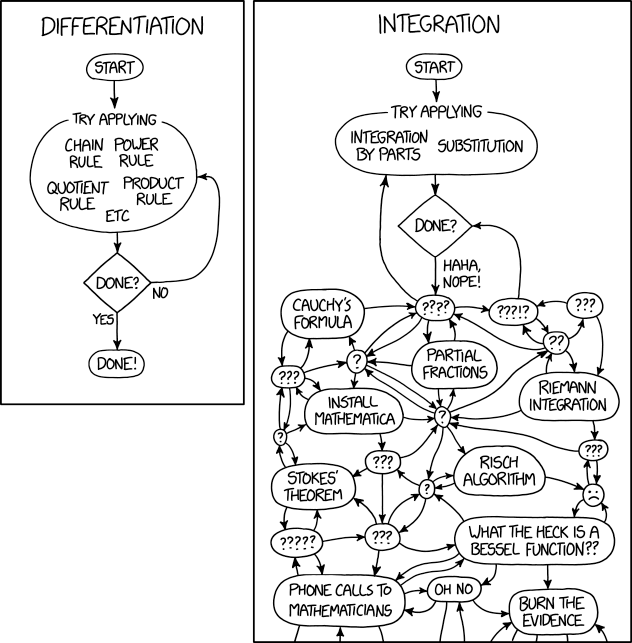
The Truth About Calculus


Alt Text: "Symbolic Integration" is when you theatrically go through the motions of finding integrals, but the actual result you get doesn't matter because it's purely symbolic."

("Symbolic integration" actually means solving an integral analytically in a general indefinite integral form, rather than numerically.)
A procedure called the Risch algorithm exists which is capable of determining whether the integral of an elementary function (function built from a finite number of exponentials, logarithms, constants, and nth roots through composition and combinations using the four elementary operations) is elementary and returning it if it is. In its original form, Risch algorithm was not suitable for a direct implementation, and its complete implementation took a long time. It was first implemented in Reduce in the case of purely transcendental functions; the case of purely algebraic functions was solved and implemented in Reduce by James H. Davenport; the general case was solved and implemented in Axiom by Manuel Bronstein. 
However, the Risch algorithm applies only to indefinite integrals and most of the integrals of interest to physicists, theoretical chemists and engineers, are definite integrals often related to Laplace transforms, Fourier transforms and Mellin transforms. Lacking of a general algorithm, the developers of computer algebra systems, have implemented heuristics based on pattern-matching and the exploitation of special functions, in particular the incomplete gamma function.[1] Although this approach is heuristic rather than algorithmic, it is nonetheless an effective method for solving many definite integrals encountered by practical engineering applications. Earlier systems such as Macsyma had a few definite integrals related to special functions within a look-up table. However this particular method, involving differentiation of special functions with respect to its parameters, variable transformation, pattern matching and other manipulations, was pioneered by developers of the Maple[2] system then later emulated by Mathematica, Axiom, MuPAD and other systems.
The fact that a function in calculus and its inverse are profoundly different in difficulty is very non-intuitive but is definitely true. The assumption that they should be similar in difficulty is similar to the faulty reasoning behind "naturalness" as a hypothesis generator and evaluator in physics.

The "alt text" while seemingly just tongue in cheek word play actually hints at a deeper truth as well. While "symbolic integration" doesn't mean what the alt text says that it does, it isn't actually uncommon in theoretical physics to have a paper that calculates something as a proof of concept or a demonstration of a method when the actual result of the calculation doesn't matter.

FYI: This blog is currently one post short of its 3% humor quota.

Tuesday, February 26, 2019

Sean Carroll On Cosmology

  1. The Big Bang model is simply the idea that our universe expanded and cooled from a hot, dense, earlier state. We have overwhelming evidence that it is true.
  2. The Big Bang event is not a point in space, but a moment in time: a singularity of infinite density and curvature. It is completely hypothetical, and probably not even strictly true. (It’s a classical prediction, ignoring quantum mechanics.)
  3. People sometimes also use “the Big Bang” as shorthand for “the hot, dense state approximately 14 billion years ago.” I do that all the time. That’s fine, as long as it’s clear what you’re referring to.
  4. The Big Bang might have been the beginning of the universe. Or it might not have been; there could have been space and time before the Big Bang. We don’t really know.
  5. Even if the BB was the beginning, the universe didn’t “pop into existence.” You can’t “pop” before time itself exists. It’s better to simply say “the Big Bang was the first moment of time.” (If it was, which we don’t know for sure.)
  6. The Borde-Guth-Vilenkin theorem says that, under some assumptions, spacetime had a singularity in the past. But it only refers to classical spacetime, so says nothing definitive about the real world.
  7. The universe did not come into existence “because the quantum vacuum is unstable.” It’s not clear that this particular “Why?” question has any answer, but that’s not it.
  8. If the universe did have an earliest moment, it doesn’t violate conservation of energy. When you take gravity into account, the total energy of any closed universe is exactly zero.
  9. The energy of non-gravitational “stuff” (particles, fields, etc.) is not conserved as the universe expands. You can try to balance the books by including gravity, but it’s not straightforward.
  10. The universe isn’t expanding “into” anything, as far as we know. General relativity describes the intrinsic geometry of spacetime, which can get bigger without anything outside.
  11. Inflation, the idea that the universe underwent super-accelerated expansion at early times, may or may not be correct; we don’t know. I’d give it a 50% chance, lower than many cosmologists but higher than some.
  12. The early universe had a low entropy. It looks like a thermal gas, but that’s only high-entropy if we ignore gravity. A truly high-entropy Big Bang would have been extremely lumpy, not smooth.
  13. Dark matter exists. Anisotropies in the cosmic microwave background establish beyond reasonable doubt the existence of a gravitational pull in a direction other than where ordinary matter is located.
  14. We haven’t directly detected dark matter yet, but most of our efforts have been focused on Weakly Interacting Massive Particles. There are many other candidates we don’t yet have the technology to look for. Patience.
  15. Dark energy may not exist; it’s conceivable that the acceleration of the universe is caused by modified gravity instead. But the dark-energy idea is simpler and a more natural fit to the data.
  16. Dark energy is not a new force; it’s a new substance. The force causing the universe to accelerate is gravity.
  17. We have a perfectly good, and likely correct, idea of what dark energy might be: vacuum energy, a.k.a. the cosmological constant. An energy inherent in space itself. But we’re not sure.
  18. We don’t know why the vacuum energy is much smaller than naive estimates would predict. That’s a real puzzle.
  19. Neither dark matter nor dark energy are anything like the nineteenth-century idea of the aether.
From Sean Carroll's blog (a January 12, 2019 post).

He is mostly, but not entirely, correct. I have put what I agree with in bold, and what I think is wrong or overstated in strikeout, and that visually makes clear the extent to which I do and do not agree with his 19 statements about cosmology.

I agree with 1-12, 14, and 18.

I disagree with 13 ("Dark matter exists. Anisotropies in the cosmic microwave background establish beyond reasonable doubt the existence of a gravitational pull in a direction other than where ordinary matter is located."). Dark matter phenomena definitely exist and require "new physics" to explain, but the interpretation he gives to the CMB is more model dependent than he acknowledges. There are, however, at most, 50-50 odds that it is caused by dark matter particles rather than gravity modification or something similar. Also, many of the more viable dark matter particle theories require a fifth force or gravity modification in addition to dark matter particles. Personally, I think that an explanation predominantly from gravity modification (including subtle refinements of GR in either a classical or quantum gravity mode) is more likely than not to be correct.

The first sentence of 15 ("Dark energy may not exist; it’s conceivable that the acceleration of the universe is caused by modified gravity instead.") is true. The second ("But the dark-energy idea is simpler and a more natural fit to the data.") is not. 

I disagree with 16 ("Dark energy is not a new force; it’s a new substance. The force causing the universe to accelerate is gravity."). This is a possibility, but not anything approaching a certainty. Indeed 16 is internally inconsistent with 15.

The last sentence of 17 ("But we’re not sure.") is true. The first two sentences of 17 ("We have a perfectly good, and likely correct, idea of what dark energy might be: vacuum energy, a.k.a. the cosmological constant. An energy inherent in space itself.") are mostly true except for the "likely correct" part.

19 is mostly true, but "anything like" in 19 is susceptible to different interpretations and if you standard for similarity is low, it isn't true, so it slightly overstates this proposition.