Friday, March 19, 2021

Muon g-2 Experiment To Report Results On April 7, 2021

The most anticipated physics experiment result since the announcement of the discovery of the Higgs boson in 2012 will be made on April 7, 2021 at 9 AM Mountain Daylight Time. A Zoom link to the announcement will be available soon.

Previous unofficial announcements had pointed towards a December 2020 release, then to a February 2021 release and then to a late March 2021 release date.

The first results from the Muon g-2 experiment at Fermilab will be unveiled and discussed in a special seminar to be held Wednesday, April 7, 2021, at 10:00 AM US Central Time. 
The Muon g-2 experiment searches for telltale signs of new particles and forces by examining the muon’s interaction with a surrounding magnetic field. By precisely determining the magnetic moment of the muon and comparing with similarly exact theoretical predictions, the experiment is sensitive to new physics lurking in the subatomic quantum fluctuations surrounding the muon. A previous experiment performed two decades ago at Brookhaven National Laboratory revealed an intriguing hint of such physics. The highly anticipated result from Fermilab pushes the precision of the experiment into uncharted territory in the quest to confirm or refute that finding. 
The experimental result will be presented by Chris Polly, Fermilab physicist and co-spokesperson for the Muon g-2 scientific collaboration, following a summary of the current theoretical status given by Aida El-Khadra, a UIUC theoretical physicist and co-chair of the Muon g-2 Theory Initiative.
Seminar agenda:
10:00 – 10:05 Introduction 
10:05 – 10:20 Theory overview — Aida El-Khadra, UIUC theoretical physicist
10:20 – 11:00 Muon g-2 results — Chris Polly, Fermilab experimental physicist 
11:00 – 11:20 Question & Answer

From here.

As I explained in a previous post:

The biggest one that is that there will be two new muon g-2 measurements, the last of which was fifteen years ago and the next of which will be announced early this year. The new measurement (and the new theoretical prediction) will be much more accurate than the last, in which the measurement which differed by about three sigma (about 2 parts per million) from the theoretically expected value. The calculation of muon g-2 is sensitive in a global way to almost all aspects of Standard Model physics and can be calculated and measured with extreme precision. The closer that the experimentally measured value of muon g-2 is, the less room there is for new physics beyond the Standard Model. On the other hand, big differences would be strong evidence that scientists are missing something in the Standard Model.

See also here where I explained that:

One of the most important discrepancies between theory and experiment in the Standard Model is the muon g-2 anomaly, a roughly 3 sigma tension. The last precision measurement of muon g-2 was done by the E821 Muon g-2 Experiment at Brookhaven National Laboratory which finished collecting data in 2001 and issued its final report analyzing that data in 2006.

Two more experiments are underway to make a new more precise measurement. The first to produce results will be the E989 Muon g-2 Experiment at Fermilab which is projected to obtain ∼20 times more data and a ∼3-fold reduction of systematic errors compared to E821. The relative error in the new measurement of muon g-2 at E989 will be about 150 parts per billion and will make the experimental error smaller than the uncertainty in theoretical prediction.

Thursday, March 18, 2021

2110 Years Of Wet and Dry Spells in Europe And Beyond

2110 Years Of Climate History From Tree Rings

A new study uses tree rings to example European droughts and wet spells over the last 2110 years, showing that Europe's dry spell from 2015-2018 was a 2110+ year record drought. 
Over the 2,110-year period, the tree-ring isotope data showed there were very wet summers, such as 200, 720 and 1100 CE, and very dry summers, such as 40, 590, 950 and 1510 CE. Despite these "out of the ordinary years", the results show that for the past two millennia, Europe has been slowly getting drier. The samples from 2015-2018, however, show that drought conditions in recent summers far exceed anything in the 2,110 years.

The current record drought in Europe could be older. But the tree ring data doesn't go back further.

Older Paleoclimate Events
We know from other data that there was a major droughts or climate events in Europe ca. 1200 BCE (possibly linked to a volcanic eruption in Iceland that took place in 1159 BCE).

There were also droughts in Europe around 2200 BCE in Europe and the "Iron Age Cold Event" around 800 BCE, in events called Bond Events
The Iron Age Cold Epoch (also referred to as Iron Age climate pessimum or Iron Age neoglaciation) was a period of unusually cold climate in the North Atlantic region, lasting from about 900 BC to about 300 BC, with an especially cold wave in 450 BC during the expansion of ancient Greece. It was followed by the Roman Warm Period (250 BC – 400 AD).

From Wikipedia. 

Bond Events are also known at around 3900 BCE (following which the Sahara Desert reforms by 3500-3000 BCE and close to the beginning of the Bronze Age) and 6200 BCE.  

See generally, my March 2, 2014 post entitled "The Holocene Climate Events That Shaped Prehistory and Ancient History" at this blog, discussing the 8.2 kiloyear event, the 5.9 kiloyear event and the 4.1 kiloyear event, and possibly less severe event which helped to precipitate the historical events known as Bronze Age Collapse about 3.2 thousand years ago, while referencing other posts on the topic including more ancient climate data.

Other Notable Papers Referenced In This Paper

A few referenced paper in the study are also worth mentioning. Their abstracts and citations are as follows:
The second plague pandemic in medieval Europe started with the Black Death epidemic of 1347–1353 and killed millions of people over a time span of four centuries. It is commonly thought that after its initial introduction from Asia, the disease persisted in Europe in rodent reservoirs until it eventually disappeared. 
Here, we show that climate-driven outbreaks of Yersinia pestis in Asian rodent plague reservoirs are significantly associated with new waves of plague arriving into Europe through its maritime trade network with Asia. This association strongly suggests that the bacterium was continuously reimported into Europe during the second plague pandemic, and offers an alternative explanation to putative European rodent reservoirs for how the disease could have persisted in Europe for so long.
Schmid, B. V. et al. "Climate-driven introduction of the Black Death and successive plague reintroductions into Europe." Proc. Natl Acad. Sci. USA 112, 3020–3025 (2015).
Climate variations influenced the agricultural productivity, health risk, and conflict level of preindustrial societies. Discrimination between environmental and anthropogenic impacts on past civilizations, however, remains difficult because of the paucity of high-resolution paleoclimatic evidence. We present tree ring–based reconstructions of central European summer precipitation and temperature variability over the past 2500 years. Recent warming is unprecedented, but modern hydroclimatic variations may have at times been exceeded in magnitude and duration. Wet and warm summers occurred during periods of Roman and medieval prosperity. Increased climate variability from ~250 to 600 C.E. coincided with the demise of the western Roman Empire and the turmoil of the Migration Period. Such historical data may provide a basis for counteracting the recent political and fiscal reluctance to mitigate projected climate change.
Büntgen, U. et al., "2500 years of European climate variability and human susceptibility." 331 Science 578–582 (2011).
Climatic changes during the first half of the Common Era have been suggested to play a role in societal reorganizations in Europe and Asia. In particular, the sixth century coincides with rising and falling civilizations, pandemics, human migration and political turmoil. Our understanding of the magnitude and spatial extent as well as the possible causes and concurrences of climate change during this period is, however, still limited. 
Here we use tree-ring chronologies from the Russian Altai and European Alps to reconstruct summer temperatures over the past two millennia. We find an unprecedented, long-lasting and spatially synchronized cooling following a cluster of large volcanic eruptions in 536, 540 and 547 AD, which was probably sustained by ocean and sea-ice feedbacks, as well as a solar minimum. 
We thus identify the interval from 536 to about 660 AD as the Late Antique Little Ice Age. Spanning most of the Northern Hemisphere, we suggest that this cold phase be considered as an additional environmental factor contributing to the establishment of the Justinian plague, transformation of the eastern Roman Empire and collapse of the Sasanian Empire, movements out of the Asian steppe and Arabian Peninsula, spread of Slavic-speaking peoples and political upheavals in China.
The Mongol invasion of Eastern Europe and especially its sudden withdrawal from Hungary in 1242 CE, has generated much speculation and an array of controversial theories. None of them, however, considered multifaceted environmental drivers and the coupled analysis of historical reports and natural archives. Here we investigate annually resolved, absolutely dated and spatially explicit paleoclimatic evidence between 1230 and 1250 CE. Documentary sources and tree-ring chronologies reveal warm and dry summers from 1238–1241, followed by cold and wet conditions in early-1242. Marshy terrain across the Hungarian plain most likely reduced pastureland and decreased mobility, as well as the military effectiveness of the Mongol cavalry, while despoliation and depopulation ostensibly contributed to widespread famine. These circumstances arguably contributed to the determination of the Mongols to abandon Hungary and return to Russia. While overcoming deterministic and reductionist arguments, our ‘environmental hypothesis’ demonstrates the importance of minor climatic fluctuations on major historical events.
Büntgen, U. & Di Cosmo, N. "Climatic and environmental aspects of the Mongol withdrawal from Hungary in 1242 CE." Sci. Rep. 6, 25606 (2016) (open access).
The spatial context is critical when assessing present-day climate anomalies, attributing them to potential forcings and making statements regarding their frequency and severity in a long-term perspective. Recent international initiatives have expanded the number of high-quality proxy-records and developed new statistical reconstruction methods. These advances allow more rigorous regional past temperature reconstructions and, in turn, the possibility of evaluating climate models on policy-relevant, spatio-temporal scales. 
Here we provide a new proxy-based, annually-resolved, spatial reconstruction of the European summer (June–August) temperature fields back to 755 CE based on Bayesian hierarchical modelling (BHM), together with estimates of the European mean temperature variation since 138 BCE based on BHM and composite-plus-scaling (CPS). Our reconstructions compare well with independent instrumental and proxy-based temperature estimates, but suggest a larger amplitude in summer temperature variability than previously reported. Both CPS and BHM reconstructions indicate that the mean 20th century European summer temperature was not significantly different from some earlier centuries, including the 1st, 2nd, 8th and 10th centuries CE. The 1st century (in BHM also the 10th century) may even have been slightly warmer than the 20th century, but the difference is not statistically significant. Comparing each 50 yr period with the 1951–2000 period reveals a similar pattern. Recent summers, however, have been unusually warm in the context of the last two millennia and there are no 30 yr periods in either reconstruction that exceed the mean average European summer temperature of the last 3 decades (1986–2015 CE). A comparison with an ensemble of climate model simulations suggests that the reconstructed European summer temperature variability over the period 850–2000 CE reflects changes in both internal variability and external forcing on multi-decadal time-scales. For pan-European temperatures we find slightly better agreement between the reconstruction and the model simulations with high-end estimates for total solar irradiance. Temperature differences between the medieval period, the recent period and the Little Ice Age are larger in the reconstructions than the simulations. This may indicate inflated variability of the reconstructions, a lack of sensitivity and processes to changes in external forcing on the simulated European climate and/or an underestimation of internal variability on centennial and longer time scales.
Luterbacher, J. et al. "European summer temperatures since Roman times." 11 Environ. Res. Lett. 024001 (2016).
A 5-year-resolution absolute-dated oxygen isotope record from Dongge Cave, southern China, provides a continuous history of the Asian monsoon over the past 9000 years. Although the record broadly follows summer insolation, it is punctuated by eight weak monsoon events lasting ∼1 to 5 centuries. One correlates with the “8200-year” event, another with the collapse of the Chinese Neolithic culture, and most with North Atlantic ice-rafting events. Cross-correlation of the decadal- to centennial-scale monsoon record with the atmospheric carbon-14 record shows that some, but not all, of the monsoon variability at these frequencies results from changes in solar output.
The lack of a precisely-dated, unequivocal climate proxy from northern China, where precipitation variability is traditionally considered as an East Asian summer monsoon (EASM) indicator, impedes our understanding of the behaviour and dynamics of the EASM. 
Here we present a well-dated, pollen-based, ~20-yr-resolution quantitative precipitation reconstruction (derived using a transfer function) from an alpine lake in North China, which provides for the first time a direct record of EASM evolution since 14.7 ka (ka = thousands of years before present, where the “present” is defined as the year AD 1950). 
Our record reveals a gradually intensifying monsoon from 14.7–7.0 ka, a maximum monsoon (30% higher precipitation than present) from ~7.8–5.3 ka and a rapid decline since ~3.3 ka. These insolation-driven EASM trends were punctuated by two millennial-scale weakening events which occurred synchronously to the cold Younger Dryas and at ~9.5–8.5 ka and by two centennial-scale intervals of enhanced (weakened) monsoon during the Medieval Warm Period (Little Ice Age). Our precipitation reconstruction, consistent with temperature changes but quite different from the prevailing view of EASM evolution, points to strong internal feedback processes driving the EASM and may aid our understanding of future monsoon behaviour under ongoing anthropogenic climate change.
Chen, F. et al. "East Asian summer monsoon precipitation variability since the last deglaciation." 5 Sci. Rep. 11186 (2015) (open access).
Oxygen isotope records from Chinese caves characterize changes in both the Asian monsoon and global climate. Here, using our new speleothem data, we extend the Chinese record to cover the full uranium/thorium dating range, that is, the past 640,000 years. The record’s length and temporal precision allow us to test the idea that insolation changes caused by the Earth’s precession drove the terminations of each of the last seven ice ages as well as the millennia-long intervals of reduced monsoon rainfall associated with each of the terminations. On the basis of our record’s timing, the terminations are separated by four or five precession cycles, supporting the idea that the ‘100,000-year’ ice age cycle is an average of discrete numbers of precession cycles. Furthermore, the suborbital component of monsoon rainfall variability exhibits power in both the precession and obliquity bands, and is nearly in anti-phase with summer boreal insolation. These observations indicate that insolation, in part, sets the pace of the occurrence of millennial-scale events, including those associated with terminations and ‘unfinished terminations’.
Cheng, H. et al. "The Asian monsoon over the past 640,000 years and ice age terminations." 534 Nature 640–646 (2016).
The latitudinal temperature gradient between the Equator and the poles influences atmospheric stability, the strength of the jet stream and extratropical cyclones. 
Recent global warming is weakening the annual surface gradient in the Northern Hemisphere by preferentially warming the high latitudes; however, the implications of these changes for mid-latitude climate remain uncertain. Here we show that a weaker latitudinal temperature gradient—that is, warming of the Arctic with respect to the Equator—during the early to middle part of the Holocene coincided with substantial decreases in mid-latitude net precipitation (precipitation minus evapotranspiration, at 30° N to 50° N). 
We quantify the evolution of the gradient and of mid-latitude moisture both in a new compilation of Holocene palaeoclimate records spanning from 10° S to 90° N and in an ensemble of mid-Holocene climate model simulations. The observed pattern is consistent with the hypothesis that a weaker temperature gradient led to weaker mid-latitude westerly flow, weaker cyclones and decreased net terrestrial mid-latitude precipitation. 
Currently, the northern high latitudes are warming at rates nearly double the global average, decreasing the Equator-to-pole temperature gradient to values comparable with those in the early to middle Holocene. If the patterns observed during the Holocene hold for current anthropogenically forced warming, the weaker latitudinal temperature gradient will lead to considerable reductions in mid-latitude water resources.
The injection of sulfur into the stratosphere by explosive volcanic eruptions is the cause of significant climate variability. Based on sulfate records from a suite of ice cores from Greenland and Antarctica, the eVolv2k database includes estimates of the magnitudes and approximate source latitudes of major volcanic stratospheric sulfur injection (VSSI) events from 500 BCE to 1900 CE, constituting an update of prior reconstructions and an extension of the record by 1000 years. 
The database incorporates improvements to the ice core records (in terms of synchronisation and dating) and refinements to the methods used to estimate VSSI from ice core records, and it includes first estimates of the random uncertainties in VSSI values. 
VSSI estimates for many of the largest eruptions, including Samalas (1257), Tambora (1815), and Laki (1783), are within 10 % of prior estimates. 
A number of strong events are included in eVolv2k which are largely underestimated or not included in earlier VSSI reconstructions, including events in 540, 574, 682, and 1108 CE. 
The long-term annual mean VSSI from major volcanic eruptions is estimated to be  ∼ 0.5 Tg [S] yr−1,  ∼ 50 % greater than a prior reconstruction due to the identification of more events and an increase in the magnitude of many intermediate events. A long-term latitudinally and monthly resolved stratospheric aerosol optical depth (SAOD) time series is reconstructed from the eVolv2k VSSI estimates, and the resulting global mean SAOD is found to be similar (within 33 %) to a prior reconstruction for most of the largest eruptions. The long-term (500 BCE–1900 CE) average global mean SAOD estimated from the eVolv2k VSSI estimates including a constant background injection of stratospheric sulfur is  ∼ 0.014, 30 % greater than a prior reconstruction. 
These new long-term reconstructions of past VSSI and SAOD variability give context to recent volcanic forcing, suggesting that the 20th century was a period of somewhat weaker than average volcanic forcing, with current best estimates of 20th century mean VSSI and SAOD values being 25 and 14 % less, respectively, than the mean of the 500 BCE to 1900 CE period. The reconstructed VSSI and SAOD data are available at https://doi.org/10.1594/WDCC/eVolv2k_v2.
Toohey, M. & Sigl, M. "Volcanic stratospheric sulfur injections and aerosol optical depth from 500 BCE to 1900 CE." 9 Earth Syst. Sci. Data 809–831 (2017).

Wednesday, March 17, 2021

FARSIDE

NASA is investigating building a radio telescope on the far side of the moon which would allow us to see very faint signals that background noise from the Earth and the Sun make impossible to discern now. For the money, it would probably be a better way to advance our understanding of fundamental physics than a new next generation particle collider.

The current state of the art is EDGES which has revealed that primordial radio wave backgrounds from around 228 million years after the Big Bang (redshift z=17) contradict the LambdaCDM prediction.

The 21cm EDGES result is one of the most striking failures of the "Standard Model of Cosmology" at the cosmology scale, in addition to its many problems at a "large scale structure" galaxy scale.  A few other cosmology scale problems with LambdaCDM are the "impossible early galaxy" problem, the Hubble tension, and deviations from the cosmological principle.

Modified gravity theories can resolve all of these cosmology issues and reproduce the Cosmic Microwave Background (CMB) peaks used as Exhibit 1 as evidence in favor of LambdaCDM, as well as its many large scale structure issues. 

The new instrument would be able to view primordial radio wave backgrounds from around 6 million years after the Big Bang (z=200).

An array of low-frequency dipole antennas on the lunar farside surface will probe a unique, unexplored epoch in the early Universe called the Dark Ages. It begins at Recombination when neutral hydrogen atoms formed, first revealed by the cosmic microwave background. This epoch is free of stars and astrophysics, so it is ideal to investigate high energy particle processes including dark matter, early Dark Energy, neutrinos, and cosmic strings. 
A NASA-funded study investigated the design of the instrument and the deployment strategy from a lander of 128 pairs of antenna dipoles across a 10 km x 10 km area on the lunar surface. The antenna nodes are tethered to the lander for central data processing, power, and data transmission to a relay satellite. The array, named FARSIDE, would provide the capability to image the entire sky in 1400 channels spanning frequencies from 100 kHz to 40 MHz, extending down two orders of magnitude below bands accessible to ground-based radio astronomy. 
The lunar farside can simultaneously provide isolation from terrestrial radio frequency interference, the Earth's auroral kilometric radiation, and plasma noise from the solar wind. It is thus the only location within the inner solar system from which sky noise limited observations can be carried out at sub-MHz frequencies. Through precision calibration via an orbiting beacon and exquisite foreground characterization, the farside array would measure the Dark Ages global 21-cm signal at redshifts z~35-200. It will also be a pathfinder for a larger 21-cm power spectrum instrument by carefully measuring the foreground with high dynamic range.
Jack Burns, et al., "A Lunar Farside Low Radio Frequency Array for Dark Ages 21-cm Cosmology" arXiv:2103.08623 (March 15, 2021) (response to DOE request for information on lunar farside radio telescope to explore the early universe).

Progress In Measuring The Electromagnetic Coupling Constant

This is probably the most precise measurement of a physical constant ever made in human history, down to 81 parts per trillion. In decimal form, this dimensionless constant has an experimentally measured value of 0.007297512320348. 

Troublingly, however, the abstract of the paper notes that: "Our value of the fine-structure constant differs by more than 5 standard deviations from the best available result from caesium recoil measurements." All other measurements of this constant mentioned in the paper are consistent with both of the divergent measurements at the two sigma (two standard deviation) level. This means that one or the other high precision measurements is almost certainly understates its actual margin of error (which has more than a dozen subcomponents). The magnitude of the discrepancy, which is a little more than one part per billion, is still modest, however, when not normalized to the estimated margins of error of the respective measurements. If the actual margins of error were understated by a bit more than a factor of two and a half, the results would be consistent with each other.

Researchers at the Kastler Brossel Laboratory in Paris have made the most precise measurement of one of the fundamental constants, called the fine-structure constant, providing physicists with a vital tool to verify the consistency of their most cherished theoretical models.
The fine-structure constant determines the strength of the electromagnetic force, and is central in explaining a number of phenomena including the interactions between light and charged elementary particles such as electrons. It is an important part of the equations of the Standard Model, a theory that predicts and describes all the known fundamental forces other than gravity—namely electromagnetism as well as the weak and strong nuclear forces. The team in Paris measured the value of the fine-structure constant as 1/137.035999206(11), to an accuracy of 11 digits. The result appears in a study published in Nature.

From here (on December 16, 202).

Reconstructing The First Mechanical Computer

The Antikythera Mechanism is an ancient Greek machine that used metal gears to generate astronomy predictions from a massive accumulated data set of naked eye observations of the Sun, the Moon, the planets and stars, fitted to an imperfect model to explain them. As Wikipedia explains:

The Antikythera mechanism (/ˌæntɪkɪˈθɪərə/ AN-tih-kih-THEER-ə) is an ancient Greek hand-powered orrery, described as the first analogue computer, the oldest known example of such a device used to predict astronomical positions and eclipses for calendar and astrological purposes decades in advance. It could also be used to track the four-year cycle of athletic games which was similar to an Olympiad, the cycle of the ancient Olympic Games.

This artefact was retrieved from the sea in 1901, and identified on 17 May 1902 as containing a gear by archaeologist Valerios Stais, among wreckage retrieved from a shipwreck off the coast of the Greek island Antikythera. The instrument is believed to have been designed and constructed by Greek scientists and has been variously dated to about 87 BC, or between 150 and 100 BC, or to 205 BC, or to within a generation before the shipwreck, which has been dated to approximately 70–60 BC.

The device, housed in the remains of a 34 cm × 18 cm × 9 cm (13.4 in × 7.1 in × 3.5 in) wooden box, was found as one lump, later separated into three main fragments which are now divided into 82 separate fragments after conservation efforts. Four of these fragments contain gears, while inscriptions are found on many others. The largest gear is approximately 13 centimetres (5.1 in) in diameter and originally had 223 teeth.

It is a complex clockwork mechanism composed of at least 30 meshing bronze gears. In 2008, a team led by Mike Edmunds and Tony Freeth at Cardiff University used modern computer x-ray tomography and high resolution surface scanning to image inside fragments of the crust-encased Mechanism and read the faintest inscriptions that once covered the outer casing of the machine.

Detailed imaging of the mechanism suggests that it had 37 gear wheels enabling it to follow the movements of the Moon and the Sun through the zodiac, to predict eclipses and to model the irregular orbit of the Moon, where the Moon's velocity is higher in its perigee than in its apogee. This motion was studied in the 2nd century BC by astronomer Hipparchus of Rhodes, and it is speculated that he may have been consulted in the machine's construction.

The knowledge of this technology was lost at some point in antiquity. Similar technological works later appeared in the medieval Byzantine and Islamic worlds, but works with similar complexity did not appear again until the development of mechanical astronomical clocks in Europe in the fourteenth century. All known fragments of the Antikythera mechanism are now kept at the National Archaeological Museum in Athens, along with a number of artistic reconstructions and replicas of the mechanism to demonstrate how it may have looked and worked.

Using incomplete fragments of it, written accounts, and related interdisciplinary inputs like knowledge of ancient astronomy and mathematics and metal working, scientists and scholars have recreated a design which is pretty much the only possible solution that can fit the available data about the complete design of it.

Many previous attempts since 1906 have failed attempting to do the same thing.


The Antikythera Mechanism is a cultural treasure that has engrossed scholars across many disciplines. It was a mechanical computer of bronze gears that used ground-breaking technology to make astronomical predictions, by mechanizing astronomical cycles and theories. 
. . .

We wanted to determine the cycles for all the planets in this Cosmos (not just the cycles discovered for Venus and Saturn); to incorporate these cycles into highly compact mechanisms, conforming to the physical evidence; and to interleave them so their outputs correspond to the customary cosmological order (CCO), described below. Here we show how we have created gearing and a display that respects the inscriptional evidence: a ring system with nine outputs—Moon, Nodes, Mercury, Venus, Sun, Mars, Jupiter, Saturn and Date—carried by nested tubes with arms supporting the rings. The result is a radical new model that matches all the data and culminates in an elegant display of the ancient Greek Cosmos. With so much missing, we ensure the integrity of our model with a strict set of Reconstruction Principles and we assess the strength of data that validates each element. The loss of evidence might suggest many options for a model. What has struck us forcefully in making the present model is just how few these options are: the constraints created by the surviving evidence are stringent and very difficult to meet. 
. . .

Figure 7, Supplementary Figs. S24, S25, Supplementary Videos S1S3 visualize our new model: the culmination of a substantial cross-disciplinary effort to elucidate the front of the Antikythera Mechanism. 
Previous research unlocked the ingenuity of the Back Dials, here we show the richness of the Cosmos at the front. The main structural features of our model are prescribed by the physical evidence, the prime factors of the restored planetary period relations and the ring description in the BCI. Hypothetical features greatly enhance and justify the Cosmos display: a Dragon Hand thematically linking the Front and Back Dials; and an Index Letter Scheme for the synodic events of the planets.

Because of the loss of evidence, we cannot claim that our model is a replica of the original, but our solution to this convoluted 3D puzzle draws powerful support from the logic of our model and its exact match to the surviving evidence. 
The Antikythera Mechanism was a computational instrument for mathematical astronomy, incorporating cycles from Babylonian astronomy and the Greek flair for geometry. It calculated the ecliptic longitudes of the Moon, Sun and planets; the phase of the Moon; the Age of the Moon; the synodic phases of the planets; the excluded days of the Metonic Calendar; eclipses—possibilities, times, characteristics, years and seasons; the heliacal risings and settings of prominent stars and constellations; and the Olympiad cycle—an ancient Greek astronomical compendium of staggering ambition. 
It is the first known device that mechanized the predictions of scientific theories and it could have automated many of the calculations needed for its own design —the first steps to the mechanization of mathematics and science. Our work reveals the Antikythera Mechanism as a beautiful conception, translated by superb engineering into a device of genius.

From here

Monday, March 15, 2021

Why Are Anatolian and Tocharian Languages The Most Divergent Indo-European Languages?

It is widely agreed that Anatolian and Tocharian are the most divergent Indo-European languages and the conventional view is to attribute this to a greater time depth of divergence from Proto-Indo-European.

The divergences are, in my humble opinion, not primarily due to time depth. 

(Note that this post expands upon a comment to this post at Gene Expression).

General Considerations In Historical Linguistics and Language Evolution

The naive mutational variation accumulation over time model of language divergence greatly overestimates that importance of that component of language change, which is actually much slower, and ignores the central role played by language contact.  See, e.g., the overview here.

One example of that is Icelandic, which was until very recent times when telecommunications and air travel became available, the closest of the Germanic languages to Old Norse (which is basically proto-Germanic), mostly because it had less contact with other languages due to its isolation at the frontier. See, e.g., here,

Another example is that phonetically, the Appalachian accent is the closest modern dialect of English to the Elizabethan English of Shakespeare, again, due to low levels of contact with other dialects of English. 

Likewise, the New Zealand accent was until recently more conservative of 19th century British dialect than modern British English, while adopting some Maori substrate words for concepts it didn't have words for and being influenced by contact with the Australian dialect.

Low population sizes also reduce mutational change in all of these case.

Also, language divergence actually tends to be punctuated:
We used vocabulary data from three of the world's major language groups—Bantu, Indo-European, and Austronesian—to show that 10 to 33% of the overall vocabulary differences among these languages arose from rapid bursts of change associated with language-splitting events. Our findings identify a general tendency for increased rates of linguistic evolution in fledgling languages, perhaps arising from a linguistic founder effect or a desire to establish a distinct social identity.
The divergence between Old English and Middle English, for example, is largely due to the singular impact of French Norman influence on the language after the Norman Conquest of England, in the common case of language change due to emulation of elite dialects (one of the most common sources of homogenization of language in a region). 

Language replacement scenarios also usually involve strong substrate influences (e.g. the quirks of the South Asian dialects of English) especially for words with no superstrate language counterpart like local botany words. 

It is also often the case that simplifications of language structure due to mass language learner effects. But see this paper reviewing this hypothesis critically.

The differences in American English from British English, in contrast, reflect another common punctuated influence, where a community of people deliberately exaggerate local dialect differences in order to create shibboleths that expose outsiders and to distinguish themselves culturally from a community that they are alienated from.

Language contact usually has mostly lexical impact (i.e. loan words), but also can give rise to other areal and contact language features (like the sentence closing term “lah” in Malaysian and Singaporian dialects derived from Arabic traders), and sometimes place names (e.g. Punic place names in Britain and Ireland).

Distinct Indo-European Substrates

The other key point is that in almost all of the Indo-European language family’s European ranges, hunter-gatherer languages were extinct or all but extinct, and the substrate first farmer languages shared a descent from the language family of Western Anatolian farmers (probably in two main subfamilies, one for Linear Pottery Farmers in the Danubian basis and point north, and the other for the Cardial Pottery Farmers of the Mediterranean coast). See also here and here.

As societies lacking metal and horses, these Neolithic first farmers of Europe also had fairly low population density (even though it was 100x that of terrestrial hunter-gatherers), so due to low population density and frontier status, the amount of divergence between the first European Neolithic farmers and the struggling farmer societies a couple of thousand years later when Indo-Europeans filled a vacuum was probably modest.

This shared substrate over so many Indo-European subfamilies no doubt hides the extent of Anatolian Neolithic language family substrate influence in them. See, e.g., here (reviewing Bronze Age outlines of Indo-European expansion in Europe). But not all Indo-European language families shared this substrate.

Why Are Tocharian Languages Divergent?

Tocharian is divergent because it is the purest of the descendants of Indo-European, because they had virtually no substrate influence or language contact, were on a frontier, and weren’t a particularly large language community despite fairly high population density, because it was geographically constrained to a handful of towns, rather than being divergent due to its great antiquity. 

Notably, J.P. Mallory, one of the leading Tocharian scholars, came around in about 2012 to the view that the Tarim basin civilization isn’t all that old, based upon archaeological evidence stating:
[T]here is really no serious evidence for arable agriculture (domestic cereals) east of the Dnieper until after c. 2000 BCE (see also Ryabogina & Ivanov 2011; Mallory, in press:a). This means that there is also no evidence for domestic cereals in the Asiatic steppe until the Late Bronze Age (Andronovo etc). From the perspective of the Pontic-Caspian model, the ancestors of the Indo-Iranians and Tokharians should not cross the Ural before c. 2000 BCE at the very earliest. Hypotheses linking the Tokharians to earlier eastward steppe expansions associated with the Afaasievo or Okunevo cultures of the Yenisei or Altai (Mallory and Mair 2000) become very difficult if not impossible to sustain (as long as there is no evidence of arable agriculture in these cultures) as Tokharian retains elements of the Indo-European agricultural vocabulary.
– J. P. Mallory, “Twenty-first century clouds over Indo-European homelands” (Conference Presentation in Moscow, September 12, 2012).

Mallory made the case in a 2011 talk that R1b was a Tocharian genetic signature based upon West Eurasian Y-DNA haplogroups found in Uyghur populations that were direct successors to and brought about the fall of the Tocharians during a period of Turkic expansion. There is also R1b in Iron Age ancient DNA east of the Tarim basin from what appears to be a related West Eurasian culture. But, ancient Tarim mummy DNA from ca. 1800 BCE, analyzed in 2009 showed uniformly R1a1a Y-DNA haplogroups (citing Li, Chunxiang, et al., “Evidence that a West-East admixed population lived in the Tarim Basin as early as the early Bronze Age” BMC Biology (February 17, 2010)).

Not exactly on point but relevant is that Tocharian cemeteries contained ephedra, a commonly hypothesized botanical extra drug to be the active ingredient in Indo-Iranian Soma/Homa. Tocharian culture also has primitive antecedents of physical culture attributes (e.g. basic Tartan weaves) typically associated with Celtic culture.

The Case For A Young Origin For Anatolian Languages

In the case of the Anatolian languages, in contrast, strong contact with a highly divergent substrate from the Anatolian Farmer substrate of Europe is what explains its divergence.

In the early metal ages, the Hattic language and civilization (probably derived from metal using civilizations of the Caucasus mountains and Zargos mountains in a language family that may have also included Hurrian and is probably modest strongly related to one or more of the modern Caucasian languages), spread across Anatolia replacing the Anatolian farmer language. There is suggestive evidence that the Minoan language was also from the same language family (e.g. the phonetic structure of the two languages, recorded in the Minoan case by Eto-Cretian inscriptions and Egyptian phonetic records of Minoan incantations).

Documentary and archaeological evidence, however, suggest that the Hittites occupied only a few towns in a sea of Hattic people ca. 1800 BCE, before their dramatic expansion, roughly contemporaneous with the appearance and expansion of the Mycenaean Greeks (the first Aegean people to speak Indo-European languages), and while there are many Anatolian languages attested, all but a couple have the relationship of the Romance language to Latin with Hittite, and the couple of earlier ones are not attested significantly earlier than the Hittite language. Iron use and cremation were important litmus tests of Anatolian Indo-Europeans that are corroborated with documentary evidence and archaeological evidence in the post-1800 BCE time period. I review some of that evidence here. See also here.

It also isn’t clear how much of the Anatolian languages were elite imitation driven (compare Hungarian ca. 1000 CE which results in language shift without much demic impact), and how much was due to population replacement/introgression. 

The frequency of R1b in modern Anatolian samples suggests a significant demic component, but is complicated by the multilayered palimpsest of periods in Anatolian history and prehistory including Hellenic sourced migration into Anatolia, and a period of Iranian steppe migration into the Levant, at least partially through Anatolia (See also here).

So, how do the Anatolian languages grow so divergent?

The grow divergent because the Hattic substrate in which they were immersed (to the extent that it influenced their choice of proper names and that Hattic remained a liturgical language in the Hittite empire centuries after it ceased to be used in daily life, like liturgical relicts of ancient Hebrew, ancient Latin, ancient Sumerian, and Coptic), was profoundly different from that of the Anatolian Neolithic farmer substrate in Europe or the Harappan substrate in Sanskrit (which may be shared by all Indo-Iranian languages, as BMAC was in the Harappan sphere of influence and both Harappan and BMAC languages may be derived at great time depth from the Caucasian Neolithic first farmer substrate). 

Copper age/early Bronze Age Hattic culture and language (like Copper Age/early Bronze Age Harappan culture) also had more staying power and influence than stone age European Neolithic culture because more advanced civilizations had more populations density and couldn’t just be trampled into oblivion by Indo-European successors. 

My suspicion is that pre-Indo-European conquest acquisition of metallurgy also was important in allowing Basque and related Vasconic languages to survive Indo-European obliteration. (See also here and here and here and here and here).

We don’t have enough Hittite, other Anatolian language speaker, and Hattic ancient DNA to confirm an appearance of steppe ancestry around 1800 BCE and its absence before then in Anatolia, but we also have no ancient or modern DNA evidence that isn’t a good fit to that hypothesis.

A Footnote On Armenian 

In the same vein, Armenian is hard to classify because it has mixed influences for different neighboring Indo-European language families, with Greek influence competing, for example, with Slavic and Indo-Iranian language influence. Armenian is attested in writing only in the mid- to late Iron Age, so a whole stew of diverse Indo-European linguistic influences is hard to parse out.

Saturday, March 13, 2021

Massacres Aren't New

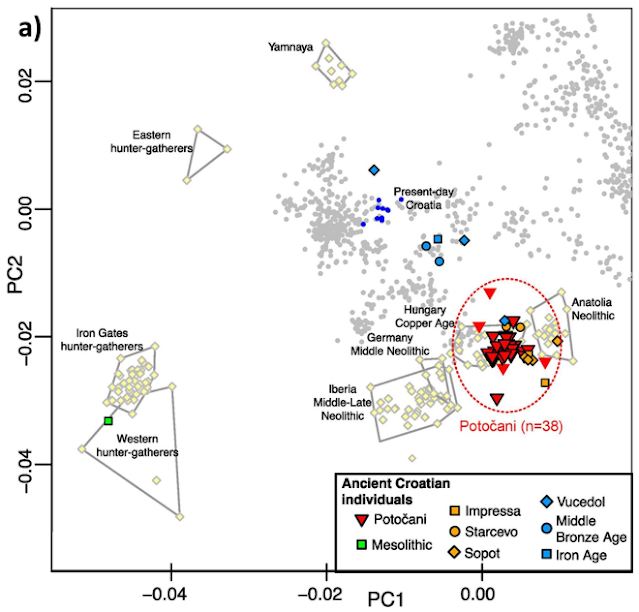
A new study of the remains of 38 people in a mass grave from 6200 years ago in Croatia provides evidence of the mass execution of the all or most of the residents of a small copper age farming villages who were predominantly descended from Anatolian Neolithic farmers. 

We don't know why it happened, but the fact that it did belies the myth that early farming civilizations were peaceful utopias.


Mario Novak and his colleagues have just published a paper entitled: Genome-wide analysis of nearly all the victims of a 6200 year old massacre. They sequenced the genome of 38 of the 41 individuals found in a mass grave 2m in diameter and 1m deep in Potočani, Croatia. 
. . .

Radiocarbon dating measurements showed that these skeletons date from 4200 BC. JC. corresponding to the Eneolithic (copper age) culture of Lasinja. Anthropological analyzes have shown that thirteen of these individuals (six children, three men and four women) presented with peri-mortem cranial injuries located on the side or back of the head which suggest a single summary execution event.

The genetic results indicate that all of these individuals show a very homogeneous ancestry. 
. . . 
On average, these individuals have 91% of farming ancestry from Anatolia and 9% of hunter-gatherer ancestry from the west. They have no ancestry at all from the pastoralists of the steppes. . . . These results are confirmed by the analysis of the haplogroups of the Y chromosome: G2, I2 and C-V20, and in particular the absence of the haplogroups R1a and R1b-M269. There are in particular six different paternal lineages. In addition, analysis of mitochondrial haplogroups identifies 30 different haplotypes suggesting a large community. . . . only eleven individuals present close relationships (up to the third degree), thus forming 4 families:

* a man, his two daughters and his nephew
* two sisters with a third cousin
* A father and his son
* a boy with his paternal aunt (or his half-sister)

This group of people does not therefore correspond to a single extended family because 70% of them have no family relationship. In addition, among all the individuals there are 20 female and 18 male. This massacre therefore does not correspond to the result of a battle but rather to the extermination of a village community made up of many different families.

Analysis of the homozygosity segments indicates that there is very little inbreeding among these individuals.
Via Bernard's blog (translated into English by Google).

Wednesday, March 10, 2021

Primordial Dark Hole Dark Matter Largely Ruled Out

Proposals for large dim objects such as brown dwarfs which are very dim from a detectable radiation perspective (called MACHOs), or dust or interstellar gas, made of ordinary matter, were ruled out as dark matter candidates long ago. So were ordinary neutrinos (called "hot dark matter").

There are some "out there" proposals that exotic electromagnetically neutral hadrons made of ordinary matter bound by the strong force (e.g. hexaquarks) could serve as dark matter if they were stable. But the strong circumstantial evidence that such hadrons are not stable (e.g., even a really heavy one would have a mass of less than 30 GeV or so and no evidence of stable heavy hadrons have been seen at the 14 TeV of the LHC),, and the lack of evidence of interactions with ordinary matter via the weak force in direct detection experiments also strongly disfavors this class of proposals at masses up to hundreds of GeVs.

Primordial black holes are the last significant proposal for dark matter particle candidates not requiring either particles beyond the Standard Model or gravitational effects beyond Newtonian gravity in the weak field (which is conventionally as a practical matter used to approximate weak field General Relativity in galaxy and galactic cluster and smaller scale cosmology settings by warm and cold dark matter cosmology theorists) to exist.

Small primordial black holes can be ruled out as dark matter candidates because they would decay due to Hawking Radiation too quickly for enough of them to survive to this point from the Big Bang to the current age of the Universe.

Large primordial black holes are ruled out by micro-lensing data and other means.

There is a window between those two constraints for asteroid sized primordial black holes to constitute dark matter, but the paper whose abstract appears below purports (convincingly) to close that gap.
The nature of dark matter (DM) is unknown. 
One compelling possibility is DM being composed of primordial black holes (PBHs), given the tight limits on some types of elementary particles as DM. There is only one remaining window of masses available for PBHs to constitute the entire DM density, 10^17 - 10^23 g. 
Here, we show that the kernel population in the cold Kuiper belt rules out this window, arguing in favor of a particle nature for DM.

Amir Sirajh, Abraham Loeb, "Eliminating the Remaining Window for Primordial Black Holes as Dark Matter from the Dynamics of the Cold Kuiper Belt" arXiv (March 8, 2021). 

To be clear, the paper doesn't rule out the possibility that primordial black holes (i.e. black holes initially formed by means other than the collapse of stars and subsequently by mergers of black holes with each other and by accreting other matter and energy on contact, in the time frame shortly after the Big Bang) exist at all. 

It merely rules out the hypothesis that primordial black holes are the exclusive or predominant part of the solution of explaining dark matter phenomena. Explanations other than that are needed to explain dark matter phenomena which are observed.

The Wikipedia article on Primordial Black Holes, linked above, provides additional recent constraints from the literature that bolster this conclusion:

Depending on the model, primordial black holes could have initial masses ranging from 10^−8 kg (the so-called Planck relics) to more than thousands of solar masses. However, primordial black holes originally having mass lower than 10^11 kg would not have survived to the present due to Hawking radiation, which causes complete evaporation in a time much shorter than the age of the Universe.  
Primordial black holes are non-baryonic and as such are plausible dark matter candidates. Primordial black holes are also good candidates for being the seeds of the supermassive black holes at the center of massive galaxies, as well as of intermediate-mass black holes.

Primordial black holes belong to the class of massive compact halo objects (MACHOs). They are naturally a good dark matter candidate: they are (nearly) collision-less and stable (if sufficiently massive), they have non-relativistic velocities, and they form very early in the history of the Universe (typically less than one second after the Big Bang). Nevertheless, tight limits on their abundance have been set up from various astrophysical and cosmological observations, so that it is now excluded that they contribute significantly to dark matter over most of the plausible mass range.

In March 2016, one month after the announcement of the detection by Advanced LIGO/VIRGO of gravitational waves emitted by the merging of two 30 solar mass black holes (about 6×10^31 kg), three groups of researchers proposed independently that the detected black holes had a primordial origin.[10][11][12][13]
Two of the groups found that the merging rates inferred by LIGO are consistent with a scenario in which all the dark matter is made of primordial black holes, if a non-negligible fraction of them are somehow clustered within halos such as faint dwarf galaxies or globular clusters, as expected by the standard theory of cosmic structure formation. The third group claimed that these merging rates are incompatible with an all-dark-matter scenario and that primordial black holes could only contribute to less than one percent of the total dark matter. The unexpected large mass of the black holes detected by LIGO has strongly revived interest in primordial black holes with masses in the range of 1 to 100 solar masses. It is however still debated whether this range is excluded or not by other observations, such as the absence of micro-lensing of stars, the cosmic microwave background anisotropies, the size of faint dwarf galaxies, and the absence of correlation between X-ray and radio sources towards the galactic center.

In May 2016, Alexander Kashlinsky suggested that the observed spatial correlations in the unresolved gamma-ray and X-ray background radiations could be due to primordial black holes with similar masses, if their abundance is comparable to that of dark matter.

In April 2019, a study was published suggesting this hypothesis may be a dead end. An international team of researchers has put a theory speculated by the late Stephen Hawking to its most rigorous test to date, and their results have ruled out the possibility that primordial black holes smaller than a tenth of a millimeter (7 × 10^22 kg) make up most of dark matter.[15][16]

In August 2019, a study was published opening up the possibility of making up all dark matter with asteroid-mass primordial black holes (3.5 × 10^−17 – 4 × 10^−12 solar masses, or 7.0 × 10^13 – 8 × 10^18 kg).[17]
<10> Bird, S.; Cholis, I. (2016). "Did LIGO Detect Dark Matter?". Physical Review Letters. 116 (20): 201301. arXiv:1603.00464. doi:10.1103/PhysRevLett.116.201301
<11> Clesse, S.; Garcia-Bellido, J. (2017). "The clustering of massive Primordial Black Holes as Dark Matter: Measuring their mass distribution with Advanced LIGO". Physics of the Dark Universe. 10 (2016): 142–147. arXiv:1603.05234.  doi:10.1016/j.dark.2016.10.002
<12> Sasaki, M.; Suyama, T.; Tanaki, T. (2016). "Primordial Black Hole Scenario for the Gravitational-Wave Event GW150914". Physical Review Letters. 117(6): 061101. arXiv:1603.08338. doi:10.1103/PhysRevLett.117.061101
<14> Kashlinsky, A. (2016). "LIGO gravitational wave detection, primordial black holes and the near-IR cosmic infrared background anisotropies". The Astrophysical Journal. 823 (2): L25. arXiv:1605.04023.  doi:10.3847/2041-8205/823/2/L25.
<15> "Dark matter is not made up of tiny black holes". ScienceDaily. 2 April 2019. Retrieved 27 September 2019.
<16> Niikura, H.; Takada, M.; Yasuda, N.; et al. (2019). "Microlensing constraints on primordial black holes with Subaru/HSC Andromeda observations". Nature Astronomy. 3 (6): 524–534. arXiv:1701.02151.  doi:10.1038/s41550-019-0723-1
<17> Montero-Camacho, Paulo; Fang, Xiao; Vasquez, Gabriel; Silva, Makana; Hirata, Christopher M. (2019-08-23). "Revisiting constraints on asteroid-mass primordial black holes as dark matter candidates". Journal of Cosmology and Astroparticle Physics. 2019 (8): 031. arXiv:1906.05950.  doi:10.1088/1475-7516/2019/08/031

The Wikipedia article goes on to note that: 

A variety of observations have been interpreted to place limits on the abundance and mass of primordial black holes: 
* Lifetime, Hawking radiation and gamma-rays: One way to detect primordial black holes, or to constrain their mass and abundance, is by their Hawking radiation. Stephen Hawking theorized in 1974 that large numbers of such smaller primordial black holes might exist in the Milky Way in our galaxy's halo region. All black holes are theorized to emit Hawking radiation at a rate inversely proportional to their mass. Since this emission further decreases their mass, black holes with very small mass would experience runaway evaporation, creating a burst of radiation at the final phase, equivalent to a hydrogen bomb yielding millions of megatons of explosive force.[21] 
A regular black hole (of about 3 solar masses) cannot lose all of its mass within the current age of the universe (they would take about 10^69 years to do so, even without any matter falling in). However, since primordial black holes are not formed by stellar core collapse, they may be of any size. A black hole with a mass of about 10^11 kg would have a lifetime about equal to the age of the universe. If such low-mass black holes were created in sufficient number in the Big Bang, we should be able to observe explosions by some of those that are relatively nearby in our own Milky Way galaxy. NASA's Fermi Gamma-ray Space Telescope satellite, launched in June 2008, was designed in part to search for such evaporating primordial black holes. Fermi data set up the limit that less than one percent of dark matter could be made of primordial black holes with masses up to 10^13 kg. Evaporating primordial black holes would have also had an impact on the Big Bang nucleosynthesis and change the abundances of light elements in the Universe. However, if theoretical Hawking radiation does not actually exist, such primordial black holes would be extremely difficult, if not impossible, to detect in space due to their small size and lack of large gravitational influence.

* Lensing of gamma-ray bursts: Compact objects can induce a change in the luminosity of gamma-ray bursts when passing close to their line-of-sight, through the gravitational lensing effect. The Fermi Gamma-Ray Burst Monitor experiment found that primordial black holes cannot contribute importantly to the dark matter within the mass range 5 x 10^14 – 10^17 kg.[22] A re-analysis, however, has removed this limit after properly taking into account the extended nature of the source as well as wave optics effects.[23]

* Capture of primordial black holes by neutron stars: If primordial black holes with masses between 10^15 kg and 10^22 kg had abundances comparable to that of dark matter, neutron stars in globular clusters should have captured some of them, leading to the rapid destruction of the star.[24] The observation of neutron stars in globular clusters can thus be used to set a limit on primordial black hole abundance. However, a detailed study of the capture dynamics has challenged this limit and led to its removal.[17]

* Survival of white dwarfs: If a primordial black hole passes through a C/O white dwarf, it may ignite the carbon and subsequently produce a runaway explosion. The observed white dwarf mass distribution can thus provide a limit on primordial black hole abundance. Primordial black holes in the range of ~10^16 – 10^17 kg have been ruled out for being a dominant constituent of the local dark matter density. Furthermore, the runaway explosion may be seen as a Type Ia supernova. Primordial black holes in the mass range 10^17–10^19  kg are limited by the observed supernova rate, though these bounds are subject to astrophysical uncertainties.[25] A detailed study with hydrodynamic simulations have challenged these limits and led to the re-opening of these mass ranges.[17]

* Micro-lensing of stars: If a primordial black hole passes between us and a distant star, it induces a magnification of these stars due to the gravitational lensing effect. By monitoring the magnitude of stars in the Magellanic Clouds, the EROS and MACHO surveys have put a limit on the abundance of primordial black holes in the range 10^23 – 10^31 kg. By observing stars in the Andromeda Galaxy (M31), the Subaru/HSC have put a limit on the abundance of primordial black holes in the range 10^19 - 10^24 kg. According to these surveys, primordial black holes within this range cannot constitute an important fraction of the dark matter.[26][27][16] However, these limits are model-dependent. It has been also argued that if primordial black holes are regrouped in dense halos, the micro-lensing constraints are then naturally evaded.[11] The micro-lensing technique suffers from the finite-size source effect and the diffraction when probing primordial black holes with smaller masses. Scaling laws were derived to demonstrate that the optical micro-lensing is unlikely to limit the abundance of primordial black holes with masses below ~10^18 kg in a foreseeable future.[17]

* Micro-lensing of Ia supernovae: Primordial black holes with masses larger than 10^28 kg would magnify distant type Ia supernova (or any other standard candle of known luminosity) due to gravitational lensing. These effects would be apparent if primordial black holes were a significant contribution to the dark matter density, which is constrained by current data sets.[28][29]

* Temperature anisotropies in the cosmic microwave background: Accretion of matter onto primordial black holes in the early Universe should lead to energy injection in the medium that affects the recombination history of the Universe. This effect induces signatures in the statistical distribution of the cosmic microwave background (CMB) anisotropies. The Planck observations of the CMB exclude that primordial black holes with masses in the range 100 – 10^4 solar masses contribute importantly to the dark matter,[30] at least in the simplest conservative model. It is still debated whether the constraints are stronger or weaker in more realistic or complex scenarios. 
* Gamma-ray signatures from annihilating dark matter: If the dark matter in the Universe is in the form of weakly interacting massive particles or WIMPs, primordial black holes would accrete a halo of WIMPs around them in the early universe.[31] The annihilation of WIMPs in the halo leads to a signal in the gamma-ray spectrum which is potentially detectable by dedicated instruments such as the Fermi Gamma-ray Space Telescope.[32]

At the time of the detection by LIGO of the gravitational waves emitted during the final coalescence of two 30 solar mass black holes, the mass range between 10 and 100 solar masses was still only poorly constrained. Since then, new observations have been claimed to close this window, at least for models in which the primordial black holes have all the same mass: 
* from the absence of X-ray and optical correlations in point sources observed in the direction of the galactic center.[33] 
* from the dynamical heating of dwarf galaxies[34] 
* from the observation of a central star cluster in the Eridanus II dwarf galaxy (but these constraints can be relaxed if Eridanus II owns a central intermediate mass black hole, which is suggested by some observations).[35] If primordial black holes exhibit a broad mass distribution, those constraints could nevertheless still be evaded. 
* from the gravitational micro-lensing of distant quasars by closer galaxies, allowing only 20% of the galactic matter to be in the form of compact objects with stellar masses, a value consistent with the expected stellar population.[36] 
* from micro-lensing of distant stars by galaxy clusters, suggesting that the fraction of dark matter in the form of primordial black holes with masses comparable to those found by LIGO must be less than 10%.[37]
Another hypothesis related to Primordial Black Holes would not ncessarily be ruled out:
In September 2019, a report by James Unwin and Jakub Scholtz proposed the possibility of a primordial black hole (PBH) with mass 5–15 M⊕, about the diameter of a tennis ball, existing in the extended Kuiper Belt to explain the orbital anomalies that are theorized to be the result of a 9th planet in the solar system.